mirror of
https://github.com/Facepunch/sbox-public.git
synced 2026-08-01 08:18:20 -04:00
 7258b356f8
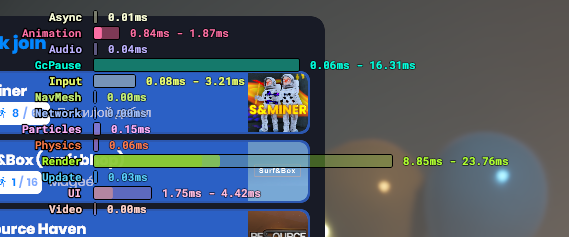
Fixes timing scopes to more accurately represent a per-frame main thread breakdown, and prevents spikes when GC is executed.

- **GcPause**
  - New separate timing scope showing time spent in GC per frame
  - GC pause time is subtracted from all other scopes, so each scope now only tracks its own code execution and no longer includes GC overhead
  - e.g. when GC occurs during the audio scope, the audio scope no longer spikes to 20ms
- **AudioMixingThread** removed from the main scopes
  - Runs on a separate thread, so its timings are effectively meaningless in the main thread view
  - All other scopes are main thread only
  - No longer relevant given the audio optimisation work done over the past months
- **Scene** scope removed
  - Didn't make much sense as it was an aggregate wrapping many other timing scopes
  - Replaced with a finer `Update` scope that tracks `Component.FixedUpdate`/`Update`
- **Editor** scope no longer shows in-game
- Scopes reschuffled
  - e.g. verlet rope physics traces are now tracked under the physics scope
  - Audio occlusion queries are now tracked under the audio scope

https://files.facepunch.com/lolleko/2026/March/02_12-59-QuixoticMarten.png
440 lines
11 KiB
C#
440 lines
11 KiB
C#
using System.Collections;
|
|
namespace Sandbox.Utility;
|
|
|
|
// From https://github.com/joaoportela/CircularBuffer-CSharp ( no license )
|
|
|
|
/// <summary>
|
|
/// Circular buffer, push pop and index access is always O(1).
|
|
/// </summary>
|
|
public class CircularBuffer<T> : IEnumerable<T>
|
|
{
|
|
private readonly T[] _buffer;
|
|
|
|
/// <summary>
|
|
/// The _start. Index of the first element in buffer.
|
|
/// </summary>
|
|
private int _start;
|
|
|
|
/// <summary>
|
|
/// The _end. Index after the last element in the buffer.
|
|
/// </summary>
|
|
private int _end;
|
|
|
|
/// <summary>
|
|
/// The _size. Buffer size.
|
|
/// </summary>
|
|
private int _size;
|
|
|
|
/// <summary>
|
|
/// Initializes a new instance of the <see cref="CircularBuffer{T}"/> class.
|
|
///
|
|
/// </summary>
|
|
/// <param name='capacity'>
|
|
/// Buffer capacity. Must be positive.
|
|
/// </param>
|
|
public CircularBuffer( int capacity ) : this( capacity, new T[] { } )
|
|
{
|
|
}
|
|
|
|
/// <summary>
|
|
/// Initializes a new instance of the <see cref="CircularBuffer{T}"/> class.
|
|
///
|
|
/// </summary>
|
|
/// <param name='capacity'>
|
|
/// Buffer capacity. Must be positive.
|
|
/// </param>
|
|
/// <param name='items'>
|
|
/// Items to fill buffer with. Items length must be less than capacity.
|
|
/// Suggestion: use Skip(x).Take(y).ToArray() to build this argument from
|
|
/// any enumerable.
|
|
/// </param>
|
|
public CircularBuffer( int capacity, T[] items )
|
|
{
|
|
if ( capacity < 1 )
|
|
{
|
|
throw new ArgumentException( "Circular buffer cannot have negative or zero capacity.", nameof( capacity ) );
|
|
}
|
|
if ( items == null )
|
|
{
|
|
throw new ArgumentNullException( nameof( items ) );
|
|
}
|
|
if ( items.Length > capacity )
|
|
{
|
|
throw new ArgumentException( "Too many items to fit circular buffer", nameof( items ) );
|
|
}
|
|
|
|
_buffer = new T[capacity];
|
|
|
|
Array.Copy( items, _buffer, items.Length );
|
|
_size = items.Length;
|
|
|
|
_start = 0;
|
|
_end = _size == capacity ? 0 : _size;
|
|
}
|
|
|
|
/// <summary>
|
|
/// Maximum capacity of the buffer. Elements pushed into the buffer after
|
|
/// maximum capacity is reached (IsFull = true), will remove an element.
|
|
/// </summary>
|
|
public int Capacity { get { return _buffer.Length; } }
|
|
|
|
/// <summary>
|
|
/// Boolean indicating if Circular is at full capacity.
|
|
/// Adding more elements when the buffer is full will
|
|
/// cause elements to be removed from the other end
|
|
/// of the buffer.
|
|
/// </summary>
|
|
public bool IsFull
|
|
{
|
|
get
|
|
{
|
|
return Size == Capacity;
|
|
}
|
|
}
|
|
|
|
/// <summary>
|
|
/// True if has no elements.
|
|
/// </summary>
|
|
public bool IsEmpty
|
|
{
|
|
get
|
|
{
|
|
return Size == 0;
|
|
}
|
|
}
|
|
|
|
/// <summary>
|
|
/// Current buffer size (the number of elements that the buffer has).
|
|
/// </summary>
|
|
public int Size { get { return _size; } }
|
|
|
|
/// <summary>
|
|
/// Element at the front of the buffer - this[0].
|
|
/// </summary>
|
|
/// <returns>The value of the element of type T at the front of the buffer.</returns>
|
|
public T Front()
|
|
{
|
|
ThrowIfEmpty();
|
|
return _buffer[_start];
|
|
}
|
|
|
|
/// <summary>
|
|
/// Element at the back of the buffer - this[Size - 1].
|
|
/// </summary>
|
|
/// <returns>The value of the element of type T at the back of the buffer.</returns>
|
|
public T Back()
|
|
{
|
|
ThrowIfEmpty();
|
|
return _buffer[(_end != 0 ? _end : Capacity) - 1];
|
|
}
|
|
|
|
/// <summary>
|
|
/// Index access to elements in buffer.
|
|
/// Index does not loop around like when adding elements,
|
|
/// valid interval is [0;Size[
|
|
/// </summary>
|
|
/// <param name="index">Index of element to access.</param>
|
|
/// <exception cref="IndexOutOfRangeException">Thrown when index is outside of [; Size[ interval.</exception>
|
|
public T this[int index]
|
|
{
|
|
get
|
|
{
|
|
if ( IsEmpty )
|
|
{
|
|
throw new IndexOutOfRangeException( string.Format( "Cannot access index {0}. Buffer is empty", index ) );
|
|
}
|
|
if ( index >= _size )
|
|
{
|
|
throw new IndexOutOfRangeException( string.Format( "Cannot access index {0}. Buffer size is {1}", index, _size ) );
|
|
}
|
|
int actualIndex = InternalIndex( index );
|
|
return _buffer[actualIndex];
|
|
}
|
|
set
|
|
{
|
|
if ( IsEmpty )
|
|
{
|
|
throw new IndexOutOfRangeException( string.Format( "Cannot access index {0}. Buffer is empty", index ) );
|
|
}
|
|
if ( index >= _size )
|
|
{
|
|
throw new IndexOutOfRangeException( string.Format( "Cannot access index {0}. Buffer size is {1}", index, _size ) );
|
|
}
|
|
int actualIndex = InternalIndex( index );
|
|
_buffer[actualIndex] = value;
|
|
}
|
|
}
|
|
|
|
/// <summary>
|
|
/// Pushes a new element to the back of the buffer. Back()/this[Size-1]
|
|
/// will now return this element.
|
|
///
|
|
/// When the buffer is full, the element at Front()/this[0] will be
|
|
/// popped to allow for this new element to fit.
|
|
/// </summary>
|
|
/// <param name="item">Item to push to the back of the buffer</param>
|
|
public void PushBack( T item )
|
|
{
|
|
if ( IsFull )
|
|
{
|
|
_buffer[_end] = item;
|
|
Increment( ref _end );
|
|
_start = _end;
|
|
}
|
|
else
|
|
{
|
|
_buffer[_end] = item;
|
|
Increment( ref _end );
|
|
++_size;
|
|
}
|
|
}
|
|
|
|
/// <summary>
|
|
/// Pushes a new element to the front of the buffer. Front()/this[0]
|
|
/// will now return this element.
|
|
///
|
|
/// When the buffer is full, the element at Back()/this[Size-1] will be
|
|
/// popped to allow for this new element to fit.
|
|
/// </summary>
|
|
/// <param name="item">Item to push to the front of the buffer</param>
|
|
public void PushFront( T item )
|
|
{
|
|
if ( IsFull )
|
|
{
|
|
Decrement( ref _start );
|
|
_end = _start;
|
|
_buffer[_start] = item;
|
|
}
|
|
else
|
|
{
|
|
Decrement( ref _start );
|
|
_buffer[_start] = item;
|
|
++_size;
|
|
}
|
|
}
|
|
|
|
/// <summary>
|
|
/// Removes the element at the back of the buffer. Decreasing the
|
|
/// Buffer size by 1.
|
|
/// </summary>
|
|
public void PopBack()
|
|
{
|
|
ThrowIfEmpty( "Cannot take elements from an empty buffer." );
|
|
Decrement( ref _end );
|
|
_buffer[_end] = default( T );
|
|
--_size;
|
|
}
|
|
|
|
/// <summary>
|
|
/// Removes the element at the front of the buffer. Decreasing the
|
|
/// Buffer size by 1.
|
|
/// </summary>
|
|
public void PopFront()
|
|
{
|
|
ThrowIfEmpty( "Cannot take elements from an empty buffer." );
|
|
_buffer[_start] = default( T );
|
|
Increment( ref _start );
|
|
--_size;
|
|
}
|
|
|
|
/// <summary>
|
|
/// Clears the contents of the array. Size = 0, Capacity is unchanged.
|
|
/// </summary>
|
|
/// <exception cref="NotImplementedException"></exception>
|
|
public void Clear()
|
|
{
|
|
// to clear we just reset everything.
|
|
_start = 0;
|
|
_end = 0;
|
|
_size = 0;
|
|
Array.Clear( _buffer, 0, _buffer.Length );
|
|
}
|
|
|
|
/// <summary>
|
|
/// Copies the buffer contents to an array, according to the logical
|
|
/// contents of the buffer (i.e. independent of the internal
|
|
/// order/contents)
|
|
/// </summary>
|
|
/// <returns>A new array with a copy of the buffer contents.</returns>
|
|
public T[] ToArray()
|
|
{
|
|
T[] newArray = new T[Size];
|
|
int newArrayOffset = 0;
|
|
foreach ( ArraySegment<T> segment in ToArraySegments() )
|
|
{
|
|
Array.Copy( segment.Array, segment.Offset, newArray, newArrayOffset, segment.Count );
|
|
newArrayOffset += segment.Count;
|
|
}
|
|
return newArray;
|
|
}
|
|
|
|
/// <summary>
|
|
/// Get the contents of the buffer as 2 ArraySegments.
|
|
/// Respects the logical contents of the buffer, where
|
|
/// each segment and items in each segment are ordered
|
|
/// according to insertion.
|
|
///
|
|
/// Fast: does not copy the array elements.
|
|
/// Useful for methods like <c>Send(IList<ArraySegment<Byte>>)</c>.
|
|
///
|
|
/// <remarks>Segments may be empty.</remarks>
|
|
/// </summary>
|
|
/// <returns>An IList with 2 segments corresponding to the buffer content.</returns>
|
|
public IEnumerable<ArraySegment<T>> ToArraySegments()
|
|
{
|
|
yield return ArrayOne();
|
|
yield return ArrayTwo();
|
|
}
|
|
|
|
#region IEnumerable<T> implementation
|
|
/// <summary>
|
|
/// Returns a struct-based enumerator that iterates through this buffer without any heap allocation.
|
|
/// The compiler's duck-typing for <see langword="foreach"/> will prefer this overload over the interface
|
|
/// methods, so <c>foreach (var x in buffer)</c> is zero-alloc.
|
|
/// </summary>
|
|
public Enumerator GetEnumerator() => new Enumerator( this );
|
|
|
|
IEnumerator<T> IEnumerable<T>.GetEnumerator() => new Enumerator( this );
|
|
#endregion
|
|
#region IEnumerable implementation
|
|
IEnumerator IEnumerable.GetEnumerator() => new Enumerator( this );
|
|
#endregion
|
|
|
|
/// <summary>
|
|
/// Zero-allocation enumerator for <see cref="CircularBuffer{T}"/>.
|
|
/// Returned as a value type so <see langword="foreach"/> never allocates.
|
|
/// </summary>
|
|
public struct Enumerator : IEnumerator<T>
|
|
{
|
|
private readonly T[] _buffer;
|
|
private readonly int _start;
|
|
private readonly int _size;
|
|
private readonly int _capacity;
|
|
private int _index;
|
|
|
|
internal Enumerator( CircularBuffer<T> owner )
|
|
{
|
|
_buffer = owner._buffer;
|
|
_start = owner._start;
|
|
_size = owner._size;
|
|
_capacity = owner._buffer.Length;
|
|
_index = -1;
|
|
}
|
|
|
|
public ref T CurrentRef
|
|
{
|
|
get
|
|
{
|
|
int raw = _start + _index;
|
|
return ref _buffer[raw < _capacity ? raw : raw - _capacity];
|
|
}
|
|
}
|
|
|
|
public T Current
|
|
{
|
|
get
|
|
{
|
|
int raw = _start + _index;
|
|
return _buffer[raw < _capacity ? raw : raw - _capacity];
|
|
}
|
|
}
|
|
|
|
object IEnumerator.Current => Current;
|
|
|
|
public bool MoveNext() => ++_index < _size;
|
|
public void Reset() => _index = -1;
|
|
public void Dispose() { }
|
|
}
|
|
|
|
private void ThrowIfEmpty( string message = "Cannot access an empty buffer." )
|
|
{
|
|
if ( IsEmpty )
|
|
{
|
|
throw new InvalidOperationException( message );
|
|
}
|
|
}
|
|
|
|
/// <summary>
|
|
/// Increments the provided index variable by one, wrapping
|
|
/// around if necessary.
|
|
/// </summary>
|
|
/// <param name="index"></param>
|
|
private void Increment( ref int index )
|
|
{
|
|
if ( ++index == Capacity )
|
|
{
|
|
index = 0;
|
|
}
|
|
}
|
|
|
|
/// <summary>
|
|
/// Decrements the provided index variable by one, wrapping
|
|
/// around if necessary.
|
|
/// </summary>
|
|
/// <param name="index"></param>
|
|
private void Decrement( ref int index )
|
|
{
|
|
if ( index == 0 )
|
|
{
|
|
index = Capacity;
|
|
}
|
|
index--;
|
|
}
|
|
|
|
/// <summary>
|
|
/// Converts the index in the argument to an index in <code>_buffer</code>
|
|
/// </summary>
|
|
/// <returns>
|
|
/// The transformed index.
|
|
/// </returns>
|
|
/// <param name='index'>
|
|
/// External index.
|
|
/// </param>
|
|
private int InternalIndex( int index )
|
|
{
|
|
return _start + (index < (Capacity - _start) ? index : index - Capacity);
|
|
}
|
|
|
|
// doing ArrayOne and ArrayTwo methods returning ArraySegment<T> as seen here:
|
|
// http://www.boost.org/doc/libs/1_37_0/libs/circular_buffer/doc/circular_buffer.html#classboost_1_1circular__buffer_1957cccdcb0c4ef7d80a34a990065818d
|
|
// http://www.boost.org/doc/libs/1_37_0/libs/circular_buffer/doc/circular_buffer.html#classboost_1_1circular__buffer_1f5081a54afbc2dfc1a7fb20329df7d5b
|
|
// should help a lot with the code.
|
|
|
|
#region Array items easy access.
|
|
// The array is composed by at most two non-contiguous segments,
|
|
// the next two methods allow easy access to those.
|
|
|
|
private ArraySegment<T> ArrayOne()
|
|
{
|
|
if ( IsEmpty )
|
|
{
|
|
return new ArraySegment<T>( Array.Empty<T>() );
|
|
}
|
|
else if ( _start < _end )
|
|
{
|
|
return new ArraySegment<T>( _buffer, _start, _end - _start );
|
|
}
|
|
else
|
|
{
|
|
return new ArraySegment<T>( _buffer, _start, _buffer.Length - _start );
|
|
}
|
|
}
|
|
|
|
private ArraySegment<T> ArrayTwo()
|
|
{
|
|
if ( IsEmpty )
|
|
{
|
|
return new ArraySegment<T>( Array.Empty<T>() );
|
|
}
|
|
else if ( _start < _end )
|
|
{
|
|
return new ArraySegment<T>( _buffer, _end, 0 );
|
|
}
|
|
else
|
|
{
|
|
return new ArraySegment<T>( _buffer, 0, _end );
|
|
}
|
|
}
|
|
#endregion
|
|
}
|