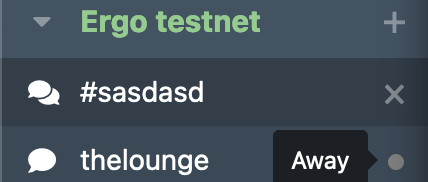
Updated version of #4550. Closes#337, closes#872 (#337 can't be fully
addressed — tracking nick changes isn't really possible atm).
<img width="253" height="149" alt="image"
src="https://github.com/user-attachments/assets/8a961868-0aa9-406b-92e2-f9d4858e2d0d"
/>
Away support:
<img width="214" alt="image"
src="https://user-images.githubusercontent.com/8675906/165882385-6f928c8e-5a0b-4502-8bd3-3cd0bd70e0e0.png">
## Summary
Query windows show whether the person behind them is online, and whether
they are away, using
[MONITOR](https://ircv3.net/specs/extensions/monitor) rather than
polling. `Network` keeps the monitor list: queries are registered in
batched `MONITOR +` commands once RPL_ISUPPORT tells us the server
supports it, and one at a time as new query windows open. The limit
advertised in `MONITOR=<n>` is respected, with anything over it waiting
for a slot; `MONITOR=0` means no monitoring at all, a bare `MONITOR`
means no limit. A nick change on a monitored query swaps the target in
place so the query keeps its slot.
[extended-monitor](https://ircv3.net/specs/extensions/extended-monitor)
is requested too, so away, nick, account and chghost updates arrive for
monitored nicks we share no channel with. Away state for people we do
share a channel with comes from a WHO on join.
The indicator is a dot on the query in the sidebar and next to the nick
in the message bubble, with a tooltip and an `img` role so it isn't
colour-only, and it can be turned off under Appearance.
Known limitation: a server that enforces a monitor limit it doesn't
advertise will reject part of a batch with `ERR_MONLISTFULL`; the user
gets a message in the lobby, but the client's own list isn't reconciled
until reconnect.
## Test Plan
- Unit tests for the monitor list: add, case-insensitive dedupe,
queueing at the limit, removal draining the queue, batching, and the
rename path.
- Ran the server against a local IRCd and watched the wire: opening
queries sends `MONITOR + <nick>` each, a reconnect with four open
queries sends a single `MONITOR + bob,carol,dave,mallory`, 730/731 drive
the online/offline state, a rename sends `MONITOR - bob` then `MONITOR +
bob2`, `MONITOR=0` sends nothing at all, and a bare `MONITOR` behaves as
unlimited.
Closes#5052
Multi-line input is currently sent as one PRIVMSG per line, so a paste
arrives as N unrelated messages. On networks that support
[draft/multiline](https://ircv3.net/specs/extensions/multiline) it can
be sent as a single BATCH and stays one message everywhere.
## Summary
Sending goes through `sayMultiline()` in `plugins/inputs/msg.ts` when
the network advertises limits we can respect (`multilineLimits()`); if
the batch is over max-bytes/max-lines the send falls back to individual
messages, and the local echo follows whichever path was actually taken
so the sender sees what everyone else got. `Client.input()` stops
splitting on newlines when the target network has the cap. Inbound
batches arrive from irc-framework already reassembled and are flagged
`multiline` on the `Msg`, which drives line-by-line rendering (`parse()`
joins lines with `<br>`), one entry per message in the text logs, and a
first-non-empty-line notification preview. `MULTILINE_*` standard
replies get readable text.
No pin bump: `master` already points at the irc-framework commit that
carries multiline (kiwiirc/irc-framework#414).
## Test Plan
- New unit tests for the send path (batch, fallback on max-bytes, no
limits advertised, blank lines), the text log format, `parse()`, and the
standard replies.
- Ran the server against a local IRCd advertising `draft/multiline` and
confirmed on the wire: a 3-line message goes out as one `BATCH …
draft/multiline` with three frames; with the cap advertised bare (no
limits) or with `max-bytes` too small it degrades to three plain
PRIVMSGs and the local echo degrades with it; a CRLF paste sends clean
frames and echoes without stray `\r`; an inbound batch from another user
renders as one message.
- Not verified: rendering was checked through unit tests rather than in
a browser.
Relies on https://github.com/kiwiirc/irc-framework/pull/411https://ircv3.net/specs/client-tags/reply.html
Design feedback very welcome
<img width="1718" height="278" alt="Screenshot 2026-04-11 at 21-00-22
#thelounge — The Lounge"
src="https://github.com/user-attachments/assets/ba6e7c69-2477-4a7b-b196-901d19ca9cba"
/>
1. we lack a 'thread' view (irccloud, slack, etc). can be a followup if
we do want it
2. need to test scrolling to messages outside of the current buffer
3. due to lack of client support, i opted to auto prefill the input with
\`<targetNick>: \` so people can follow along even without reply support
4. CSS can definitely be improved (once a design is settled on)
---------
Co-authored-by: Copilot <175728472+Copilot@users.noreply.github.com>
Co-authored-by: Copilot Autofix powered by AI <223894421+github-code-quality[bot]@users.noreply.github.com>
LockNetwork is documented as:
> When set to `true`, users will not be able to modify host, port and TLS
> settings and will be limited to the configured network.

Looking at the view, that also includes the name field (for some reason).

When leaveMessage was added to the defaults, the white list for the LockedConfigNetDefaults
wasn't adjusted.

Rather than playing whack a mole, disallow the documented fields + name and export the rest.

Fixes: https://github.com/thelounge/thelounge/issues/4956
The auth functions are a bloody mess and need to be cleaned up.
using various callback functions and using variables as pointers makes the logic
hard to follow and hence idiotic to type too, as multiple orthogonal logic paths
are mixed up into one function.

This really needs to be untangled
The sort event bundled networks and channels for no reason at all.
They share none of the actual logic, so combining them just makes
the typing poor but serves no benefit.
There were quite some errors, where the type was passed the wrong way
```
// This is invalid
"change-password": ({ old_password: string, new_password: string, verify_password: string})

// What was actually meant
"change-password": (data: { old_password: string, new_password: string, verify_password: string})
```

The whole callback function is also very verbose as is, with fluff we don't need.
It's always a function that returns void, so there's no real information to be gained
by spelling it out time and time again.

Let's use a helper type that just accepts the payload.
That should make the above error impossible to do.
Overriding the built in is poor form, as this prevents adding
a new type handler with its own normalize handler.

We only ever want to override protocol-less URLs to http, so
we just do so explicitly in the "//" schema normalizer.

This also means that we don't need all that type conversion dance,
we simply set the schema to null when we patch it and filter on the
schema directly