mirror of
https://github.com/mudler/LocalAI.git
synced 2026-07-30 18:09:05 -04:00
 40dae953f4
* feat(schema): accept reasoning_content as inbound alias for reasoning

Interleaved-thinking clients (cogito, vLLM/DeepSeek-style) emit reasoning_content
on assistant turns. Accept it as an inbound alias so reasoning survives the
tool-result loop; canonical reasoning wins when both are present. Emission is
unchanged (still reasoning).

Signed-off-by: Ettore Di Giacinto <mudler@localai.io>

* test(schema): pin interleaved reasoning+tool_calls round-trip

Signed-off-by: Ettore Di Giacinto <mudler@localai.io>

* test(openai): pin reachedTokenBudget truncation detection

Signed-off-by: Ettore Di Giacinto <mudler@localai.io>

* feat(anthropic): add thinking and signature fields to content blocks

Signed-off-by: Ettore Di Giacinto <mudler@localai.io>

* feat(anthropic): parse inbound thinking blocks into reasoning

Signed-off-by: Ettore Di Giacinto <mudler@localai.io>

* feat(anthropic): emit thinking blocks with synthetic signature on tool turns

Extract buildAnthropicContentBlocks so non-streaming content assembly is
unit-testable, and prepend a thinking block (with an opaque synthetic
signature) before text/tool_use blocks when the request opts into thinking.

Signed-off-by: Ettore Di Giacinto <mudler@localai.io>

* feat(anthropic): stream thinking_delta and signature_delta before tool_use

Extract anthropicStreamSequence so the streaming block order is unit-testable,
and emit content_block_start(thinking) -> thinking_delta -> signature_delta ->
content_block_stop before the tool_use block sequence when thinking is enabled.

Signed-off-by: Ettore Di Giacinto <mudler@localai.io>

* docs: add interleaved thinking with tool calls guide

Add a features guide describing interleaved thinking: an assistant turn
carrying reasoning and tool_calls together, the reasoning-round-trip
contract (including the reasoning_content inbound alias and Anthropic
thinking blocks with a synthetic signature), per-backend enablement
(reasoning_format for llama.cpp, reasoning_parser/tool_call_parser for
vLLM/SGLang plus the vLLM auto-config hook), a worked request/response
example, and known limitations. Cross-link from model-configuration,
text-generation, and openai-functions.

Signed-off-by: Ettore Di Giacinto <mudler@localai.io>

---------

Signed-off-by: Ettore Di Giacinto <mudler@localai.io>
Co-authored-by: Ettore Di Giacinto <mudler@localai.io>
315 lines
11 KiB
Markdown
315 lines
11 KiB
Markdown
|
||
+++
|
||
disableToc = false
|
||
title = "OpenAI Functions and Tools"
|
||
weight = 17
|
||
url = "/features/openai-functions/"
|
||
+++
|
||
|
||

|
||
|
||
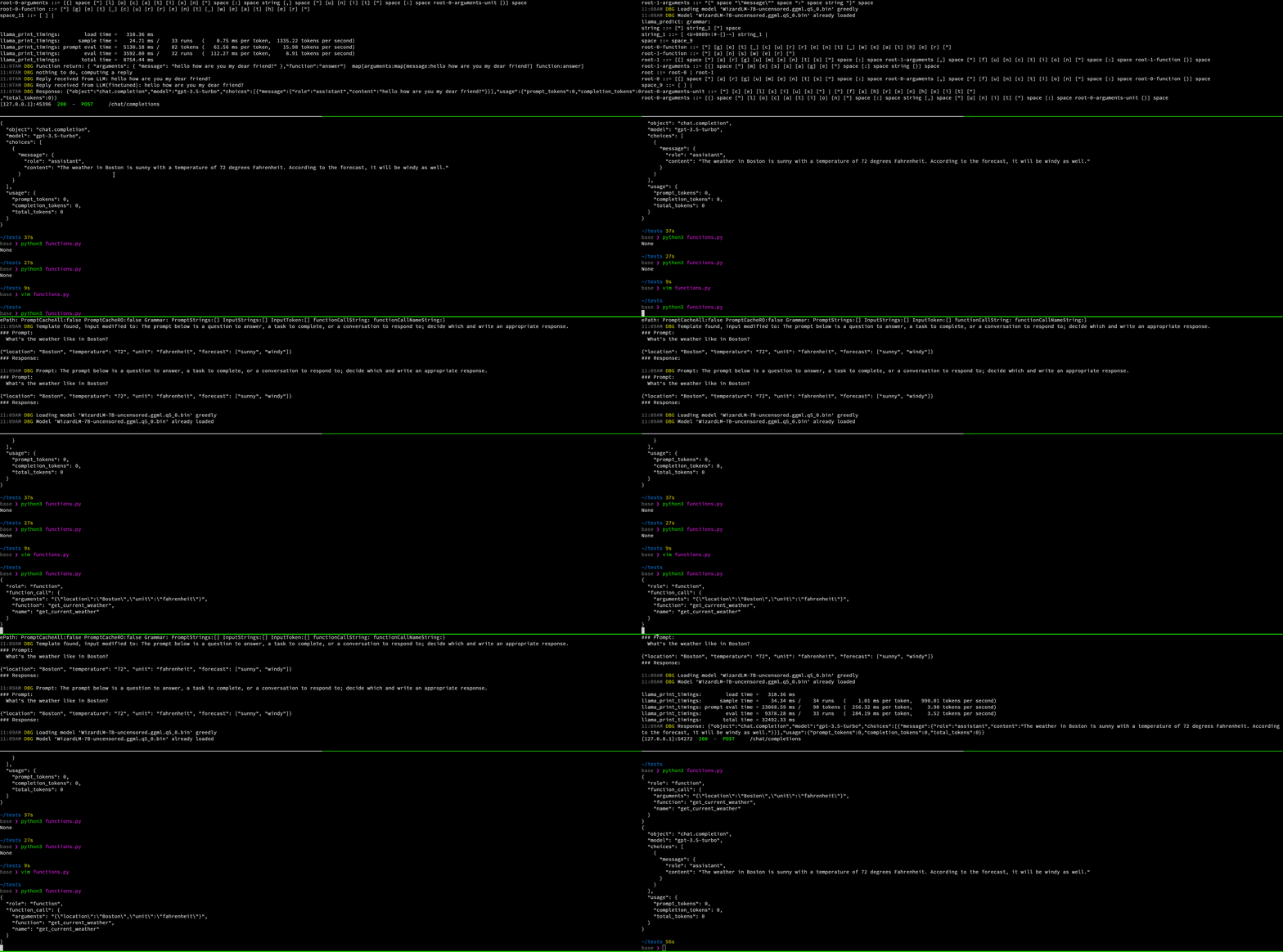
LocalAI supports running the OpenAI [functions and tools API](https://platform.openai.com/docs/api-reference/chat/create#chat-create-tools) across multiple backends. The OpenAI request shape is the same regardless of which backend runs your model — LocalAI is responsible for extracting structured tool calls from the model's output before returning the response.
|
||
|
||
|
||
|
||
To learn more about OpenAI functions, see also the [OpenAI API blog post](https://openai.com/blog/function-calling-and-other-api-updates).
|
||
|
||
LocalAI also supports [JSON mode](https://platform.openai.com/docs/guides/text-generation/json-mode) out of the box on llama.cpp-compatible models.
|
||
|
||
💡 Check out [LocalAGI](https://github.com/mudler/LocalAGI) for an example on how to use LocalAI functions.
|
||
|
||
## Supported backends
|
||
|
||
| Backend | How tool calls are extracted |
|
||
|---------|------------------------------|
|
||
| `llama.cpp` | C++ incremental parser; any `ggml`/`gguf` model works out of the box, no configuration needed |
|
||
| `vllm` | vLLM's native `ToolParserManager` — select a parser with `tool_parser:<name>` in the model `options`. Auto-set by the gallery importer for known families |
|
||
| `vllm-omni` | Same as vLLM |
|
||
| `mlx` | `mlx_lm.tool_parsers` — **auto-detected from the chat template**, no configuration needed |
|
||
| `mlx-vlm` | `mlx_vlm.tool_parsers` (with fallback to mlx-lm parsers) — **auto-detected from the chat template**, no configuration needed |
|
||
|
||
Reasoning content (`<think>...</think>` blocks from DeepSeek R1, Qwen3, Gemma 4, etc.) is returned in the OpenAI `reasoning_content` field on the same backends. When a model both reasons and calls a tool in the same turn, see [Interleaved Thinking with Tool Calls]({{%relref "features/interleaved-thinking" %}}) for how the reasoning survives the tool-result round trip.
|
||
|
||
## Setup
|
||
|
||
### llama.cpp
|
||
|
||
No configuration required — the autoparser detects the tool call format for any `ggml`/`gguf` model that was trained with tool support.
|
||
|
||
### vLLM / vLLM Omni
|
||
|
||
The parser must be specified explicitly because vLLM itself doesn't auto-detect one. Pass it via the model `options`:
|
||
|
||
```yaml
|
||
name: qwen3-8b
|
||
backend: vllm
|
||
parameters:
|
||
model: Qwen/Qwen3-8B
|
||
options:
|
||
- tool_parser:hermes
|
||
- reasoning_parser:qwen3
|
||
template:
|
||
use_tokenizer_template: true
|
||
```
|
||
|
||
When you import a vLLM model through the LocalAI gallery, the importer looks up the model family and pre-fills `tool_parser:` and `reasoning_parser:` for you — you only need to override them for non-standard model names.
|
||
|
||
Available tool parsers include `hermes`, `llama3_json`, `llama4_pythonic`, `mistral`, `qwen3_xml`, `deepseek_v3`, `granite4`, `kimi_k2`, `glm45`, and more. Available reasoning parsers include `deepseek_r1`, `qwen3`, `mistral`, `gemma4`, `granite`. See the upstream vLLM documentation for the full list.
|
||
|
||
### MLX / MLX-VLM
|
||
|
||
MLX backends **auto-detect** the right tool parser by inspecting the model's chat template — you don't need to set anything. Just load an MLX-quantized model that was trained with tool support:
|
||
|
||
```yaml
|
||
name: qwen2.5-0.5b-mlx
|
||
backend: mlx
|
||
parameters:
|
||
model: mlx-community/Qwen2.5-0.5B-Instruct-4bit
|
||
template:
|
||
use_tokenizer_template: true
|
||
```
|
||
|
||
The gallery importer will still append `tool_parser:` and `reasoning_parser:` entries to the YAML for visibility and consistency with the other backends, but those are informational — the runtime auto-detection in the MLX backend ignores them and uses the parser matched to the chat template.
|
||
|
||
Supported parser families: `hermes`/`json_tools`, `mistral`, `gemma4`, `glm47`, `kimi_k2`, `longcat`, `minimax_m2`, `pythonic`, `qwen3_coder`, `function_gemma`.
|
||
|
||
|
||
## Usage example
|
||
|
||
You can configure a model manually with a YAML config file in the models directory, for example:
|
||
|
||
```yaml
|
||
name: gpt-3.5-turbo
|
||
parameters:
|
||
# Model file name
|
||
model: ggml-openllama.bin
|
||
top_p: 80
|
||
top_k: 0.9
|
||
temperature: 0.1
|
||
```
|
||
|
||
To use the functions with the OpenAI client in python:
|
||
|
||
```python
|
||
from openai import OpenAI
|
||
|
||
messages = [{"role": "user", "content": "What is the weather like in Beijing now?"}]
|
||
tools = [
|
||
{
|
||
"type": "function",
|
||
"function": {
|
||
"name": "get_current_weather",
|
||
"description": "Return the temperature of the specified region specified by the user",
|
||
"parameters": {
|
||
"type": "object",
|
||
"properties": {
|
||
"location": {
|
||
"type": "string",
|
||
"description": "User specified region",
|
||
},
|
||
"unit": {
|
||
"type": "string",
|
||
"enum": ["celsius", "fahrenheit"],
|
||
"description": "temperature unit"
|
||
},
|
||
},
|
||
"required": ["location"],
|
||
},
|
||
},
|
||
}
|
||
]
|
||
|
||
client = OpenAI(
|
||
# This is the default and can be omitted
|
||
api_key="test",
|
||
base_url="http://localhost:8080/v1/"
|
||
)
|
||
|
||
response =client.chat.completions.create(
|
||
messages=messages,
|
||
tools=tools,
|
||
tool_choice ="auto",
|
||
model="gpt-4",
|
||
)
|
||
#...
|
||
```
|
||
|
||
For example, with curl:
|
||
|
||
```bash
|
||
curl http://localhost:8080/v1/chat/completions -H "Content-Type: application/json" -d '{
|
||
"model": "gpt-4",
|
||
"messages": [{"role": "user", "content": "What is the weather like in Beijing now?"}],
|
||
"tools": [
|
||
{
|
||
"type": "function",
|
||
"function": {
|
||
"name": "get_current_weather",
|
||
"description": "Return the temperature of the specified region specified by the user",
|
||
"parameters": {
|
||
"type": "object",
|
||
"properties": {
|
||
"location": {
|
||
"type": "string",
|
||
"description": "User specified region"
|
||
},
|
||
"unit": {
|
||
"type": "string",
|
||
"enum": ["celsius", "fahrenheit"],
|
||
"description": "temperature unit"
|
||
}
|
||
},
|
||
"required": ["location"]
|
||
}
|
||
}
|
||
}
|
||
],
|
||
"tool_choice":"auto"
|
||
}'
|
||
```
|
||
|
||
Return data:
|
||
|
||
```json
|
||
{
|
||
"created": 1724210813,
|
||
"object": "chat.completion",
|
||
"id": "16b57014-477c-4e6b-8d25-aad028a5625e",
|
||
"model": "gpt-4",
|
||
"choices": [
|
||
{
|
||
"index": 0,
|
||
"finish_reason": "tool_calls",
|
||
"message": {
|
||
"role": "assistant",
|
||
"content": "",
|
||
"tool_calls": [
|
||
{
|
||
"index": 0,
|
||
"id": "16b57014-477c-4e6b-8d25-aad028a5625e",
|
||
"type": "function",
|
||
"function": {
|
||
"name": "get_current_weather",
|
||
"arguments": "{\"location\":\"Beijing\",\"unit\":\"celsius\"}"
|
||
}
|
||
}
|
||
]
|
||
}
|
||
}
|
||
],
|
||
"usage": {
|
||
"prompt_tokens": 221,
|
||
"completion_tokens": 26,
|
||
"total_tokens": 247
|
||
}
|
||
}
|
||
```
|
||
|
||
## Advanced
|
||
|
||
### Use functions without grammars
|
||
|
||
The functions calls maps automatically to grammars which are currently supported only by llama.cpp, however, it is possible to turn off the use of grammars, and extract tool arguments from the LLM responses, by specifying in the YAML file `no_grammar` and a regex to map the response from the LLM:
|
||
|
||
```yaml
|
||
name: model_name
|
||
parameters:
|
||
# Model file name
|
||
model: model/name
|
||
|
||
function:
|
||
# set to true to not use grammars
|
||
no_grammar: true
|
||
# set one or more regexes used to extract the function tool arguments from the LLM response
|
||
response_regex:
|
||
- "(?P<function>\w+)\s*\((?P<arguments>.*)\)"
|
||
```
|
||
|
||
The response regex have to be a regex with named parameters to allow to scan the function name and the arguments. For instance, consider:
|
||
|
||
```
|
||
(?P<function>\w+)\s*\((?P<arguments>.*)\)
|
||
```
|
||
|
||
will catch
|
||
|
||
```
|
||
function_name({ "foo": "bar"})
|
||
```
|
||
|
||
### Parallel tools calls
|
||
|
||
This feature is experimental and has to be configured in the YAML of the model by enabling `function.parallel_calls`:
|
||
|
||
```yaml
|
||
name: gpt-3.5-turbo
|
||
parameters:
|
||
# Model file name
|
||
model: ggml-openllama.bin
|
||
top_p: 80
|
||
top_k: 0.9
|
||
temperature: 0.1
|
||
|
||
function:
|
||
# set to true to allow the model to call multiple functions in parallel
|
||
parallel_calls: true
|
||
```
|
||
|
||
### Use functions with grammar
|
||
|
||
It is possible to also specify the full function signature (for debugging, or to use with other clients).
|
||
|
||
The chat endpoint accepts the `grammar_json_functions` additional parameter which takes a JSON schema object.
|
||
|
||
For example, with curl:
|
||
|
||
```bash
|
||
curl http://localhost:8080/v1/chat/completions -H "Content-Type: application/json" -d '{
|
||
"model": "gpt-4",
|
||
"messages": [{"role": "user", "content": "How are you?"}],
|
||
"temperature": 0.1,
|
||
"grammar_json_functions": {
|
||
"oneOf": [
|
||
{
|
||
"type": "object",
|
||
"properties": {
|
||
"function": {"const": "create_event"},
|
||
"arguments": {
|
||
"type": "object",
|
||
"properties": {
|
||
"title": {"type": "string"},
|
||
"date": {"type": "string"},
|
||
"time": {"type": "string"}
|
||
}
|
||
}
|
||
}
|
||
},
|
||
{
|
||
"type": "object",
|
||
"properties": {
|
||
"function": {"const": "search"},
|
||
"arguments": {
|
||
"type": "object",
|
||
"properties": {
|
||
"query": {"type": "string"}
|
||
}
|
||
}
|
||
}
|
||
}
|
||
]
|
||
}
|
||
}'
|
||
```
|
||
|
||
Grammars and function tools can be used as well in conjunction with vision APIs:
|
||
|
||
```bash
|
||
curl http://localhost:8080/v1/chat/completions -H "Content-Type: application/json" -d '{
|
||
"model": "llava", "grammar": "root ::= (\"yes\" | \"no\")",
|
||
"messages": [{"role": "user", "content": [{"type":"text", "text": "Is there some grass in the image?"}, {"type": "image_url", "image_url": {"url": "https://upload.wikimedia.org/wikipedia/commons/thumb/d/dd/Gfp-wisconsin-madison-the-nature-boardwalk.jpg/2560px-Gfp-wisconsin-madison-the-nature-boardwalk.jpg" }}], "temperature": 0.9}]}'
|
||
```
|
||
|
||
|
||
## 💡 Examples
|
||
|
||
A full e2e example with `docker-compose` is available [here](https://github.com/mudler/LocalAI-examples/tree/main/functions). |