 Joe Schafer
bf1b5e5506
Joe Schafer
bf1b5e5506
Resolve relative request URLs against only the path component of the
base URL. Previously, URL.resolve searched for the last slash in the
whole base URL after the authority, so slashes inside a query string or
hash route could be mistaken for path directory separators.

The reported failure was a hash-routed page loaded at
http://127.0.0.1:8123/#/login. When that page ran
fetch("api/users/login", { method: "POST" }), browser-compatible URL
resolution should have requested
http://127.0.0.1:8123/api/users/login. Instead, Lightpanda 0.3.1
reported the response URL as
http://127.0.0.1:8123/#/api/users/login, and the HTTP server received
POST /.

That meant the server returned the single-page app shell instead of the
JSON login response. The failure broke a RealWorld/Conduit-style SPA
benchmark after login because the app used relative API URLs such as
api/users/login. Changing the benchmark fixture to root-absolute API
URLs, such as /api/users/login, worked around the benchmark failure, but
left Lightpanda incompatible with normal browser behavior for relative
request URLs on hash-routed pages.

The same issue was not limited to fragments. A base URL such as
https://example/app/page?next=/foo/bar also contains slashes after the
path component. Those slashes must not affect how path-relative inputs
such as api/users/login or ../api/users/login are merged with the base
path.

This change bounds the directory calculation at the first ? or # in the
base URL and searches for the last path slash only inside that path
component. Root-absolute inputs still keep only the scheme and
authority, query-only inputs still replace the query on the current
path, and fragment-only inputs still replace the fragment on the
current path.

This matches the behavior of the WHATWG URL algorithm, Chromium's
relative URL canonicalization, Node's WHATWG URL implementation, Go's
net/url ResolveReference, and Python's urllib.parse.urljoin for the
cases covered here. All of those implementations split the base URL into
components before merging a path-relative reference, so slashes in the
query or fragment do not change the base directory.

The URL resolver tests now cover the original hash-route repro, slashes
inside query strings and fragments, host-only bases with query or
fragment components, dot-segment paths, query-only references, and
fragment-only references. The fetch Web API tests also move a page to
/#/login and POST fetch("xhr"), expecting the request URL to resolve to
http://127.0.0.1:9582/xhr rather than the hash route.

Verified with:

mise x zig@0.15.2 -- zig fmt --check ./*.zig ./**/*.zig
mise x zig@0.15.2 rust@stable -- make ZIG=zig test

Lightpanda Browser
The headless browser built from scratch for AI agents and automation.
Not a Chromium fork. Not a WebKit patch. A new browser, written in Zig.




Benchmarks
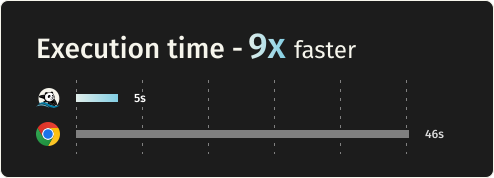
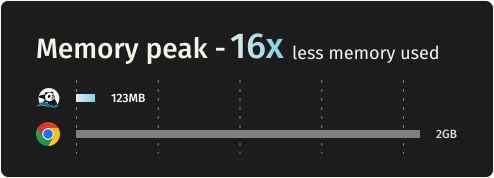
Requesting 933 real web pages over the network on a AWS EC2 m5.large instance. See benchmark details.
| Metric | Lightpanda | Headless Chrome | Difference |
|---|---|---|---|
| Memory (peak, 100 pages) | 123MB | 2GB | ~16 less |
| Execution time (100 pages) | 5s | 46s | ~9x faster |
Quick start
Install
Package Managers
Latest nightly from Homebrew:
brew install lightpanda-io/browser/lightpanda
Latest nightly from Arch Linux User Repository:
yay -S lightpanda-nightly-bi
Download from the nightly builds
You can download the last binary from the nightly builds for Linux and MacOS for both x86_64 and aarch64.
For Linux
curl -L -o lightpanda https://github.com/lightpanda-io/browser/releases/download/nightly/lightpanda-x86_64-linux && \
chmod a+x ./lightpanda
Verify the binary before running anything:
./lightpanda version
Linux aarch64 is also available
Note: The Linux release binaries are linked against glibc. On musl-based distros (Alpine, etc.) the binary fails with
cannot execute: required file not foundbecause the glibc dynamic linker is missing. Use a glibc-based base image (e.g.,FROM debian:bookworm-slimorFROM ubuntu:24.04) or build from sources.
For MacOS
curl -L -o lightpanda https://github.com/lightpanda-io/browser/releases/download/nightly/lightpanda-aarch64-macos && \
chmod a+x ./lightpanda
MacOS x86_64 is also available
For Windows + WSL2
Lightpanda has no native Windows binary. Install it inside WSL following the Linux steps above.
WSL not installed? Run wsl --install from an administrator shell, restart, then open wsl.
See Microsoft's WSL install guide for details.
Your automation client (Puppeteer, Playwright, etc.) can run either inside WSL or on the Windows host. WSL forwards localhost:9222 automatically.
Install from Docker
Lightpanda provides official Docker
images for both Linux amd64 and
arm64 architectures.
The following command fetches the Docker image and starts a new container exposing Lightpanda's CDP server on port 9222.
docker run -d --name lightpanda -p 127.0.0.1:9222:9222 lightpanda/browser:nightly
Dump a URL
./lightpanda fetch --obey-robots --dump html --log-format pretty --log-level info https://demo-browser.lightpanda.io/campfire-commerce/
You can use --dump markdown to convert directly into markdown.
--wait-until, --wait-ms, --wait-selector and --wait-script are
available to adjust waiting time before dump.
Start a CDP server
./lightpanda serve --obey-robots --log-format pretty --log-level info --host 127.0.0.1 --port 9222
Once the CDP server started, you can run a Puppeteer script by configuring the
browserWSEndpoint.
Example Puppeteer script
import puppeteer from 'puppeteer-core';

// use browserWSEndpoint to pass the Lightpanda's CDP server address.
const browser = await puppeteer.connect({
  browserWSEndpoint: "ws://127.0.0.1:9222",
});

// The rest of your script remains the same.
const context = await browser.createBrowserContext();
const frame = await context.newPage();

// Dump all the links from the frame.
await frame.goto('https://demo-browser.lightpanda.io/amiibo/', {waitUntil: "networkidle0"});

const links = await frame.evaluate(() => {
  return Array.from(document.querySelectorAll('a')).map(row => {
    return row.getAttribute('href');
  });
});

console.log(links);

await frame.close();
await context.close();
await browser.disconnect();
Native MCP and skill
The MCP server communicates via MCP JSON-RPC 2.0 over stdio.
Add to your MCP configuration:
{
  "mcpServers": {
    "lightpanda": {
      "command": "/path/to/lightpanda",
      "args": ["mcp"]
    }
  }
}
A skill is available in lightpanda-io/agent-skill.
Telemetry
By default, Lightpanda collects and sends usage telemetry. This can be disabled by setting an environment variable LIGHTPANDA_DISABLE_TELEMETRY=true. You can read Lightpanda's privacy policy at: https://lightpanda.io/privacy-policy.
Status
Lightpanda is in Beta and currently a work in progress. Stability and coverage are improving and many websites now work. You may still encounter errors or crashes. Please open an issue with specifics if so.
Here are the key features we have implemented:
- CORS #2015
- HTTP loader (Libcurl)
- HTML parser (html5ever)
- DOM tree
- Javascript support (v8)
- DOM APIs
- Ajax
- XHR API
- Fetch API
- DOM dump
- CDP/websockets server
- Click
- Input form
- Cookies
- Custom HTTP headers
- Proxy support
- Network interception
- Respect
robots.txtwith option--obey-robots
NOTE: There are hundreds of Web APIs. Developing a browser (even just for headless mode) is a huge task. Coverage will increase over time.
Build from sources
Prerequisites
Lightpanda is written with Zig 0.15.2. You have to
install it with the right version in order to build the project.
Lightpanda also depends on v8, Libcurl and html5ever.
To be able to build the v8 engine, you have to install some libs:
For Debian/Ubuntu based Linux:
sudo apt install xz-utils ca-certificates \
    pkg-config libglib2.0-dev \
    clang make curl git
You also need to install Rust.
For systems with Nix, you can use the devShell:
nix develop
For MacOS, you need cmake and Rust.
brew install cmake
Build and run
You can build the entire browser with make build or make build-dev for debug
env.
But you can directly use the zig command: zig build run.
Embed v8 snapshot
Lighpanda uses v8 snapshot. By default, it is created on startup but you can embed it by using the following commands:
Generate the snapshot.
zig build snapshot_creator -- src/snapshot.bin
Build using the snapshot binary.
zig build -Dsnapshot_path=../../snapshot.bin
See #1279 for more details.
Test
Unit Tests
You can test Lightpanda by running make test.
make test                                       # Run all tests
make test F="server"                            # Filter by substring
TEST_FILTER="WebApi: #selector_all" make test   # Filter main + subtest (separator: #)
TEST_VERBOSE=true make test
TEST_FAIL_FIRST=true make test
METRICS=true make test                          # Capture allocation/duration metrics as JSON
End to end tests
To run end to end tests, you need to clone the demo
repository into ../demo dir.
You have to install the demo's node requirements
You also need to install Go > v1.24.
make end2end
Web Platform Tests
Lightpanda is tested against the standardized Web Platform Tests.
We use a fork including a custom
testharnessreport.js.
For reference, you can easily execute a WPT test case with your browser via wpt.live.
Configure WPT HTTP server
To run the test, you must clone the repository, configure the custom hosts and generate the
MANIFEST.json file.
Clone the repository with the fork branch.
git clone -b fork --depth=1 git@github.com:lightpanda-io/wpt.git
Enter into the wpt/ dir.
Install custom domains in your /etc/hosts
./wpt make-hosts-file | sudo tee -a /etc/hosts
Generate MANIFEST.json
./wpt manifest
Use the WPT's setup guide for details.
Run WPT test suite
An external Go runner is provided by
github.com/lightpanda-io/demo/
repository, located into wptrunner/ dir.
You need to clone the project first.
First start the WPT's HTTP server from your wpt/ clone dir.
./wpt serve
Run a Lightpanda browser
zig build run -- --insecure-disable-tls-host-verification
Then you can start the wptrunner from the demo's clone dir:
cd wptrunner && go run .
Or one specific test:
cd wptrunner && go run . Node-childNodes.html
wptrunner command accepts --summary and --json options modifying output.
Also --concurrency define the concurrency limit.
⚠️ Running the whole test suite will take a long time. In this case,
it's useful to build in releaseFast mode to make tests faster.
zig build -Doptimize=ReleaseFast run
Contributing
See CONTRIBUTING.md for guidelines. You must sign our CLA during the pull request process.
Why Lightpanda?
Javascript execution is mandatory for the modern web
Simple HTTP requests used to be enough for web automation. That's no longer the case. Javascript now drives most of the web:
- Ajax, Single Page Apps, infinite loading, instant search
- JS frameworks: React, Vue, Angular, and others
Chrome is not the right tool
Running a full desktop browser on a server works, but it does not scale well. Chrome at hundreds or thousands of instances is expensive:
- Heavy on RAM and CPU
- Hard to package, deploy, and maintain at scale
- Many features are not necessary in headless made
Lightpanda is built for performance
Supporting Javascript with real performance meant building from scratch rather than forking Chromium:
- Not based on Chromium, Blink, or WebKit
- Written in Zig, a low-level language with explicit memory control
- No graphical rendering engine