Compare commits
58 Commits
| Author | SHA1 | Date | |
|---|---|---|---|

|
1ce16c2f40 | ||
|
|
03d4d4c38e | ||
|
|
2d2f1dee5d | ||
|
|
59e36481dc | ||
|
|
4fcb00328c | ||
|
|
9d56a3cb59 | ||
|
|
78b07cb809 | ||
|
|
6034f80687 | ||
|
|
b93f8a709a | ||
|
|
618c99d774 | ||
|
|
291180bf2d | ||
|
|
cbe8d552c1 | ||
|
|
af18d5c49f | ||
|
|
a698908ed6 | ||
|
|
dba9ea8120 | ||
|
|
f8d4d04015 | ||
|
|
5a864d8261 | ||
|
|
1bf55200a9 | ||
|
|
59b1f353b3 | ||
|
|
569afb4378 | ||
|
|
0f8349fcb7 | ||
|
|
6215fdd39e | ||
|
|
94ca8c1e29 | ||
|
|
f4963f05bf | ||
|
|
d4608a00cf | ||
|
|
699b5ef841 | ||
|
|
3de0fb82bf | ||
|
|
85518bc58b | ||
|
|
ca5d57ea79 | ||
|
|
347e391271 | ||
|
|
a75d080124 | ||
|
|
f0388915a8 | ||
|
|
9e2f5c67b6 | ||
|
|
93e4a19e35 | ||
|
|
e1c6d7d310 | ||
|
|
d23b295b96 | ||
|
|
26e94116c1 | ||
|
|
24968937e5 | ||
|
|
5c5b889288 | ||
|
|
436261b3ea | ||
|
|
5c62a59e7b | ||
|
|
acbe79da37 | ||
|
|
a85aa125d2 | ||
|
|
9af8cc69d5 | ||
|
|
7fe79441c1 | ||
|
|
b8ae84d460 | ||
|
|
ca2b1dbb64 | ||
|
|
672c55ac62 | ||
|
|
66c27c3e07 | ||
|
|
44f4885c66 | ||
|
|
4da33e3031 | ||
|
|
a1ede32f29 | ||
|
|
0a82b3a900 | ||
|
|
d08a062ee2 | ||
|
|
83f6781037 | ||
|
|
764ecae2d4 | ||
|
|
4e9f75912f | ||
|
|
2b10ca1cc4 |
4
.github/workflows/build-docs.yml
vendored
@@ -1,6 +1,8 @@
|
||||
name: Build Docs
|
||||
on:
|
||||
push:
|
||||
branches:
|
||||
- master
|
||||
pull_request:
|
||||
types: [opened, synchronize]
|
||||
jobs:
|
||||
@@ -20,7 +22,7 @@ jobs:
|
||||
id: cache
|
||||
with:
|
||||
path: ${{ env.pythonLocation }}
|
||||
key: ${{ runner.os }}-python-${{ env.pythonLocation }}-${{ hashFiles('pyproject.toml') }}-docs
|
||||
key: ${{ runner.os }}-python-${{ env.pythonLocation }}-${{ hashFiles('pyproject.toml') }}-docs-v2
|
||||
- name: Install Flit
|
||||
if: steps.cache.outputs.cache-hit != 'true'
|
||||
run: python3.7 -m pip install flit
|
||||
|
||||
2
.github/workflows/test.yml
vendored
@@ -12,7 +12,7 @@ jobs:
|
||||
runs-on: ubuntu-latest
|
||||
strategy:
|
||||
matrix:
|
||||
python-version: [3.6, 3.7, 3.8, 3.9]
|
||||
python-version: ["3.6", "3.7", "3.8", "3.9", "3.10"]
|
||||
fail-fast: false
|
||||
|
||||
steps:
|
||||
|
||||
@@ -49,6 +49,8 @@ The key features are:
|
||||
|
||||
<a href="https://bit.ly/2QSouzH" target="_blank" title="Jina: build neural search-as-a-service for any kind of data in just minutes."><img src="https://fastapi.tiangolo.com/img/sponsors/jina.svg"></a>
|
||||
<a href="https://cryptapi.io/" target="_blank" title="CryptAPI: Your easy to use, secure and privacy oriented payment gateway."><img src="https://fastapi.tiangolo.com/img/sponsors/cryptapi.svg"></a>
|
||||
<a href="https://www.dropbase.io/careers" target="_blank" title="Dropbase - seamlessly collect, clean, and centralize data."><img src="https://fastapi.tiangolo.com/img/sponsors/dropbase.svg"></a>
|
||||
<a href="https://striveworks.us/careers?utm_source=fastapi&utm_medium=sponsor_banner&utm_campaign=feb_march#openings" target="_blank" title="https://striveworks.us/careers"><img src="https://fastapi.tiangolo.com/img/sponsors/striveworks.png"></a>
|
||||
<a href="https://www.deta.sh/?ref=fastapi" target="_blank" title="The launchpad for all your (team's) ideas"><img src="https://fastapi.tiangolo.com/img/sponsors/deta.svg"></a>
|
||||
<a href="https://www.investsuite.com/jobs" target="_blank" title="Wealthtech jobs with FastAPI"><img src="https://fastapi.tiangolo.com/img/sponsors/investsuite.svg"></a>
|
||||
<a href="https://www.vim.so/?utm_source=FastAPI" target="_blank" title="We help you master vim with interactive exercises"><img src="https://fastapi.tiangolo.com/img/sponsors/vimso.png"></a>
|
||||
|
||||
@@ -29,9 +29,6 @@ theme:
|
||||
repo_name: tiangolo/fastapi
|
||||
repo_url: https://github.com/tiangolo/fastapi
|
||||
edit_uri: ''
|
||||
google_analytics:
|
||||
- UA-133183413-1
|
||||
- auto
|
||||
plugins:
|
||||
- search
|
||||
- markdownextradata:
|
||||
@@ -70,8 +67,12 @@ markdown_extensions:
|
||||
- name: mermaid
|
||||
class: mermaid
|
||||
format: !!python/name:pymdownx.superfences.fence_code_format ''
|
||||
- pymdownx.tabbed
|
||||
- pymdownx.tabbed:
|
||||
alternate_style: true
|
||||
extra:
|
||||
analytics:
|
||||
provider: google
|
||||
property: UA-133183413-1
|
||||
social:
|
||||
- icon: fontawesome/brands/github-alt
|
||||
link: https://github.com/tiangolo/fastapi
|
||||
|
||||
@@ -29,9 +29,6 @@ theme:
|
||||
repo_name: tiangolo/fastapi
|
||||
repo_url: https://github.com/tiangolo/fastapi
|
||||
edit_uri: ''
|
||||
google_analytics:
|
||||
- UA-133183413-1
|
||||
- auto
|
||||
plugins:
|
||||
- search
|
||||
- markdownextradata:
|
||||
@@ -71,8 +68,12 @@ markdown_extensions:
|
||||
- name: mermaid
|
||||
class: mermaid
|
||||
format: !!python/name:pymdownx.superfences.fence_code_format ''
|
||||
- pymdownx.tabbed
|
||||
- pymdownx.tabbed:
|
||||
alternate_style: true
|
||||
extra:
|
||||
analytics:
|
||||
provider: google
|
||||
property: UA-133183413-1
|
||||
social:
|
||||
- icon: fontawesome/brands/github-alt
|
||||
link: https://github.com/tiangolo/fastapi
|
||||
|
||||
@@ -1,20 +1,20 @@
|
||||
maintainers:
|
||||
- login: tiangolo
|
||||
answers: 1230
|
||||
prs: 269
|
||||
answers: 1237
|
||||
prs: 280
|
||||
avatarUrl: https://avatars.githubusercontent.com/u/1326112?u=5cad72c846b7aba2e960546af490edc7375dafc4&v=4
|
||||
url: https://github.com/tiangolo
|
||||
experts:
|
||||
- login: Kludex
|
||||
count: 315
|
||||
avatarUrl: https://avatars.githubusercontent.com/u/7353520?u=cf8455cb899806b774a3a71073f88583adec99f6&v=4
|
||||
count: 319
|
||||
avatarUrl: https://avatars.githubusercontent.com/u/7353520?u=3682d9b9b93bef272f379ab623dc031c8d71432e&v=4
|
||||
url: https://github.com/Kludex
|
||||
- login: dmontagu
|
||||
count: 262
|
||||
avatarUrl: https://avatars.githubusercontent.com/u/35119617?u=58ed2a45798a4339700e2f62b2e12e6e54bf0396&v=4
|
||||
url: https://github.com/dmontagu
|
||||
- login: ycd
|
||||
count: 219
|
||||
count: 221
|
||||
avatarUrl: https://avatars.githubusercontent.com/u/62724709?u=826f228edf0bab0d19ad1d5c4ba4df1047ccffef&v=4
|
||||
url: https://github.com/ycd
|
||||
- login: Mause
|
||||
@@ -34,7 +34,7 @@ experts:
|
||||
avatarUrl: https://avatars.githubusercontent.com/u/31127044?u=81a84af39c89b898b0fbc5a04e8834f60f23e55a&v=4
|
||||
url: https://github.com/ArcLightSlavik
|
||||
- login: raphaelauv
|
||||
count: 63
|
||||
count: 68
|
||||
avatarUrl: https://avatars.githubusercontent.com/u/10202690?u=e6f86f5c0c3026a15d6b51792fa3e532b12f1371&v=4
|
||||
url: https://github.com/raphaelauv
|
||||
- login: falkben
|
||||
@@ -45,6 +45,10 @@ experts:
|
||||
count: 48
|
||||
avatarUrl: https://avatars.githubusercontent.com/u/516999?u=437c0c5038558c67e887ccd863c1ba0f846c03da&v=4
|
||||
url: https://github.com/sm-Fifteen
|
||||
- login: insomnes
|
||||
count: 46
|
||||
avatarUrl: https://avatars.githubusercontent.com/u/16958893?u=f8be7088d5076d963984a21f95f44e559192d912&v=4
|
||||
url: https://github.com/insomnes
|
||||
- login: Dustyposa
|
||||
count: 42
|
||||
avatarUrl: https://avatars.githubusercontent.com/u/27180793?u=5cf2877f50b3eb2bc55086089a78a36f07042889&v=4
|
||||
@@ -53,22 +57,22 @@ experts:
|
||||
count: 38
|
||||
avatarUrl: https://avatars.githubusercontent.com/u/11836741?u=8bd5ef7e62fe6a82055e33c4c0e0a7879ff8cfb6&v=4
|
||||
url: https://github.com/includeamin
|
||||
- login: insomnes
|
||||
- login: STeveShary
|
||||
count: 37
|
||||
avatarUrl: https://avatars.githubusercontent.com/u/16958893?u=f8be7088d5076d963984a21f95f44e559192d912&v=4
|
||||
url: https://github.com/insomnes
|
||||
avatarUrl: https://avatars.githubusercontent.com/u/5167622?u=de8f597c81d6336fcebc37b32dfd61a3f877160c&v=4
|
||||
url: https://github.com/STeveShary
|
||||
- login: prostomarkeloff
|
||||
count: 33
|
||||
avatarUrl: https://avatars.githubusercontent.com/u/28061158?u=72309cc1f2e04e40fa38b29969cb4e9d3f722e7b&v=4
|
||||
url: https://github.com/prostomarkeloff
|
||||
- login: STeveShary
|
||||
count: 32
|
||||
avatarUrl: https://avatars.githubusercontent.com/u/5167622?u=de8f597c81d6336fcebc37b32dfd61a3f877160c&v=4
|
||||
url: https://github.com/STeveShary
|
||||
- login: krishnardt
|
||||
count: 31
|
||||
avatarUrl: https://avatars.githubusercontent.com/u/31960541?u=47f4829c77f4962ab437ffb7995951e41eeebe9b&v=4
|
||||
url: https://github.com/krishnardt
|
||||
- login: adriangb
|
||||
count: 30
|
||||
avatarUrl: https://avatars.githubusercontent.com/u/1755071?u=81f0262df34e1460ca546fbd0c211169c2478532&v=4
|
||||
url: https://github.com/adriangb
|
||||
- login: wshayes
|
||||
count: 29
|
||||
avatarUrl: https://avatars.githubusercontent.com/u/365303?u=07ca03c5ee811eb0920e633cc3c3db73dbec1aa5&v=4
|
||||
@@ -77,10 +81,10 @@ experts:
|
||||
count: 29
|
||||
avatarUrl: https://avatars.githubusercontent.com/u/1144727?u=85c025e3fcc7bd79a5665c63ee87cdf8aae13374&v=4
|
||||
url: https://github.com/frankie567
|
||||
- login: adriangb
|
||||
count: 26
|
||||
avatarUrl: https://avatars.githubusercontent.com/u/1755071?u=81f0262df34e1460ca546fbd0c211169c2478532&v=4
|
||||
url: https://github.com/adriangb
|
||||
- login: chbndrhnns
|
||||
count: 25
|
||||
avatarUrl: https://avatars.githubusercontent.com/u/7534547?v=4
|
||||
url: https://github.com/chbndrhnns
|
||||
- login: ghandic
|
||||
count: 25
|
||||
avatarUrl: https://avatars.githubusercontent.com/u/23500353?u=e2e1d736f924d9be81e8bfc565b6d8836ba99773&v=4
|
||||
@@ -89,10 +93,10 @@ experts:
|
||||
count: 25
|
||||
avatarUrl: https://avatars.githubusercontent.com/u/43723790?u=9bcce836bbce55835291c5b2ac93a4e311f4b3c3&v=4
|
||||
url: https://github.com/dbanty
|
||||
- login: chbndrhnns
|
||||
count: 24
|
||||
avatarUrl: https://avatars.githubusercontent.com/u/7534547?v=4
|
||||
url: https://github.com/chbndrhnns
|
||||
- login: panla
|
||||
count: 25
|
||||
avatarUrl: https://avatars.githubusercontent.com/u/41326348?u=ba2fda6b30110411ecbf406d187907e2b420ac19&v=4
|
||||
url: https://github.com/panla
|
||||
- login: SirTelemak
|
||||
count: 24
|
||||
avatarUrl: https://avatars.githubusercontent.com/u/9435877?u=719327b7d2c4c62212456d771bfa7c6b8dbb9eac&v=4
|
||||
@@ -109,10 +113,6 @@ experts:
|
||||
count: 21
|
||||
avatarUrl: https://avatars.githubusercontent.com/u/565544?v=4
|
||||
url: https://github.com/chris-allnutt
|
||||
- login: panla
|
||||
count: 21
|
||||
avatarUrl: https://avatars.githubusercontent.com/u/41326348?u=ba2fda6b30110411ecbf406d187907e2b420ac19&v=4
|
||||
url: https://github.com/panla
|
||||
- login: retnikt
|
||||
count: 19
|
||||
avatarUrl: https://avatars.githubusercontent.com/u/24581770?v=4
|
||||
@@ -129,22 +129,34 @@ experts:
|
||||
count: 17
|
||||
avatarUrl: https://avatars.githubusercontent.com/u/28262306?u=66ee21316275ef356081c2efc4ed7a4572e690dc&v=4
|
||||
url: https://github.com/nkhitrov
|
||||
- login: acidjunk
|
||||
count: 16
|
||||
avatarUrl: https://avatars.githubusercontent.com/u/685002?u=b5094ab4527fc84b006c0ac9ff54367bdebb2267&v=4
|
||||
url: https://github.com/acidjunk
|
||||
- login: waynerv
|
||||
count: 16
|
||||
avatarUrl: https://avatars.githubusercontent.com/u/39515546?u=ec35139777597cdbbbddda29bf8b9d4396b429a9&v=4
|
||||
url: https://github.com/waynerv
|
||||
- login: acidjunk
|
||||
count: 15
|
||||
avatarUrl: https://avatars.githubusercontent.com/u/685002?u=b5094ab4527fc84b006c0ac9ff54367bdebb2267&v=4
|
||||
url: https://github.com/acidjunk
|
||||
- login: dstlny
|
||||
count: 16
|
||||
avatarUrl: https://avatars.githubusercontent.com/u/41964673?u=9f2174f9d61c15c6e3a4c9e3aeee66f711ce311f&v=4
|
||||
url: https://github.com/dstlny
|
||||
- login: jgould22
|
||||
count: 14
|
||||
avatarUrl: https://avatars.githubusercontent.com/u/4335847?u=ed77f67e0bb069084639b24d812dbb2a2b1dc554&v=4
|
||||
url: https://github.com/jgould22
|
||||
- login: harunyasar
|
||||
count: 14
|
||||
avatarUrl: https://avatars.githubusercontent.com/u/1765494?u=5b1ab7c582db4b4016fa31affe977d10af108ad4&v=4
|
||||
url: https://github.com/harunyasar
|
||||
- login: haizaar
|
||||
count: 13
|
||||
avatarUrl: https://avatars.githubusercontent.com/u/58201?u=4f1f9843d69433ca0d380d95146cfe119e5fdac4&v=4
|
||||
url: https://github.com/haizaar
|
||||
- login: dstlny
|
||||
count: 13
|
||||
avatarUrl: https://avatars.githubusercontent.com/u/41964673?u=9f2174f9d61c15c6e3a4c9e3aeee66f711ce311f&v=4
|
||||
url: https://github.com/dstlny
|
||||
- login: hellocoldworld
|
||||
count: 12
|
||||
avatarUrl: https://avatars.githubusercontent.com/u/47581948?v=4
|
||||
url: https://github.com/hellocoldworld
|
||||
- login: David-Lor
|
||||
count: 12
|
||||
avatarUrl: https://avatars.githubusercontent.com/u/17401854?u=474680c02b94cba810cb9032fb7eb787d9cc9d22&v=4
|
||||
@@ -173,31 +185,47 @@ experts:
|
||||
count: 10
|
||||
avatarUrl: https://avatars.githubusercontent.com/u/20441825?u=ee1e59446b98f8ec2363caeda4c17164d0d9cc7d&v=4
|
||||
url: https://github.com/stefanondisponibile
|
||||
- login: hellocoldworld
|
||||
count: 10
|
||||
avatarUrl: https://avatars.githubusercontent.com/u/47581948?v=4
|
||||
url: https://github.com/hellocoldworld
|
||||
- login: oligond
|
||||
count: 10
|
||||
avatarUrl: https://avatars.githubusercontent.com/u/2858306?u=1bb1182a5944e93624b7fb26585f22c8f7a9d76e&v=4
|
||||
url: https://github.com/oligond
|
||||
last_month_active:
|
||||
- login: raphaelauv
|
||||
count: 6
|
||||
avatarUrl: https://avatars.githubusercontent.com/u/10202690?u=e6f86f5c0c3026a15d6b51792fa3e532b12f1371&v=4
|
||||
url: https://github.com/raphaelauv
|
||||
- login: oligond
|
||||
- login: harunyasar
|
||||
count: 10
|
||||
avatarUrl: https://avatars.githubusercontent.com/u/1765494?u=5b1ab7c582db4b4016fa31affe977d10af108ad4&v=4
|
||||
url: https://github.com/harunyasar
|
||||
- login: jgould22
|
||||
count: 10
|
||||
avatarUrl: https://avatars.githubusercontent.com/u/4335847?u=ed77f67e0bb069084639b24d812dbb2a2b1dc554&v=4
|
||||
url: https://github.com/jgould22
|
||||
- login: rafsaf
|
||||
count: 9
|
||||
avatarUrl: https://avatars.githubusercontent.com/u/51059348?u=be9f06b8ced2d2b677297decc781fa8ce4f7ddbd&v=4
|
||||
url: https://github.com/rafsaf
|
||||
- login: STeveShary
|
||||
count: 5
|
||||
avatarUrl: https://avatars.githubusercontent.com/u/2858306?u=1bb1182a5944e93624b7fb26585f22c8f7a9d76e&v=4
|
||||
url: https://github.com/oligond
|
||||
- login: Kludex
|
||||
count: 5
|
||||
avatarUrl: https://avatars.githubusercontent.com/u/7353520?u=cf8455cb899806b774a3a71073f88583adec99f6&v=4
|
||||
url: https://github.com/Kludex
|
||||
- login: Dustyposa
|
||||
avatarUrl: https://avatars.githubusercontent.com/u/5167622?u=de8f597c81d6336fcebc37b32dfd61a3f877160c&v=4
|
||||
url: https://github.com/STeveShary
|
||||
- login: ahnaf-zamil
|
||||
count: 3
|
||||
avatarUrl: https://avatars.githubusercontent.com/u/27180793?u=5cf2877f50b3eb2bc55086089a78a36f07042889&v=4
|
||||
url: https://github.com/Dustyposa
|
||||
avatarUrl: https://avatars.githubusercontent.com/u/57180217?u=849128b146771ace47beca5b5ff68eb82905dd6d&v=4
|
||||
url: https://github.com/ahnaf-zamil
|
||||
- login: lucastosetto
|
||||
count: 3
|
||||
avatarUrl: https://avatars.githubusercontent.com/u/89307132?u=56326696423df7126c9e7c702ee58f294db69a2a&v=4
|
||||
url: https://github.com/lucastosetto
|
||||
- login: blokje
|
||||
count: 3
|
||||
avatarUrl: https://avatars.githubusercontent.com/u/851418?v=4
|
||||
url: https://github.com/blokje
|
||||
- login: MatthijsKok
|
||||
count: 3
|
||||
avatarUrl: https://avatars.githubusercontent.com/u/7658129?u=1243e32d57e13abc45e3f5235ed5b9197e0d2b41&v=4
|
||||
url: https://github.com/MatthijsKok
|
||||
- login: Kludex
|
||||
count: 3
|
||||
avatarUrl: https://avatars.githubusercontent.com/u/7353520?u=3682d9b9b93bef272f379ab623dc031c8d71432e&v=4
|
||||
url: https://github.com/Kludex
|
||||
top_contributors:
|
||||
- login: waynerv
|
||||
count: 25
|
||||
@@ -211,14 +239,14 @@ top_contributors:
|
||||
count: 16
|
||||
avatarUrl: https://avatars.githubusercontent.com/u/35119617?u=58ed2a45798a4339700e2f62b2e12e6e54bf0396&v=4
|
||||
url: https://github.com/dmontagu
|
||||
- login: jaystone776
|
||||
count: 15
|
||||
avatarUrl: https://avatars.githubusercontent.com/u/11191137?u=299205a95e9b6817a43144a48b643346a5aac5cc&v=4
|
||||
url: https://github.com/jaystone776
|
||||
- login: euri10
|
||||
count: 13
|
||||
avatarUrl: https://avatars.githubusercontent.com/u/1104190?u=321a2e953e6645a7d09b732786c7a8061e0f8a8b&v=4
|
||||
url: https://github.com/euri10
|
||||
- login: jaystone776
|
||||
count: 13
|
||||
avatarUrl: https://avatars.githubusercontent.com/u/11191137?u=299205a95e9b6817a43144a48b643346a5aac5cc&v=4
|
||||
url: https://github.com/jaystone776
|
||||
- login: mariacamilagl
|
||||
count: 12
|
||||
avatarUrl: https://avatars.githubusercontent.com/u/11489395?u=4adb6986bf3debfc2b8216ae701f2bd47d73da7d&v=4
|
||||
@@ -237,7 +265,7 @@ top_contributors:
|
||||
url: https://github.com/RunningIkkyu
|
||||
- login: Kludex
|
||||
count: 7
|
||||
avatarUrl: https://avatars.githubusercontent.com/u/7353520?u=cf8455cb899806b774a3a71073f88583adec99f6&v=4
|
||||
avatarUrl: https://avatars.githubusercontent.com/u/7353520?u=3682d9b9b93bef272f379ab623dc031c8d71432e&v=4
|
||||
url: https://github.com/Kludex
|
||||
- login: hard-coders
|
||||
count: 7
|
||||
@@ -273,12 +301,12 @@ top_contributors:
|
||||
url: https://github.com/komtaki
|
||||
- login: NinaHwang
|
||||
count: 4
|
||||
avatarUrl: https://avatars.githubusercontent.com/u/79563565?u=36ca24be1fc3daa967b0f409bab0e17132d8c80c&v=4
|
||||
avatarUrl: https://avatars.githubusercontent.com/u/79563565?u=1741703bd6c8f491503354b363a86e879b4c1cab&v=4
|
||||
url: https://github.com/NinaHwang
|
||||
top_reviewers:
|
||||
- login: Kludex
|
||||
count: 91
|
||||
avatarUrl: https://avatars.githubusercontent.com/u/7353520?u=cf8455cb899806b774a3a71073f88583adec99f6&v=4
|
||||
count: 93
|
||||
avatarUrl: https://avatars.githubusercontent.com/u/7353520?u=3682d9b9b93bef272f379ab623dc031c8d71432e&v=4
|
||||
url: https://github.com/Kludex
|
||||
- login: waynerv
|
||||
count: 47
|
||||
@@ -293,7 +321,7 @@ top_reviewers:
|
||||
avatarUrl: https://avatars.githubusercontent.com/u/41147016?u=55010621aece725aa702270b54fed829b6a1fe60&v=4
|
||||
url: https://github.com/tokusumi
|
||||
- login: ycd
|
||||
count: 44
|
||||
count: 45
|
||||
avatarUrl: https://avatars.githubusercontent.com/u/62724709?u=826f228edf0bab0d19ad1d5c4ba4df1047ccffef&v=4
|
||||
url: https://github.com/ycd
|
||||
- login: AdrianDeAnda
|
||||
@@ -304,12 +332,16 @@ top_reviewers:
|
||||
count: 31
|
||||
avatarUrl: https://avatars.githubusercontent.com/u/31127044?u=81a84af39c89b898b0fbc5a04e8834f60f23e55a&v=4
|
||||
url: https://github.com/ArcLightSlavik
|
||||
- login: cikay
|
||||
count: 24
|
||||
avatarUrl: https://avatars.githubusercontent.com/u/24587499?u=e772190a051ab0eaa9c8542fcff1892471638f2b&v=4
|
||||
url: https://github.com/cikay
|
||||
- login: dmontagu
|
||||
count: 23
|
||||
avatarUrl: https://avatars.githubusercontent.com/u/35119617?u=58ed2a45798a4339700e2f62b2e12e6e54bf0396&v=4
|
||||
url: https://github.com/dmontagu
|
||||
- login: cassiobotaro
|
||||
count: 22
|
||||
count: 23
|
||||
avatarUrl: https://avatars.githubusercontent.com/u/3127847?u=b0a652331da17efeb85cd6e3a4969182e5004804&v=4
|
||||
url: https://github.com/cassiobotaro
|
||||
- login: komtaki
|
||||
@@ -328,6 +360,10 @@ top_reviewers:
|
||||
count: 16
|
||||
avatarUrl: https://avatars.githubusercontent.com/u/21978760?v=4
|
||||
url: https://github.com/yanever
|
||||
- login: lsglucas
|
||||
count: 16
|
||||
avatarUrl: https://avatars.githubusercontent.com/u/61513630?u=320e43fe4dc7bc6efc64e9b8f325f8075634fd20&v=4
|
||||
url: https://github.com/lsglucas
|
||||
- login: SwftAlpc
|
||||
count: 16
|
||||
avatarUrl: https://avatars.githubusercontent.com/u/52768429?u=6a3aa15277406520ad37f6236e89466ed44bc5b8&v=4
|
||||
@@ -348,18 +384,18 @@ top_reviewers:
|
||||
count: 15
|
||||
avatarUrl: https://avatars.githubusercontent.com/u/63476957?u=6c86e59b48e0394d4db230f37fc9ad4d7e2c27c7&v=4
|
||||
url: https://github.com/delhi09
|
||||
- login: lsglucas
|
||||
count: 14
|
||||
avatarUrl: https://avatars.githubusercontent.com/u/61513630?u=320e43fe4dc7bc6efc64e9b8f325f8075634fd20&v=4
|
||||
url: https://github.com/lsglucas
|
||||
- login: rjNemo
|
||||
count: 13
|
||||
count: 14
|
||||
avatarUrl: https://avatars.githubusercontent.com/u/56785022?u=d5c3a02567c8649e146fcfc51b6060ccaf8adef8&v=4
|
||||
url: https://github.com/rjNemo
|
||||
- login: RunningIkkyu
|
||||
count: 12
|
||||
avatarUrl: https://avatars.githubusercontent.com/u/31848542?u=706e1ee3f248245f2d68b976d149d06fd5a2010d&v=4
|
||||
url: https://github.com/RunningIkkyu
|
||||
- login: yezz123
|
||||
count: 12
|
||||
avatarUrl: https://avatars.githubusercontent.com/u/52716203?u=636b4f79645176df4527dd45c12d5dbb5a4193cf&v=4
|
||||
url: https://github.com/yezz123
|
||||
- login: sh0nk
|
||||
count: 12
|
||||
avatarUrl: https://avatars.githubusercontent.com/u/6478810?u=af15d724875cec682ed8088a86d36b2798f981c0&v=4
|
||||
@@ -376,10 +412,6 @@ top_reviewers:
|
||||
count: 10
|
||||
avatarUrl: https://avatars.githubusercontent.com/u/7887703?v=4
|
||||
url: https://github.com/maoyibo
|
||||
- login: yezz123
|
||||
count: 9
|
||||
avatarUrl: https://avatars.githubusercontent.com/u/52716203?u=636b4f79645176df4527dd45c12d5dbb5a4193cf&v=4
|
||||
url: https://github.com/yezz123
|
||||
- login: graingert
|
||||
count: 9
|
||||
avatarUrl: https://avatars.githubusercontent.com/u/413772?v=4
|
||||
@@ -392,6 +424,10 @@ top_reviewers:
|
||||
count: 9
|
||||
avatarUrl: https://avatars.githubusercontent.com/u/49435654?v=4
|
||||
url: https://github.com/kty4119
|
||||
- login: zy7y
|
||||
count: 9
|
||||
avatarUrl: https://avatars.githubusercontent.com/u/67154681?u=5d634834cc514028ea3f9115f7030b99a1f4d5a4&v=4
|
||||
url: https://github.com/zy7y
|
||||
- login: bezaca
|
||||
count: 9
|
||||
avatarUrl: https://avatars.githubusercontent.com/u/69092910?u=4ac58eab99bd37d663f3d23551df96d4fbdbf760&v=4
|
||||
@@ -420,6 +456,10 @@ top_reviewers:
|
||||
count: 7
|
||||
avatarUrl: https://avatars.githubusercontent.com/u/10202690?u=e6f86f5c0c3026a15d6b51792fa3e532b12f1371&v=4
|
||||
url: https://github.com/raphaelauv
|
||||
- login: BilalAlpaslan
|
||||
count: 7
|
||||
avatarUrl: https://avatars.githubusercontent.com/u/47563997?u=63ed66e304fe8d765762c70587d61d9196e5c82d&v=4
|
||||
url: https://github.com/BilalAlpaslan
|
||||
- login: NastasiaSaby
|
||||
count: 7
|
||||
avatarUrl: https://avatars.githubusercontent.com/u/8245071?u=b3afd005f9e4bf080c219ef61a592b3a8004b764&v=4
|
||||
@@ -432,43 +472,31 @@ top_reviewers:
|
||||
count: 7
|
||||
avatarUrl: https://avatars.githubusercontent.com/u/34248814?v=4
|
||||
url: https://github.com/krocdort
|
||||
- login: dimaqq
|
||||
count: 7
|
||||
avatarUrl: https://avatars.githubusercontent.com/u/662249?v=4
|
||||
url: https://github.com/dimaqq
|
||||
- login: jovicon
|
||||
count: 6
|
||||
avatarUrl: https://avatars.githubusercontent.com/u/21287303?u=b049eac3e51a4c0473c2efe66b4d28a7d8f2b572&v=4
|
||||
url: https://github.com/jovicon
|
||||
- login: BilalAlpaslan
|
||||
- login: NinaHwang
|
||||
count: 6
|
||||
avatarUrl: https://avatars.githubusercontent.com/u/47563997?u=63ed66e304fe8d765762c70587d61d9196e5c82d&v=4
|
||||
url: https://github.com/BilalAlpaslan
|
||||
avatarUrl: https://avatars.githubusercontent.com/u/79563565?u=1741703bd6c8f491503354b363a86e879b4c1cab&v=4
|
||||
url: https://github.com/NinaHwang
|
||||
- login: diogoduartec
|
||||
count: 5
|
||||
avatarUrl: https://avatars.githubusercontent.com/u/31852339?u=b50fc11c531e9b77922e19edfc9e7233d4d7b92e&v=4
|
||||
url: https://github.com/diogoduartec
|
||||
- login: nimctl
|
||||
- login: n25a
|
||||
count: 5
|
||||
avatarUrl: https://avatars.githubusercontent.com/u/49960770?u=e39b11d47188744ee07b2a1c7ce1a1bdf3c80760&v=4
|
||||
url: https://github.com/nimctl
|
||||
- login: juntatalor
|
||||
avatarUrl: https://avatars.githubusercontent.com/u/49960770?u=eb3c95338741c78fff7d9d5d7ace9617e53eee4a&v=4
|
||||
url: https://github.com/n25a
|
||||
- login: izaguerreiro
|
||||
count: 5
|
||||
avatarUrl: https://avatars.githubusercontent.com/u/8134632?v=4
|
||||
url: https://github.com/juntatalor
|
||||
- login: SnkSynthesis
|
||||
avatarUrl: https://avatars.githubusercontent.com/u/2241504?v=4
|
||||
url: https://github.com/izaguerreiro
|
||||
- login: israteneda
|
||||
count: 5
|
||||
avatarUrl: https://avatars.githubusercontent.com/u/63564282?u=0078826509dbecb2fdb543f4e881c9cd06157893&v=4
|
||||
url: https://github.com/SnkSynthesis
|
||||
- login: anthonycepeda
|
||||
count: 5
|
||||
avatarUrl: https://avatars.githubusercontent.com/u/72019805?u=892f700c79f9732211bd5221bf16eec32356a732&v=4
|
||||
url: https://github.com/anthonycepeda
|
||||
- login: oandersonmagalhaes
|
||||
count: 5
|
||||
avatarUrl: https://avatars.githubusercontent.com/u/83456692?v=4
|
||||
url: https://github.com/oandersonmagalhaes
|
||||
- login: euri10
|
||||
count: 4
|
||||
avatarUrl: https://avatars.githubusercontent.com/u/1104190?u=321a2e953e6645a7d09b732786c7a8061e0f8a8b&v=4
|
||||
url: https://github.com/euri10
|
||||
- login: rkbeatss
|
||||
count: 4
|
||||
avatarUrl: https://avatars.githubusercontent.com/u/23391143?u=56ab6bff50be950fa8cae5cf736f2ae66e319ff3&v=4
|
||||
url: https://github.com/rkbeatss
|
||||
avatarUrl: https://avatars.githubusercontent.com/u/20668624?u=d7b2961d330aca65fbce5bdb26a0800a3d23ed2d&v=4
|
||||
url: https://github.com/israteneda
|
||||
|
||||
@@ -5,6 +5,12 @@ gold:
|
||||
- url: https://cryptapi.io/
|
||||
title: "CryptAPI: Your easy to use, secure and privacy oriented payment gateway."
|
||||
img: https://fastapi.tiangolo.com/img/sponsors/cryptapi.svg
|
||||
- url: https://www.dropbase.io/careers
|
||||
title: Dropbase - seamlessly collect, clean, and centralize data.
|
||||
img: https://fastapi.tiangolo.com/img/sponsors/dropbase.svg
|
||||
- url: https://striveworks.us/careers?utm_source=fastapi&utm_medium=sponsor_banner&utm_campaign=feb_march#openings
|
||||
title: https://striveworks.us/careers
|
||||
img: https://fastapi.tiangolo.com/img/sponsors/striveworks.png
|
||||
silver:
|
||||
- url: https://www.deta.sh/?ref=fastapi
|
||||
title: The launchpad for all your (team's) ideas
|
||||
|
||||
@@ -7,3 +7,5 @@ logins:
|
||||
- koaning
|
||||
- deepset-ai
|
||||
- cryptapi
|
||||
- DropbaseHQ
|
||||
- Striveworks
|
||||
|
||||
@@ -233,3 +233,82 @@ Now, to be able to test that everything works, create a *path operation*:
|
||||
Now, you should be able to disconnect your WiFi, go to your docs at <a href="http://127.0.0.1:8000/docs" class="external-link" target="_blank">http://127.0.0.1:8000/docs</a>, and reload the page.
|
||||
|
||||
And even without Internet, you would be able to see the docs for your API and interact with it.
|
||||
|
||||
## Configuring Swagger UI
|
||||
|
||||
You can configure some extra <a href="https://swagger.io/docs/open-source-tools/swagger-ui/usage/configuration" class="external-link" target="_blank">Swagger UI parameters</a>.
|
||||
|
||||
To configure them, pass the `swagger_ui_parameters` argument when creating the `FastAPI()` app object or to the `get_swagger_ui_html()` function.
|
||||
|
||||
`swagger_ui_parameters` receives a dictionary with the configurations passed to Swagger UI directly.
|
||||
|
||||
FastAPI converts the configurations to **JSON** to make them compatible with JavaScript, as that's what Swagger UI needs.
|
||||
|
||||
### Disable Syntax Highlighting
|
||||
|
||||
For example, you could disable syntax highlighting in Swagger UI.
|
||||
|
||||
Without changing the settings, syntax highlighting is enabled by default:
|
||||
|
||||
<img src="/img/tutorial/extending-openapi/image02.png">
|
||||
|
||||
But you can disable it by setting `syntaxHighlight` to `False`:
|
||||
|
||||
```Python hl_lines="3"
|
||||
{!../../../docs_src/extending_openapi/tutorial003.py!}
|
||||
```
|
||||
|
||||
...and then Swagger UI won't show the syntax highlighting anymore:
|
||||
|
||||
<img src="/img/tutorial/extending-openapi/image03.png">
|
||||
|
||||
### Change the Theme
|
||||
|
||||
The same way you could set the syntax highlighting theme with the key `"syntaxHighlight.theme"` (notice that it has a dot in the middle):
|
||||
|
||||
```Python hl_lines="3"
|
||||
{!../../../docs_src/extending_openapi/tutorial004.py!}
|
||||
```
|
||||
|
||||
That configuration would change the syntax highlighting color theme:
|
||||
|
||||
<img src="/img/tutorial/extending-openapi/image04.png">
|
||||
|
||||
### Change Default Swagger UI Parameters
|
||||
|
||||
FastAPI includes some default configuration parameters appropriate for most of the use cases.
|
||||
|
||||
It includes these default configurations:
|
||||
|
||||
```Python
|
||||
{!../../../fastapi/openapi/docs.py[ln:7-13]!}
|
||||
```
|
||||
|
||||
You can override any of them by setting a different value in the argument `swagger_ui_parameters`.
|
||||
|
||||
For example, to disable `deepLinking` you could pass these settings to `swagger_ui_parameters`:
|
||||
|
||||
```Python hl_lines="3"
|
||||
{!../../../docs_src/extending_openapi/tutorial005.py!}
|
||||
```
|
||||
|
||||
### Other Swagger UI Parameters
|
||||
|
||||
To see all the other possible configurations you can use, read the official <a href="https://swagger.io/docs/open-source-tools/swagger-ui/usage/configuration" class="external-link" target="_blank">docs for Swagger UI parameters</a>.
|
||||
|
||||
### JavaScript-only settings
|
||||
|
||||
Swagger UI also allows other configurations to be **JavaScript-only** objects (for example, JavaScript functions).
|
||||
|
||||
FastAPI also includes these JavaScript-only `presets` settings:
|
||||
|
||||
```JavaScript
|
||||
presets: [
|
||||
SwaggerUIBundle.presets.apis,
|
||||
SwaggerUIBundle.SwaggerUIStandalonePreset
|
||||
]
|
||||
```
|
||||
|
||||
These are **JavaScript** objects, not strings, so you can't pass them from Python code directly.
|
||||
|
||||
If you need to use JavaScript-only configurations like those, you can use one of the methods above. Override all the Swagger UI *path operation* and manually write any JavaScript you need.
|
||||
|
||||
117
docs/en/docs/img/sponsors/dropbase-banner.svg
Normal file

|
After Width: | Height: | Size: 21 KiB |
124
docs/en/docs/img/sponsors/dropbase.svg
Normal file

@@ -0,0 +1,124 @@
|
||||
<?xml version="1.0" encoding="UTF-8" standalone="no"?>
|
||||
<svg
|
||||
xmlns:dc="http://purl.org/dc/elements/1.1/"
|
||||
xmlns:cc="http://creativecommons.org/ns#"
|
||||
xmlns:rdf="http://www.w3.org/1999/02/22-rdf-syntax-ns#"
|
||||
xmlns:svg="http://www.w3.org/2000/svg"
|
||||
xmlns="http://www.w3.org/2000/svg"
|
||||
width="240.00002"
|
||||
height="100"
|
||||
viewBox="0 0 240.00002 100"
|
||||
fill="none"
|
||||
version="1.1"
|
||||
id="svg35">
|
||||
<metadata
|
||||
id="metadata39">
|
||||
<rdf:RDF>
|
||||
<cc:Work
|
||||
rdf:about="">
|
||||
<dc:format>image/svg+xml</dc:format>
|
||||
<dc:type
|
||||
rdf:resource="http://purl.org/dc/dcmitype/StillImage" />
|
||||
<dc:title></dc:title>
|
||||
</cc:Work>
|
||||
</rdf:RDF>
|
||||
</metadata>
|
||||
<path
|
||||
d="M 0,0 H 240.00002 V 100 H 0 Z"
|
||||
fill="#ffffff"
|
||||
id="path2"
|
||||
style="stroke-width:0.0406002" />
|
||||
<g
|
||||
id="g908"
|
||||
transform="translate(0,8.4984581)">
|
||||
<path
|
||||
d="m 89.098346,53.723081 c 6.816739,0 10.858339,-4.216615 10.858339,-11.208001 0,-6.969268 -4.0416,-11.164025 -10.705478,-11.164025 h -7.733908 v 22.372026 z m -3.52837,-3.506585 V 34.857603 h 3.451939 c 4.544493,0 6.914955,2.5344 6.914955,7.657477 0,5.145232 -2.370462,7.701416 -7.034955,7.701416 z m 18.062774,3.506585 h 3.95446 v -9.86437 c 0,-2.130092 1.60578,-3.637661 3.77945,-3.637661 0.66646,0 1.49649,0.120369 1.83507,0.229661 v -3.637736 c -0.36037,-0.06554 -0.98289,-0.109255 -1.42006,-0.109255 -1.92258,0 -3.52837,1.092222 -4.14018,3.03696 h -0.17465 v -2.796554 h -3.83409 z m 18.82449,0.327877 c 4.91557,0 8.04,-3.463015 8.04,-8.651816 0,-5.199877 -3.12443,-8.673564 -8.04,-8.673564 -4.91594,0 -8.04,3.473687 -8.04,8.673564 0,5.188801 3.12406,8.651816 8.04,8.651816 z m 0.0218,-3.168 c -2.72013,0 -4.05268,-2.425108 -4.05268,-5.494893 0,-3.069415 1.33255,-5.527385 4.05268,-5.527385 2.67618,0 4.0091,2.45797 4.0091,5.527385 0,3.069785 -1.33292,5.494893 -4.0091,5.494893 z m 11.37452,9.132185 h 3.95446 v -8.935754 h 0.16357 c 0.62289,1.223631 1.92259,2.938708 4.80665,2.938708 3.95446,0 6.91458,-3.135139 6.91458,-8.662524 0,-5.593108 -3.04763,-8.629995 -6.92566,-8.629995 -2.96012,0 -4.19446,1.780764 -4.79557,2.993318 h -0.22929 v -2.77477 h -3.88874 z m 3.87766,-14.681724 c 0,-3.255139 1.39828,-5.363446 3.94376,-5.363446 2.63261,0 3.98695,2.239384 3.98695,5.363446 0,3.146216 -1.37612,5.440247 -3.98695,5.440247 -2.52333,0 -3.94376,-2.184739 -3.94376,-5.440247 z m 15.52283,8.389662 h 3.88911 v -2.643692 h 0.22929 c 0.62253,1.223631 1.92259,2.938708 4.80665,2.938708 3.95446,0 6.91459,-3.135139 6.91459,-8.662524 0,-5.593108 -3.04764,-8.629995 -6.92567,-8.629995 -2.96049,0 -4.19483,1.780764 -4.79557,2.993318 h -0.16393 v -8.367841 h -3.95447 z m 3.87803,-8.389662 c 0,-3.255139 1.39828,-5.363446 3.94339,-5.363446 2.63298,0 3.98732,2.239384 3.98732,5.363446 0,3.146216 -1.37649,5.440247 -3.98732,5.440247 -2.52332,0 -3.94339,-2.184739 -3.94339,-5.440247 z m 20.15188,8.728247 c 2.63262,0 4.20554,-1.234339 4.92665,-2.643692 h 0.13108 v 2.305107 h 3.8016 V 42.493296 c 0,-4.434831 -3.61588,-5.767718 -6.81674,-5.767718 -3.52837,0 -6.23742,1.572887 -7.11139,4.631595 l 3.69231,0.524307 c 0.39323,-1.14683 1.50757,-2.130092 3.44086,-2.130092 1.83545,0 2.8405,0.939692 2.8405,2.589046 v 0.06572 c 0,1.135754 -1.19077,1.1904 -4.15127,1.507201 -3.25514,0.349661 -6.36849,1.321846 -6.36849,5.101661 0,3.298708 2.41403,5.046647 5.61489,5.046647 z m 1.02683,-2.905846 c -1.64972,0 -2.82941,-0.7536 -2.82941,-2.206524 0,-1.518277 1.32184,-2.151877 3.09157,-2.403323 1.03754,-0.141785 3.11335,-0.403938 3.62658,-0.819323 v 1.977231 c 0,1.868308 -1.50757,3.451939 -3.88874,3.451939 z m 25.07004,-9.776863 c -0.5461,-2.840123 -2.81834,-4.653379 -6.75065,-4.653379 -4.04197,0 -6.79495,1.988271 -6.78388,5.090549 -0.0111,2.446892 1.4965,4.063754 4.71914,4.729846 l 2.86191,0.601108 c 1.54043,0.338584 2.26117,0.961108 2.26117,1.911508 0,1.146831 -1.24505,2.010092 -3.12406,2.010092 -1.8133,0 -2.99299,-0.786461 -3.33194,-2.294031 l -3.85588,0.371446 c 0.49145,3.080493 3.08049,4.904862 7.19889,4.904862 4.19447,0 7.15496,-2.174031 7.16604,-5.352739 -0.0111,-2.392246 -1.55114,-3.856246 -4.71914,-4.544492 l -2.86228,-0.611816 c -1.704,-0.382154 -2.38117,-0.972184 -2.37046,-1.944369 -0.0107,-1.136123 1.24541,-1.922585 2.89477,-1.922585 1.82437,0 2.78584,0.993969 3.09157,2.0976 z m 11.0496,12.672001 c 3.91089,0 6.59815,-1.911877 7.29711,-4.828431 l -3.69231,-0.415015 c -0.53539,1.420061 -1.84616,2.162585 -3.55016,2.162585 -2.55618,0 -4.24947,-1.682216 -4.28233,-4.555201 h 11.68873 v -1.212554 c 0,-5.887754 -3.53944,-8.476764 -7.66855,-8.476764 -4.80665,0 -7.94179,3.528333 -7.94179,8.706426 0,5.265231 3.09157,8.618954 8.1493,8.618954 z m -4.21662,-10.30117 c 0.12,-2.141169 1.704,-3.943754 4.06376,-3.943754 2.27224,0 3.8016,1.660431 3.82338,3.943754 z"
|
||||
fill="#161616"
|
||||
id="path4"
|
||||
style="stroke-width:0.0369231" />
|
||||
<g
|
||||
id="g898">
|
||||
<g
|
||||
filter="url(#filter0_d_2_165)"
|
||||
id="g8"
|
||||
transform="scale(0.03692308)">
|
||||
<rect
|
||||
x="454"
|
||||
y="401"
|
||||
width="1438"
|
||||
height="1438"
|
||||
rx="100"
|
||||
fill="#ffffff"
|
||||
id="rect6" />
|
||||
</g>
|
||||
<rect
|
||||
x="21.821541"
|
||||
y="19.864616"
|
||||
width="42.978466"
|
||||
height="42.978466"
|
||||
rx="2.9887683"
|
||||
fill="#161616"
|
||||
id="rect10"
|
||||
style="stroke-width:0.0369231" />
|
||||
<path
|
||||
d="m 41.202465,54.873605 h -7.07077 c -2.332837,0 -4.224,-1.891201 -4.224,-4.224001 V 32.064003 c 0,-2.332837 1.891163,-4.224001 4.224,-4.224001 h 7.07077 z"
|
||||
fill="#ffffff"
|
||||
id="path12"
|
||||
style="stroke-width:0.0369231" />
|
||||
<path
|
||||
d="m 45.437542,29.205086 c 0,-0.583201 0.472616,-1.056001 1.056,-1.056001 h 7.07077 c 1.749785,0 3.168,1.418364 3.168,3.168001 v 7.919963 c 0,0.583385 -0.472615,1.056001 -1.056,1.056001 h -7.070769 c -1.749785,0 -3.168001,-1.418216 -3.168001,-3.168001 z"
|
||||
fill="#ffffff"
|
||||
id="path14"
|
||||
style="stroke-width:0.0369231" />
|
||||
<path
|
||||
d="m 45.437542,43.77785 c 0,-0.583016 0.472616,-1.056 1.056,-1.056 h 7.07077 c 1.749785,0 3.168,1.418215 3.168,3.168 v 7.920001 c 0,0.583384 -0.472615,1.056 -1.056,1.056 h -7.070769 c -1.749785,0 -3.168001,-1.418216 -3.168001,-3.168001 z"
|
||||
fill="#ffffff"
|
||||
id="path16"
|
||||
style="stroke-width:0.0369231" />
|
||||
</g>
|
||||
</g>
|
||||
<defs
|
||||
id="defs33">
|
||||
<filter
|
||||
id="filter0_d_2_165"
|
||||
x="408"
|
||||
y="355"
|
||||
width="1538"
|
||||
height="1538"
|
||||
filterUnits="userSpaceOnUse"
|
||||
color-interpolation-filters="sRGB">
|
||||
<feFlood
|
||||
flood-opacity="0"
|
||||
result="BackgroundImageFix"
|
||||
id="feFlood18" />
|
||||
<feColorMatrix
|
||||
in="SourceAlpha"
|
||||
type="matrix"
|
||||
values="0 0 0 0 0 0 0 0 0 0 0 0 0 0 0 0 0 0 127 0"
|
||||
result="hardAlpha"
|
||||
id="feColorMatrix20" />
|
||||
<feOffset
|
||||
dx="4"
|
||||
dy="4"
|
||||
id="feOffset22" />
|
||||
<feGaussianBlur
|
||||
stdDeviation="25"
|
||||
id="feGaussianBlur24" />
|
||||
<feColorMatrix
|
||||
type="matrix"
|
||||
values="0 0 0 0 0 0 0 0 0 0 0 0 0 0 0 0 0 0 0.5 0"
|
||||
id="feColorMatrix26" />
|
||||
<feBlend
|
||||
mode="normal"
|
||||
in2="BackgroundImageFix"
|
||||
result="effect1_dropShadow_2_165"
|
||||
id="feBlend28" />
|
||||
<feBlend
|
||||
mode="normal"
|
||||
in="SourceGraphic"
|
||||
in2="effect1_dropShadow_2_165"
|
||||
result="shape"
|
||||
id="feBlend30" />
|
||||
</filter>
|
||||
</defs>
|
||||
</svg>
|
||||
|
After Width: | Height: | Size: 7.3 KiB |
BIN
docs/en/docs/img/sponsors/striveworks-banner.png
Normal file

|
After Width: | Height: | Size: 9.5 KiB |
BIN
docs/en/docs/img/sponsors/striveworks.png
Normal file

|
After Width: | Height: | Size: 22 KiB |
BIN
docs/en/docs/img/tutorial/extending-openapi/image02.png
Normal file

|
After Width: | Height: | Size: 11 KiB |
BIN
docs/en/docs/img/tutorial/extending-openapi/image03.png
Normal file

|
After Width: | Height: | Size: 11 KiB |
BIN
docs/en/docs/img/tutorial/extending-openapi/image04.png
Normal file

|
After Width: | Height: | Size: 11 KiB |
@@ -148,37 +148,62 @@ You can use, for example:
|
||||
|
||||
There are some data structures that can contain other values, like `dict`, `list`, `set` and `tuple`. And the internal values can have their own type too.
|
||||
|
||||
To declare those types and the internal types, you can use the standard Python module `typing`.
|
||||
These types that have internal types are called "**generic**" types. And it's possible to declare them, even with their internal types.
|
||||
|
||||
It exists specifically to support these type hints.
|
||||
To declare those types and the internal types, you can use the standard Python module `typing`. It exists specifically to support these type hints.
|
||||
|
||||
#### `List`
|
||||
#### Newer versions of Python
|
||||
|
||||
The syntax using `typing` is **compatible** with all versions, from Python 3.6 to the latest ones, including Python 3.9, Python 3.10, etc.
|
||||
|
||||
As Python advances, **newer versions** come with improved support for these type annotations and in many cases you won't even need to import and use the `typing` module to declare the type annotations.
|
||||
|
||||
If you can chose a more recent version of Python for your project, you will be able to take advantage of that extra simplicity. See some examples below.
|
||||
|
||||
#### List
|
||||
|
||||
For example, let's define a variable to be a `list` of `str`.
|
||||
|
||||
From `typing`, import `List` (with a capital `L`):
|
||||
=== "Python 3.6 and above"
|
||||
|
||||
```Python hl_lines="1"
|
||||
{!../../../docs_src/python_types/tutorial006.py!}
|
||||
```
|
||||
From `typing`, import `List` (with a capital `L`):
|
||||
|
||||
Declare the variable, with the same colon (`:`) syntax.
|
||||
``` Python hl_lines="1"
|
||||
{!> ../../../docs_src/python_types/tutorial006.py!}
|
||||
```
|
||||
|
||||
As the type, put the `List`.
|
||||
Declare the variable, with the same colon (`:`) syntax.
|
||||
|
||||
As the list is a type that contains some internal types, you put them in square brackets:
|
||||
As the type, put the `List` that you imported from `typing`.
|
||||
|
||||
```Python hl_lines="4"
|
||||
{!../../../docs_src/python_types/tutorial006.py!}
|
||||
```
|
||||
As the list is a type that contains some internal types, you put them in square brackets:
|
||||
|
||||
!!! tip
|
||||
```Python hl_lines="4"
|
||||
{!> ../../../docs_src/python_types/tutorial006.py!}
|
||||
```
|
||||
|
||||
=== "Python 3.9 and above"
|
||||
|
||||
Declare the variable, with the same colon (`:`) syntax.
|
||||
|
||||
As the type, put `list`.
|
||||
|
||||
As the list is a type that contains some internal types, you put them in square brackets:
|
||||
|
||||
```Python hl_lines="1"
|
||||
{!> ../../../docs_src/python_types/tutorial006_py39.py!}
|
||||
```
|
||||
|
||||
!!! info
|
||||
Those internal types in the square brackets are called "type parameters".
|
||||
|
||||
In this case, `str` is the type parameter passed to `List`.
|
||||
In this case, `str` is the type parameter passed to `List` (or `list` in Python 3.9 and above).
|
||||
|
||||
That means: "the variable `items` is a `list`, and each of the items in this list is a `str`".
|
||||
|
||||
!!! tip
|
||||
If you use Python 3.9 or above, you don't have to import `List` from `typing`, you can use the same regular `list` type instead.
|
||||
|
||||
By doing that, your editor can provide support even while processing items from the list:
|
||||
|
||||
<img src="/img/python-types/image05.png">
|
||||
@@ -189,20 +214,28 @@ Notice that the variable `item` is one of the elements in the list `items`.
|
||||
|
||||
And still, the editor knows it is a `str`, and provides support for that.
|
||||
|
||||
#### `Tuple` and `Set`
|
||||
#### Tuple and Set
|
||||
|
||||
You would do the same to declare `tuple`s and `set`s:
|
||||
|
||||
```Python hl_lines="1 4"
|
||||
{!../../../docs_src/python_types/tutorial007.py!}
|
||||
```
|
||||
=== "Python 3.6 and above"
|
||||
|
||||
```Python hl_lines="1 4"
|
||||
{!> ../../../docs_src/python_types/tutorial007.py!}
|
||||
```
|
||||
|
||||
=== "Python 3.9 and above"
|
||||
|
||||
```Python hl_lines="1"
|
||||
{!> ../../../docs_src/python_types/tutorial007_py39.py!}
|
||||
```
|
||||
|
||||
This means:
|
||||
|
||||
* The variable `items_t` is a `tuple` with 3 items, an `int`, another `int`, and a `str`.
|
||||
* The variable `items_s` is a `set`, and each of its items is of type `bytes`.
|
||||
|
||||
#### `Dict`
|
||||
#### Dict
|
||||
|
||||
To define a `dict`, you pass 2 type parameters, separated by commas.
|
||||
|
||||
@@ -210,9 +243,17 @@ The first type parameter is for the keys of the `dict`.
|
||||
|
||||
The second type parameter is for the values of the `dict`:
|
||||
|
||||
```Python hl_lines="1 4"
|
||||
{!../../../docs_src/python_types/tutorial008.py!}
|
||||
```
|
||||
=== "Python 3.6 and above"
|
||||
|
||||
```Python hl_lines="1 4"
|
||||
{!> ../../../docs_src/python_types/tutorial008.py!}
|
||||
```
|
||||
|
||||
=== "Python 3.9 and above"
|
||||
|
||||
```Python hl_lines="1"
|
||||
{!> ../../../docs_src/python_types/tutorial008_py39.py!}
|
||||
```
|
||||
|
||||
This means:
|
||||
|
||||
@@ -220,9 +261,33 @@ This means:
|
||||
* The keys of this `dict` are of type `str` (let's say, the name of each item).
|
||||
* The values of this `dict` are of type `float` (let's say, the price of each item).
|
||||
|
||||
#### `Optional`
|
||||
#### Union
|
||||
|
||||
You can also use `Optional` to declare that a variable has a type, like `str`, but that it is "optional", which means that it could also be `None`:
|
||||
You can declare that a variable can be any of **several types**, for example, an `int` or a `str`.
|
||||
|
||||
In Python 3.6 and above (including Python 3.10) you can use the `Union` type from `typing` and put inside the square brackets the possible types to accept.
|
||||
|
||||
In Python 3.10 there's also an **alternative syntax** were you can put the possible types separated by a <abbr title='also called "bitwise or operator", but that meaning is not relevant here'>vertical bar (`|`)</abbr>.
|
||||
|
||||
=== "Python 3.6 and above"
|
||||
|
||||
```Python hl_lines="1 4"
|
||||
{!> ../../../docs_src/python_types/tutorial008b.py!}
|
||||
```
|
||||
|
||||
=== "Python 3.10 and above"
|
||||
|
||||
```Python hl_lines="1"
|
||||
{!> ../../../docs_src/python_types/tutorial008b_py310.py!}
|
||||
```
|
||||
|
||||
In both cases this means that `item` could be an `int` or a `str`.
|
||||
|
||||
#### Possibly `None`
|
||||
|
||||
You can declare that a value could have a type, like `str`, but that it could also be `None`.
|
||||
|
||||
In Python 3.6 and above (including Python 3.10) you can declare it by importing and using `Optional` from the `typing` module.
|
||||
|
||||
```Python hl_lines="1 4"
|
||||
{!../../../docs_src/python_types/tutorial009.py!}
|
||||
@@ -230,18 +295,73 @@ You can also use `Optional` to declare that a variable has a type, like `str`, b
|
||||
|
||||
Using `Optional[str]` instead of just `str` will let the editor help you detecting errors where you could be assuming that a value is always a `str`, when it could actually be `None` too.
|
||||
|
||||
`Optional[Something]` is actually a shortcut for `Union[Something, None]`, they are equivalent.
|
||||
|
||||
This also means that in Python 3.10, you can use `Something | None`:
|
||||
|
||||
=== "Python 3.6 and above"
|
||||
|
||||
```Python hl_lines="1 4"
|
||||
{!> ../../../docs_src/python_types/tutorial009.py!}
|
||||
```
|
||||
|
||||
=== "Python 3.6 and above - alternative"
|
||||
|
||||
```Python hl_lines="1 4"
|
||||
{!> ../../../docs_src/python_types/tutorial009b.py!}
|
||||
```
|
||||
|
||||
=== "Python 3.10 and above"
|
||||
|
||||
```Python hl_lines="1"
|
||||
{!> ../../../docs_src/python_types/tutorial009_py310.py!}
|
||||
```
|
||||
|
||||
#### Generic types
|
||||
|
||||
These types that take type parameters in square brackets, like:
|
||||
These types that take type parameters in square brackets are called **Generic types** or **Generics**, for example:
|
||||
|
||||
* `List`
|
||||
* `Tuple`
|
||||
* `Set`
|
||||
* `Dict`
|
||||
* `Optional`
|
||||
* ...and others.
|
||||
=== "Python 3.6 and above"
|
||||
|
||||
are called **Generic types** or **Generics**.
|
||||
* `List`
|
||||
* `Tuple`
|
||||
* `Set`
|
||||
* `Dict`
|
||||
* `Union`
|
||||
* `Optional`
|
||||
* ...and others.
|
||||
|
||||
=== "Python 3.9 and above"
|
||||
|
||||
You can use the same builtin types as generics (with square brakets and types inside):
|
||||
|
||||
* `list`
|
||||
* `tuple`
|
||||
* `set`
|
||||
* `dict`
|
||||
|
||||
And the same as with Python 3.6, from the `typing` module:
|
||||
|
||||
* `Union`
|
||||
* `Optional`
|
||||
* ...and others.
|
||||
|
||||
=== "Python 3.10 and above"
|
||||
|
||||
You can use the same builtin types as generics (with square brakets and types inside):
|
||||
|
||||
* `list`
|
||||
* `tuple`
|
||||
* `set`
|
||||
* `dict`
|
||||
|
||||
And the same as with Python 3.6, from the `typing` module:
|
||||
|
||||
* `Union`
|
||||
* `Optional` (the same as with Python 3.6)
|
||||
* ...and others.
|
||||
|
||||
In Python 3.10, as an alternative to using the generics `Union` and `Optional`, you can use the <abbr title='also called "bitwise or operator", but that meaning is not relevant here'>vertical bar (`|`)</abbr> to declare unions of types.
|
||||
|
||||
### Classes as types
|
||||
|
||||
@@ -275,11 +395,25 @@ Then you create an instance of that class with some values and it will validate
|
||||
|
||||
And you get all the editor support with that resulting object.
|
||||
|
||||
Taken from the official Pydantic docs:
|
||||
An example from the official Pydantic docs:
|
||||
|
||||
```Python
|
||||
{!../../../docs_src/python_types/tutorial011.py!}
|
||||
```
|
||||
=== "Python 3.6 and above"
|
||||
|
||||
```Python
|
||||
{!> ../../../docs_src/python_types/tutorial011.py!}
|
||||
```
|
||||
|
||||
=== "Python 3.9 and above"
|
||||
|
||||
```Python
|
||||
{!> ../../../docs_src/python_types/tutorial011_py39.py!}
|
||||
```
|
||||
|
||||
=== "Python 3.10 and above"
|
||||
|
||||
```Python
|
||||
{!> ../../../docs_src/python_types/tutorial011_py310.py!}
|
||||
```
|
||||
|
||||
!!! info
|
||||
To learn more about <a href="https://pydantic-docs.helpmanual.io/" class="external-link" target="_blank">Pydantic, check its docs</a>.
|
||||
|
||||
@@ -2,6 +2,136 @@
|
||||
|
||||
## Latest Changes
|
||||
|
||||
|
||||
## 0.74.0
|
||||
|
||||
### Breaking Changes
|
||||
|
||||
* ✨ Update internal `AsyncExitStack` to fix context for dependencies with `yield`. PR [#4575](https://github.com/tiangolo/fastapi/pull/4575) by [@tiangolo](https://github.com/tiangolo).
|
||||
|
||||
Dependencies with `yield` can now catch `HTTPException` and custom exceptions. For example:
|
||||
|
||||
```Python
|
||||
async def get_database():
|
||||
with Session() as session:
|
||||
try:
|
||||
yield session
|
||||
except HTTPException:
|
||||
session.rollback()
|
||||
raise
|
||||
finally:
|
||||
session.close()
|
||||
```
|
||||
|
||||
After the dependency with `yield` handles the exception (or not) the exception is raised again. So that any exception handlers can catch it, or ultimately the default internal `ServerErrorMiddleware`.
|
||||
|
||||
If you depended on exceptions not being received by dependencies with `yield`, and receiving an exception breaks the code after `yield`, you can use a block with `try` and `finally`:
|
||||
|
||||
```Python
|
||||
async def do_something():
|
||||
try:
|
||||
yield something
|
||||
finally:
|
||||
some_cleanup()
|
||||
```
|
||||
|
||||
...that way the `finally` block is run regardless of any exception that might happen.
|
||||
|
||||
### Features
|
||||
|
||||
* The same PR [#4575](https://github.com/tiangolo/fastapi/pull/4575) from above also fixes the `contextvars` context for the code before and after `yield`. This was the main objective of that PR.
|
||||
|
||||
This means that now, if you set a value in a context variable before `yield`, the value would still be available after `yield` (as you would intuitively expect). And it also means that you can reset the context variable with a token afterwards.
|
||||
|
||||
For example, this works correctly now:
|
||||
|
||||
```Python
|
||||
from contextvars import ContextVar
|
||||
from typing import Any, Dict, Optional
|
||||
|
||||
|
||||
legacy_request_state_context_var: ContextVar[Optional[Dict[str, Any]]] = ContextVar(
|
||||
"legacy_request_state_context_var", default=None
|
||||
)
|
||||
|
||||
async def set_up_request_state_dependency():
|
||||
request_state = {"user": "deadpond"}
|
||||
contextvar_token = legacy_request_state_context_var.set(request_state)
|
||||
yield request_state
|
||||
legacy_request_state_context_var.reset(contextvar_token)
|
||||
```
|
||||
|
||||
...before this change it would raise an error when resetting the context variable, because the `contextvars` context was different, because of the way it was implemented.
|
||||
|
||||
**Note**: You probably don't need `contextvars`, and you should probably avoid using them. But they are powerful and useful in some advanced scenarios, for example, migrating from code that used Flask's `g` semi-global variable.
|
||||
|
||||
**Technical Details**: If you want to know more of the technical details you can check out the PR description [#4575](https://github.com/tiangolo/fastapi/pull/4575).
|
||||
|
||||
### Internal
|
||||
|
||||
* 🔧 Add Striveworks sponsor. PR [#4596](https://github.com/tiangolo/fastapi/pull/4596) by [@tiangolo](https://github.com/tiangolo).
|
||||
* 💚 Only build docs on push when on master to avoid duplicate runs from PRs. PR [#4564](https://github.com/tiangolo/fastapi/pull/4564) by [@tiangolo](https://github.com/tiangolo).
|
||||
* 👥 Update FastAPI People. PR [#4502](https://github.com/tiangolo/fastapi/pull/4502) by [@github-actions[bot]](https://github.com/apps/github-actions).
|
||||
|
||||
## 0.73.0
|
||||
|
||||
### Features
|
||||
|
||||
* ✨ Add support for declaring `UploadFile` parameters without explicit `File()`. PR [#4469](https://github.com/tiangolo/fastapi/pull/4469) by [@tiangolo](https://github.com/tiangolo). New docs: [Request Files - File Parameters with UploadFile](https://fastapi.tiangolo.com/tutorial/request-files/#file-parameters-with-uploadfile).
|
||||
* ✨ Add support for tags with Enums. PR [#4468](https://github.com/tiangolo/fastapi/pull/4468) by [@tiangolo](https://github.com/tiangolo). New docs: [Path Operation Configuration - Tags with Enums](https://fastapi.tiangolo.com/tutorial/path-operation-configuration/#tags-with-enums).
|
||||
* ✨ Allow hiding from OpenAPI (and Swagger UI) `Query`, `Cookie`, `Header`, and `Path` parameters. PR [#3144](https://github.com/tiangolo/fastapi/pull/3144) by [@astraldawn](https://github.com/astraldawn). New docs: [Query Parameters and String Validations - Exclude from OpenAPI](https://fastapi.tiangolo.com/tutorial/query-params-str-validations/#exclude-from-openapi).
|
||||
|
||||
### Docs
|
||||
|
||||
* 📝 Tweak and improve docs for Request Files. PR [#4470](https://github.com/tiangolo/fastapi/pull/4470) by [@tiangolo](https://github.com/tiangolo).
|
||||
|
||||
### Fixes
|
||||
|
||||
* 🐛 Fix bug preventing to use OpenAPI when using tuples. PR [#3874](https://github.com/tiangolo/fastapi/pull/3874) by [@victorbenichoux](https://github.com/victorbenichoux).
|
||||
* 🐛 Prefer custom encoder over defaults if specified in `jsonable_encoder`. PR [#2061](https://github.com/tiangolo/fastapi/pull/2061) by [@viveksunder](https://github.com/viveksunder).
|
||||
* 💚 Duplicate PR to trigger CI. PR [#4467](https://github.com/tiangolo/fastapi/pull/4467) by [@tiangolo](https://github.com/tiangolo).
|
||||
|
||||
### Internal
|
||||
|
||||
* 🐛 Fix docs dependencies cache, to get the latest Material for MkDocs. PR [#4466](https://github.com/tiangolo/fastapi/pull/4466) by [@tiangolo](https://github.com/tiangolo).
|
||||
* 🔧 Add sponsor Dropbase. PR [#4465](https://github.com/tiangolo/fastapi/pull/4465) by [@tiangolo](https://github.com/tiangolo).
|
||||
|
||||
## 0.72.0
|
||||
|
||||
### Features
|
||||
|
||||
* ✨ Enable configuring Swagger UI parameters. Original PR [#2568](https://github.com/tiangolo/fastapi/pull/2568) by [@jmriebold](https://github.com/jmriebold). Here are the new docs: [Configuring Swagger UI](https://fastapi.tiangolo.com/advanced/extending-openapi/#configuring-swagger-ui).
|
||||
|
||||
### Docs
|
||||
|
||||
* 📝 Update Python Types docs, add missing 3.6 / 3.9 example. PR [#4434](https://github.com/tiangolo/fastapi/pull/4434) by [@tiangolo](https://github.com/tiangolo).
|
||||
|
||||
### Translations
|
||||
|
||||
* 🌐 Update Chinese translation for `docs/help-fastapi.md`. PR [#3847](https://github.com/tiangolo/fastapi/pull/3847) by [@jaystone776](https://github.com/jaystone776).
|
||||
* 🌐 Fix Korean translation for `docs/ko/docs/index.md`. PR [#4195](https://github.com/tiangolo/fastapi/pull/4195) by [@kty4119](https://github.com/kty4119).
|
||||
* 🌐 Add Polish translation for `docs/pl/docs/index.md`. PR [#4245](https://github.com/tiangolo/fastapi/pull/4245) by [@MicroPanda123](https://github.com/MicroPanda123).
|
||||
* 🌐 Add Chinese translation for `docs\tutorial\path-operation-configuration.md`. PR [#3312](https://github.com/tiangolo/fastapi/pull/3312) by [@jaystone776](https://github.com/jaystone776).
|
||||
|
||||
### Internal
|
||||
|
||||
* 🔧 Enable MkDocs Material Insiders' `content.tabs.link`. PR [#4399](https://github.com/tiangolo/fastapi/pull/4399) by [@tiangolo](https://github.com/tiangolo).
|
||||
|
||||
## 0.71.0
|
||||
|
||||
### Features
|
||||
|
||||
* ✨ Add docs and tests for Python 3.9 and Python 3.10. PR [#3712](https://github.com/tiangolo/fastapi/pull/3712) by [@tiangolo](https://github.com/tiangolo).
|
||||
* You can start with [Python Types Intro](https://fastapi.tiangolo.com/python-types/), it explains what changes between different Python versions, in Python 3.9 and in Python 3.10.
|
||||
* All the FastAPI docs are updated. Each code example in the docs that could use different syntax in Python 3.9 or Python 3.10 now has all the alternatives in tabs.
|
||||
* ⬆️ Upgrade Starlette to 0.17.1. PR [#4145](https://github.com/tiangolo/fastapi/pull/4145) by [@simondale00](https://github.com/simondale00).
|
||||
|
||||
### Internal
|
||||
|
||||
* 👥 Update FastAPI People. PR [#4354](https://github.com/tiangolo/fastapi/pull/4354) by [@github-actions[bot]](https://github.com/apps/github-actions).
|
||||
* 🔧 Add FastAPI Trove Classifier for PyPI as now there's one 🤷😁. PR [#4386](https://github.com/tiangolo/fastapi/pull/4386) by [@tiangolo](https://github.com/tiangolo).
|
||||
* ⬆ Upgrade MkDocs Material and configs. PR [#4385](https://github.com/tiangolo/fastapi/pull/4385) by [@tiangolo](https://github.com/tiangolo).
|
||||
|
||||
## 0.70.1
|
||||
|
||||
There's nothing interesting in this particular FastAPI release. It is mainly to enable/unblock the release of the next version of Pydantic that comes packed with features and improvements. 🤩
|
||||
|
||||
@@ -57,9 +57,17 @@ Using `BackgroundTasks` also works with the dependency injection system, you can
|
||||
|
||||
**FastAPI** knows what to do in each case and how to re-use the same object, so that all the background tasks are merged together and are run in the background afterwards:
|
||||
|
||||
```Python hl_lines="13 15 22 25"
|
||||
{!../../../docs_src/background_tasks/tutorial002.py!}
|
||||
```
|
||||
=== "Python 3.6 and above"
|
||||
|
||||
```Python hl_lines="13 15 22 25"
|
||||
{!> ../../../docs_src/background_tasks/tutorial002.py!}
|
||||
```
|
||||
|
||||
=== "Python 3.10 and above"
|
||||
|
||||
```Python hl_lines="11 13 20 23"
|
||||
{!> ../../../docs_src/background_tasks/tutorial002_py310.py!}
|
||||
```
|
||||
|
||||
In this example, the messages will be written to the `log.txt` file *after* the response is sent.
|
||||
|
||||
|
||||
@@ -6,9 +6,17 @@ The same way you can declare additional validation and metadata in *path operati
|
||||
|
||||
First, you have to import it:
|
||||
|
||||
```Python hl_lines="4"
|
||||
{!../../../docs_src/body_fields/tutorial001.py!}
|
||||
```
|
||||
=== "Python 3.6 and above"
|
||||
|
||||
```Python hl_lines="4"
|
||||
{!> ../../../docs_src/body_fields/tutorial001.py!}
|
||||
```
|
||||
|
||||
=== "Python 3.10 and above"
|
||||
|
||||
```Python hl_lines="2"
|
||||
{!> ../../../docs_src/body_fields/tutorial001_py310.py!}
|
||||
```
|
||||
|
||||
!!! warning
|
||||
Notice that `Field` is imported directly from `pydantic`, not from `fastapi` as are all the rest (`Query`, `Path`, `Body`, etc).
|
||||
@@ -17,9 +25,17 @@ First, you have to import it:
|
||||
|
||||
You can then use `Field` with model attributes:
|
||||
|
||||
```Python hl_lines="11-14"
|
||||
{!../../../docs_src/body_fields/tutorial001.py!}
|
||||
```
|
||||
=== "Python 3.6 and above"
|
||||
|
||||
```Python hl_lines="11-14"
|
||||
{!> ../../../docs_src/body_fields/tutorial001.py!}
|
||||
```
|
||||
|
||||
=== "Python 3.10 and above"
|
||||
|
||||
```Python hl_lines="9-12"
|
||||
{!> ../../../docs_src/body_fields/tutorial001_py310.py!}
|
||||
```
|
||||
|
||||
`Field` works the same way as `Query`, `Path` and `Body`, it has all the same parameters, etc.
|
||||
|
||||
|
||||
@@ -8,9 +8,17 @@ First, of course, you can mix `Path`, `Query` and request body parameter declara
|
||||
|
||||
And you can also declare body parameters as optional, by setting the default to `None`:
|
||||
|
||||
```Python hl_lines="19-21"
|
||||
{!../../../docs_src/body_multiple_params/tutorial001.py!}
|
||||
```
|
||||
=== "Python 3.6 and above"
|
||||
|
||||
```Python hl_lines="19-21"
|
||||
{!> ../../../docs_src/body_multiple_params/tutorial001.py!}
|
||||
```
|
||||
|
||||
=== "Python 3.10 and above"
|
||||
|
||||
```Python hl_lines="17-19"
|
||||
{!> ../../../docs_src/body_multiple_params/tutorial001_py310.py!}
|
||||
```
|
||||
|
||||
!!! note
|
||||
Notice that, in this case, the `item` that would be taken from the body is optional. As it has a `None` default value.
|
||||
@@ -30,9 +38,17 @@ In the previous example, the *path operations* would expect a JSON body with the
|
||||
|
||||
But you can also declare multiple body parameters, e.g. `item` and `user`:
|
||||
|
||||
```Python hl_lines="22"
|
||||
{!../../../docs_src/body_multiple_params/tutorial002.py!}
|
||||
```
|
||||
=== "Python 3.6 and above"
|
||||
|
||||
```Python hl_lines="22"
|
||||
{!> ../../../docs_src/body_multiple_params/tutorial002.py!}
|
||||
```
|
||||
|
||||
=== "Python 3.10 and above"
|
||||
|
||||
```Python hl_lines="20"
|
||||
{!> ../../../docs_src/body_multiple_params/tutorial002_py310.py!}
|
||||
```
|
||||
|
||||
In this case, **FastAPI** will notice that there are more than one body parameters in the function (two parameters that are Pydantic models).
|
||||
|
||||
@@ -71,14 +87,20 @@ If you declare it as is, because it is a singular value, **FastAPI** will assume
|
||||
|
||||
But you can instruct **FastAPI** to treat it as another body key using `Body`:
|
||||
|
||||
=== "Python 3.6 and above"
|
||||
|
||||
```Python hl_lines="23"
|
||||
{!../../../docs_src/body_multiple_params/tutorial003.py!}
|
||||
```
|
||||
```Python hl_lines="23"
|
||||
{!> ../../../docs_src/body_multiple_params/tutorial003.py!}
|
||||
```
|
||||
|
||||
=== "Python 3.10 and above"
|
||||
|
||||
```Python hl_lines="21"
|
||||
{!> ../../../docs_src/body_multiple_params/tutorial003_py310.py!}
|
||||
```
|
||||
|
||||
In this case, **FastAPI** will expect a body like:
|
||||
|
||||
|
||||
```JSON
|
||||
{
|
||||
"item": {
|
||||
@@ -107,12 +129,26 @@ As, by default, singular values are interpreted as query parameters, you don't h
|
||||
q: Optional[str] = None
|
||||
```
|
||||
|
||||
as in:
|
||||
Or in Python 3.10 and above:
|
||||
|
||||
```Python hl_lines="28"
|
||||
{!../../../docs_src/body_multiple_params/tutorial004.py!}
|
||||
```Python
|
||||
q: str | None = None
|
||||
```
|
||||
|
||||
For example:
|
||||
|
||||
=== "Python 3.6 and above"
|
||||
|
||||
```Python hl_lines="28"
|
||||
{!> ../../../docs_src/body_multiple_params/tutorial004.py!}
|
||||
```
|
||||
|
||||
=== "Python 3.10 and above"
|
||||
|
||||
```Python hl_lines="26"
|
||||
{!> ../../../docs_src/body_multiple_params/tutorial004_py310.py!}
|
||||
```
|
||||
|
||||
!!! info
|
||||
`Body` also has all the same extra validation and metadata parameters as `Query`,`Path` and others you will see later.
|
||||
|
||||
@@ -131,9 +167,17 @@ item: Item = Body(..., embed=True)
|
||||
|
||||
as in:
|
||||
|
||||
```Python hl_lines="17"
|
||||
{!../../../docs_src/body_multiple_params/tutorial005.py!}
|
||||
```
|
||||
=== "Python 3.6 and above"
|
||||
|
||||
```Python hl_lines="17"
|
||||
{!> ../../../docs_src/body_multiple_params/tutorial005.py!}
|
||||
```
|
||||
|
||||
=== "Python 3.10 and above"
|
||||
|
||||
```Python hl_lines="15"
|
||||
{!> ../../../docs_src/body_multiple_params/tutorial005_py310.py!}
|
||||
```
|
||||
|
||||
In this case **FastAPI** will expect a body like:
|
||||
|
||||
|
||||
@@ -6,9 +6,17 @@ With **FastAPI**, you can define, validate, document, and use arbitrarily deeply
|
||||
|
||||
You can define an attribute to be a subtype. For example, a Python `list`:
|
||||
|
||||
```Python hl_lines="14"
|
||||
{!../../../docs_src/body_nested_models/tutorial001.py!}
|
||||
```
|
||||
=== "Python 3.6 and above"
|
||||
|
||||
```Python hl_lines="14"
|
||||
{!> ../../../docs_src/body_nested_models/tutorial001.py!}
|
||||
```
|
||||
|
||||
=== "Python 3.10 and above"
|
||||
|
||||
```Python hl_lines="12"
|
||||
{!> ../../../docs_src/body_nested_models/tutorial001_py310.py!}
|
||||
```
|
||||
|
||||
This will make `tags` be a list of items. Although it doesn't declare the type of each of the items.
|
||||
|
||||
@@ -18,19 +26,29 @@ But Python has a specific way to declare lists with internal types, or "type par
|
||||
|
||||
### Import typing's `List`
|
||||
|
||||
First, import `List` from standard Python's `typing` module:
|
||||
In Python 3.9 and above you can use the standard `list` to declare these type annotations as we'll see below. 💡
|
||||
|
||||
But in Python versions before 3.9 (3.6 and above), you first need to import `List` from standard Python's `typing` module:
|
||||
|
||||
```Python hl_lines="1"
|
||||
{!../../../docs_src/body_nested_models/tutorial002.py!}
|
||||
{!> ../../../docs_src/body_nested_models/tutorial002.py!}
|
||||
```
|
||||
|
||||
### Declare a `List` with a type parameter
|
||||
### Declare a `list` with a type parameter
|
||||
|
||||
To declare types that have type parameters (internal types), like `list`, `dict`, `tuple`:
|
||||
|
||||
* Import them from the `typing` module
|
||||
* If you are in a Python version lower than 3.9, import their equivalent version from the `typing` module
|
||||
* Pass the internal type(s) as "type parameters" using square brackets: `[` and `]`
|
||||
|
||||
In Python 3.9 it would be:
|
||||
|
||||
```Python
|
||||
my_list: list[str]
|
||||
```
|
||||
|
||||
In versions of Python before 3.9, it would be:
|
||||
|
||||
```Python
|
||||
from typing import List
|
||||
|
||||
@@ -43,9 +61,23 @@ Use that same standard syntax for model attributes with internal types.
|
||||
|
||||
So, in our example, we can make `tags` be specifically a "list of strings":
|
||||
|
||||
```Python hl_lines="14"
|
||||
{!../../../docs_src/body_nested_models/tutorial002.py!}
|
||||
```
|
||||
=== "Python 3.6 and above"
|
||||
|
||||
```Python hl_lines="14"
|
||||
{!> ../../../docs_src/body_nested_models/tutorial002.py!}
|
||||
```
|
||||
|
||||
=== "Python 3.9 and above"
|
||||
|
||||
```Python hl_lines="14"
|
||||
{!> ../../../docs_src/body_nested_models/tutorial002_py39.py!}
|
||||
```
|
||||
|
||||
=== "Python 3.10 and above"
|
||||
|
||||
```Python hl_lines="12"
|
||||
{!> ../../../docs_src/body_nested_models/tutorial002_py310.py!}
|
||||
```
|
||||
|
||||
## Set types
|
||||
|
||||
@@ -53,11 +85,25 @@ But then we think about it, and realize that tags shouldn't repeat, they would p
|
||||
|
||||
And Python has a special data type for sets of unique items, the `set`.
|
||||
|
||||
Then we can import `Set` and declare `tags` as a `set` of `str`:
|
||||
Then we can declare `tags` as a set of strings:
|
||||
|
||||
```Python hl_lines="1 14"
|
||||
{!../../../docs_src/body_nested_models/tutorial003.py!}
|
||||
```
|
||||
=== "Python 3.6 and above"
|
||||
|
||||
```Python hl_lines="1 14"
|
||||
{!> ../../../docs_src/body_nested_models/tutorial003.py!}
|
||||
```
|
||||
|
||||
=== "Python 3.9 and above"
|
||||
|
||||
```Python hl_lines="14"
|
||||
{!> ../../../docs_src/body_nested_models/tutorial003_py39.py!}
|
||||
```
|
||||
|
||||
=== "Python 3.10 and above"
|
||||
|
||||
```Python hl_lines="12"
|
||||
{!> ../../../docs_src/body_nested_models/tutorial003_py310.py!}
|
||||
```
|
||||
|
||||
With this, even if you receive a request with duplicate data, it will be converted to a set of unique items.
|
||||
|
||||
@@ -79,17 +125,45 @@ All that, arbitrarily nested.
|
||||
|
||||
For example, we can define an `Image` model:
|
||||
|
||||
```Python hl_lines="9-11"
|
||||
{!../../../docs_src/body_nested_models/tutorial004.py!}
|
||||
```
|
||||
=== "Python 3.6 and above"
|
||||
|
||||
```Python hl_lines="9-11"
|
||||
{!> ../../../docs_src/body_nested_models/tutorial004.py!}
|
||||
```
|
||||
|
||||
=== "Python 3.9 and above"
|
||||
|
||||
```Python hl_lines="9-11"
|
||||
{!> ../../../docs_src/body_nested_models/tutorial004_py39.py!}
|
||||
```
|
||||
|
||||
=== "Python 3.10 and above"
|
||||
|
||||
```Python hl_lines="7-9"
|
||||
{!> ../../../docs_src/body_nested_models/tutorial004_py310.py!}
|
||||
```
|
||||
|
||||
### Use the submodel as a type
|
||||
|
||||
And then we can use it as the type of an attribute:
|
||||
|
||||
```Python hl_lines="20"
|
||||
{!../../../docs_src/body_nested_models/tutorial004.py!}
|
||||
```
|
||||
=== "Python 3.6 and above"
|
||||
|
||||
```Python hl_lines="20"
|
||||
{!> ../../../docs_src/body_nested_models/tutorial004.py!}
|
||||
```
|
||||
|
||||
=== "Python 3.9 and above"
|
||||
|
||||
```Python hl_lines="20"
|
||||
{!> ../../../docs_src/body_nested_models/tutorial004_py39.py!}
|
||||
```
|
||||
|
||||
=== "Python 3.10 and above"
|
||||
|
||||
```Python hl_lines="18"
|
||||
{!> ../../../docs_src/body_nested_models/tutorial004_py310.py!}
|
||||
```
|
||||
|
||||
This would mean that **FastAPI** would expect a body similar to:
|
||||
|
||||
@@ -122,9 +196,23 @@ To see all the options you have, checkout the docs for <a href="https://pydantic
|
||||
|
||||
For example, as in the `Image` model we have a `url` field, we can declare it to be instead of a `str`, a Pydantic's `HttpUrl`:
|
||||
|
||||
```Python hl_lines="4 10"
|
||||
{!../../../docs_src/body_nested_models/tutorial005.py!}
|
||||
```
|
||||
=== "Python 3.6 and above"
|
||||
|
||||
```Python hl_lines="4 10"
|
||||
{!> ../../../docs_src/body_nested_models/tutorial005.py!}
|
||||
```
|
||||
|
||||
=== "Python 3.9 and above"
|
||||
|
||||
```Python hl_lines="4 10"
|
||||
{!> ../../../docs_src/body_nested_models/tutorial005_py39.py!}
|
||||
```
|
||||
|
||||
=== "Python 3.10 and above"
|
||||
|
||||
```Python hl_lines="2 8"
|
||||
{!> ../../../docs_src/body_nested_models/tutorial005_py310.py!}
|
||||
```
|
||||
|
||||
The string will be checked to be a valid URL, and documented in JSON Schema / OpenAPI as such.
|
||||
|
||||
@@ -132,9 +220,23 @@ The string will be checked to be a valid URL, and documented in JSON Schema / Op
|
||||
|
||||
You can also use Pydantic models as subtypes of `list`, `set`, etc:
|
||||
|
||||
```Python hl_lines="20"
|
||||
{!../../../docs_src/body_nested_models/tutorial006.py!}
|
||||
```
|
||||
=== "Python 3.6 and above"
|
||||
|
||||
```Python hl_lines="20"
|
||||
{!> ../../../docs_src/body_nested_models/tutorial006.py!}
|
||||
```
|
||||
|
||||
=== "Python 3.9 and above"
|
||||
|
||||
```Python hl_lines="20"
|
||||
{!> ../../../docs_src/body_nested_models/tutorial006_py39.py!}
|
||||
```
|
||||
|
||||
=== "Python 3.10 and above"
|
||||
|
||||
```Python hl_lines="18"
|
||||
{!> ../../../docs_src/body_nested_models/tutorial006_py310.py!}
|
||||
```
|
||||
|
||||
This will expect (convert, validate, document, etc) a JSON body like:
|
||||
|
||||
@@ -169,9 +271,23 @@ This will expect (convert, validate, document, etc) a JSON body like:
|
||||
|
||||
You can define arbitrarily deeply nested models:
|
||||
|
||||
```Python hl_lines="9 14 20 23 27"
|
||||
{!../../../docs_src/body_nested_models/tutorial007.py!}
|
||||
```
|
||||
=== "Python 3.6 and above"
|
||||
|
||||
```Python hl_lines="9 14 20 23 27"
|
||||
{!> ../../../docs_src/body_nested_models/tutorial007.py!}
|
||||
```
|
||||
|
||||
=== "Python 3.9 and above"
|
||||
|
||||
```Python hl_lines="9 14 20 23 27"
|
||||
{!> ../../../docs_src/body_nested_models/tutorial007_py39.py!}
|
||||
```
|
||||
|
||||
=== "Python 3.10 and above"
|
||||
|
||||
```Python hl_lines="7 12 18 21 25"
|
||||
{!> ../../../docs_src/body_nested_models/tutorial007_py310.py!}
|
||||
```
|
||||
|
||||
!!! info
|
||||
Notice how `Offer` has a list of `Item`s, which in turn have an optional list of `Image`s
|
||||
@@ -184,11 +300,25 @@ If the top level value of the JSON body you expect is a JSON `array` (a Python `
|
||||
images: List[Image]
|
||||
```
|
||||
|
||||
or in Python 3.9 and above:
|
||||
|
||||
```Python
|
||||
images: list[Image]
|
||||
```
|
||||
|
||||
as in:
|
||||
|
||||
```Python hl_lines="15"
|
||||
{!../../../docs_src/body_nested_models/tutorial008.py!}
|
||||
```
|
||||
=== "Python 3.6 and above"
|
||||
|
||||
```Python hl_lines="15"
|
||||
{!> ../../../docs_src/body_nested_models/tutorial008.py!}
|
||||
```
|
||||
|
||||
=== "Python 3.9 and above"
|
||||
|
||||
```Python hl_lines="13"
|
||||
{!> ../../../docs_src/body_nested_models/tutorial008_py39.py!}
|
||||
```
|
||||
|
||||
## Editor support everywhere
|
||||
|
||||
@@ -218,9 +348,17 @@ That's what we are going to see here.
|
||||
|
||||
In this case, you would accept any `dict` as long as it has `int` keys with `float` values:
|
||||
|
||||
```Python hl_lines="9"
|
||||
{!../../../docs_src/body_nested_models/tutorial009.py!}
|
||||
```
|
||||
=== "Python 3.6 and above"
|
||||
|
||||
```Python hl_lines="9"
|
||||
{!> ../../../docs_src/body_nested_models/tutorial009.py!}
|
||||
```
|
||||
|
||||
=== "Python 3.9 and above"
|
||||
|
||||
```Python hl_lines="7"
|
||||
{!> ../../../docs_src/body_nested_models/tutorial009_py39.py!}
|
||||
```
|
||||
|
||||
!!! tip
|
||||
Have in mind that JSON only supports `str` as keys.
|
||||
|
||||
@@ -6,9 +6,23 @@ To update an item you can use the <a href="https://developer.mozilla.org/en-US/d
|
||||
|
||||
You can use the `jsonable_encoder` to convert the input data to data that can be stored as JSON (e.g. with a NoSQL database). For example, converting `datetime` to `str`.
|
||||
|
||||
```Python hl_lines="30-35"
|
||||
{!../../../docs_src/body_updates/tutorial001.py!}
|
||||
```
|
||||
=== "Python 3.6 and above"
|
||||
|
||||
```Python hl_lines="30-35"
|
||||
{!> ../../../docs_src/body_updates/tutorial001.py!}
|
||||
```
|
||||
|
||||
=== "Python 3.9 and above"
|
||||
|
||||
```Python hl_lines="30-35"
|
||||
{!> ../../../docs_src/body_updates/tutorial001_py39.py!}
|
||||
```
|
||||
|
||||
=== "Python 3.10 and above"
|
||||
|
||||
```Python hl_lines="28-33"
|
||||
{!> ../../../docs_src/body_updates/tutorial001_py310.py!}
|
||||
```
|
||||
|
||||
`PUT` is used to receive data that should replace the existing data.
|
||||
|
||||
@@ -53,9 +67,23 @@ That would generate a `dict` with only the data that was set when creating the `
|
||||
|
||||
Then you can use this to generate a `dict` with only the data that was set (sent in the request), omitting default values:
|
||||
|
||||
```Python hl_lines="34"
|
||||
{!../../../docs_src/body_updates/tutorial002.py!}
|
||||
```
|
||||
=== "Python 3.6 and above"
|
||||
|
||||
```Python hl_lines="34"
|
||||
{!> ../../../docs_src/body_updates/tutorial002.py!}
|
||||
```
|
||||
|
||||
=== "Python 3.9 and above"
|
||||
|
||||
```Python hl_lines="34"
|
||||
{!> ../../../docs_src/body_updates/tutorial002_py39.py!}
|
||||
```
|
||||
|
||||
=== "Python 3.10 and above"
|
||||
|
||||
```Python hl_lines="32"
|
||||
{!> ../../../docs_src/body_updates/tutorial002_py310.py!}
|
||||
```
|
||||
|
||||
### Using Pydantic's `update` parameter
|
||||
|
||||
@@ -63,9 +91,23 @@ Now, you can create a copy of the existing model using `.copy()`, and pass the `
|
||||
|
||||
Like `stored_item_model.copy(update=update_data)`:
|
||||
|
||||
```Python hl_lines="35"
|
||||
{!../../../docs_src/body_updates/tutorial002.py!}
|
||||
```
|
||||
=== "Python 3.6 and above"
|
||||
|
||||
```Python hl_lines="35"
|
||||
{!> ../../../docs_src/body_updates/tutorial002.py!}
|
||||
```
|
||||
|
||||
=== "Python 3.9 and above"
|
||||
|
||||
```Python hl_lines="35"
|
||||
{!> ../../../docs_src/body_updates/tutorial002_py39.py!}
|
||||
```
|
||||
|
||||
=== "Python 3.10 and above"
|
||||
|
||||
```Python hl_lines="33"
|
||||
{!> ../../../docs_src/body_updates/tutorial002_py310.py!}
|
||||
```
|
||||
|
||||
### Partial updates recap
|
||||
|
||||
@@ -82,9 +124,23 @@ In summary, to apply partial updates you would:
|
||||
* Save the data to your DB.
|
||||
* Return the updated model.
|
||||
|
||||
```Python hl_lines="30-37"
|
||||
{!../../../docs_src/body_updates/tutorial002.py!}
|
||||
```
|
||||
=== "Python 3.6 and above"
|
||||
|
||||
```Python hl_lines="30-37"
|
||||
{!> ../../../docs_src/body_updates/tutorial002.py!}
|
||||
```
|
||||
|
||||
=== "Python 3.9 and above"
|
||||
|
||||
```Python hl_lines="30-37"
|
||||
{!> ../../../docs_src/body_updates/tutorial002_py39.py!}
|
||||
```
|
||||
|
||||
=== "Python 3.10 and above"
|
||||
|
||||
```Python hl_lines="28-35"
|
||||
{!> ../../../docs_src/body_updates/tutorial002_py310.py!}
|
||||
```
|
||||
|
||||
!!! tip
|
||||
You can actually use this same technique with an HTTP `PUT` operation.
|
||||
|
||||
@@ -19,9 +19,17 @@ To declare a **request** body, you use <a href="https://pydantic-docs.helpmanual
|
||||
|
||||
First, you need to import `BaseModel` from `pydantic`:
|
||||
|
||||
```Python hl_lines="4"
|
||||
{!../../../docs_src/body/tutorial001.py!}
|
||||
```
|
||||
=== "Python 3.6 and above"
|
||||
|
||||
```Python hl_lines="4"
|
||||
{!> ../../../docs_src/body/tutorial001.py!}
|
||||
```
|
||||
|
||||
=== "Python 3.10 and above"
|
||||
|
||||
```Python hl_lines="2"
|
||||
{!> ../../../docs_src/body/tutorial001_py310.py!}
|
||||
```
|
||||
|
||||
## Create your data model
|
||||
|
||||
@@ -29,9 +37,17 @@ Then you declare your data model as a class that inherits from `BaseModel`.
|
||||
|
||||
Use standard Python types for all the attributes:
|
||||
|
||||
```Python hl_lines="7-11"
|
||||
{!../../../docs_src/body/tutorial001.py!}
|
||||
```
|
||||
=== "Python 3.6 and above"
|
||||
|
||||
```Python hl_lines="7-11"
|
||||
{!> ../../../docs_src/body/tutorial001.py!}
|
||||
```
|
||||
|
||||
=== "Python 3.10 and above"
|
||||
|
||||
```Python hl_lines="5-9"
|
||||
{!> ../../../docs_src/body/tutorial001_py310.py!}
|
||||
```
|
||||
|
||||
The same as when declaring query parameters, when a model attribute has a default value, it is not required. Otherwise, it is required. Use `None` to make it just optional.
|
||||
|
||||
@@ -59,9 +75,17 @@ For example, this model above declares a JSON "`object`" (or Python `dict`) like
|
||||
|
||||
To add it to your *path operation*, declare it the same way you declared path and query parameters:
|
||||
|
||||
```Python hl_lines="18"
|
||||
{!../../../docs_src/body/tutorial001.py!}
|
||||
```
|
||||
=== "Python 3.6 and above"
|
||||
|
||||
```Python hl_lines="18"
|
||||
{!> ../../../docs_src/body/tutorial001.py!}
|
||||
```
|
||||
|
||||
=== "Python 3.10 and above"
|
||||
|
||||
```Python hl_lines="16"
|
||||
{!> ../../../docs_src/body/tutorial001_py310.py!}
|
||||
```
|
||||
|
||||
...and declare its type as the model you created, `Item`.
|
||||
|
||||
@@ -125,9 +149,17 @@ But you would get the same editor support with <a href="https://www.jetbrains.co
|
||||
|
||||
Inside of the function, you can access all the attributes of the model object directly:
|
||||
|
||||
```Python hl_lines="21"
|
||||
{!../../../docs_src/body/tutorial002.py!}
|
||||
```
|
||||
=== "Python 3.6 and above"
|
||||
|
||||
```Python hl_lines="21"
|
||||
{!> ../../../docs_src/body/tutorial002.py!}
|
||||
```
|
||||
|
||||
=== "Python 3.10 and above"
|
||||
|
||||
```Python hl_lines="19"
|
||||
{!> ../../../docs_src/body/tutorial002_py310.py!}
|
||||
```
|
||||
|
||||
## Request body + path parameters
|
||||
|
||||
@@ -135,9 +167,17 @@ You can declare path parameters and request body at the same time.
|
||||
|
||||
**FastAPI** will recognize that the function parameters that match path parameters should be **taken from the path**, and that function parameters that are declared to be Pydantic models should be **taken from the request body**.
|
||||
|
||||
```Python hl_lines="17-18"
|
||||
{!../../../docs_src/body/tutorial003.py!}
|
||||
```
|
||||
=== "Python 3.6 and above"
|
||||
|
||||
```Python hl_lines="17-18"
|
||||
{!> ../../../docs_src/body/tutorial003.py!}
|
||||
```
|
||||
|
||||
=== "Python 3.10 and above"
|
||||
|
||||
```Python hl_lines="15-16"
|
||||
{!> ../../../docs_src/body/tutorial003_py310.py!}
|
||||
```
|
||||
|
||||
## Request body + path + query parameters
|
||||
|
||||
@@ -145,9 +185,17 @@ You can also declare **body**, **path** and **query** parameters, all at the sam
|
||||
|
||||
**FastAPI** will recognize each of them and take the data from the correct place.
|
||||
|
||||
```Python hl_lines="18"
|
||||
{!../../../docs_src/body/tutorial004.py!}
|
||||
```
|
||||
=== "Python 3.6 and above"
|
||||
|
||||
```Python hl_lines="18"
|
||||
{!> ../../../docs_src/body/tutorial004.py!}
|
||||
```
|
||||
|
||||
=== "Python 3.10 and above"
|
||||
|
||||
```Python hl_lines="16"
|
||||
{!> ../../../docs_src/body/tutorial004_py310.py!}
|
||||
```
|
||||
|
||||
The function parameters will be recognized as follows:
|
||||
|
||||
|
||||
@@ -6,9 +6,17 @@ You can define Cookie parameters the same way you define `Query` and `Path` para
|
||||
|
||||
First import `Cookie`:
|
||||
|
||||
```Python hl_lines="3"
|
||||
{!../../../docs_src/cookie_params/tutorial001.py!}
|
||||
```
|
||||
=== "Python 3.6 and above"
|
||||
|
||||
```Python hl_lines="3"
|
||||
{!> ../../../docs_src/cookie_params/tutorial001.py!}
|
||||
```
|
||||
|
||||
=== "Python 3.10 and above"
|
||||
|
||||
```Python hl_lines="1"
|
||||
{!> ../../../docs_src/cookie_params/tutorial001_py310.py!}
|
||||
```
|
||||
|
||||
## Declare `Cookie` parameters
|
||||
|
||||
@@ -16,9 +24,17 @@ Then declare the cookie parameters using the same structure as with `Path` and `
|
||||
|
||||
The first value is the default value, you can pass all the extra validation or annotation parameters:
|
||||
|
||||
```Python hl_lines="9"
|
||||
{!../../../docs_src/cookie_params/tutorial001.py!}
|
||||
```
|
||||
=== "Python 3.6 and above"
|
||||
|
||||
```Python hl_lines="9"
|
||||
{!> ../../../docs_src/cookie_params/tutorial001.py!}
|
||||
```
|
||||
|
||||
=== "Python 3.10 and above"
|
||||
|
||||
```Python hl_lines="7"
|
||||
{!> ../../../docs_src/cookie_params/tutorial001_py310.py!}
|
||||
```
|
||||
|
||||
!!! note "Technical Details"
|
||||
`Cookie` is a "sister" class of `Path` and `Query`. It also inherits from the same common `Param` class.
|
||||
|
||||
@@ -6,9 +6,17 @@ Before diving deeper into the **Dependency Injection** system, let's upgrade the
|
||||
|
||||
In the previous example, we were returning a `dict` from our dependency ("dependable"):
|
||||
|
||||
```Python hl_lines="9"
|
||||
{!../../../docs_src/dependencies/tutorial001.py!}
|
||||
```
|
||||
=== "Python 3.6 and above"
|
||||
|
||||
```Python hl_lines="9"
|
||||
{!> ../../../docs_src/dependencies/tutorial001.py!}
|
||||
```
|
||||
|
||||
=== "Python 3.10 and above"
|
||||
|
||||
```Python hl_lines="7"
|
||||
{!> ../../../docs_src/dependencies/tutorial001_py310.py!}
|
||||
```
|
||||
|
||||
But then we get a `dict` in the parameter `commons` of the *path operation function*.
|
||||
|
||||
@@ -71,21 +79,45 @@ That also applies to callables with no parameters at all. The same as it would b
|
||||
|
||||
Then, we can change the dependency "dependable" `common_parameters` from above to the class `CommonQueryParams`:
|
||||
|
||||
```Python hl_lines="11-15"
|
||||
{!../../../docs_src/dependencies/tutorial002.py!}
|
||||
```
|
||||
=== "Python 3.6 and above"
|
||||
|
||||
```Python hl_lines="11-15"
|
||||
{!> ../../../docs_src/dependencies/tutorial002.py!}
|
||||
```
|
||||
|
||||
=== "Python 3.10 and above"
|
||||
|
||||
```Python hl_lines="9-13"
|
||||
{!> ../../../docs_src/dependencies/tutorial002_py310.py!}
|
||||
```
|
||||
|
||||
Pay attention to the `__init__` method used to create the instance of the class:
|
||||
|
||||
```Python hl_lines="12"
|
||||
{!../../../docs_src/dependencies/tutorial002.py!}
|
||||
```
|
||||
=== "Python 3.6 and above"
|
||||
|
||||
```Python hl_lines="12"
|
||||
{!> ../../../docs_src/dependencies/tutorial002.py!}
|
||||
```
|
||||
|
||||
=== "Python 3.10 and above"
|
||||
|
||||
```Python hl_lines="10"
|
||||
{!> ../../../docs_src/dependencies/tutorial002_py310.py!}
|
||||
```
|
||||
|
||||
...it has the same parameters as our previous `common_parameters`:
|
||||
|
||||
```Python hl_lines="8"
|
||||
{!../../../docs_src/dependencies/tutorial001.py!}
|
||||
```
|
||||
=== "Python 3.6 and above"
|
||||
|
||||
```Python hl_lines="8"
|
||||
{!> ../../../docs_src/dependencies/tutorial001.py!}
|
||||
```
|
||||
|
||||
=== "Python 3.10 and above"
|
||||
|
||||
```Python hl_lines="6"
|
||||
{!> ../../../docs_src/dependencies/tutorial001_py310.py!}
|
||||
```
|
||||
|
||||
Those parameters are what **FastAPI** will use to "solve" the dependency.
|
||||
|
||||
@@ -101,9 +133,17 @@ In both cases the data will be converted, validated, documented on the OpenAPI s
|
||||
|
||||
Now you can declare your dependency using this class.
|
||||
|
||||
```Python hl_lines="19"
|
||||
{!../../../docs_src/dependencies/tutorial002.py!}
|
||||
```
|
||||
=== "Python 3.6 and above"
|
||||
|
||||
```Python hl_lines="19"
|
||||
{!> ../../../docs_src/dependencies/tutorial002.py!}
|
||||
```
|
||||
|
||||
=== "Python 3.10 and above"
|
||||
|
||||
```Python hl_lines="17"
|
||||
{!> ../../../docs_src/dependencies/tutorial002_py310.py!}
|
||||
```
|
||||
|
||||
**FastAPI** calls the `CommonQueryParams` class. This creates an "instance" of that class and the instance will be passed as the parameter `commons` to your function.
|
||||
|
||||
@@ -143,9 +183,17 @@ commons = Depends(CommonQueryParams)
|
||||
|
||||
..as in:
|
||||
|
||||
```Python hl_lines="19"
|
||||
{!../../../docs_src/dependencies/tutorial003.py!}
|
||||
```
|
||||
=== "Python 3.6 and above"
|
||||
|
||||
```Python hl_lines="19"
|
||||
{!> ../../../docs_src/dependencies/tutorial003.py!}
|
||||
```
|
||||
|
||||
=== "Python 3.10 and above"
|
||||
|
||||
```Python hl_lines="17"
|
||||
{!> ../../../docs_src/dependencies/tutorial003_py310.py!}
|
||||
```
|
||||
|
||||
But declaring the type is encouraged as that way your editor will know what will be passed as the parameter `commons`, and then it can help you with code completion, type checks, etc:
|
||||
|
||||
@@ -179,9 +227,17 @@ You declare the dependency as the type of the parameter, and you use `Depends()`
|
||||
|
||||
The same example would then look like:
|
||||
|
||||
```Python hl_lines="19"
|
||||
{!../../../docs_src/dependencies/tutorial004.py!}
|
||||
```
|
||||
=== "Python 3.6 and above"
|
||||
|
||||
```Python hl_lines="19"
|
||||
{!> ../../../docs_src/dependencies/tutorial004.py!}
|
||||
```
|
||||
|
||||
=== "Python 3.10 and above"
|
||||
|
||||
```Python hl_lines="17"
|
||||
{!> ../../../docs_src/dependencies/tutorial004_py310.py!}
|
||||
```
|
||||
|
||||
...and **FastAPI** will know what to do.
|
||||
|
||||
|
||||
@@ -99,7 +99,7 @@ You saw that you can use dependencies with `yield` and have `try` blocks that ca
|
||||
|
||||
It might be tempting to raise an `HTTPException` or similar in the exit code, after the `yield`. But **it won't work**.
|
||||
|
||||
The exit code in dependencies with `yield` is executed *after* [Exception Handlers](../handling-errors.md#install-custom-exception-handlers){.internal-link target=_blank}. There's nothing catching exceptions thrown by your dependencies in the exit code (after the `yield`).
|
||||
The exit code in dependencies with `yield` is executed *after* the response is sent, so [Exception Handlers](../handling-errors.md#install-custom-exception-handlers){.internal-link target=_blank} will have already run. There's nothing catching exceptions thrown by your dependencies in the exit code (after the `yield`).
|
||||
|
||||
So, if you raise an `HTTPException` after the `yield`, the default (or any custom) exception handler that catches `HTTPException`s and returns an HTTP 400 response won't be there to catch that exception anymore.
|
||||
|
||||
@@ -138,9 +138,11 @@ participant tasks as Background tasks
|
||||
end
|
||||
dep ->> operation: Run dependency, e.g. DB session
|
||||
opt raise
|
||||
operation -->> handler: Raise HTTPException
|
||||
operation -->> dep: Raise HTTPException
|
||||
dep -->> handler: Auto forward exception
|
||||
handler -->> client: HTTP error response
|
||||
operation -->> dep: Raise other exception
|
||||
dep -->> handler: Auto forward exception
|
||||
end
|
||||
operation ->> client: Return response to client
|
||||
Note over client,operation: Response is already sent, can't change it anymore
|
||||
@@ -162,9 +164,9 @@ participant tasks as Background tasks
|
||||
After one of those responses is sent, no other response can be sent.
|
||||
|
||||
!!! tip
|
||||
This diagram shows `HTTPException`, but you could also raise any other exception for which you create a [Custom Exception Handler](../handling-errors.md#install-custom-exception-handlers){.internal-link target=_blank}. And that exception would be handled by that custom exception handler instead of the dependency exit code.
|
||||
This diagram shows `HTTPException`, but you could also raise any other exception for which you create a [Custom Exception Handler](../handling-errors.md#install-custom-exception-handlers){.internal-link target=_blank}.
|
||||
|
||||
But if you raise an exception that is not handled by the exception handlers, it will be handled by the exit code of the dependency.
|
||||
If you raise any exception, it will be passed to the dependencies with yield, including `HTTPException`, and then **again** to the exception handlers. If there's no exception handler for that exception, it will then be handled by the default internal `ServerErrorMiddleware`, returning a 500 HTTP status code, to let the client know that there was an error in the server.
|
||||
|
||||
## Context Managers
|
||||
|
||||
|
||||
@@ -31,9 +31,17 @@ Let's first focus on the dependency.
|
||||
|
||||
It is just a function that can take all the same parameters that a *path operation function* can take:
|
||||
|
||||
```Python hl_lines="8-9"
|
||||
{!../../../docs_src/dependencies/tutorial001.py!}
|
||||
```
|
||||
=== "Python 3.6 and above"
|
||||
|
||||
```Python hl_lines="8-9"
|
||||
{!> ../../../docs_src/dependencies/tutorial001.py!}
|
||||
```
|
||||
|
||||
=== "Python 3.10 and above"
|
||||
|
||||
```Python hl_lines="6-7"
|
||||
{!> ../../../docs_src/dependencies/tutorial001_py310.py!}
|
||||
```
|
||||
|
||||
That's it.
|
||||
|
||||
@@ -55,17 +63,33 @@ And then it just returns a `dict` containing those values.
|
||||
|
||||
### Import `Depends`
|
||||
|
||||
```Python hl_lines="3"
|
||||
{!../../../docs_src/dependencies/tutorial001.py!}
|
||||
```
|
||||
=== "Python 3.6 and above"
|
||||
|
||||
```Python hl_lines="3"
|
||||
{!> ../../../docs_src/dependencies/tutorial001.py!}
|
||||
```
|
||||
|
||||
=== "Python 3.10 and above"
|
||||
|
||||
```Python hl_lines="1"
|
||||
{!> ../../../docs_src/dependencies/tutorial001_py310.py!}
|
||||
```
|
||||
|
||||
### Declare the dependency, in the "dependant"
|
||||
|
||||
The same way you use `Body`, `Query`, etc. with your *path operation function* parameters, use `Depends` with a new parameter:
|
||||
|
||||
```Python hl_lines="13 18"
|
||||
{!../../../docs_src/dependencies/tutorial001.py!}
|
||||
```
|
||||
=== "Python 3.6 and above"
|
||||
|
||||
```Python hl_lines="13 18"
|
||||
{!> ../../../docs_src/dependencies/tutorial001.py!}
|
||||
```
|
||||
|
||||
=== "Python 3.10 and above"
|
||||
|
||||
```Python hl_lines="11 16"
|
||||
{!> ../../../docs_src/dependencies/tutorial001_py310.py!}
|
||||
```
|
||||
|
||||
Although you use `Depends` in the parameters of your function the same way you use `Body`, `Query`, etc, `Depends` works a bit differently.
|
||||
|
||||
|
||||
@@ -6,25 +6,41 @@ They can be as **deep** as you need them to be.
|
||||
|
||||
**FastAPI** will take care of solving them.
|
||||
|
||||
### First dependency "dependable"
|
||||
## First dependency "dependable"
|
||||
|
||||
You could create a first dependency ("dependable") like:
|
||||
|
||||
```Python hl_lines="8-9"
|
||||
{!../../../docs_src/dependencies/tutorial005.py!}
|
||||
```
|
||||
=== "Python 3.6 and above"
|
||||
|
||||
```Python hl_lines="8-9"
|
||||
{!> ../../../docs_src/dependencies/tutorial005.py!}
|
||||
```
|
||||
|
||||
=== "Python 3.10 and above"
|
||||
|
||||
```Python hl_lines="6-7"
|
||||
{!> ../../../docs_src/dependencies/tutorial005_py310.py!}
|
||||
```
|
||||
|
||||
It declares an optional query parameter `q` as a `str`, and then it just returns it.
|
||||
|
||||
This is quite simple (not very useful), but will help us focus on how the sub-dependencies work.
|
||||
|
||||
### Second dependency, "dependable" and "dependant"
|
||||
## Second dependency, "dependable" and "dependant"
|
||||
|
||||
Then you can create another dependency function (a "dependable") that at the same time declares a dependency of its own (so it is a "dependant" too):
|
||||
|
||||
```Python hl_lines="13"
|
||||
{!../../../docs_src/dependencies/tutorial005.py!}
|
||||
```
|
||||
=== "Python 3.6 and above"
|
||||
|
||||
```Python hl_lines="13"
|
||||
{!> ../../../docs_src/dependencies/tutorial005.py!}
|
||||
```
|
||||
|
||||
=== "Python 3.10 and above"
|
||||
|
||||
```Python hl_lines="11"
|
||||
{!> ../../../docs_src/dependencies/tutorial005_py310.py!}
|
||||
```
|
||||
|
||||
Let's focus on the parameters declared:
|
||||
|
||||
@@ -33,13 +49,21 @@ Let's focus on the parameters declared:
|
||||
* It also declares an optional `last_query` cookie, as a `str`.
|
||||
* If the user didn't provide any query `q`, we use the last query used, which we saved to a cookie before.
|
||||
|
||||
### Use the dependency
|
||||
## Use the dependency
|
||||
|
||||
Then we can use the dependency with:
|
||||
|
||||
```Python hl_lines="21"
|
||||
{!../../../docs_src/dependencies/tutorial005.py!}
|
||||
```
|
||||
=== "Python 3.6 and above"
|
||||
|
||||
```Python hl_lines="21"
|
||||
{!> ../../../docs_src/dependencies/tutorial005.py!}
|
||||
```
|
||||
|
||||
=== "Python 3.10 and above"
|
||||
|
||||
```Python hl_lines="19"
|
||||
{!> ../../../docs_src/dependencies/tutorial005_py310.py!}
|
||||
```
|
||||
|
||||
!!! info
|
||||
Notice that we are only declaring one dependency in the *path operation function*, the `query_or_cookie_extractor`.
|
||||
|
||||
@@ -20,9 +20,17 @@ You can use `jsonable_encoder` for that.
|
||||
|
||||
It receives an object, like a Pydantic model, and returns a JSON compatible version:
|
||||
|
||||
```Python hl_lines="5 22"
|
||||
{!../../../docs_src/encoder/tutorial001.py!}
|
||||
```
|
||||
=== "Python 3.6 and above"
|
||||
|
||||
```Python hl_lines="5 22"
|
||||
{!> ../../../docs_src/encoder/tutorial001.py!}
|
||||
```
|
||||
|
||||
=== "Python 3.10 and above"
|
||||
|
||||
```Python hl_lines="4 21"
|
||||
{!> ../../../docs_src/encoder/tutorial001_py310.py!}
|
||||
```
|
||||
|
||||
In this example, it would convert the Pydantic model to a `dict`, and the `datetime` to a `str`.
|
||||
|
||||
|
||||
@@ -55,12 +55,28 @@ Here are some of the additional data types you can use:
|
||||
|
||||
Here's an example *path operation* with parameters using some of the above types.
|
||||
|
||||
```Python hl_lines="1 3 12-16"
|
||||
{!../../../docs_src/extra_data_types/tutorial001.py!}
|
||||
```
|
||||
=== "Python 3.6 and above"
|
||||
|
||||
```Python hl_lines="1 3 12-16"
|
||||
{!> ../../../docs_src/extra_data_types/tutorial001.py!}
|
||||
```
|
||||
|
||||
=== "Python 3.10 and above"
|
||||
|
||||
```Python hl_lines="1 2 11-15"
|
||||
{!> ../../../docs_src/extra_data_types/tutorial001_py310.py!}
|
||||
```
|
||||
|
||||
Note that the parameters inside the function have their natural data type, and you can, for example, perform normal date manipulations, like:
|
||||
|
||||
```Python hl_lines="18-19"
|
||||
{!../../../docs_src/extra_data_types/tutorial001.py!}
|
||||
```
|
||||
=== "Python 3.6 and above"
|
||||
|
||||
```Python hl_lines="18-19"
|
||||
{!> ../../../docs_src/extra_data_types/tutorial001.py!}
|
||||
```
|
||||
|
||||
=== "Python 3.10 and above"
|
||||
|
||||
```Python hl_lines="17-18"
|
||||
{!> ../../../docs_src/extra_data_types/tutorial001_py310.py!}
|
||||
```
|
||||
|
||||
@@ -17,9 +17,17 @@ This is especially the case for user models, because:
|
||||
|
||||
Here's a general idea of how the models could look like with their password fields and the places where they are used:
|
||||
|
||||
```Python hl_lines="9 11 16 22 24 29-30 33-35 40-41"
|
||||
{!../../../docs_src/extra_models/tutorial001.py!}
|
||||
```
|
||||
=== "Python 3.6 and above"
|
||||
|
||||
```Python hl_lines="9 11 16 22 24 29-30 33-35 40-41"
|
||||
{!> ../../../docs_src/extra_models/tutorial001.py!}
|
||||
```
|
||||
|
||||
=== "Python 3.10 and above"
|
||||
|
||||
```Python hl_lines="7 9 14 20 22 27-28 31-33 38-39"
|
||||
{!> ../../../docs_src/extra_models/tutorial001_py310.py!}
|
||||
```
|
||||
|
||||
### About `**user_in.dict()`
|
||||
|
||||
@@ -150,9 +158,17 @@ All the data conversion, validation, documentation, etc. will still work as norm
|
||||
|
||||
That way, we can declare just the differences between the models (with plaintext `password`, with `hashed_password` and without password):
|
||||
|
||||
```Python hl_lines="9 15-16 19-20 23-24"
|
||||
{!../../../docs_src/extra_models/tutorial002.py!}
|
||||
```
|
||||
=== "Python 3.6 and above"
|
||||
|
||||
```Python hl_lines="9 15-16 19-20 23-24"
|
||||
{!> ../../../docs_src/extra_models/tutorial002.py!}
|
||||
```
|
||||
|
||||
=== "Python 3.10 and above"
|
||||
|
||||
```Python hl_lines="7 13-14 17-18 21-22"
|
||||
{!> ../../../docs_src/extra_models/tutorial002_py310.py!}
|
||||
```
|
||||
|
||||
## `Union` or `anyOf`
|
||||
|
||||
@@ -165,19 +181,49 @@ To do that, use the standard Python type hint <a href="https://docs.python.org/3
|
||||
!!! note
|
||||
When defining a <a href="https://pydantic-docs.helpmanual.io/usage/types/#unions" class="external-link" target="_blank">`Union`</a>, include the most specific type first, followed by the less specific type. In the example below, the more specific `PlaneItem` comes before `CarItem` in `Union[PlaneItem, CarItem]`.
|
||||
|
||||
```Python hl_lines="1 14-15 18-20 33"
|
||||
{!../../../docs_src/extra_models/tutorial003.py!}
|
||||
=== "Python 3.6 and above"
|
||||
|
||||
```Python hl_lines="1 14-15 18-20 33"
|
||||
{!> ../../../docs_src/extra_models/tutorial003.py!}
|
||||
```
|
||||
|
||||
=== "Python 3.10 and above"
|
||||
|
||||
```Python hl_lines="1 14-15 18-20 33"
|
||||
{!> ../../../docs_src/extra_models/tutorial003_py310.py!}
|
||||
```
|
||||
|
||||
### `Union` in Python 3.10
|
||||
|
||||
In this example we pass `Union[PlaneItem, CarItem]` as the value of the argument `response_model`.
|
||||
|
||||
Because we are passing it as a **value to an argument** instead of putting it in a **type annotation**, we have to use `Union` even in Python 3.10.
|
||||
|
||||
If it was in a type annotation we could have used the vertical bar, as:
|
||||
|
||||
```Python
|
||||
some_variable: PlaneItem | CarItem
|
||||
```
|
||||
|
||||
But if we put that in `response_model=PlaneItem | CarItem` we would get an error, because Python would try to perform an **invalid operation** between `PlaneItem` and `CarItem` instead of interpreting that as a type annotation.
|
||||
|
||||
## List of models
|
||||
|
||||
The same way, you can declare responses of lists of objects.
|
||||
|
||||
For that, use the standard Python `typing.List`:
|
||||
For that, use the standard Python `typing.List` (or just `list` in Python 3.9 and above):
|
||||
|
||||
```Python hl_lines="1 20"
|
||||
{!../../../docs_src/extra_models/tutorial004.py!}
|
||||
```
|
||||
=== "Python 3.6 and above"
|
||||
|
||||
```Python hl_lines="1 20"
|
||||
{!> ../../../docs_src/extra_models/tutorial004.py!}
|
||||
```
|
||||
|
||||
=== "Python 3.9 and above"
|
||||
|
||||
```Python hl_lines="18"
|
||||
{!> ../../../docs_src/extra_models/tutorial004_py39.py!}
|
||||
```
|
||||
|
||||
## Response with arbitrary `dict`
|
||||
|
||||
@@ -185,11 +231,19 @@ You can also declare a response using a plain arbitrary `dict`, declaring just t
|
||||
|
||||
This is useful if you don't know the valid field/attribute names (that would be needed for a Pydantic model) beforehand.
|
||||
|
||||
In this case, you can use `typing.Dict`:
|
||||
In this case, you can use `typing.Dict` (or just `dict` in Python 3.9 and above):
|
||||
|
||||
```Python hl_lines="1 8"
|
||||
{!../../../docs_src/extra_models/tutorial005.py!}
|
||||
```
|
||||
=== "Python 3.6 and above"
|
||||
|
||||
```Python hl_lines="1 8"
|
||||
{!> ../../../docs_src/extra_models/tutorial005.py!}
|
||||
```
|
||||
|
||||
=== "Python 3.9 and above"
|
||||
|
||||
```Python hl_lines="6"
|
||||
{!> ../../../docs_src/extra_models/tutorial005_py39.py!}
|
||||
```
|
||||
|
||||
## Recap
|
||||
|
||||
|
||||
@@ -6,9 +6,17 @@ You can define Header parameters the same way you define `Query`, `Path` and `Co
|
||||
|
||||
First import `Header`:
|
||||
|
||||
```Python hl_lines="3"
|
||||
{!../../../docs_src/header_params/tutorial001.py!}
|
||||
```
|
||||
=== "Python 3.6 and above"
|
||||
|
||||
```Python hl_lines="3"
|
||||
{!> ../../../docs_src/header_params/tutorial001.py!}
|
||||
```
|
||||
|
||||
=== "Python 3.10 and above"
|
||||
|
||||
```Python hl_lines="1"
|
||||
{!> ../../../docs_src/header_params/tutorial001_py310.py!}
|
||||
```
|
||||
|
||||
## Declare `Header` parameters
|
||||
|
||||
@@ -16,9 +24,17 @@ Then declare the header parameters using the same structure as with `Path`, `Que
|
||||
|
||||
The first value is the default value, you can pass all the extra validation or annotation parameters:
|
||||
|
||||
```Python hl_lines="9"
|
||||
{!../../../docs_src/header_params/tutorial001.py!}
|
||||
```
|
||||
=== "Python 3.6 and above"
|
||||
|
||||
```Python hl_lines="9"
|
||||
{!> ../../../docs_src/header_params/tutorial001.py!}
|
||||
```
|
||||
|
||||
=== "Python 3.10 and above"
|
||||
|
||||
```Python hl_lines="7"
|
||||
{!> ../../../docs_src/header_params/tutorial001_py310.py!}
|
||||
```
|
||||
|
||||
!!! note "Technical Details"
|
||||
`Header` is a "sister" class of `Path`, `Query` and `Cookie`. It also inherits from the same common `Param` class.
|
||||
@@ -44,14 +60,21 @@ So, you can use `user_agent` as you normally would in Python code, instead of ne
|
||||
|
||||
If for some reason you need to disable automatic conversion of underscores to hyphens, set the parameter `convert_underscores` of `Header` to `False`:
|
||||
|
||||
```Python hl_lines="10"
|
||||
{!../../../docs_src/header_params/tutorial002.py!}
|
||||
```
|
||||
=== "Python 3.6 and above"
|
||||
|
||||
```Python hl_lines="10"
|
||||
{!> ../../../docs_src/header_params/tutorial002.py!}
|
||||
```
|
||||
|
||||
=== "Python 3.10 and above"
|
||||
|
||||
```Python hl_lines="8"
|
||||
{!> ../../../docs_src/header_params/tutorial002_py310.py!}
|
||||
```
|
||||
|
||||
!!! warning
|
||||
Before setting `convert_underscores` to `False`, bear in mind that some HTTP proxies and servers disallow the usage of headers with underscores.
|
||||
|
||||
|
||||
## Duplicate headers
|
||||
|
||||
It is possible to receive duplicate headers. That means, the same header with multiple values.
|
||||
@@ -62,9 +85,23 @@ You will receive all the values from the duplicate header as a Python `list`.
|
||||
|
||||
For example, to declare a header of `X-Token` that can appear more than once, you can write:
|
||||
|
||||
```Python hl_lines="9"
|
||||
{!../../../docs_src/header_params/tutorial003.py!}
|
||||
```
|
||||
=== "Python 3.6 and above"
|
||||
|
||||
```Python hl_lines="9"
|
||||
{!> ../../../docs_src/header_params/tutorial003.py!}
|
||||
```
|
||||
|
||||
=== "Python 3.9 and above"
|
||||
|
||||
```Python hl_lines="9"
|
||||
{!> ../../../docs_src/header_params/tutorial003_py39.py!}
|
||||
```
|
||||
|
||||
=== "Python 3.10 and above"
|
||||
|
||||
```Python hl_lines="7"
|
||||
{!> ../../../docs_src/header_params/tutorial003_py310.py!}
|
||||
```
|
||||
|
||||
If you communicate with that *path operation* sending two HTTP headers like:
|
||||
|
||||
|
||||
@@ -13,9 +13,23 @@ You can pass directly the `int` code, like `404`.
|
||||
|
||||
But if you don't remember what each number code is for, you can use the shortcut constants in `status`:
|
||||
|
||||
```Python hl_lines="3 17"
|
||||
{!../../../docs_src/path_operation_configuration/tutorial001.py!}
|
||||
```
|
||||
=== "Python 3.6 and above"
|
||||
|
||||
```Python hl_lines="3 17"
|
||||
{!> ../../../docs_src/path_operation_configuration/tutorial001.py!}
|
||||
```
|
||||
|
||||
=== "Python 3.9 and above"
|
||||
|
||||
```Python hl_lines="3 17"
|
||||
{!> ../../../docs_src/path_operation_configuration/tutorial001_py39.py!}
|
||||
```
|
||||
|
||||
=== "Python 3.10 and above"
|
||||
|
||||
```Python hl_lines="1 15"
|
||||
{!> ../../../docs_src/path_operation_configuration/tutorial001_py310.py!}
|
||||
```
|
||||
|
||||
That status code will be used in the response and will be added to the OpenAPI schema.
|
||||
|
||||
@@ -28,21 +42,61 @@ That status code will be used in the response and will be added to the OpenAPI s
|
||||
|
||||
You can add tags to your *path operation*, pass the parameter `tags` with a `list` of `str` (commonly just one `str`):
|
||||
|
||||
```Python hl_lines="17 22 27"
|
||||
{!../../../docs_src/path_operation_configuration/tutorial002.py!}
|
||||
```
|
||||
=== "Python 3.6 and above"
|
||||
|
||||
```Python hl_lines="17 22 27"
|
||||
{!> ../../../docs_src/path_operation_configuration/tutorial002.py!}
|
||||
```
|
||||
|
||||
=== "Python 3.9 and above"
|
||||
|
||||
```Python hl_lines="17 22 27"
|
||||
{!> ../../../docs_src/path_operation_configuration/tutorial002_py39.py!}
|
||||
```
|
||||
|
||||
=== "Python 3.10 and above"
|
||||
|
||||
```Python hl_lines="15 20 25"
|
||||
{!> ../../../docs_src/path_operation_configuration/tutorial002_py310.py!}
|
||||
```
|
||||
|
||||
They will be added to the OpenAPI schema and used by the automatic documentation interfaces:
|
||||
|
||||
<img src="/img/tutorial/path-operation-configuration/image01.png">
|
||||
|
||||
### Tags with Enums
|
||||
|
||||
If you have a big application, you might end up accumulating **several tags**, and you would want to make sure you always use the **same tag** for related *path operations*.
|
||||
|
||||
In these cases, it could make sense to store the tags in an `Enum`.
|
||||
|
||||
**FastAPI** supports that the same way as with plain strings:
|
||||
|
||||
```Python hl_lines="1 8-10 13 18"
|
||||
{!../../../docs_src/path_operation_configuration/tutorial002b.py!}
|
||||
```
|
||||
|
||||
## Summary and description
|
||||
|
||||
You can add a `summary` and `description`:
|
||||
|
||||
```Python hl_lines="20-21"
|
||||
{!../../../docs_src/path_operation_configuration/tutorial003.py!}
|
||||
```
|
||||
=== "Python 3.6 and above"
|
||||
|
||||
```Python hl_lines="20-21"
|
||||
{!> ../../../docs_src/path_operation_configuration/tutorial003.py!}
|
||||
```
|
||||
|
||||
=== "Python 3.9 and above"
|
||||
|
||||
```Python hl_lines="20-21"
|
||||
{!> ../../../docs_src/path_operation_configuration/tutorial003_py39.py!}
|
||||
```
|
||||
|
||||
=== "Python 3.10 and above"
|
||||
|
||||
```Python hl_lines="18-19"
|
||||
{!> ../../../docs_src/path_operation_configuration/tutorial003_py310.py!}
|
||||
```
|
||||
|
||||
## Description from docstring
|
||||
|
||||
@@ -50,9 +104,23 @@ As descriptions tend to be long and cover multiple lines, you can declare the *p
|
||||
|
||||
You can write <a href="https://en.wikipedia.org/wiki/Markdown" class="external-link" target="_blank">Markdown</a> in the docstring, it will be interpreted and displayed correctly (taking into account docstring indentation).
|
||||
|
||||
```Python hl_lines="19-27"
|
||||
{!../../../docs_src/path_operation_configuration/tutorial004.py!}
|
||||
```
|
||||
=== "Python 3.6 and above"
|
||||
|
||||
```Python hl_lines="19-27"
|
||||
{!> ../../../docs_src/path_operation_configuration/tutorial004.py!}
|
||||
```
|
||||
|
||||
=== "Python 3.9 and above"
|
||||
|
||||
```Python hl_lines="19-27"
|
||||
{!> ../../../docs_src/path_operation_configuration/tutorial004_py39.py!}
|
||||
```
|
||||
|
||||
=== "Python 3.10 and above"
|
||||
|
||||
```Python hl_lines="17-25"
|
||||
{!> ../../../docs_src/path_operation_configuration/tutorial004_py310.py!}
|
||||
```
|
||||
|
||||
It will be used in the interactive docs:
|
||||
|
||||
@@ -62,9 +130,23 @@ It will be used in the interactive docs:
|
||||
|
||||
You can specify the response description with the parameter `response_description`:
|
||||
|
||||
```Python hl_lines="21"
|
||||
{!../../../docs_src/path_operation_configuration/tutorial005.py!}
|
||||
```
|
||||
=== "Python 3.6 and above"
|
||||
|
||||
```Python hl_lines="21"
|
||||
{!> ../../../docs_src/path_operation_configuration/tutorial005.py!}
|
||||
```
|
||||
|
||||
=== "Python 3.9 and above"
|
||||
|
||||
```Python hl_lines="21"
|
||||
{!> ../../../docs_src/path_operation_configuration/tutorial005_py39.py!}
|
||||
```
|
||||
|
||||
=== "Python 3.10 and above"
|
||||
|
||||
```Python hl_lines="19"
|
||||
{!> ../../../docs_src/path_operation_configuration/tutorial005_py310.py!}
|
||||
```
|
||||
|
||||
!!! info
|
||||
Notice that `response_description` refers specifically to the response, the `description` refers to the *path operation* in general.
|
||||
|
||||
@@ -6,9 +6,17 @@ The same way you can declare more validations and metadata for query parameters
|
||||
|
||||
First, import `Path` from `fastapi`:
|
||||
|
||||
```Python hl_lines="3"
|
||||
{!../../../docs_src/path_params_numeric_validations/tutorial001.py!}
|
||||
```
|
||||
=== "Python 3.6 and above"
|
||||
|
||||
```Python hl_lines="3"
|
||||
{!> ../../../docs_src/path_params_numeric_validations/tutorial001.py!}
|
||||
```
|
||||
|
||||
=== "Python 3.10 and above"
|
||||
|
||||
```Python hl_lines="1"
|
||||
{!> ../../../docs_src/path_params_numeric_validations/tutorial001_py310.py!}
|
||||
```
|
||||
|
||||
## Declare metadata
|
||||
|
||||
@@ -16,13 +24,21 @@ You can declare all the same parameters as for `Query`.
|
||||
|
||||
For example, to declare a `title` metadata value for the path parameter `item_id` you can type:
|
||||
|
||||
```Python hl_lines="10"
|
||||
{!../../../docs_src/path_params_numeric_validations/tutorial001.py!}
|
||||
```
|
||||
=== "Python 3.6 and above"
|
||||
|
||||
```Python hl_lines="10"
|
||||
{!> ../../../docs_src/path_params_numeric_validations/tutorial001.py!}
|
||||
```
|
||||
|
||||
=== "Python 3.10 and above"
|
||||
|
||||
```Python hl_lines="8"
|
||||
{!> ../../../docs_src/path_params_numeric_validations/tutorial001_py310.py!}
|
||||
```
|
||||
|
||||
!!! note
|
||||
A path parameter is always required as it has to be part of the path.
|
||||
|
||||
|
||||
So, you should declare it with `...` to mark it as required.
|
||||
|
||||
Nevertheless, even if you declared it with `None` or set a default value, it would not affect anything, it would still be always required.
|
||||
|
||||
@@ -4,11 +4,19 @@
|
||||
|
||||
Let's take this application as example:
|
||||
|
||||
```Python hl_lines="9"
|
||||
{!../../../docs_src/query_params_str_validations/tutorial001.py!}
|
||||
```
|
||||
=== "Python 3.6 and above"
|
||||
|
||||
The query parameter `q` is of type `Optional[str]`, that means that it's of type `str` but could also be `None`, and indeed, the default value is `None`, so FastAPI will know it's not required.
|
||||
```Python hl_lines="9"
|
||||
{!> ../../../docs_src/query_params_str_validations/tutorial001.py!}
|
||||
```
|
||||
|
||||
=== "Python 3.10 and above"
|
||||
|
||||
```Python hl_lines="7"
|
||||
{!> ../../../docs_src/query_params_str_validations/tutorial001_py310.py!}
|
||||
```
|
||||
|
||||
The query parameter `q` is of type `Optional[str]` (or `str | None` in Python 3.10), that means that it's of type `str` but could also be `None`, and indeed, the default value is `None`, so FastAPI will know it's not required.
|
||||
|
||||
!!! note
|
||||
FastAPI will know that the value of `q` is not required because of the default value `= None`.
|
||||
@@ -23,17 +31,33 @@ We are going to enforce that even though `q` is optional, whenever it is provide
|
||||
|
||||
To achieve that, first import `Query` from `fastapi`:
|
||||
|
||||
```Python hl_lines="3"
|
||||
{!../../../docs_src/query_params_str_validations/tutorial002.py!}
|
||||
```
|
||||
=== "Python 3.6 and above"
|
||||
|
||||
```Python hl_lines="3"
|
||||
{!> ../../../docs_src/query_params_str_validations/tutorial002.py!}
|
||||
```
|
||||
|
||||
=== "Python 3.10 and above"
|
||||
|
||||
```Python hl_lines="1"
|
||||
{!> ../../../docs_src/query_params_str_validations/tutorial002_py310.py!}
|
||||
```
|
||||
|
||||
## Use `Query` as the default value
|
||||
|
||||
And now use it as the default value of your parameter, setting the parameter `max_length` to 50:
|
||||
|
||||
```Python hl_lines="9"
|
||||
{!../../../docs_src/query_params_str_validations/tutorial002.py!}
|
||||
```
|
||||
=== "Python 3.6 and above"
|
||||
|
||||
```Python hl_lines="9"
|
||||
{!> ../../../docs_src/query_params_str_validations/tutorial002.py!}
|
||||
```
|
||||
|
||||
=== "Python 3.10 and above"
|
||||
|
||||
```Python hl_lines="7"
|
||||
{!> ../../../docs_src/query_params_str_validations/tutorial002_py310.py!}
|
||||
```
|
||||
|
||||
As we have to replace the default value `None` with `Query(None)`, the first parameter to `Query` serves the same purpose of defining that default value.
|
||||
|
||||
@@ -49,10 +73,22 @@ q: Optional[str] = Query(None)
|
||||
q: Optional[str] = None
|
||||
```
|
||||
|
||||
And in Python 3.10 and above:
|
||||
|
||||
```Python
|
||||
q: str | None = Query(None)
|
||||
```
|
||||
|
||||
...makes the parameter optional, the same as:
|
||||
|
||||
```Python
|
||||
q: str | None = None
|
||||
```
|
||||
|
||||
But it declares it explicitly as being a query parameter.
|
||||
|
||||
!!! info
|
||||
Have in mind that FastAPI cares about the part:
|
||||
Have in mind that the most important part to make a parameter optional is the part:
|
||||
|
||||
```Python
|
||||
= None
|
||||
@@ -64,9 +100,9 @@ But it declares it explicitly as being a query parameter.
|
||||
= Query(None)
|
||||
```
|
||||
|
||||
and will use that `None` to detect that the query parameter is not required.
|
||||
as it will use that `None` as the default value, and that way make the parameter **not required**.
|
||||
|
||||
The `Optional` part is only to allow your editor to provide better support.
|
||||
The `Optional` part allows your editor to provide better support, but it is not what tells FastAPI that this parameter is not required.
|
||||
|
||||
Then, we can pass more parameters to `Query`. In this case, the `max_length` parameter that applies to strings:
|
||||
|
||||
@@ -80,17 +116,33 @@ This will validate the data, show a clear error when the data is not valid, and
|
||||
|
||||
You can also add a parameter `min_length`:
|
||||
|
||||
```Python hl_lines="9"
|
||||
{!../../../docs_src/query_params_str_validations/tutorial003.py!}
|
||||
```
|
||||
=== "Python 3.6 and above"
|
||||
|
||||
```Python hl_lines="9"
|
||||
{!> ../../../docs_src/query_params_str_validations/tutorial003.py!}
|
||||
```
|
||||
|
||||
=== "Python 3.10 and above"
|
||||
|
||||
```Python hl_lines="7"
|
||||
{!> ../../../docs_src/query_params_str_validations/tutorial003_py310.py!}
|
||||
```
|
||||
|
||||
## Add regular expressions
|
||||
|
||||
You can define a <abbr title="A regular expression, regex or regexp is a sequence of characters that define a search pattern for strings.">regular expression</abbr> that the parameter should match:
|
||||
|
||||
```Python hl_lines="10"
|
||||
{!../../../docs_src/query_params_str_validations/tutorial004.py!}
|
||||
```
|
||||
=== "Python 3.6 and above"
|
||||
|
||||
```Python hl_lines="10"
|
||||
{!> ../../../docs_src/query_params_str_validations/tutorial004.py!}
|
||||
```
|
||||
|
||||
=== "Python 3.10 and above"
|
||||
|
||||
```Python hl_lines="8"
|
||||
{!> ../../../docs_src/query_params_str_validations/tutorial004_py310.py!}
|
||||
```
|
||||
|
||||
This specific regular expression checks that the received parameter value:
|
||||
|
||||
@@ -152,9 +204,23 @@ When you define a query parameter explicitly with `Query` you can also declare i
|
||||
|
||||
For example, to declare a query parameter `q` that can appear multiple times in the URL, you can write:
|
||||
|
||||
```Python hl_lines="9"
|
||||
{!../../../docs_src/query_params_str_validations/tutorial011.py!}
|
||||
```
|
||||
=== "Python 3.6 and above"
|
||||
|
||||
```Python hl_lines="9"
|
||||
{!> ../../../docs_src/query_params_str_validations/tutorial011.py!}
|
||||
```
|
||||
|
||||
=== "Python 3.9 and above"
|
||||
|
||||
```Python hl_lines="9"
|
||||
{!> ../../../docs_src/query_params_str_validations/tutorial011_py39.py!}
|
||||
```
|
||||
|
||||
=== "Python 3.10 and above"
|
||||
|
||||
```Python hl_lines="7"
|
||||
{!> ../../../docs_src/query_params_str_validations/tutorial011_py310.py!}
|
||||
```
|
||||
|
||||
Then, with a URL like:
|
||||
|
||||
@@ -186,9 +252,17 @@ The interactive API docs will update accordingly, to allow multiple values:
|
||||
|
||||
And you can also define a default `list` of values if none are provided:
|
||||
|
||||
```Python hl_lines="9"
|
||||
{!../../../docs_src/query_params_str_validations/tutorial012.py!}
|
||||
```
|
||||
=== "Python 3.6 and above"
|
||||
|
||||
```Python hl_lines="9"
|
||||
{!> ../../../docs_src/query_params_str_validations/tutorial012.py!}
|
||||
```
|
||||
|
||||
=== "Python 3.9 and above"
|
||||
|
||||
```Python hl_lines="7"
|
||||
{!> ../../../docs_src/query_params_str_validations/tutorial012_py39.py!}
|
||||
```
|
||||
|
||||
If you go to:
|
||||
|
||||
@@ -209,7 +283,7 @@ the default of `q` will be: `["foo", "bar"]` and your response will be:
|
||||
|
||||
#### Using `list`
|
||||
|
||||
You can also use `list` directly instead of `List[str]`:
|
||||
You can also use `list` directly instead of `List[str]` (or `list[str]` in Python 3.9+):
|
||||
|
||||
```Python hl_lines="7"
|
||||
{!../../../docs_src/query_params_str_validations/tutorial013.py!}
|
||||
@@ -233,15 +307,31 @@ That information will be included in the generated OpenAPI and used by the docum
|
||||
|
||||
You can add a `title`:
|
||||
|
||||
```Python hl_lines="10"
|
||||
{!../../../docs_src/query_params_str_validations/tutorial007.py!}
|
||||
```
|
||||
=== "Python 3.6 and above"
|
||||
|
||||
```Python hl_lines="10"
|
||||
{!> ../../../docs_src/query_params_str_validations/tutorial007.py!}
|
||||
```
|
||||
|
||||
=== "Python 3.10 and above"
|
||||
|
||||
```Python hl_lines="7"
|
||||
{!> ../../../docs_src/query_params_str_validations/tutorial007_py310.py!}
|
||||
```
|
||||
|
||||
And a `description`:
|
||||
|
||||
```Python hl_lines="13"
|
||||
{!../../../docs_src/query_params_str_validations/tutorial008.py!}
|
||||
```
|
||||
=== "Python 3.6 and above"
|
||||
|
||||
```Python hl_lines="13"
|
||||
{!> ../../../docs_src/query_params_str_validations/tutorial008.py!}
|
||||
```
|
||||
|
||||
=== "Python 3.10 and above"
|
||||
|
||||
```Python hl_lines="12"
|
||||
{!> ../../../docs_src/query_params_str_validations/tutorial008_py310.py!}
|
||||
```
|
||||
|
||||
## Alias parameters
|
||||
|
||||
@@ -261,9 +351,17 @@ But you still need it to be exactly `item-query`...
|
||||
|
||||
Then you can declare an `alias`, and that alias is what will be used to find the parameter value:
|
||||
|
||||
```Python hl_lines="9"
|
||||
{!../../../docs_src/query_params_str_validations/tutorial009.py!}
|
||||
```
|
||||
=== "Python 3.6 and above"
|
||||
|
||||
```Python hl_lines="9"
|
||||
{!> ../../../docs_src/query_params_str_validations/tutorial009.py!}
|
||||
```
|
||||
|
||||
=== "Python 3.10 and above"
|
||||
|
||||
```Python hl_lines="7"
|
||||
{!> ../../../docs_src/query_params_str_validations/tutorial009_py310.py!}
|
||||
```
|
||||
|
||||
## Deprecating parameters
|
||||
|
||||
@@ -273,14 +371,38 @@ You have to leave it there a while because there are clients using it, but you w
|
||||
|
||||
Then pass the parameter `deprecated=True` to `Query`:
|
||||
|
||||
```Python hl_lines="18"
|
||||
{!../../../docs_src/query_params_str_validations/tutorial010.py!}
|
||||
```
|
||||
=== "Python 3.6 and above"
|
||||
|
||||
```Python hl_lines="18"
|
||||
{!> ../../../docs_src/query_params_str_validations/tutorial010.py!}
|
||||
```
|
||||
|
||||
=== "Python 3.10 and above"
|
||||
|
||||
```Python hl_lines="17"
|
||||
{!> ../../../docs_src/query_params_str_validations/tutorial010_py310.py!}
|
||||
```
|
||||
|
||||
The docs will show it like this:
|
||||
|
||||
<img src="/img/tutorial/query-params-str-validations/image01.png">
|
||||
|
||||
## Exclude from OpenAPI
|
||||
|
||||
To exclude a query parameter from the generated OpenAPI schema (and thus, from the automatic documentation systems), set the parameter `include_in_schema` of `Query` to `False`:
|
||||
|
||||
=== "Python 3.6 and above"
|
||||
|
||||
```Python hl_lines="10"
|
||||
{!> ../../../docs_src/query_params_str_validations/tutorial014.py!}
|
||||
```
|
||||
|
||||
=== "Python 3.10 and above"
|
||||
|
||||
```Python hl_lines="7"
|
||||
{!> ../../../docs_src/query_params_str_validations/tutorial014_py310.py!}
|
||||
```
|
||||
|
||||
## Recap
|
||||
|
||||
You can declare additional validations and metadata for your parameters.
|
||||
|
||||
@@ -63,27 +63,38 @@ The parameter values in your function will be:
|
||||
|
||||
The same way, you can declare optional query parameters, by setting their default to `None`:
|
||||
|
||||
```Python hl_lines="9"
|
||||
{!../../../docs_src/query_params/tutorial002.py!}
|
||||
```
|
||||
=== "Python 3.6 and above"
|
||||
|
||||
```Python hl_lines="9"
|
||||
{!> ../../../docs_src/query_params/tutorial002.py!}
|
||||
```
|
||||
|
||||
=== "Python 3.10 and above"
|
||||
|
||||
```Python hl_lines="7"
|
||||
{!> ../../../docs_src/query_params/tutorial002_py310.py!}
|
||||
```
|
||||
|
||||
In this case, the function parameter `q` will be optional, and will be `None` by default.
|
||||
|
||||
!!! check
|
||||
Also notice that **FastAPI** is smart enough to notice that the path parameter `item_id` is a path parameter and `q` is not, so, it's a query parameter.
|
||||
|
||||
!!! note
|
||||
FastAPI will know that `q` is optional because of the `= None`.
|
||||
|
||||
The `Optional` in `Optional[str]` is not used by FastAPI (FastAPI will only use the `str` part), but the `Optional[str]` will let your editor help you finding errors in your code.
|
||||
|
||||
## Query parameter type conversion
|
||||
|
||||
You can also declare `bool` types, and they will be converted:
|
||||
|
||||
```Python hl_lines="9"
|
||||
{!../../../docs_src/query_params/tutorial003.py!}
|
||||
```
|
||||
=== "Python 3.6 and above"
|
||||
|
||||
```Python hl_lines="9"
|
||||
{!> ../../../docs_src/query_params/tutorial003.py!}
|
||||
```
|
||||
|
||||
=== "Python 3.10 and above"
|
||||
|
||||
```Python hl_lines="7"
|
||||
{!> ../../../docs_src/query_params/tutorial003_py310.py!}
|
||||
```
|
||||
|
||||
In this case, if you go to:
|
||||
|
||||
@@ -126,9 +137,17 @@ And you don't have to declare them in any specific order.
|
||||
|
||||
They will be detected by name:
|
||||
|
||||
```Python hl_lines="8 10"
|
||||
{!../../../docs_src/query_params/tutorial004.py!}
|
||||
```
|
||||
=== "Python 3.6 and above"
|
||||
|
||||
```Python hl_lines="8 10"
|
||||
{!> ../../../docs_src/query_params/tutorial004.py!}
|
||||
```
|
||||
|
||||
=== "Python 3.10 and above"
|
||||
|
||||
```Python hl_lines="6 8"
|
||||
{!> ../../../docs_src/query_params/tutorial004_py310.py!}
|
||||
```
|
||||
|
||||
## Required query parameters
|
||||
|
||||
@@ -184,9 +203,17 @@ http://127.0.0.1:8000/items/foo-item?needy=sooooneedy
|
||||
|
||||
And of course, you can define some parameters as required, some as having a default value, and some entirely optional:
|
||||
|
||||
```Python hl_lines="10"
|
||||
{!../../../docs_src/query_params/tutorial006.py!}
|
||||
```
|
||||
=== "Python 3.6 and above"
|
||||
|
||||
```Python hl_lines="10"
|
||||
{!> ../../../docs_src/query_params/tutorial006.py!}
|
||||
```
|
||||
|
||||
=== "Python 3.10 and above"
|
||||
|
||||
```Python hl_lines="8"
|
||||
{!> ../../../docs_src/query_params/tutorial006_py310.py!}
|
||||
```
|
||||
|
||||
In this case, there are 3 query parameters:
|
||||
|
||||
|
||||
@@ -17,7 +17,7 @@ Import `File` and `UploadFile` from `fastapi`:
|
||||
{!../../../docs_src/request_files/tutorial001.py!}
|
||||
```
|
||||
|
||||
## Define `File` parameters
|
||||
## Define `File` Parameters
|
||||
|
||||
Create file parameters the same way you would for `Body` or `Form`:
|
||||
|
||||
@@ -41,9 +41,9 @@ Have in mind that this means that the whole contents will be stored in memory. T
|
||||
|
||||
But there are several cases in which you might benefit from using `UploadFile`.
|
||||
|
||||
## `File` parameters with `UploadFile`
|
||||
## File Parameters with `UploadFile`
|
||||
|
||||
Define a `File` parameter with a type of `UploadFile`:
|
||||
Define a file parameter with a type of `UploadFile`:
|
||||
|
||||
```Python hl_lines="12"
|
||||
{!../../../docs_src/request_files/tutorial001.py!}
|
||||
@@ -51,6 +51,7 @@ Define a `File` parameter with a type of `UploadFile`:
|
||||
|
||||
Using `UploadFile` has several advantages over `bytes`:
|
||||
|
||||
* You don't have to use `File()` in the default value of the parameter.
|
||||
* It uses a "spooled" file:
|
||||
* A file stored in memory up to a maximum size limit, and after passing this limit it will be stored in disk.
|
||||
* This means that it will work well for large files like images, videos, large binaries, etc. without consuming all the memory.
|
||||
@@ -113,17 +114,49 @@ The way HTML forms (`<form></form>`) sends the data to the server normally uses
|
||||
|
||||
This is not a limitation of **FastAPI**, it's part of the HTTP protocol.
|
||||
|
||||
## Multiple file uploads
|
||||
## Optional File Upload
|
||||
|
||||
You can make a file optional by using standard type annotations and setting a default value of `None`:
|
||||
|
||||
=== "Python 3.6 and above"
|
||||
|
||||
```Python hl_lines="9 17"
|
||||
{!> ../../../docs_src/request_files/tutorial001_02.py!}
|
||||
```
|
||||
|
||||
=== "Python 3.9 and above"
|
||||
|
||||
```Python hl_lines="7 14"
|
||||
{!> ../../../docs_src/request_files/tutorial001_02_py310.py!}
|
||||
```
|
||||
|
||||
## `UploadFile` with Additional Metadata
|
||||
|
||||
You can also use `File()` with `UploadFile`, for example, to set additional metadata:
|
||||
|
||||
```Python hl_lines="13"
|
||||
{!../../../docs_src/request_files/tutorial001_03.py!}
|
||||
```
|
||||
|
||||
## Multiple File Uploads
|
||||
|
||||
It's possible to upload several files at the same time.
|
||||
|
||||
They would be associated to the same "form field" sent using "form data".
|
||||
|
||||
To use that, declare a `List` of `bytes` or `UploadFile`:
|
||||
To use that, declare a list of `bytes` or `UploadFile`:
|
||||
|
||||
```Python hl_lines="10 15"
|
||||
{!../../../docs_src/request_files/tutorial002.py!}
|
||||
```
|
||||
=== "Python 3.6 and above"
|
||||
|
||||
```Python hl_lines="10 15"
|
||||
{!> ../../../docs_src/request_files/tutorial002.py!}
|
||||
```
|
||||
|
||||
=== "Python 3.9 and above"
|
||||
|
||||
```Python hl_lines="8 13"
|
||||
{!> ../../../docs_src/request_files/tutorial002_py39.py!}
|
||||
```
|
||||
|
||||
You will receive, as declared, a `list` of `bytes` or `UploadFile`s.
|
||||
|
||||
@@ -132,6 +165,22 @@ You will receive, as declared, a `list` of `bytes` or `UploadFile`s.
|
||||
|
||||
**FastAPI** provides the same `starlette.responses` as `fastapi.responses` just as a convenience for you, the developer. But most of the available responses come directly from Starlette.
|
||||
|
||||
### Multiple File Uploads with Additional Metadata
|
||||
|
||||
And the same way as before, you can use `File()` to set additional parameters, even for `UploadFile`:
|
||||
|
||||
=== "Python 3.6 and above"
|
||||
|
||||
```Python hl_lines="18"
|
||||
{!> ../../../docs_src/request_files/tutorial003.py!}
|
||||
```
|
||||
|
||||
=== "Python 3.9 and above"
|
||||
|
||||
```Python hl_lines="16"
|
||||
{!> ../../../docs_src/request_files/tutorial003_py39.py!}
|
||||
```
|
||||
|
||||
## Recap
|
||||
|
||||
Use `File` to declare files to be uploaded as input parameters (as form data).
|
||||
Use `File`, `bytes`, and `UploadFile` to declare files to be uploaded in the request, sent as form data.
|
||||
|
||||
@@ -8,9 +8,23 @@ You can declare the model used for the response with the parameter `response_mod
|
||||
* `@app.delete()`
|
||||
* etc.
|
||||
|
||||
```Python hl_lines="17"
|
||||
{!../../../docs_src/response_model/tutorial001.py!}
|
||||
```
|
||||
=== "Python 3.6 and above"
|
||||
|
||||
```Python hl_lines="17"
|
||||
{!> ../../../docs_src/response_model/tutorial001.py!}
|
||||
```
|
||||
|
||||
=== "Python 3.9 and above"
|
||||
|
||||
```Python hl_lines="17"
|
||||
{!> ../../../docs_src/response_model/tutorial001_py39.py!}
|
||||
```
|
||||
|
||||
=== "Python 3.10 and above"
|
||||
|
||||
```Python hl_lines="15"
|
||||
{!> ../../../docs_src/response_model/tutorial001_py310.py!}
|
||||
```
|
||||
|
||||
!!! note
|
||||
Notice that `response_model` is a parameter of the "decorator" method (`get`, `post`, etc). Not of your *path operation function*, like all the parameters and body.
|
||||
@@ -35,15 +49,31 @@ But most importantly:
|
||||
|
||||
Here we are declaring a `UserIn` model, it will contain a plaintext password:
|
||||
|
||||
```Python hl_lines="9 11"
|
||||
{!../../../docs_src/response_model/tutorial002.py!}
|
||||
```
|
||||
=== "Python 3.6 and above"
|
||||
|
||||
```Python hl_lines="9 11"
|
||||
{!> ../../../docs_src/response_model/tutorial002.py!}
|
||||
```
|
||||
|
||||
=== "Python 3.10 and above"
|
||||
|
||||
```Python hl_lines="7 9"
|
||||
{!> ../../../docs_src/response_model/tutorial002_py310.py!}
|
||||
```
|
||||
|
||||
And we are using this model to declare our input and the same model to declare our output:
|
||||
|
||||
```Python hl_lines="17-18"
|
||||
{!../../../docs_src/response_model/tutorial002.py!}
|
||||
```
|
||||
=== "Python 3.6 and above"
|
||||
|
||||
```Python hl_lines="17-18"
|
||||
{!> ../../../docs_src/response_model/tutorial002.py!}
|
||||
```
|
||||
|
||||
=== "Python 3.10 and above"
|
||||
|
||||
```Python hl_lines="15-16"
|
||||
{!> ../../../docs_src/response_model/tutorial002_py310.py!}
|
||||
```
|
||||
|
||||
Now, whenever a browser is creating a user with a password, the API will return the same password in the response.
|
||||
|
||||
@@ -58,21 +88,45 @@ But if we use the same model for another *path operation*, we could be sending o
|
||||
|
||||
We can instead create an input model with the plaintext password and an output model without it:
|
||||
|
||||
```Python hl_lines="9 11 16"
|
||||
{!../../../docs_src/response_model/tutorial003.py!}
|
||||
```
|
||||
=== "Python 3.6 and above"
|
||||
|
||||
```Python hl_lines="9 11 16"
|
||||
{!> ../../../docs_src/response_model/tutorial003.py!}
|
||||
```
|
||||
|
||||
=== "Python 3.10 and above"
|
||||
|
||||
```Python hl_lines="7 9 14"
|
||||
{!> ../../../docs_src/response_model/tutorial003_py310.py!}
|
||||
```
|
||||
|
||||
Here, even though our *path operation function* is returning the same input user that contains the password:
|
||||
|
||||
```Python hl_lines="24"
|
||||
{!../../../docs_src/response_model/tutorial003.py!}
|
||||
```
|
||||
=== "Python 3.6 and above"
|
||||
|
||||
```Python hl_lines="24"
|
||||
{!> ../../../docs_src/response_model/tutorial003.py!}
|
||||
```
|
||||
|
||||
=== "Python 3.10 and above"
|
||||
|
||||
```Python hl_lines="22"
|
||||
{!> ../../../docs_src/response_model/tutorial003_py310.py!}
|
||||
```
|
||||
|
||||
...we declared the `response_model` to be our model `UserOut`, that doesn't include the password:
|
||||
|
||||
```Python hl_lines="22"
|
||||
{!../../../docs_src/response_model/tutorial003.py!}
|
||||
```
|
||||
=== "Python 3.6 and above"
|
||||
|
||||
```Python hl_lines="22"
|
||||
{!> ../../../docs_src/response_model/tutorial003.py!}
|
||||
```
|
||||
|
||||
=== "Python 3.10 and above"
|
||||
|
||||
```Python hl_lines="20"
|
||||
{!> ../../../docs_src/response_model/tutorial003_py310.py!}
|
||||
```
|
||||
|
||||
So, **FastAPI** will take care of filtering out all the data that is not declared in the output model (using Pydantic).
|
||||
|
||||
@@ -90,9 +144,23 @@ And both models will be used for the interactive API documentation:
|
||||
|
||||
Your response model could have default values, like:
|
||||
|
||||
```Python hl_lines="11 13-14"
|
||||
{!../../../docs_src/response_model/tutorial004.py!}
|
||||
```
|
||||
=== "Python 3.6 and above"
|
||||
|
||||
```Python hl_lines="11 13-14"
|
||||
{!> ../../../docs_src/response_model/tutorial004.py!}
|
||||
```
|
||||
|
||||
=== "Python 3.9 and above"
|
||||
|
||||
```Python hl_lines="11 13-14"
|
||||
{!> ../../../docs_src/response_model/tutorial004_py39.py!}
|
||||
```
|
||||
|
||||
=== "Python 3.10 and above"
|
||||
|
||||
```Python hl_lines="9 11-12"
|
||||
{!> ../../../docs_src/response_model/tutorial004_py310.py!}
|
||||
```
|
||||
|
||||
* `description: Optional[str] = None` has a default of `None`.
|
||||
* `tax: float = 10.5` has a default of `10.5`.
|
||||
@@ -106,9 +174,23 @@ For example, if you have models with many optional attributes in a NoSQL databas
|
||||
|
||||
You can set the *path operation decorator* parameter `response_model_exclude_unset=True`:
|
||||
|
||||
```Python hl_lines="24"
|
||||
{!../../../docs_src/response_model/tutorial004.py!}
|
||||
```
|
||||
=== "Python 3.6 and above"
|
||||
|
||||
```Python hl_lines="24"
|
||||
{!> ../../../docs_src/response_model/tutorial004.py!}
|
||||
```
|
||||
|
||||
=== "Python 3.9 and above"
|
||||
|
||||
```Python hl_lines="24"
|
||||
{!> ../../../docs_src/response_model/tutorial004_py39.py!}
|
||||
```
|
||||
|
||||
=== "Python 3.10 and above"
|
||||
|
||||
```Python hl_lines="22"
|
||||
{!> ../../../docs_src/response_model/tutorial004_py310.py!}
|
||||
```
|
||||
|
||||
and those default values won't be included in the response, only the values actually set.
|
||||
|
||||
@@ -185,9 +267,17 @@ This can be used as a quick shortcut if you have only one Pydantic model and wan
|
||||
|
||||
This also applies to `response_model_by_alias` that works similarly.
|
||||
|
||||
```Python hl_lines="31 37"
|
||||
{!../../../docs_src/response_model/tutorial005.py!}
|
||||
```
|
||||
=== "Python 3.6 and above"
|
||||
|
||||
```Python hl_lines="31 37"
|
||||
{!> ../../../docs_src/response_model/tutorial005.py!}
|
||||
```
|
||||
|
||||
=== "Python 3.10 and above"
|
||||
|
||||
```Python hl_lines="29 35"
|
||||
{!> ../../../docs_src/response_model/tutorial005_py310.py!}
|
||||
```
|
||||
|
||||
!!! tip
|
||||
The syntax `{"name", "description"}` creates a `set` with those two values.
|
||||
@@ -198,9 +288,17 @@ This can be used as a quick shortcut if you have only one Pydantic model and wan
|
||||
|
||||
If you forget to use a `set` and use a `list` or `tuple` instead, FastAPI will still convert it to a `set` and it will work correctly:
|
||||
|
||||
```Python hl_lines="31 37"
|
||||
{!../../../docs_src/response_model/tutorial006.py!}
|
||||
```
|
||||
=== "Python 3.6 and above"
|
||||
|
||||
```Python hl_lines="31 37"
|
||||
{!> ../../../docs_src/response_model/tutorial006.py!}
|
||||
```
|
||||
|
||||
=== "Python 3.10 and above"
|
||||
|
||||
```Python hl_lines="29 35"
|
||||
{!> ../../../docs_src/response_model/tutorial006_py310.py!}
|
||||
```
|
||||
|
||||
## Recap
|
||||
|
||||
|
||||
@@ -8,9 +8,17 @@ Here are several ways to do it.
|
||||
|
||||
You can declare an `example` for a Pydantic model using `Config` and `schema_extra`, as described in <a href="https://pydantic-docs.helpmanual.io/usage/schema/#schema-customization" class="external-link" target="_blank">Pydantic's docs: Schema customization</a>:
|
||||
|
||||
```Python hl_lines="15-23"
|
||||
{!../../../docs_src/schema_extra_example/tutorial001.py!}
|
||||
```
|
||||
=== "Python 3.6 and above"
|
||||
|
||||
```Python hl_lines="15-23"
|
||||
{!> ../../../docs_src/schema_extra_example/tutorial001.py!}
|
||||
```
|
||||
|
||||
=== "Python 3.10 and above"
|
||||
|
||||
```Python hl_lines="13-21"
|
||||
{!> ../../../docs_src/schema_extra_example/tutorial001_py310.py!}
|
||||
```
|
||||
|
||||
That extra info will be added as-is to the output **JSON Schema** for that model, and it will be used in the API docs.
|
||||
|
||||
@@ -25,9 +33,17 @@ When using `Field()` with Pydantic models, you can also declare extra info for t
|
||||
|
||||
You can use this to add `example` for each field:
|
||||
|
||||
```Python hl_lines="4 10-13"
|
||||
{!../../../docs_src/schema_extra_example/tutorial002.py!}
|
||||
```
|
||||
=== "Python 3.6 and above"
|
||||
|
||||
```Python hl_lines="4 10-13"
|
||||
{!> ../../../docs_src/schema_extra_example/tutorial002.py!}
|
||||
```
|
||||
|
||||
=== "Python 3.10 and above"
|
||||
|
||||
```Python hl_lines="2 8-11"
|
||||
{!> ../../../docs_src/schema_extra_example/tutorial002_py310.py!}
|
||||
```
|
||||
|
||||
!!! warning
|
||||
Keep in mind that those extra arguments passed won't add any validation, only extra information, for documentation purposes.
|
||||
@@ -50,9 +66,17 @@ you can also declare a data `example` or a group of `examples` with additional i
|
||||
|
||||
Here we pass an `example` of the data expected in `Body()`:
|
||||
|
||||
```Python hl_lines="21-26"
|
||||
{!../../../docs_src/schema_extra_example/tutorial003.py!}
|
||||
```
|
||||
=== "Python 3.6 and above"
|
||||
|
||||
```Python hl_lines="21-26"
|
||||
{!> ../../../docs_src/schema_extra_example/tutorial003.py!}
|
||||
```
|
||||
|
||||
=== "Python 3.10 and above"
|
||||
|
||||
```Python hl_lines="19-24"
|
||||
{!> ../../../docs_src/schema_extra_example/tutorial003_py310.py!}
|
||||
```
|
||||
|
||||
### Example in the docs UI
|
||||
|
||||
@@ -73,9 +97,17 @@ Each specific example `dict` in the `examples` can contain:
|
||||
* `value`: This is the actual example shown, e.g. a `dict`.
|
||||
* `externalValue`: alternative to `value`, a URL pointing to the example. Although this might not be supported by as many tools as `value`.
|
||||
|
||||
```Python hl_lines="22-48"
|
||||
{!../../../docs_src/schema_extra_example/tutorial004.py!}
|
||||
```
|
||||
=== "Python 3.6 and above"
|
||||
|
||||
```Python hl_lines="22-48"
|
||||
{!> ../../../docs_src/schema_extra_example/tutorial004.py!}
|
||||
```
|
||||
|
||||
=== "Python 3.10 and above"
|
||||
|
||||
```Python hl_lines="20-46"
|
||||
{!> ../../../docs_src/schema_extra_example/tutorial004_py310.py!}
|
||||
```
|
||||
|
||||
### Examples in the docs UI
|
||||
|
||||
|
||||
@@ -16,9 +16,17 @@ First, let's create a Pydantic user model.
|
||||
|
||||
The same way we use Pydantic to declare bodies, we can use it anywhere else:
|
||||
|
||||
```Python hl_lines="5 12-16"
|
||||
{!../../../docs_src/security/tutorial002.py!}
|
||||
```
|
||||
=== "Python 3.6 and above"
|
||||
|
||||
```Python hl_lines="5 12-16"
|
||||
{!> ../../../docs_src/security/tutorial002.py!}
|
||||
```
|
||||
|
||||
=== "Python 3.10 and above"
|
||||
|
||||
```Python hl_lines="3 10-14"
|
||||
{!> ../../../docs_src/security/tutorial002_py310.py!}
|
||||
```
|
||||
|
||||
## Create a `get_current_user` dependency
|
||||
|
||||
@@ -30,25 +38,49 @@ Remember that dependencies can have sub-dependencies?
|
||||
|
||||
The same as we were doing before in the *path operation* directly, our new dependency `get_current_user` will receive a `token` as a `str` from the sub-dependency `oauth2_scheme`:
|
||||
|
||||
```Python hl_lines="25"
|
||||
{!../../../docs_src/security/tutorial002.py!}
|
||||
```
|
||||
=== "Python 3.6 and above"
|
||||
|
||||
```Python hl_lines="25"
|
||||
{!> ../../../docs_src/security/tutorial002.py!}
|
||||
```
|
||||
|
||||
=== "Python 3.10 and above"
|
||||
|
||||
```Python hl_lines="23"
|
||||
{!> ../../../docs_src/security/tutorial002_py310.py!}
|
||||
```
|
||||
|
||||
## Get the user
|
||||
|
||||
`get_current_user` will use a (fake) utility function we created, that takes a token as a `str` and returns our Pydantic `User` model:
|
||||
|
||||
```Python hl_lines="19-22 26-27"
|
||||
{!../../../docs_src/security/tutorial002.py!}
|
||||
```
|
||||
=== "Python 3.6 and above"
|
||||
|
||||
```Python hl_lines="19-22 26-27"
|
||||
{!> ../../../docs_src/security/tutorial002.py!}
|
||||
```
|
||||
|
||||
=== "Python 3.10 and above"
|
||||
|
||||
```Python hl_lines="17-20 24-25"
|
||||
{!> ../../../docs_src/security/tutorial002_py310.py!}
|
||||
```
|
||||
|
||||
## Inject the current user
|
||||
|
||||
So now we can use the same `Depends` with our `get_current_user` in the *path operation*:
|
||||
|
||||
```Python hl_lines="31"
|
||||
{!../../../docs_src/security/tutorial002.py!}
|
||||
```
|
||||
=== "Python 3.6 and above"
|
||||
|
||||
```Python hl_lines="31"
|
||||
{!> ../../../docs_src/security/tutorial002.py!}
|
||||
```
|
||||
|
||||
=== "Python 3.10 and above"
|
||||
|
||||
```Python hl_lines="29"
|
||||
{!> ../../../docs_src/security/tutorial002_py310.py!}
|
||||
```
|
||||
|
||||
Notice that we declare the type of `current_user` as the Pydantic model `User`.
|
||||
|
||||
@@ -64,7 +96,6 @@ This will help us inside of the function with all the completion and type checks
|
||||
|
||||
We are not restricted to having only one dependency that can return that type of data.
|
||||
|
||||
|
||||
## Other models
|
||||
|
||||
You can now get the current user directly in the *path operation functions* and deal with the security mechanisms at the **Dependency Injection** level, using `Depends`.
|
||||
@@ -81,7 +112,6 @@ You actually don't have users that log in to your application but robots, bots,
|
||||
|
||||
Just use any kind of model, any kind of class, any kind of database that you need for your application. **FastAPI** has you covered with the dependency injection system.
|
||||
|
||||
|
||||
## Code size
|
||||
|
||||
This example might seem verbose. Have in mind that we are mixing security, data models, utility functions and *path operations* in the same file.
|
||||
@@ -98,9 +128,17 @@ And all of them (or any portion of them that you want) can take the advantage of
|
||||
|
||||
And all these thousands of *path operations* can be as small as 3 lines:
|
||||
|
||||
```Python hl_lines="30-32"
|
||||
{!../../../docs_src/security/tutorial002.py!}
|
||||
```
|
||||
=== "Python 3.6 and above"
|
||||
|
||||
```Python hl_lines="30-32"
|
||||
{!> ../../../docs_src/security/tutorial002.py!}
|
||||
```
|
||||
|
||||
=== "Python 3.10 and above"
|
||||
|
||||
```Python hl_lines="28-30"
|
||||
{!> ../../../docs_src/security/tutorial002_py310.py!}
|
||||
```
|
||||
|
||||
## Recap
|
||||
|
||||
|
||||
@@ -109,9 +109,17 @@ And another utility to verify if a received password matches the hash stored.
|
||||
|
||||
And another one to authenticate and return a user.
|
||||
|
||||
```Python hl_lines="7 48 55-56 59-60 69-75"
|
||||
{!../../../docs_src/security/tutorial004.py!}
|
||||
```
|
||||
=== "Python 3.6 and above"
|
||||
|
||||
```Python hl_lines="7 48 55-56 59-60 69-75"
|
||||
{!> ../../../docs_src/security/tutorial004.py!}
|
||||
```
|
||||
|
||||
=== "Python 3.10 and above"
|
||||
|
||||
```Python hl_lines="6 47 54-55 58-59 68-74"
|
||||
{!> ../../../docs_src/security/tutorial004_py310.py!}
|
||||
```
|
||||
|
||||
!!! note
|
||||
If you check the new (fake) database `fake_users_db`, you will see how the hashed password looks like now: `"$2b$12$EixZaYVK1fsbw1ZfbX3OXePaWxn96p36WQoeG6Lruj3vjPGga31lW"`.
|
||||
@@ -144,9 +152,17 @@ Define a Pydantic Model that will be used in the token endpoint for the response
|
||||
|
||||
Create a utility function to generate a new access token.
|
||||
|
||||
```Python hl_lines="6 12-14 28-30 78-86"
|
||||
{!../../../docs_src/security/tutorial004.py!}
|
||||
```
|
||||
=== "Python 3.6 and above"
|
||||
|
||||
```Python hl_lines="6 12-14 28-30 78-86"
|
||||
{!> ../../../docs_src/security/tutorial004.py!}
|
||||
```
|
||||
|
||||
=== "Python 3.10 and above"
|
||||
|
||||
```Python hl_lines="5 11-13 27-29 77-85"
|
||||
{!> ../../../docs_src/security/tutorial004_py310.py!}
|
||||
```
|
||||
|
||||
## Update the dependencies
|
||||
|
||||
@@ -156,9 +172,17 @@ Decode the received token, verify it, and return the current user.
|
||||
|
||||
If the token is invalid, return an HTTP error right away.
|
||||
|
||||
```Python hl_lines="89-106"
|
||||
{!../../../docs_src/security/tutorial004.py!}
|
||||
```
|
||||
=== "Python 3.6 and above"
|
||||
|
||||
```Python hl_lines="89-106"
|
||||
{!> ../../../docs_src/security/tutorial004.py!}
|
||||
```
|
||||
|
||||
=== "Python 3.10 and above"
|
||||
|
||||
```Python hl_lines="88-105"
|
||||
{!> ../../../docs_src/security/tutorial004_py310.py!}
|
||||
```
|
||||
|
||||
## Update the `/token` *path operation*
|
||||
|
||||
@@ -166,9 +190,17 @@ Create a `timedelta` with the expiration time of the token.
|
||||
|
||||
Create a real JWT access token and return it.
|
||||
|
||||
```Python hl_lines="115-128"
|
||||
{!../../../docs_src/security/tutorial004.py!}
|
||||
```
|
||||
=== "Python 3.6 and above"
|
||||
|
||||
```Python hl_lines="115-128"
|
||||
{!> ../../../docs_src/security/tutorial004.py!}
|
||||
```
|
||||
|
||||
=== "Python 3.10 and above"
|
||||
|
||||
```Python hl_lines="114-127"
|
||||
{!> ../../../docs_src/security/tutorial004_py310.py!}
|
||||
```
|
||||
|
||||
### Technical details about the JWT "subject" `sub`
|
||||
|
||||
|
||||
@@ -49,9 +49,17 @@ Now let's use the utilities provided by **FastAPI** to handle this.
|
||||
|
||||
First, import `OAuth2PasswordRequestForm`, and use it as a dependency with `Depends` in the *path operation* for `/token`:
|
||||
|
||||
```Python hl_lines="4 76"
|
||||
{!../../../docs_src/security/tutorial003.py!}
|
||||
```
|
||||
=== "Python 3.6 and above"
|
||||
|
||||
```Python hl_lines="4 76"
|
||||
{!> ../../../docs_src/security/tutorial003.py!}
|
||||
```
|
||||
|
||||
=== "Python 3.10 and above"
|
||||
|
||||
```Python hl_lines="2 74"
|
||||
{!> ../../../docs_src/security/tutorial003_py310.py!}
|
||||
```
|
||||
|
||||
`OAuth2PasswordRequestForm` is a class dependency that declares a form body with:
|
||||
|
||||
@@ -90,9 +98,17 @@ If there is no such user, we return an error saying "incorrect username or passw
|
||||
|
||||
For the error, we use the exception `HTTPException`:
|
||||
|
||||
```Python hl_lines="3 77-79"
|
||||
{!../../../docs_src/security/tutorial003.py!}
|
||||
```
|
||||
=== "Python 3.6 and above"
|
||||
|
||||
```Python hl_lines="3 77-79"
|
||||
{!> ../../../docs_src/security/tutorial003.py!}
|
||||
```
|
||||
|
||||
=== "Python 3.10 and above"
|
||||
|
||||
```Python hl_lines="1 75-77"
|
||||
{!> ../../../docs_src/security/tutorial003_py310.py!}
|
||||
```
|
||||
|
||||
### Check the password
|
||||
|
||||
@@ -118,9 +134,17 @@ If your database is stolen, the thief won't have your users' plaintext passwords
|
||||
|
||||
So, the thief won't be able to try to use those same passwords in another system (as many users use the same password everywhere, this would be dangerous).
|
||||
|
||||
```Python hl_lines="80-83"
|
||||
{!../../../docs_src/security/tutorial003.py!}
|
||||
```
|
||||
=== "Python 3.6 and above"
|
||||
|
||||
```Python hl_lines="80-83"
|
||||
{!> ../../../docs_src/security/tutorial003.py!}
|
||||
```
|
||||
|
||||
=== "Python 3.10 and above"
|
||||
|
||||
```Python hl_lines="78-81"
|
||||
{!> ../../../docs_src/security/tutorial003_py310.py!}
|
||||
```
|
||||
|
||||
#### About `**user_dict`
|
||||
|
||||
@@ -156,9 +180,17 @@ For this simple example, we are going to just be completely insecure and return
|
||||
|
||||
But for now, let's focus on the specific details we need.
|
||||
|
||||
```Python hl_lines="85"
|
||||
{!../../../docs_src/security/tutorial003.py!}
|
||||
```
|
||||
=== "Python 3.6 and above"
|
||||
|
||||
```Python hl_lines="85"
|
||||
{!> ../../../docs_src/security/tutorial003.py!}
|
||||
```
|
||||
|
||||
=== "Python 3.10 and above"
|
||||
|
||||
```Python hl_lines="83"
|
||||
{!> ../../../docs_src/security/tutorial003_py310.py!}
|
||||
```
|
||||
|
||||
!!! tip
|
||||
By the spec, you should return a JSON with an `access_token` and a `token_type`, the same as in this example.
|
||||
@@ -181,9 +213,17 @@ Both of these dependencies will just return an HTTP error if the user doesn't ex
|
||||
|
||||
So, in our endpoint, we will only get a user if the user exists, was correctly authenticated, and is active:
|
||||
|
||||
```Python hl_lines="58-67 69-72 90"
|
||||
{!../../../docs_src/security/tutorial003.py!}
|
||||
```
|
||||
=== "Python 3.6 and above"
|
||||
|
||||
```Python hl_lines="58-66 69-72 90"
|
||||
{!> ../../../docs_src/security/tutorial003.py!}
|
||||
```
|
||||
|
||||
=== "Python 3.10 and above"
|
||||
|
||||
```Python hl_lines="55-64 67-70 88"
|
||||
{!> ../../../docs_src/security/tutorial003_py310.py!}
|
||||
```
|
||||
|
||||
!!! info
|
||||
The additional header `WWW-Authenticate` with value `Bearer` we are returning here is also part of the spec.
|
||||
|
||||
@@ -248,9 +248,23 @@ So, the user will also have a `password` when creating it.
|
||||
|
||||
But for security, the `password` won't be in other Pydantic *models*, for example, it won't be sent from the API when reading a user.
|
||||
|
||||
```Python hl_lines="3 6-8 11-12 23-24 27-28"
|
||||
{!../../../docs_src/sql_databases/sql_app/schemas.py!}
|
||||
```
|
||||
=== "Python 3.6 and above"
|
||||
|
||||
```Python hl_lines="3 6-8 11-12 23-24 27-28"
|
||||
{!> ../../../docs_src/sql_databases/sql_app/schemas.py!}
|
||||
```
|
||||
|
||||
=== "Python 3.9 and above"
|
||||
|
||||
```Python hl_lines="3 6-8 11-12 23-24 27-28"
|
||||
{!> ../../../docs_src/sql_databases/sql_app_py39/schemas.py!}
|
||||
```
|
||||
|
||||
=== "Python 3.10 and above"
|
||||
|
||||
```Python hl_lines="1 4-6 9-10 21-22 25-26"
|
||||
{!> ../../../docs_src/sql_databases/sql_app_py310/schemas.py!}
|
||||
```
|
||||
|
||||
#### SQLAlchemy style and Pydantic style
|
||||
|
||||
@@ -278,9 +292,23 @@ The same way, when reading a user, we can now declare that `items` will contain
|
||||
|
||||
Not only the IDs of those items, but all the data that we defined in the Pydantic *model* for reading items: `Item`.
|
||||
|
||||
```Python hl_lines="15-17 31-34"
|
||||
{!../../../docs_src/sql_databases/sql_app/schemas.py!}
|
||||
```
|
||||
=== "Python 3.6 and above"
|
||||
|
||||
```Python hl_lines="15-17 31-34"
|
||||
{!> ../../../docs_src/sql_databases/sql_app/schemas.py!}
|
||||
```
|
||||
|
||||
=== "Python 3.9 and above"
|
||||
|
||||
```Python hl_lines="15-17 31-34"
|
||||
{!> ../../../docs_src/sql_databases/sql_app_py39/schemas.py!}
|
||||
```
|
||||
|
||||
=== "Python 3.10 and above"
|
||||
|
||||
```Python hl_lines="13-15 29-32"
|
||||
{!> ../../../docs_src/sql_databases/sql_app_py310/schemas.py!}
|
||||
```
|
||||
|
||||
!!! tip
|
||||
Notice that the `User`, the Pydantic *model* that will be used when reading a user (returning it from the API) doesn't include the `password`.
|
||||
@@ -293,9 +321,23 @@ This <a href="https://pydantic-docs.helpmanual.io/#config" class="external-link"
|
||||
|
||||
In the `Config` class, set the attribute `orm_mode = True`.
|
||||
|
||||
```Python hl_lines="15 19-20 31 36-37"
|
||||
{!../../../docs_src/sql_databases/sql_app/schemas.py!}
|
||||
```
|
||||
=== "Python 3.6 and above"
|
||||
|
||||
```Python hl_lines="15 19-20 31 36-37"
|
||||
{!> ../../../docs_src/sql_databases/sql_app/schemas.py!}
|
||||
```
|
||||
|
||||
=== "Python 3.9 and above"
|
||||
|
||||
```Python hl_lines="15 19-20 31 36-37"
|
||||
{!> ../../../docs_src/sql_databases/sql_app_py39/schemas.py!}
|
||||
```
|
||||
|
||||
=== "Python 3.10 and above"
|
||||
|
||||
```Python hl_lines="13 17-18 29 34-35"
|
||||
{!> ../../../docs_src/sql_databases/sql_app_py310/schemas.py!}
|
||||
```
|
||||
|
||||
!!! tip
|
||||
Notice it's assigning a value with `=`, like:
|
||||
@@ -425,9 +467,17 @@ And now in the file `sql_app/main.py` let's integrate and use all the other part
|
||||
|
||||
In a very simplistic way create the database tables:
|
||||
|
||||
```Python hl_lines="9"
|
||||
{!../../../docs_src/sql_databases/sql_app/main.py!}
|
||||
```
|
||||
=== "Python 3.6 and above"
|
||||
|
||||
```Python hl_lines="9"
|
||||
{!> ../../../docs_src/sql_databases/sql_app/main.py!}
|
||||
```
|
||||
|
||||
=== "Python 3.9 and above"
|
||||
|
||||
```Python hl_lines="7"
|
||||
{!> ../../../docs_src/sql_databases/sql_app_py39/main.py!}
|
||||
```
|
||||
|
||||
#### Alembic Note
|
||||
|
||||
@@ -451,9 +501,17 @@ For that, we will create a new dependency with `yield`, as explained before in t
|
||||
|
||||
Our dependency will create a new SQLAlchemy `SessionLocal` that will be used in a single request, and then close it once the request is finished.
|
||||
|
||||
```Python hl_lines="15-20"
|
||||
{!../../../docs_src/sql_databases/sql_app/main.py!}
|
||||
```
|
||||
=== "Python 3.6 and above"
|
||||
|
||||
```Python hl_lines="15-20"
|
||||
{!> ../../../docs_src/sql_databases/sql_app/main.py!}
|
||||
```
|
||||
|
||||
=== "Python 3.9 and above"
|
||||
|
||||
```Python hl_lines="13-18"
|
||||
{!> ../../../docs_src/sql_databases/sql_app_py39/main.py!}
|
||||
```
|
||||
|
||||
!!! info
|
||||
We put the creation of the `SessionLocal()` and handling of the requests in a `try` block.
|
||||
@@ -468,9 +526,17 @@ And then, when using the dependency in a *path operation function*, we declare i
|
||||
|
||||
This will then give us better editor support inside the *path operation function*, because the editor will know that the `db` parameter is of type `Session`:
|
||||
|
||||
```Python hl_lines="24 32 38 47 53"
|
||||
{!../../../docs_src/sql_databases/sql_app/main.py!}
|
||||
```
|
||||
=== "Python 3.6 and above"
|
||||
|
||||
```Python hl_lines="24 32 38 47 53"
|
||||
{!> ../../../docs_src/sql_databases/sql_app/main.py!}
|
||||
```
|
||||
|
||||
=== "Python 3.9 and above"
|
||||
|
||||
```Python hl_lines="22 30 36 45 51"
|
||||
{!> ../../../docs_src/sql_databases/sql_app_py39/main.py!}
|
||||
```
|
||||
|
||||
!!! info "Technical Details"
|
||||
The parameter `db` is actually of type `SessionLocal`, but this class (created with `sessionmaker()`) is a "proxy" of a SQLAlchemy `Session`, so, the editor doesn't really know what methods are provided.
|
||||
@@ -481,9 +547,17 @@ This will then give us better editor support inside the *path operation function
|
||||
|
||||
Now, finally, here's the standard **FastAPI** *path operations* code.
|
||||
|
||||
```Python hl_lines="23-28 31-34 37-42 45-49 52-55"
|
||||
{!../../../docs_src/sql_databases/sql_app/main.py!}
|
||||
```
|
||||
=== "Python 3.6 and above"
|
||||
|
||||
```Python hl_lines="23-28 31-34 37-42 45-49 52-55"
|
||||
{!> ../../../docs_src/sql_databases/sql_app/main.py!}
|
||||
```
|
||||
|
||||
=== "Python 3.9 and above"
|
||||
|
||||
```Python hl_lines="21-26 29-32 35-40 43-47 50-53"
|
||||
{!> ../../../docs_src/sql_databases/sql_app_py39/main.py!}
|
||||
```
|
||||
|
||||
We are creating the database session before each request in the dependency with `yield`, and then closing it afterwards.
|
||||
|
||||
@@ -566,9 +640,23 @@ For example, in a background task worker with <a href="https://docs.celeryprojec
|
||||
|
||||
* `sql_app/schemas.py`:
|
||||
|
||||
```Python
|
||||
{!../../../docs_src/sql_databases/sql_app/schemas.py!}
|
||||
```
|
||||
=== "Python 3.6 and above"
|
||||
|
||||
```Python
|
||||
{!> ../../../docs_src/sql_databases/sql_app/schemas.py!}
|
||||
```
|
||||
|
||||
=== "Python 3.9 and above"
|
||||
|
||||
```Python
|
||||
{!> ../../../docs_src/sql_databases/sql_app_py39/schemas.py!}
|
||||
```
|
||||
|
||||
=== "Python 3.10 and above"
|
||||
|
||||
```Python
|
||||
{!> ../../../docs_src/sql_databases/sql_app_py310/schemas.py!}
|
||||
```
|
||||
|
||||
* `sql_app/crud.py`:
|
||||
|
||||
@@ -578,9 +666,17 @@ For example, in a background task worker with <a href="https://docs.celeryprojec
|
||||
|
||||
* `sql_app/main.py`:
|
||||
|
||||
```Python
|
||||
{!../../../docs_src/sql_databases/sql_app/main.py!}
|
||||
```
|
||||
=== "Python 3.6 and above"
|
||||
|
||||
```Python
|
||||
{!> ../../../docs_src/sql_databases/sql_app/main.py!}
|
||||
```
|
||||
|
||||
=== "Python 3.9 and above"
|
||||
|
||||
```Python
|
||||
{!> ../../../docs_src/sql_databases/sql_app_py39/main.py!}
|
||||
```
|
||||
|
||||
## Check it
|
||||
|
||||
@@ -629,9 +725,17 @@ A "middleware" is basically a function that is always executed for each request,
|
||||
|
||||
The middleware we'll add (just a function) will create a new SQLAlchemy `SessionLocal` for each request, add it to the request and then close it once the request is finished.
|
||||
|
||||
```Python hl_lines="14-22"
|
||||
{!../../../docs_src/sql_databases/sql_app/alt_main.py!}
|
||||
```
|
||||
=== "Python 3.6 and above"
|
||||
|
||||
```Python hl_lines="14-22"
|
||||
{!> ../../../docs_src/sql_databases/sql_app/alt_main.py!}
|
||||
```
|
||||
|
||||
=== "Python 3.9 and above"
|
||||
|
||||
```Python hl_lines="12-20"
|
||||
{!> ../../../docs_src/sql_databases/sql_app_py39/alt_main.py!}
|
||||
```
|
||||
|
||||
!!! info
|
||||
We put the creation of the `SessionLocal()` and handling of the requests in a `try` block.
|
||||
|
||||
@@ -65,7 +65,7 @@ Now let's extend this example and add more details to see how to test different
|
||||
|
||||
### Extended **FastAPI** app file
|
||||
|
||||
Let's say you have a file `main_b.py` with your **FastAPI** app.
|
||||
Let's say that now the file `main.py` with your **FastAPI** app has some other **path operations**.
|
||||
|
||||
It has a `GET` operation that could return an error.
|
||||
|
||||
@@ -73,16 +73,24 @@ It has a `POST` operation that could return several errors.
|
||||
|
||||
Both *path operations* require an `X-Token` header.
|
||||
|
||||
```Python
|
||||
{!../../../docs_src/app_testing/main_b.py!}
|
||||
```
|
||||
=== "Python 3.6 and above"
|
||||
|
||||
```Python
|
||||
{!> ../../../docs_src/app_testing/app_b/main.py!}
|
||||
```
|
||||
|
||||
=== "Python 3.10 and above"
|
||||
|
||||
```Python
|
||||
{!> ../../../docs_src/app_testing/app_b_py310/main.py!}
|
||||
```
|
||||
|
||||
### Extended testing file
|
||||
|
||||
You could then have a `test_main_b.py`, the same as before, with the extended tests:
|
||||
You could then update `test_main.py` with the extended tests:
|
||||
|
||||
```Python
|
||||
{!../../../docs_src/app_testing/test_main_b.py!}
|
||||
{!> ../../../docs_src/app_testing/app_b/test_main.py!}
|
||||
```
|
||||
|
||||
Whenever you need the client to pass information in the request and you don't know how to, you can search (Google) how to do it in `requests`.
|
||||
|
||||
@@ -29,9 +29,6 @@ theme:
|
||||
repo_name: tiangolo/fastapi
|
||||
repo_url: https://github.com/tiangolo/fastapi
|
||||
edit_uri: ''
|
||||
google_analytics:
|
||||
- UA-133183413-1
|
||||
- auto
|
||||
plugins:
|
||||
- search
|
||||
- markdownextradata:
|
||||
@@ -176,8 +173,12 @@ markdown_extensions:
|
||||
- name: mermaid
|
||||
class: mermaid
|
||||
format: !!python/name:pymdownx.superfences.fence_code_format ''
|
||||
- pymdownx.tabbed
|
||||
- pymdownx.tabbed:
|
||||
alternate_style: true
|
||||
extra:
|
||||
analytics:
|
||||
provider: google
|
||||
property: UA-133183413-1
|
||||
social:
|
||||
- icon: fontawesome/brands/github-alt
|
||||
link: https://github.com/tiangolo/fastapi
|
||||
|
||||
@@ -46,6 +46,18 @@
|
||||
<img class="sponsor-image" src="/img/sponsors/cryptapi-banner.svg" />
|
||||
</a>
|
||||
</div>
|
||||
<div class="item">
|
||||
<a title="Dropbase - seamlessly collect, clean, and centralize data." style="display: block; position: relative;" href="https://www.dropbase.io/careers" target="_blank">
|
||||
<span class="sponsor-badge">sponsor</span>
|
||||
<img class="sponsor-image" src="/img/sponsors/dropbase-banner.svg" />
|
||||
</a>
|
||||
</div>
|
||||
<div class="item">
|
||||
<a title="https://striveworks.us/careers" style="display: block; position: relative;" href="https://striveworks.us/careers?utm_source=fastapi&utm_medium=small_banner&utm_campaign=feb_march#openings" target="_blank">
|
||||
<span class="sponsor-badge">sponsor</span>
|
||||
<img class="sponsor-image" src="/img/sponsors/striveworks-banner.png" />
|
||||
</a>
|
||||
</div>
|
||||
</div>
|
||||
</div>
|
||||
{% endblock %}
|
||||
|
||||
@@ -29,9 +29,6 @@ theme:
|
||||
repo_name: tiangolo/fastapi
|
||||
repo_url: https://github.com/tiangolo/fastapi
|
||||
edit_uri: ''
|
||||
google_analytics:
|
||||
- UA-133183413-1
|
||||
- auto
|
||||
plugins:
|
||||
- search
|
||||
- markdownextradata:
|
||||
@@ -80,8 +77,12 @@ markdown_extensions:
|
||||
- name: mermaid
|
||||
class: mermaid
|
||||
format: !!python/name:pymdownx.superfences.fence_code_format ''
|
||||
- pymdownx.tabbed
|
||||
- pymdownx.tabbed:
|
||||
alternate_style: true
|
||||
extra:
|
||||
analytics:
|
||||
provider: google
|
||||
property: UA-133183413-1
|
||||
social:
|
||||
- icon: fontawesome/brands/github-alt
|
||||
link: https://github.com/tiangolo/fastapi
|
||||
|
||||
@@ -29,9 +29,6 @@ theme:
|
||||
repo_name: tiangolo/fastapi
|
||||
repo_url: https://github.com/tiangolo/fastapi
|
||||
edit_uri: ''
|
||||
google_analytics:
|
||||
- UA-133183413-1
|
||||
- auto
|
||||
plugins:
|
||||
- search
|
||||
- markdownextradata:
|
||||
@@ -85,8 +82,12 @@ markdown_extensions:
|
||||
- name: mermaid
|
||||
class: mermaid
|
||||
format: !!python/name:pymdownx.superfences.fence_code_format ''
|
||||
- pymdownx.tabbed
|
||||
- pymdownx.tabbed:
|
||||
alternate_style: true
|
||||
extra:
|
||||
analytics:
|
||||
provider: google
|
||||
property: UA-133183413-1
|
||||
social:
|
||||
- icon: fontawesome/brands/github-alt
|
||||
link: https://github.com/tiangolo/fastapi
|
||||
|
||||
@@ -29,9 +29,6 @@ theme:
|
||||
repo_name: tiangolo/fastapi
|
||||
repo_url: https://github.com/tiangolo/fastapi
|
||||
edit_uri: ''
|
||||
google_analytics:
|
||||
- UA-133183413-1
|
||||
- auto
|
||||
plugins:
|
||||
- search
|
||||
- markdownextradata:
|
||||
@@ -70,8 +67,12 @@ markdown_extensions:
|
||||
- name: mermaid
|
||||
class: mermaid
|
||||
format: !!python/name:pymdownx.superfences.fence_code_format ''
|
||||
- pymdownx.tabbed
|
||||
- pymdownx.tabbed:
|
||||
alternate_style: true
|
||||
extra:
|
||||
analytics:
|
||||
provider: google
|
||||
property: UA-133183413-1
|
||||
social:
|
||||
- icon: fontawesome/brands/github-alt
|
||||
link: https://github.com/tiangolo/fastapi
|
||||
|
||||
@@ -29,9 +29,6 @@ theme:
|
||||
repo_name: tiangolo/fastapi
|
||||
repo_url: https://github.com/tiangolo/fastapi
|
||||
edit_uri: ''
|
||||
google_analytics:
|
||||
- UA-133183413-1
|
||||
- auto
|
||||
plugins:
|
||||
- search
|
||||
- markdownextradata:
|
||||
@@ -70,8 +67,12 @@ markdown_extensions:
|
||||
- name: mermaid
|
||||
class: mermaid
|
||||
format: !!python/name:pymdownx.superfences.fence_code_format ''
|
||||
- pymdownx.tabbed
|
||||
- pymdownx.tabbed:
|
||||
alternate_style: true
|
||||
extra:
|
||||
analytics:
|
||||
provider: google
|
||||
property: UA-133183413-1
|
||||
social:
|
||||
- icon: fontawesome/brands/github-alt
|
||||
link: https://github.com/tiangolo/fastapi
|
||||
|
||||
@@ -29,9 +29,6 @@ theme:
|
||||
repo_name: tiangolo/fastapi
|
||||
repo_url: https://github.com/tiangolo/fastapi
|
||||
edit_uri: ''
|
||||
google_analytics:
|
||||
- UA-133183413-1
|
||||
- auto
|
||||
plugins:
|
||||
- search
|
||||
- markdownextradata:
|
||||
@@ -110,8 +107,12 @@ markdown_extensions:
|
||||
- name: mermaid
|
||||
class: mermaid
|
||||
format: !!python/name:pymdownx.superfences.fence_code_format ''
|
||||
- pymdownx.tabbed
|
||||
- pymdownx.tabbed:
|
||||
alternate_style: true
|
||||
extra:
|
||||
analytics:
|
||||
provider: google
|
||||
property: UA-133183413-1
|
||||
social:
|
||||
- icon: fontawesome/brands/github-alt
|
||||
link: https://github.com/tiangolo/fastapi
|
||||
|
||||
@@ -35,7 +35,7 @@ FastAPI는 현대적이고, 빠르며(고성능), 파이썬 표준 타입 힌트
|
||||
* **직관적**: 훌륭한 편집기 지원. 모든 곳에서 <abbr title="also known as auto-complete, autocompletion, IntelliSense">자동완성</abbr>. 적은 디버깅 시간.
|
||||
* **쉬움**: 쉽게 사용하고 배우도록 설계. 적은 문서 읽기 시간.
|
||||
* **짧음**: 코드 중복 최소화. 각 매개변수 선언의 여러 기능. 적은 버그.
|
||||
* **견고함**: 준비된 프로덕션 용 코드를 얻으세요. 자동 대화형 문서와 함께.
|
||||
* **견고함**: 준비된 프로덕션 용 코드를 얻으십시오. 자동 대화형 문서와 함께.
|
||||
* **표준 기반**: API에 대한 (완전히 호환되는) 개방형 표준 기반: <a href="https://github.com/OAI/OpenAPI-Specification" class="external-link" target="_blank">OpenAPI</a> (이전에 Swagger로 알려졌던) 및 <a href="http://json-schema.org/" class="external-link" target="_blank">JSON 스키마</a>.
|
||||
|
||||
<small>* 내부 개발팀의 프로덕션 애플리케이션을 빌드한 테스트에 근거한 측정</small>
|
||||
@@ -89,9 +89,9 @@ FastAPI는 현대적이고, 빠르며(고성능), 파이썬 표준 타입 힌트
|
||||
|
||||
---
|
||||
|
||||
"_REST API를 만들기 위해 **현대적인 프레임워크**를 찾고 있다면 **FastAPI**를 확인해 보세요. [...] 빠르고, 쓰기 쉽고, 배우기도 쉽습니다 [...]_"
|
||||
"_REST API를 만들기 위해 **현대적인 프레임워크**를 찾고 있다면 **FastAPI**를 확인해 보십시오. [...] 빠르고, 쓰기 쉽고, 배우기도 쉽습니다 [...]_"
|
||||
|
||||
"_우리 **API**를 **FastAPI**로 바꿨습니다 [...] 아마 여러분도 좋아하실 겁니다 [...]_"
|
||||
"_우리 **API**를 **FastAPI**로 바꿨습니다 [...] 아마 여러분도 좋아하실 것입니다 [...]_"
|
||||
|
||||
<div style="text-align: right; margin-right: 10%;">Ines Montani - Matthew Honnibal - <strong><a href="https://explosion.ai" target="_blank">Explosion AI</a> 설립자 - <a href="https://spacy.io" target="_blank">spaCy</a> 제작자</strong> <a href="https://twitter.com/_inesmontani/status/1144173225322143744" target="_blank"><small>(ref)</small></a> - <a href="https://twitter.com/honnibal/status/1144031421859655680" target="_blank"><small>(ref)</small></a></div>
|
||||
|
||||
@@ -193,7 +193,7 @@ async def read_item(item_id: int, q: Optional[str] = None):
|
||||
|
||||
### 실행하기
|
||||
|
||||
서버를 실행하세요:
|
||||
서버를 실행하십시오:
|
||||
|
||||
<div class="termy">
|
||||
|
||||
@@ -239,7 +239,7 @@ INFO: Application startup complete.
|
||||
|
||||
### 대화형 API 문서
|
||||
|
||||
이제 <a href="http://127.0.0.1:8000/docs" class="external-link" target="_blank">http://127.0.0.1:8000/docs</a>로 가보세요.
|
||||
이제 <a href="http://127.0.0.1:8000/docs" class="external-link" target="_blank">http://127.0.0.1:8000/docs</a>로 가보십시오.
|
||||
|
||||
자동 대화형 API 문서를 볼 수 있습니다 (<a href="https://github.com/swagger-api/swagger-ui" class="external-link" target="_blank">Swagger UI</a> 제공):
|
||||
|
||||
@@ -388,7 +388,7 @@ item: Item
|
||||
|
||||
우리는 그저 수박 겉핡기만 했을 뿐인데 여러분은 벌써 어떻게 작동하는지 알고 있습니다.
|
||||
|
||||
다음 줄을 바꿔보세요:
|
||||
다음 줄을 바꿔보십시오:
|
||||
|
||||
```Python
|
||||
return {"item_name": item.name, "item_id": item_id}
|
||||
@@ -447,7 +447,7 @@ Starlette이 사용하는:
|
||||
* <a href="http://jinja.pocoo.org" target="_blank"><code>jinja2</code></a> - 기본 템플릿 설정을 사용하려면 필요.
|
||||
* <a href="https://andrew-d.github.io/python-multipart/" target="_blank"><code>python-multipart</code></a> - `request.form()`과 함께 <abbr title="HTTP 요청에서 파이썬 데이터로 가는 문자열 변환">"parsing"</abbr>의 지원을 원하면 필요.
|
||||
* <a href="https://pythonhosted.org/itsdangerous/" target="_blank"><code>itsdangerous</code></a> - `SessionMiddleware` 지원을 위해 필요.
|
||||
* <a href="https://pyyaml.org/wiki/PyYAMLDocumentation" target="_blank"><code>pyyaml</code></a> - Starlette의 `SchemaGenerator` 지원을 위해 필요 (FastAPI와 쓸때는 필요가 없을 겁니다).
|
||||
* <a href="https://pyyaml.org/wiki/PyYAMLDocumentation" target="_blank"><code>pyyaml</code></a> - Starlette의 `SchemaGenerator` 지원을 위해 필요 (FastAPI와 쓸때는 필요 없을 것입니다).
|
||||
* <a href="https://graphene-python.org/" target="_blank"><code>graphene</code></a> - `GraphQLApp` 지원을 위해 필요.
|
||||
* <a href="https://github.com/esnme/ultrajson" target="_blank"><code>ujson</code></a> - `UJSONResponse`를 사용하려면 필요.
|
||||
|
||||
|
||||
@@ -29,9 +29,6 @@ theme:
|
||||
repo_name: tiangolo/fastapi
|
||||
repo_url: https://github.com/tiangolo/fastapi
|
||||
edit_uri: ''
|
||||
google_analytics:
|
||||
- UA-133183413-1
|
||||
- auto
|
||||
plugins:
|
||||
- search
|
||||
- markdownextradata:
|
||||
@@ -80,8 +77,12 @@ markdown_extensions:
|
||||
- name: mermaid
|
||||
class: mermaid
|
||||
format: !!python/name:pymdownx.superfences.fence_code_format ''
|
||||
- pymdownx.tabbed
|
||||
- pymdownx.tabbed:
|
||||
alternate_style: true
|
||||
extra:
|
||||
analytics:
|
||||
provider: google
|
||||
property: UA-133183413-1
|
||||
social:
|
||||
- icon: fontawesome/brands/github-alt
|
||||
link: https://github.com/tiangolo/fastapi
|
||||
|
||||
@@ -1,12 +1,8 @@
|
||||
|
||||
{!../../../docs/missing-translation.md!}
|
||||
|
||||
|
||||
<p align="center">
|
||||
<a href="https://fastapi.tiangolo.com"><img src="https://fastapi.tiangolo.com/img/logo-margin/logo-teal.png" alt="FastAPI"></a>
|
||||
</p>
|
||||
<p align="center">
|
||||
<em>FastAPI framework, high performance, easy to learn, fast to code, ready for production</em>
|
||||
<em>FastAPI to szybki, prosty w nauce i gotowy do użycia w produkcji framework</em>
|
||||
</p>
|
||||
<p align="center">
|
||||
<a href="https://github.com/tiangolo/fastapi/actions?query=workflow%3ATest" target="_blank">
|
||||
@@ -22,29 +18,28 @@
|
||||
|
||||
---
|
||||
|
||||
**Documentation**: <a href="https://fastapi.tiangolo.com" target="_blank">https://fastapi.tiangolo.com</a>
|
||||
**Dokumentacja**: <a href="https://fastapi.tiangolo.com" target="_blank">https://fastapi.tiangolo.com</a>
|
||||
|
||||
**Source Code**: <a href="https://github.com/tiangolo/fastapi" target="_blank">https://github.com/tiangolo/fastapi</a>
|
||||
**Kod żródłowy**: <a href="https://github.com/tiangolo/fastapi" target="_blank">https://github.com/tiangolo/fastapi</a>
|
||||
|
||||
---
|
||||
|
||||
FastAPI is a modern, fast (high-performance), web framework for building APIs with Python 3.6+ based on standard Python type hints.
|
||||
FastAPI to nowoczesny, wydajny framework webowy do budowania API z użyciem Pythona 3.6+ bazujący na standardowym typowaniu Pythona.
|
||||
|
||||
The key features are:
|
||||
Kluczowe cechy:
|
||||
|
||||
* **Fast**: Very high performance, on par with **NodeJS** and **Go** (thanks to Starlette and Pydantic). [One of the fastest Python frameworks available](#performance).
|
||||
* **Wydajność**: FastAPI jest bardzo wydajny, na równi z **NodeJS** oraz **Go** (dzięki Starlette i Pydantic). [Jeden z najszybszych dostępnych frameworków Pythonowych](#wydajnosc).
|
||||
* **Szybkość kodowania**: Przyśpiesza szybkość pisania nowych funkcjonalności o około 200% do 300%. *
|
||||
* **Mniejsza ilość błędów**: Zmniejsza ilość ludzkich (dewelopera) błędy o około 40%. *
|
||||
* **Intuicyjność**: Wspaniałe wsparcie dla edytorów kodu. Dostępne wszędzie <abbr title="znane jako auto-complete, autocompletion, IntelliSense">automatyczne uzupełnianie</abbr> kodu. Krótszy czas debugowania.
|
||||
* **Łatwość**: Zaprojektowany by być prosty i łatwy do nauczenia. Mniej czasu spędzonego na czytanie dokumentacji.
|
||||
* **Kompaktowość**: Minimalizacja powtarzającego się kodu. Wiele funkcjonalności dla każdej deklaracji parametru. Mniej błędów.
|
||||
* **Solidność**: Kod gotowy dla środowiska produkcyjnego. Wraz z automatyczną interaktywną dokumentacją.
|
||||
* **Bazujący na standardach**: Oparty na (i w pełni kompatybilny z) otwartych standardach API: <a href="https://github.com/OAI/OpenAPI-Specification" class="external-link" target="_blank">OpenAPI</a> (wcześniej znane jako Swagger) oraz <a href="https://json-schema.org/" class="external-link" target="_blank">JSON Schema</a>.
|
||||
|
||||
* **Fast to code**: Increase the speed to develop features by about 200% to 300%. *
|
||||
* **Fewer bugs**: Reduce about 40% of human (developer) induced errors. *
|
||||
* **Intuitive**: Great editor support. <abbr title="also known as auto-complete, autocompletion, IntelliSense">Completion</abbr> everywhere. Less time debugging.
|
||||
* **Easy**: Designed to be easy to use and learn. Less time reading docs.
|
||||
* **Short**: Minimize code duplication. Multiple features from each parameter declaration. Fewer bugs.
|
||||
* **Robust**: Get production-ready code. With automatic interactive documentation.
|
||||
* **Standards-based**: Based on (and fully compatible with) the open standards for APIs: <a href="https://github.com/OAI/OpenAPI-Specification" class="external-link" target="_blank">OpenAPI</a> (previously known as Swagger) and <a href="https://json-schema.org/" class="external-link" target="_blank">JSON Schema</a>.
|
||||
<small>* oszacowania bazowane na testach wykonanych przez wewnętrzny zespół deweloperów, budujących aplikacie używane na środowisku produkcyjnym.</small>
|
||||
|
||||
<small>* estimation based on tests on an internal development team, building production applications.</small>
|
||||
|
||||
## Sponsors
|
||||
## Sponsorzy
|
||||
|
||||
<!-- sponsors -->
|
||||
|
||||
@@ -59,9 +54,9 @@ The key features are:
|
||||
|
||||
<!-- /sponsors -->
|
||||
|
||||
<a href="https://fastapi.tiangolo.com/fastapi-people/#sponsors" class="external-link" target="_blank">Other sponsors</a>
|
||||
<a href="https://fastapi.tiangolo.com/fastapi-people/#sponsors" class="external-link" target="_blank">Inni sponsorzy</a>
|
||||
|
||||
## Opinions
|
||||
## Opinie
|
||||
|
||||
"_[...] I'm using **FastAPI** a ton these days. [...] I'm actually planning to use it for all of my team's **ML services at Microsoft**. Some of them are getting integrated into the core **Windows** product and some **Office** products._"
|
||||
|
||||
@@ -101,24 +96,24 @@ The key features are:
|
||||
|
||||
---
|
||||
|
||||
## **Typer**, the FastAPI of CLIs
|
||||
## **Typer**, FastAPI aplikacji konsolowych
|
||||
|
||||
<a href="https://typer.tiangolo.com" target="_blank"><img src="https://typer.tiangolo.com/img/logo-margin/logo-margin-vector.svg" style="width: 20%;"></a>
|
||||
|
||||
If you are building a <abbr title="Command Line Interface">CLI</abbr> app to be used in the terminal instead of a web API, check out <a href="https://typer.tiangolo.com/" class="external-link" target="_blank">**Typer**</a>.
|
||||
Jeżeli tworzysz aplikacje <abbr title="aplikacja z interfejsem konsolowym">CLI</abbr>, która ma być używana w terminalu zamiast API, sprawdź <a href="https://typer.tiangolo.com/" class="external-link" target="_blank">**Typer**</a>.
|
||||
|
||||
**Typer** is FastAPI's little sibling. And it's intended to be the **FastAPI of CLIs**. ⌨️ 🚀
|
||||
**Typer** to młodsze rodzeństwo FastAPI. Jego celem jest pozostanie **FastAPI aplikacji konsolowych** . ⌨️ 🚀
|
||||
|
||||
## Requirements
|
||||
## Wymagania
|
||||
|
||||
Python 3.6+
|
||||
|
||||
FastAPI stands on the shoulders of giants:
|
||||
FastAPI oparty jest na:
|
||||
|
||||
* <a href="https://www.starlette.io/" class="external-link" target="_blank">Starlette</a> for the web parts.
|
||||
* <a href="https://pydantic-docs.helpmanual.io/" class="external-link" target="_blank">Pydantic</a> for the data parts.
|
||||
* <a href="https://www.starlette.io/" class="external-link" target="_blank">Starlette</a> dla części webowej.
|
||||
* <a href="https://pydantic-docs.helpmanual.io/" class="external-link" target="_blank">Pydantic</a> dla części obsługujących dane.
|
||||
|
||||
## Installation
|
||||
## Instalacja
|
||||
|
||||
<div class="termy">
|
||||
|
||||
@@ -130,7 +125,7 @@ $ pip install fastapi
|
||||
|
||||
</div>
|
||||
|
||||
You will also need an ASGI server, for production such as <a href="https://www.uvicorn.org" class="external-link" target="_blank">Uvicorn</a> or <a href="https://gitlab.com/pgjones/hypercorn" class="external-link" target="_blank">Hypercorn</a>.
|
||||
Na serwerze produkcyjnym będziesz także potrzebował serwera ASGI, np. <a href="https://www.uvicorn.org" class="external-link" target="_blank">Uvicorn</a> lub <a href="https://gitlab.com/pgjones/hypercorn" class="external-link" target="_blank">Hypercorn</a>.
|
||||
|
||||
<div class="termy">
|
||||
|
||||
@@ -142,11 +137,11 @@ $ pip install uvicorn[standard]
|
||||
|
||||
</div>
|
||||
|
||||
## Example
|
||||
## Przykład
|
||||
|
||||
### Create it
|
||||
### Stwórz
|
||||
|
||||
* Create a file `main.py` with:
|
||||
* Utwórz plik o nazwie `main.py` z:
|
||||
|
||||
```Python
|
||||
from typing import Optional
|
||||
@@ -167,9 +162,9 @@ def read_item(item_id: int, q: Optional[str] = None):
|
||||
```
|
||||
|
||||
<details markdown="1">
|
||||
<summary>Or use <code>async def</code>...</summary>
|
||||
<summary>Albo użyj <code>async def</code>...</summary>
|
||||
|
||||
If your code uses `async` / `await`, use `async def`:
|
||||
Jeżeli twój kod korzysta z `async` / `await`, użyj `async def`:
|
||||
|
||||
```Python hl_lines="9 14"
|
||||
from typing import Optional
|
||||
@@ -189,15 +184,15 @@ async def read_item(item_id: int, q: Optional[str] = None):
|
||||
return {"item_id": item_id, "q": q}
|
||||
```
|
||||
|
||||
**Note**:
|
||||
**Przypis**:
|
||||
|
||||
If you don't know, check the _"In a hurry?"_ section about <a href="https://fastapi.tiangolo.com/async/#in-a-hurry" target="_blank">`async` and `await` in the docs</a>.
|
||||
Jeżeli nie znasz, sprawdź sekcję _"In a hurry?"_ o <a href="https://fastapi.tiangolo.com/async/#in-a-hurry" target="_blank">`async` i `await` w dokumentacji</a>.
|
||||
|
||||
</details>
|
||||
|
||||
### Run it
|
||||
### Uruchom
|
||||
|
||||
Run the server with:
|
||||
Uruchom serwer używając:
|
||||
|
||||
<div class="termy">
|
||||
|
||||
@@ -214,54 +209,53 @@ INFO: Application startup complete.
|
||||
</div>
|
||||
|
||||
<details markdown="1">
|
||||
<summary>About the command <code>uvicorn main:app --reload</code>...</summary>
|
||||
<summary>O komendzie <code>uvicorn main:app --reload</code>...</summary>
|
||||
Komenda `uvicorn main:app` odnosi się do:
|
||||
|
||||
The command `uvicorn main:app` refers to:
|
||||
|
||||
* `main`: the file `main.py` (the Python "module").
|
||||
* `app`: the object created inside of `main.py` with the line `app = FastAPI()`.
|
||||
* `--reload`: make the server restart after code changes. Only do this for development.
|
||||
* `main`: plik `main.py` ("moduł" w Pythonie).
|
||||
* `app`: obiekt stworzony w `main.py` w lini `app = FastAPI()`.
|
||||
* `--reload`: spraw by serwer resetował się po każdej zmianie w kodzie. Używaj tego tylko w środowisku deweloperskim.
|
||||
|
||||
</details>
|
||||
|
||||
### Check it
|
||||
### Wypróbuj
|
||||
|
||||
Open your browser at <a href="http://127.0.0.1:8000/items/5?q=somequery" class="external-link" target="_blank">http://127.0.0.1:8000/items/5?q=somequery</a>.
|
||||
Otwórz link <a href="http://127.0.0.1:8000/items/5?q=somequery" class="external-link" target="_blank">http://127.0.0.1:8000/items/5?q=somequery</a> w przeglądarce.
|
||||
|
||||
You will see the JSON response as:
|
||||
Zobaczysz następującą odpowiedź JSON:
|
||||
|
||||
```JSON
|
||||
{"item_id": 5, "q": "somequery"}
|
||||
```
|
||||
|
||||
You already created an API that:
|
||||
Właśnie stworzyłeś API które:
|
||||
|
||||
* Receives HTTP requests in the _paths_ `/` and `/items/{item_id}`.
|
||||
* Both _paths_ take `GET` <em>operations</em> (also known as HTTP _methods_).
|
||||
* The _path_ `/items/{item_id}` has a _path parameter_ `item_id` that should be an `int`.
|
||||
* The _path_ `/items/{item_id}` has an optional `str` _query parameter_ `q`.
|
||||
* Otrzymuje żądania HTTP w _ścieżce_ `/` i `/items/{item_id}`.
|
||||
* Obie _ścieżki_ używają <em>operacji</em> `GET` (znane także jako _metody_ HTTP).
|
||||
* _Ścieżka_ `/items/{item_id}` ma _parametr ścieżki_ `item_id` który powinien być obiektem typu `int`.
|
||||
* _Ścieżka_ `/items/{item_id}` ma opcjonalny _parametr zapytania_ typu `str` o nazwie `q`.
|
||||
|
||||
### Interactive API docs
|
||||
### Interaktywna dokumentacja API
|
||||
|
||||
Now go to <a href="http://127.0.0.1:8000/docs" class="external-link" target="_blank">http://127.0.0.1:8000/docs</a>.
|
||||
Otwórz teraz stronę <a href="http://127.0.0.1:8000/docs" class="external-link" target="_blank">http://127.0.0.1:8000/docs</a>.
|
||||
|
||||
You will see the automatic interactive API documentation (provided by <a href="https://github.com/swagger-api/swagger-ui" class="external-link" target="_blank">Swagger UI</a>):
|
||||
Zobaczysz automatyczną interaktywną dokumentację API (dostarczoną z pomocą <a href="https://github.com/swagger-api/swagger-ui" class="external-link" target="_blank">Swagger UI</a>):
|
||||
|
||||
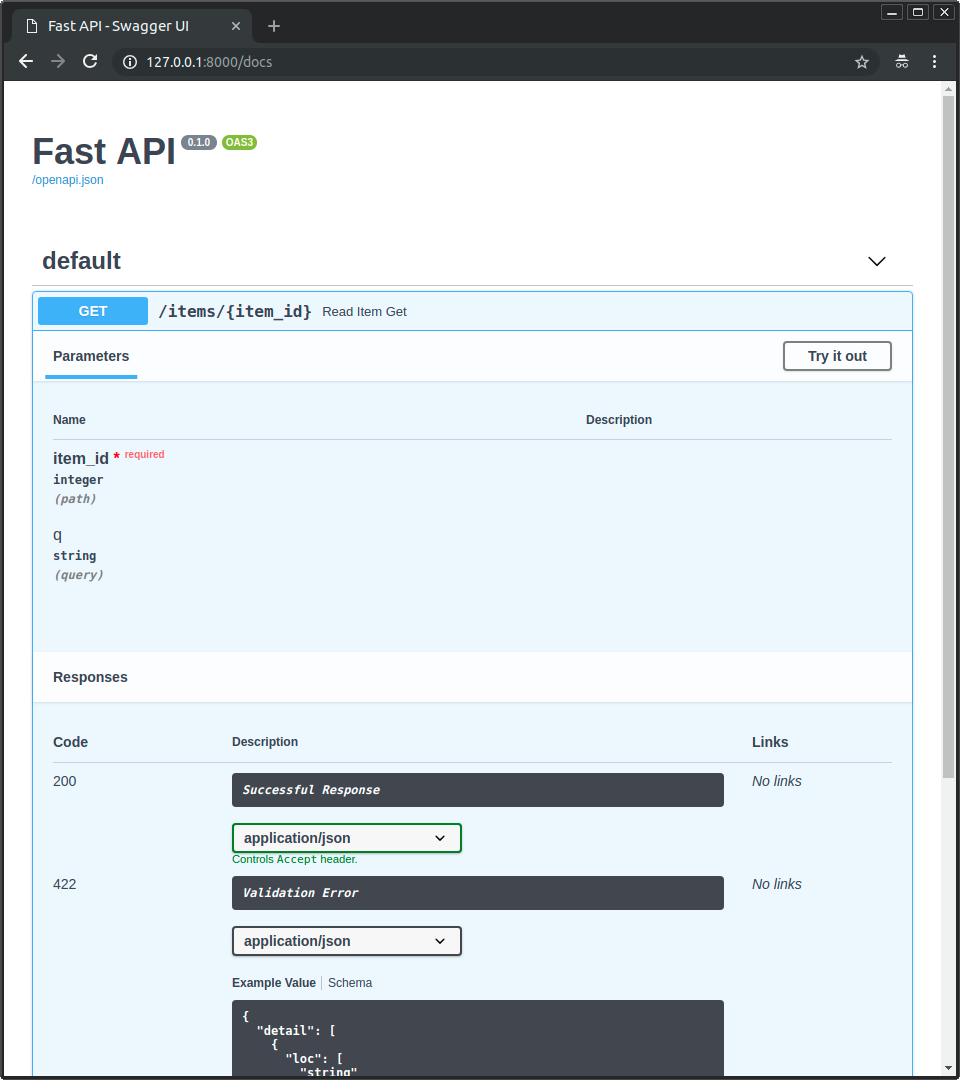
|
||||
|
||||
### Alternative API docs
|
||||
### Alternatywna dokumentacja API
|
||||
|
||||
And now, go to <a href="http://127.0.0.1:8000/redoc" class="external-link" target="_blank">http://127.0.0.1:8000/redoc</a>.
|
||||
Otwórz teraz <a href="http://127.0.0.1:8000/redoc" class="external-link" target="_blank">http://127.0.0.1:8000/redoc</a>.
|
||||
|
||||
You will see the alternative automatic documentation (provided by <a href="https://github.com/Rebilly/ReDoc" class="external-link" target="_blank">ReDoc</a>):
|
||||
Zobaczysz alternatywną, lecz wciąż automatyczną dokumentację (wygenerowaną z pomocą <a href="https://github.com/Rebilly/ReDoc" class="external-link" target="_blank">ReDoc</a>):
|
||||
|
||||
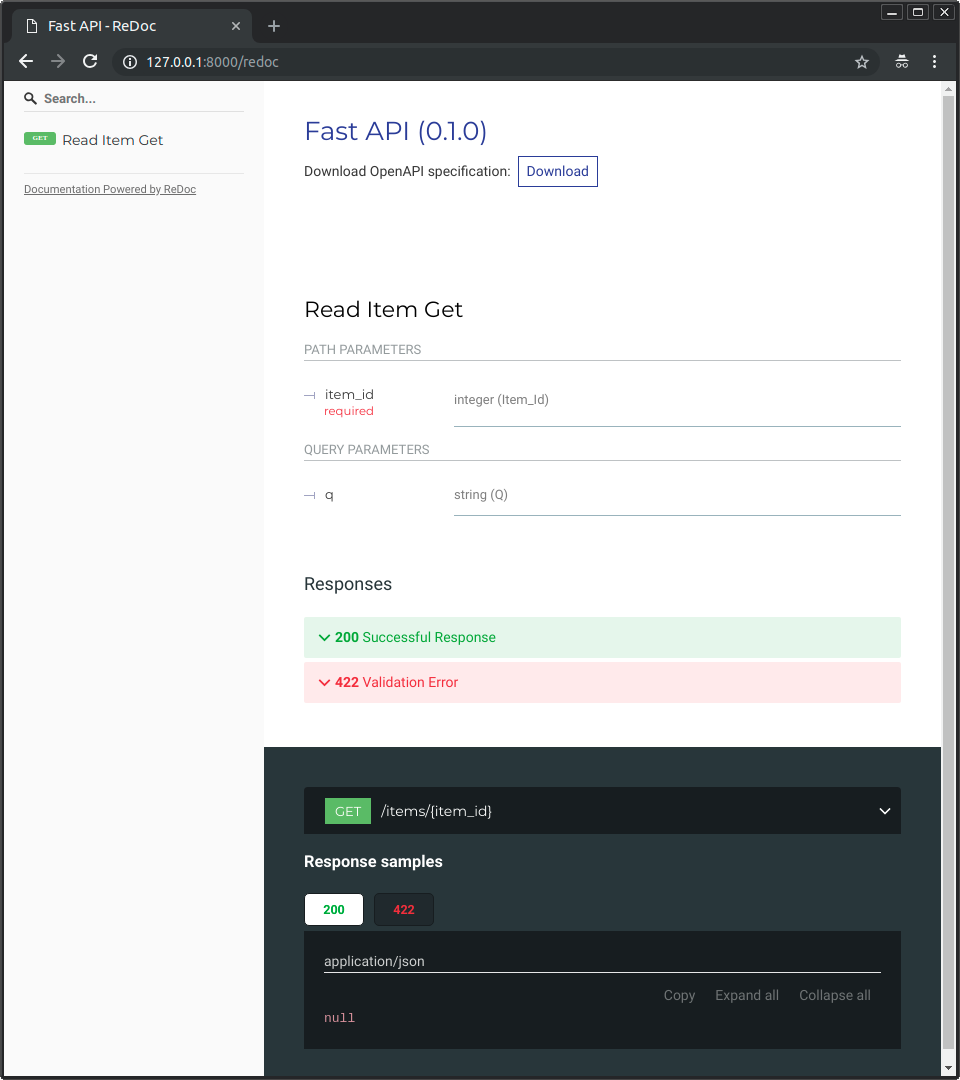
|
||||
|
||||
## Example upgrade
|
||||
## Aktualizacja przykładu
|
||||
|
||||
Now modify the file `main.py` to receive a body from a `PUT` request.
|
||||
Zmodyfikuj teraz plik `main.py`, aby otrzmywał treść (body) żądania `PUT`.
|
||||
|
||||
Declare the body using standard Python types, thanks to Pydantic.
|
||||
Zadeklaruj treść żądania, używając standardowych typów w Pythonie dzięki Pydantic.
|
||||
|
||||
```Python hl_lines="4 9-12 25-27"
|
||||
from typing import Optional
|
||||
@@ -293,175 +287,175 @@ def update_item(item_id: int, item: Item):
|
||||
return {"item_name": item.name, "item_id": item_id}
|
||||
```
|
||||
|
||||
The server should reload automatically (because you added `--reload` to the `uvicorn` command above).
|
||||
Serwer powinien przeładować się automatycznie (ponieważ dodałeś `--reload` do komendy `uvicorn` powyżej).
|
||||
|
||||
### Interactive API docs upgrade
|
||||
### Zaktualizowana interaktywna dokumentacja API
|
||||
|
||||
Now go to <a href="http://127.0.0.1:8000/docs" class="external-link" target="_blank">http://127.0.0.1:8000/docs</a>.
|
||||
Wejdź teraz na <a href="http://127.0.0.1:8000/docs" class="external-link" target="_blank">http://127.0.0.1:8000/docs</a>.
|
||||
|
||||
* The interactive API documentation will be automatically updated, including the new body:
|
||||
* Interaktywna dokumentacja API zaktualizuje sie automatycznie, także z nową treścią żądania (body):
|
||||
|
||||
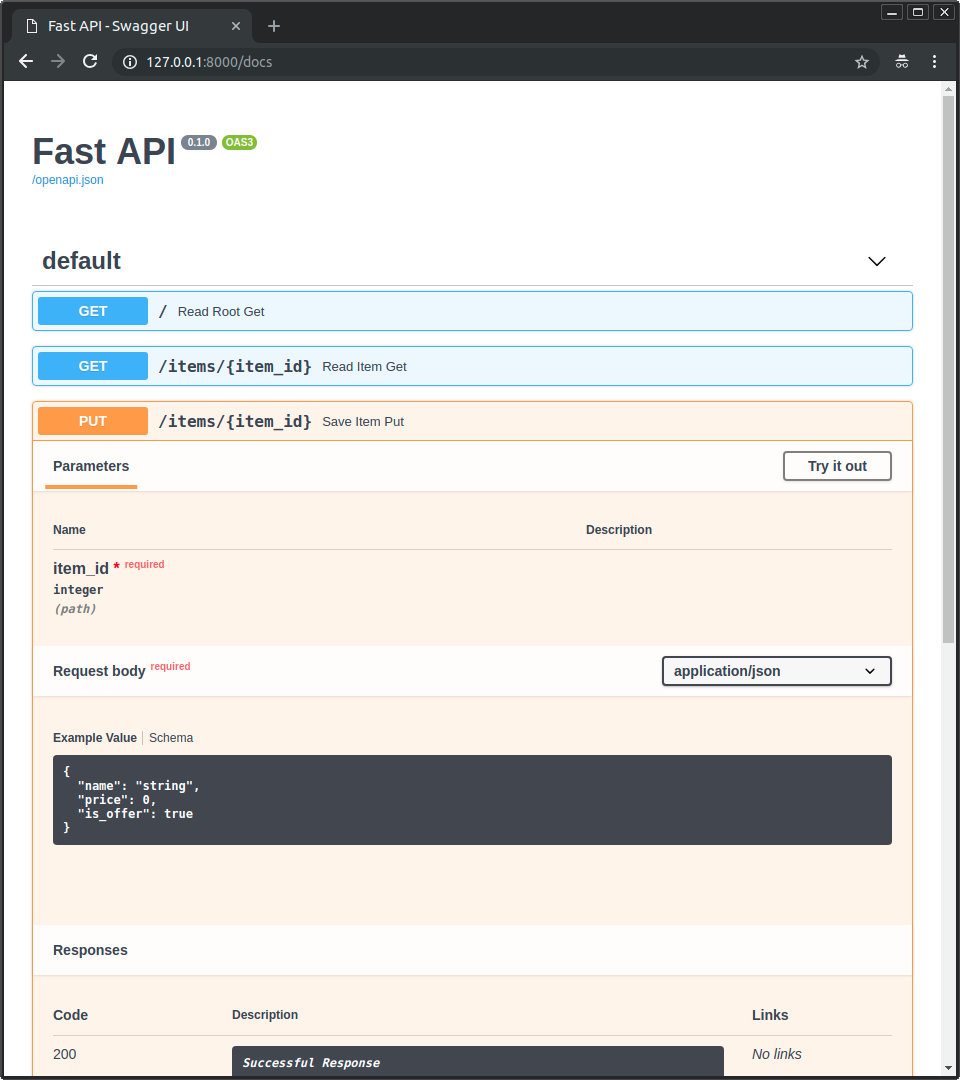
|
||||
|
||||
* Click on the button "Try it out", it allows you to fill the parameters and directly interact with the API:
|
||||
* Kliknij przycisk "Try it out" (wypróbuj), pozwoli Ci to wypełnić parametry i bezpośrednio użyć API:
|
||||
|
||||
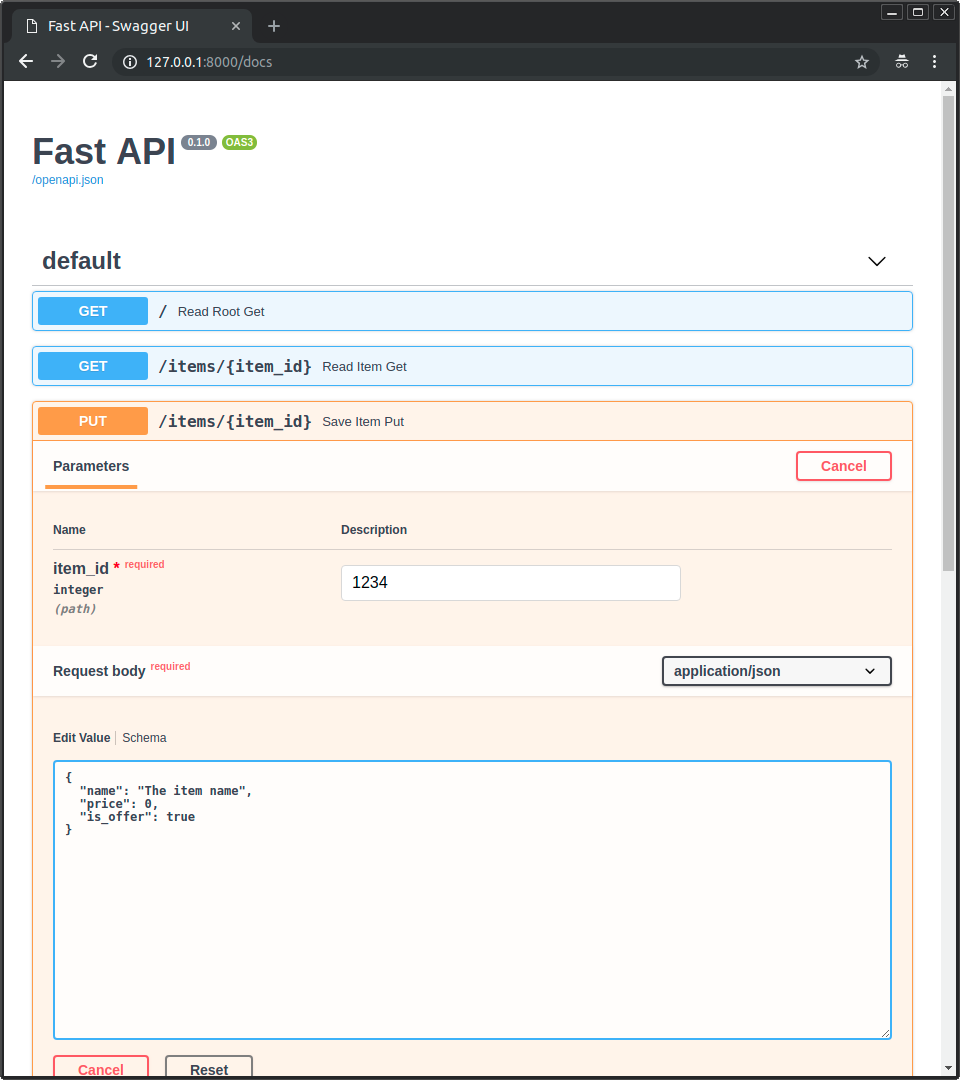
|
||||
|
||||
* Then click on the "Execute" button, the user interface will communicate with your API, send the parameters, get the results and show them on the screen:
|
||||
* Kliknij potem przycisk "Execute" (wykonaj), interfejs użytkownika połączy się z API, wyśle parametry, otrzyma odpowiedź i wyświetli ją na ekranie:
|
||||
|
||||
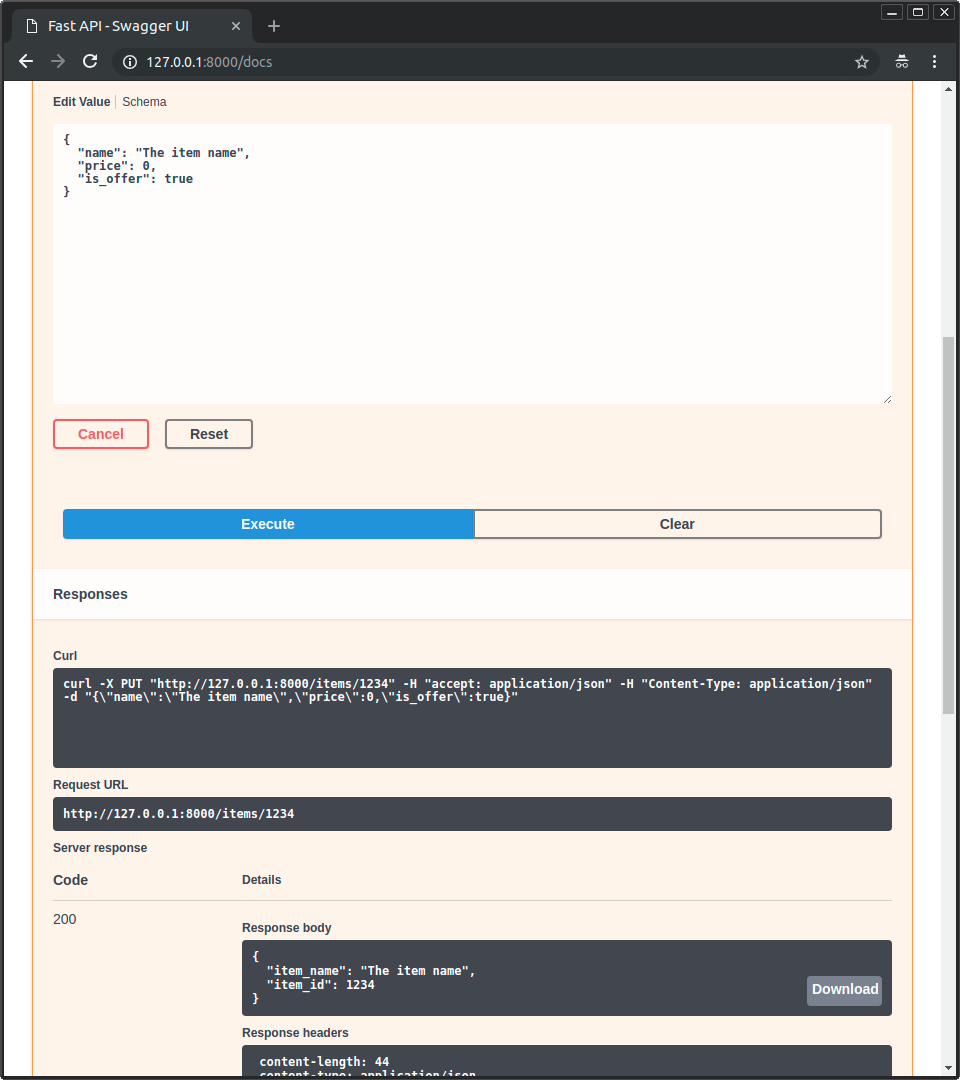
|
||||
|
||||
### Alternative API docs upgrade
|
||||
### Zaktualizowana alternatywna dokumentacja API
|
||||
|
||||
And now, go to <a href="http://127.0.0.1:8000/redoc" class="external-link" target="_blank">http://127.0.0.1:8000/redoc</a>.
|
||||
Otwórz teraz <a href="http://127.0.0.1:8000/redoc" class="external-link" target="_blank">http://127.0.0.1:8000/redoc</a>.
|
||||
|
||||
* The alternative documentation will also reflect the new query parameter and body:
|
||||
* Alternatywna dokumentacja również pokaże zaktualizowane parametry i treść żądania (body):
|
||||
|
||||
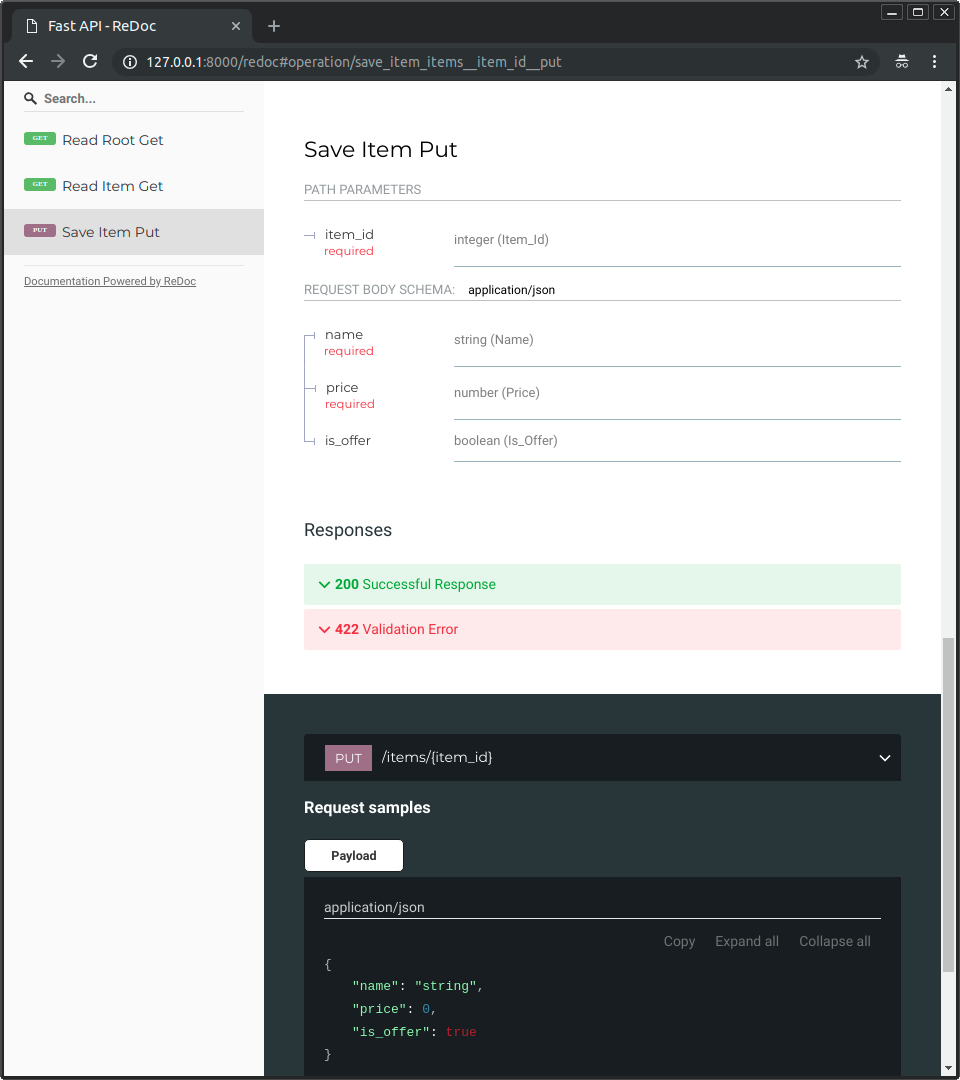
|
||||
|
||||
### Recap
|
||||
### Podsumowanie
|
||||
|
||||
In summary, you declare **once** the types of parameters, body, etc. as function parameters.
|
||||
Podsumowując, musiałeś zadeklarować typy parametrów, treści żądania (body) itp. tylko **raz**, i są one dostępne jako parametry funkcji.
|
||||
|
||||
You do that with standard modern Python types.
|
||||
Robisz to tak samo jak ze standardowymi typami w Pythonie.
|
||||
|
||||
You don't have to learn a new syntax, the methods or classes of a specific library, etc.
|
||||
Nie musisz sie uczyć żadnej nowej składni, metod lub klas ze specyficznych bibliotek itp.
|
||||
|
||||
Just standard **Python 3.6+**.
|
||||
Po prostu standardowy **Python 3.6+**.
|
||||
|
||||
For example, for an `int`:
|
||||
Na przykład, dla danych typu `int`:
|
||||
|
||||
```Python
|
||||
item_id: int
|
||||
```
|
||||
|
||||
or for a more complex `Item` model:
|
||||
albo dla bardziej złożonego obiektu `Item`:
|
||||
|
||||
```Python
|
||||
item: Item
|
||||
```
|
||||
|
||||
...and with that single declaration you get:
|
||||
...i z pojedyńczą deklaracją otrzymujesz:
|
||||
|
||||
* Editor support, including:
|
||||
* Completion.
|
||||
* Type checks.
|
||||
* Validation of data:
|
||||
* Automatic and clear errors when the data is invalid.
|
||||
* Validation even for deeply nested JSON objects.
|
||||
* <abbr title="also known as: serialization, parsing, marshalling">Conversion</abbr> of input data: coming from the network to Python data and types. Reading from:
|
||||
* Wsparcie edytorów kodu, wliczając:
|
||||
* Auto-uzupełnianie.
|
||||
* Sprawdzanie typów.
|
||||
* Walidacja danych:
|
||||
* Automatyczne i przejrzyste błędy gdy dane są niepoprawne.
|
||||
* Walidacja nawet dla głęboko zagnieżdżonych obiektów JSON.
|
||||
* <abbr title="znane również jako: serializacja, przetwarzanie, marshalling">Konwersja</abbr> danych wejściowych: przychodzących z sieci na Pythonowe typy. Pozwala na przetwarzanie danych:
|
||||
* JSON.
|
||||
* Path parameters.
|
||||
* Query parameters.
|
||||
* Cookies.
|
||||
* Headers.
|
||||
* Forms.
|
||||
* Files.
|
||||
* <abbr title="also known as: serialization, parsing, marshalling">Conversion</abbr> of output data: converting from Python data and types to network data (as JSON):
|
||||
* Convert Python types (`str`, `int`, `float`, `bool`, `list`, etc).
|
||||
* `datetime` objects.
|
||||
* `UUID` objects.
|
||||
* Database models.
|
||||
* ...and many more.
|
||||
* Automatic interactive API documentation, including 2 alternative user interfaces:
|
||||
* Parametrów ścieżki.
|
||||
* Parametrów zapytania.
|
||||
* Dane cookies.
|
||||
* Dane nagłówków (headers).
|
||||
* Formularze.
|
||||
* Pliki.
|
||||
* <abbr title="znane również jako: serializacja, przetwarzanie, marshalling">Konwersja</abbr> danych wyjściowych: wychodzących z Pythona do sieci (jako JSON):
|
||||
* Przetwarzanie Pythonowych typów (`str`, `int`, `float`, `bool`, `list`, itp).
|
||||
* Obiekty `datetime`.
|
||||
* Obiekty `UUID`.
|
||||
* Modele baz danych.
|
||||
* ...i wiele więcej.
|
||||
* Automatyczne interaktywne dokumentacje API, wliczając 2 alternatywne interfejsy użytkownika:
|
||||
* Swagger UI.
|
||||
* ReDoc.
|
||||
|
||||
---
|
||||
|
||||
Coming back to the previous code example, **FastAPI** will:
|
||||
Wracając do poprzedniego przykładu, **FastAPI** :
|
||||
|
||||
* Validate that there is an `item_id` in the path for `GET` and `PUT` requests.
|
||||
* Validate that the `item_id` is of type `int` for `GET` and `PUT` requests.
|
||||
* If it is not, the client will see a useful, clear error.
|
||||
* Check if there is an optional query parameter named `q` (as in `http://127.0.0.1:8000/items/foo?q=somequery`) for `GET` requests.
|
||||
* As the `q` parameter is declared with `= None`, it is optional.
|
||||
* Without the `None` it would be required (as is the body in the case with `PUT`).
|
||||
* For `PUT` requests to `/items/{item_id}`, Read the body as JSON:
|
||||
* Check that it has a required attribute `name` that should be a `str`.
|
||||
* Check that it has a required attribute `price` that has to be a `float`.
|
||||
* Check that it has an optional attribute `is_offer`, that should be a `bool`, if present.
|
||||
* All this would also work for deeply nested JSON objects.
|
||||
* Convert from and to JSON automatically.
|
||||
* Document everything with OpenAPI, that can be used by:
|
||||
* Interactive documentation systems.
|
||||
* Automatic client code generation systems, for many languages.
|
||||
* Provide 2 interactive documentation web interfaces directly.
|
||||
* Potwierdzi, że w ścieżce jest `item_id` dla żądań `GET` i `PUT`.
|
||||
* Potwierdzi, że `item_id` jest typu `int` dla żądań `GET` i `PUT`.
|
||||
* Jeżeli nie jest, odbiorca zobaczy przydatną, przejrzystą wiadomość z błędem.
|
||||
* Sprawdzi czy w ścieżce jest opcjonalny parametr zapytania `q` (np. `http://127.0.0.1:8000/items/foo?q=somequery`) dla żądania `GET`.
|
||||
* Jako że parametr `q` jest zadeklarowany jako `= None`, jest on opcjonalny.
|
||||
* Gdyby tego `None` nie było, parametr ten byłby wymagany (tak jak treść żądania w żądaniu `PUT`).
|
||||
* Dla żądania `PUT` z ścieżką `/items/{item_id}`, odczyta treść żądania jako JSON:
|
||||
* Sprawdzi czy posiada wymagany atrybut `name`, który powinien być typu `str`.
|
||||
* Sprawdzi czy posiada wymagany atrybut `price`, który musi być typu `float`.
|
||||
* Sprawdzi czy posiada opcjonalny atrybut `is_offer`, który (jeżeli obecny) powinien być typu `bool`.
|
||||
* To wszystko będzie również działać dla głęboko zagnieżdżonych obiektów JSON.
|
||||
* Automatycznie konwertuje z i do JSON.
|
||||
* Dokumentuje wszystko w OpenAPI, które może być używane przez:
|
||||
* Interaktywne systemy dokumentacji.
|
||||
* Systemy automatycznego generowania kodu klienckiego, dla wielu języków.
|
||||
* Dostarczy bezpośrednio 2 interaktywne dokumentacje webowe.
|
||||
|
||||
---
|
||||
|
||||
We just scratched the surface, but you already get the idea of how it all works.
|
||||
To dopiero początek, ale już masz mniej-więcej pojęcie jak to wszystko działa.
|
||||
|
||||
Try changing the line with:
|
||||
Spróbuj zmienić linijkę:
|
||||
|
||||
```Python
|
||||
return {"item_name": item.name, "item_id": item_id}
|
||||
```
|
||||
|
||||
...from:
|
||||
...z:
|
||||
|
||||
```Python
|
||||
... "item_name": item.name ...
|
||||
```
|
||||
|
||||
...to:
|
||||
...na:
|
||||
|
||||
```Python
|
||||
... "item_price": item.price ...
|
||||
```
|
||||
|
||||
...and see how your editor will auto-complete the attributes and know their types:
|
||||
...i zobacz jak edytor kodu automatycznie uzupełni atrybuty i będzie znał ich typy:
|
||||
|
||||
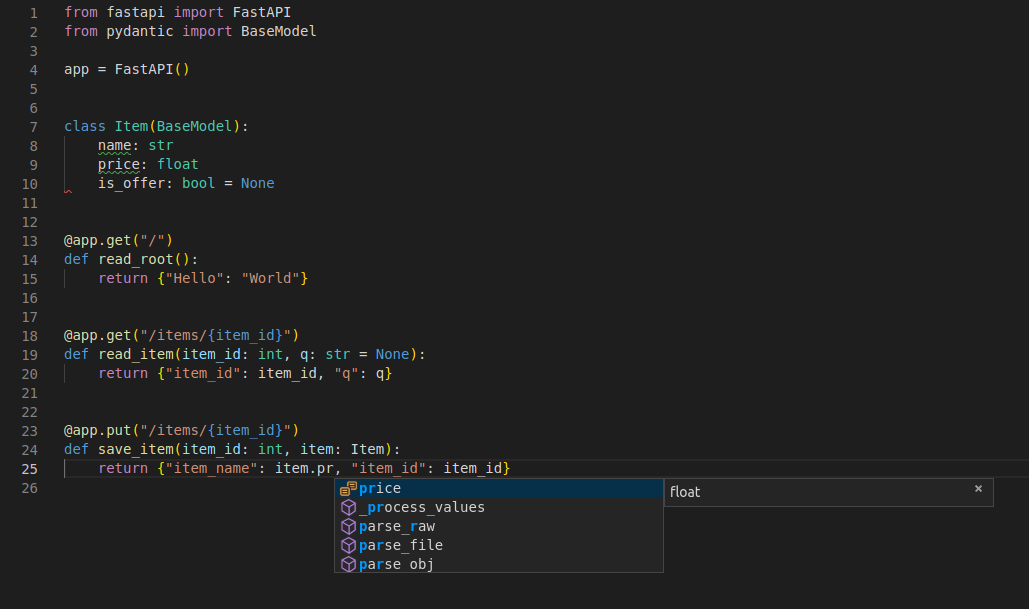
|
||||
|
||||
For a more complete example including more features, see the <a href="https://fastapi.tiangolo.com/tutorial/">Tutorial - User Guide</a>.
|
||||
Dla bardziej kompletnych przykładów posiadających więcej funkcjonalności, zobacz <a href="https://fastapi.tiangolo.com/tutorial/">Tutorial - User Guide</a>.
|
||||
|
||||
**Spoiler alert**: the tutorial - user guide includes:
|
||||
**Uwaga Spoiler**: tutorial - user guide zawiera:
|
||||
|
||||
* Declaration of **parameters** from other different places as: **headers**, **cookies**, **form fields** and **files**.
|
||||
* How to set **validation constraints** as `maximum_length` or `regex`.
|
||||
* A very powerful and easy to use **<abbr title="also known as components, resources, providers, services, injectables">Dependency Injection</abbr>** system.
|
||||
* Security and authentication, including support for **OAuth2** with **JWT tokens** and **HTTP Basic** auth.
|
||||
* More advanced (but equally easy) techniques for declaring **deeply nested JSON models** (thanks to Pydantic).
|
||||
* Many extra features (thanks to Starlette) as:
|
||||
* **WebSockets**
|
||||
* Deklaracje **parametrów** z innych miejsc takich jak: **nagłówki**, **pliki cookies**, **formularze** i **pliki**.
|
||||
* Jak ustawić **ograniczenia walidacyjne** takie jak `maksymalna długość` lub `regex`.
|
||||
* Potężny i łatwy w użyciu system **<abbr title="znane jako komponenty, resources, providers, services, injectables">Dependency Injection</abbr>**.
|
||||
* Zabezpieczenia i autentykacja, wliczając wsparcie dla **OAuth2** z **tokenami JWT** oraz autoryzacją **HTTP Basic**.
|
||||
* Bardziej zaawansowane (ale równie proste) techniki deklarowania **głęboko zagnieżdżonych modeli JSON** (dzięki Pydantic).
|
||||
* Wiele dodatkowych funkcji (dzięki Starlette) takie jak:
|
||||
* **WebSockety**
|
||||
* **GraphQL**
|
||||
* extremely easy tests based on `requests` and `pytest`
|
||||
* bardzo proste testy bazujące na `requests` oraz `pytest`
|
||||
* **CORS**
|
||||
* **Cookie Sessions**
|
||||
* ...and more.
|
||||
* **Sesje cookie**
|
||||
* ...i więcej.
|
||||
|
||||
## Performance
|
||||
## Wydajność
|
||||
|
||||
Independent TechEmpower benchmarks show **FastAPI** applications running under Uvicorn as <a href="https://www.techempower.com/benchmarks/#section=test&runid=7464e520-0dc2-473d-bd34-dbdfd7e85911&hw=ph&test=query&l=zijzen-7" class="external-link" target="_blank">one of the fastest Python frameworks available</a>, only below Starlette and Uvicorn themselves (used internally by FastAPI). (*)
|
||||
Niezależne benchmarki TechEmpower pokazują, że **FastAPI** (uruchomiony na serwerze Uvicorn) <a href="https://www.techempower.com/benchmarks/#section=test&runid=7464e520-0dc2-473d-bd34-dbdfd7e85911&hw=ph&test=query&l=zijzen-7" class="external-link" target="_blank">jest jednym z najszybszych dostępnych Pythonowych frameworków</a>, zaraz po Starlette i Uvicorn (używanymi wewnątrznie przez FastAPI). (*)
|
||||
|
||||
To understand more about it, see the section <a href="https://fastapi.tiangolo.com/benchmarks/" class="internal-link" target="_blank">Benchmarks</a>.
|
||||
Aby dowiedzieć się o tym więcej, zobacz sekcję <a href="https://fastapi.tiangolo.com/benchmarks/" class="internal-link" target="_blank">Benchmarks</a>.
|
||||
|
||||
## Optional Dependencies
|
||||
## Opcjonalne zależności
|
||||
|
||||
Used by Pydantic:
|
||||
Używane przez Pydantic:
|
||||
|
||||
* <a href="https://github.com/esnme/ultrajson" target="_blank"><code>ujson</code></a> - for faster JSON <abbr title="converting the string that comes from an HTTP request into Python data">"parsing"</abbr>.
|
||||
* <a href="https://github.com/JoshData/python-email-validator" target="_blank"><code>email_validator</code></a> - for email validation.
|
||||
* <a href="https://github.com/esnme/ultrajson" target="_blank"><code>ujson</code></a> - dla szybszego <abbr title="przetwarzania stringa który przychodzi z żądaniem HTTP na dane używane przez Pythona">"parsowania"</abbr> danych JSON.
|
||||
* <a href="https://github.com/JoshData/python-email-validator" target="_blank"><code>email_validator</code></a> - dla walidacji adresów email.
|
||||
|
||||
Used by Starlette:
|
||||
Używane przez Starlette:
|
||||
|
||||
* <a href="https://requests.readthedocs.io" target="_blank"><code>requests</code></a> - Required if you want to use the `TestClient`.
|
||||
* <a href="https://github.com/Tinche/aiofiles" target="_blank"><code>aiofiles</code></a> - Required if you want to use `FileResponse` or `StaticFiles`.
|
||||
* <a href="https://jinja.palletsprojects.com" target="_blank"><code>jinja2</code></a> - Required if you want to use the default template configuration.
|
||||
* <a href="https://andrew-d.github.io/python-multipart/" target="_blank"><code>python-multipart</code></a> - Required if you want to support form <abbr title="converting the string that comes from an HTTP request into Python data">"parsing"</abbr>, with `request.form()`.
|
||||
* <a href="https://pythonhosted.org/itsdangerous/" target="_blank"><code>itsdangerous</code></a> - Required for `SessionMiddleware` support.
|
||||
* <a href="https://pyyaml.org/wiki/PyYAMLDocumentation" target="_blank"><code>pyyaml</code></a> - Required for Starlette's `SchemaGenerator` support (you probably don't need it with FastAPI).
|
||||
* <a href="https://graphene-python.org/" target="_blank"><code>graphene</code></a> - Required for `GraphQLApp` support.
|
||||
* <a href="https://github.com/esnme/ultrajson" target="_blank"><code>ujson</code></a> - Required if you want to use `UJSONResponse`.
|
||||
* <a href="https://requests.readthedocs.io" target="_blank"><code>requests</code></a> - Wymagane jeżeli chcesz korzystać z `TestClient`.
|
||||
* <a href="https://github.com/Tinche/aiofiles" target="_blank"><code>aiofiles</code></a> - Wymagane jeżeli chcesz korzystać z `FileResponse` albo `StaticFiles`.
|
||||
* <a href="https://jinja.palletsprojects.com" target="_blank"><code>jinja2</code></a> - Wymagane jeżeli chcesz używać domyślnej konfiguracji szablonów.
|
||||
* <a href="https://andrew-d.github.io/python-multipart/" target="_blank"><code>python-multipart</code></a> - Wymagane jeżelich chcesz wsparcie <abbr title="przetwarzania stringa którzy przychodzi z żądaniem HTTP na dane używane przez Pythona">"parsowania"</abbr> formularzy, używając `request.form()`.
|
||||
* <a href="https://pythonhosted.org/itsdangerous/" target="_blank"><code>itsdangerous</code></a> - Wymagany dla wsparcia `SessionMiddleware`.
|
||||
* <a href="https://pyyaml.org/wiki/PyYAMLDocumentation" target="_blank"><code>pyyaml</code></a> - Wymagane dla wsparcia `SchemaGenerator` z Starlette (z FastAPI prawdopodobnie tego nie potrzebujesz).
|
||||
* <a href="https://graphene-python.org/" target="_blank"><code>graphene</code></a> - Wymagane dla wsparcia `GraphQLApp`.
|
||||
* <a href="https://github.com/esnme/ultrajson" target="_blank"><code>ujson</code></a> - Wymagane jeżeli chcesz korzystać z `UJSONResponse`.
|
||||
|
||||
Used by FastAPI / Starlette:
|
||||
Używane przez FastAPI / Starlette:
|
||||
|
||||
* <a href="https://www.uvicorn.org" target="_blank"><code>uvicorn</code></a> - for the server that loads and serves your application.
|
||||
* <a href="https://github.com/ijl/orjson" target="_blank"><code>orjson</code></a> - Required if you want to use `ORJSONResponse`.
|
||||
* <a href="https://www.uvicorn.org" target="_blank"><code>uvicorn</code></a> - jako serwer, który ładuje i obsługuje Twoją aplikację.
|
||||
* <a href="https://github.com/ijl/orjson" target="_blank"><code>orjson</code></a> - Wymagane jeżeli chcesz używać `ORJSONResponse`.
|
||||
|
||||
You can install all of these with `pip install fastapi[all]`.
|
||||
Możesz zainstalować wszystkie te aplikacje przy pomocy `pip install fastapi[all]`.
|
||||
|
||||
## License
|
||||
## Licencja
|
||||
|
||||
This project is licensed under the terms of the MIT license.
|
||||
Ten projekt jest na licencji MIT.
|
||||
|
||||
@@ -29,9 +29,6 @@ theme:
|
||||
repo_name: tiangolo/fastapi
|
||||
repo_url: https://github.com/tiangolo/fastapi
|
||||
edit_uri: ''
|
||||
google_analytics:
|
||||
- UA-133183413-1
|
||||
- auto
|
||||
plugins:
|
||||
- search
|
||||
- markdownextradata:
|
||||
@@ -70,8 +67,12 @@ markdown_extensions:
|
||||
- name: mermaid
|
||||
class: mermaid
|
||||
format: !!python/name:pymdownx.superfences.fence_code_format ''
|
||||
- pymdownx.tabbed
|
||||
- pymdownx.tabbed:
|
||||
alternate_style: true
|
||||
extra:
|
||||
analytics:
|
||||
provider: google
|
||||
property: UA-133183413-1
|
||||
social:
|
||||
- icon: fontawesome/brands/github-alt
|
||||
link: https://github.com/tiangolo/fastapi
|
||||
|
||||
@@ -29,9 +29,6 @@ theme:
|
||||
repo_name: tiangolo/fastapi
|
||||
repo_url: https://github.com/tiangolo/fastapi
|
||||
edit_uri: ''
|
||||
google_analytics:
|
||||
- UA-133183413-1
|
||||
- auto
|
||||
plugins:
|
||||
- search
|
||||
- markdownextradata:
|
||||
@@ -90,8 +87,12 @@ markdown_extensions:
|
||||
- name: mermaid
|
||||
class: mermaid
|
||||
format: !!python/name:pymdownx.superfences.fence_code_format ''
|
||||
- pymdownx.tabbed
|
||||
- pymdownx.tabbed:
|
||||
alternate_style: true
|
||||
extra:
|
||||
analytics:
|
||||
provider: google
|
||||
property: UA-133183413-1
|
||||
social:
|
||||
- icon: fontawesome/brands/github-alt
|
||||
link: https://github.com/tiangolo/fastapi
|
||||
|
||||
@@ -29,9 +29,6 @@ theme:
|
||||
repo_name: tiangolo/fastapi
|
||||
repo_url: https://github.com/tiangolo/fastapi
|
||||
edit_uri: ''
|
||||
google_analytics:
|
||||
- UA-133183413-1
|
||||
- auto
|
||||
plugins:
|
||||
- search
|
||||
- markdownextradata:
|
||||
@@ -70,8 +67,12 @@ markdown_extensions:
|
||||
- name: mermaid
|
||||
class: mermaid
|
||||
format: !!python/name:pymdownx.superfences.fence_code_format ''
|
||||
- pymdownx.tabbed
|
||||
- pymdownx.tabbed:
|
||||
alternate_style: true
|
||||
extra:
|
||||
analytics:
|
||||
provider: google
|
||||
property: UA-133183413-1
|
||||
social:
|
||||
- icon: fontawesome/brands/github-alt
|
||||
link: https://github.com/tiangolo/fastapi
|
||||
|
||||
@@ -29,9 +29,6 @@ theme:
|
||||
repo_name: tiangolo/fastapi
|
||||
repo_url: https://github.com/tiangolo/fastapi
|
||||
edit_uri: ''
|
||||
google_analytics:
|
||||
- UA-133183413-1
|
||||
- auto
|
||||
plugins:
|
||||
- search
|
||||
- markdownextradata:
|
||||
@@ -70,8 +67,12 @@ markdown_extensions:
|
||||
- name: mermaid
|
||||
class: mermaid
|
||||
format: !!python/name:pymdownx.superfences.fence_code_format ''
|
||||
- pymdownx.tabbed
|
||||
- pymdownx.tabbed:
|
||||
alternate_style: true
|
||||
extra:
|
||||
analytics:
|
||||
provider: google
|
||||
property: UA-133183413-1
|
||||
social:
|
||||
- icon: fontawesome/brands/github-alt
|
||||
link: https://github.com/tiangolo/fastapi
|
||||
|
||||
@@ -29,9 +29,6 @@ theme:
|
||||
repo_name: tiangolo/fastapi
|
||||
repo_url: https://github.com/tiangolo/fastapi
|
||||
edit_uri: ''
|
||||
google_analytics:
|
||||
- UA-133183413-1
|
||||
- auto
|
||||
plugins:
|
||||
- search
|
||||
- markdownextradata:
|
||||
@@ -73,8 +70,12 @@ markdown_extensions:
|
||||
- name: mermaid
|
||||
class: mermaid
|
||||
format: !!python/name:pymdownx.superfences.fence_code_format ''
|
||||
- pymdownx.tabbed
|
||||
- pymdownx.tabbed:
|
||||
alternate_style: true
|
||||
extra:
|
||||
analytics:
|
||||
provider: google
|
||||
property: UA-133183413-1
|
||||
social:
|
||||
- icon: fontawesome/brands/github-alt
|
||||
link: https://github.com/tiangolo/fastapi
|
||||
|
||||
@@ -29,9 +29,6 @@ theme:
|
||||
repo_name: tiangolo/fastapi
|
||||
repo_url: https://github.com/tiangolo/fastapi
|
||||
edit_uri: ''
|
||||
google_analytics:
|
||||
- UA-133183413-1
|
||||
- auto
|
||||
plugins:
|
||||
- search
|
||||
- markdownextradata:
|
||||
@@ -70,8 +67,12 @@ markdown_extensions:
|
||||
- name: mermaid
|
||||
class: mermaid
|
||||
format: !!python/name:pymdownx.superfences.fence_code_format ''
|
||||
- pymdownx.tabbed
|
||||
- pymdownx.tabbed:
|
||||
alternate_style: true
|
||||
extra:
|
||||
analytics:
|
||||
provider: google
|
||||
property: UA-133183413-1
|
||||
social:
|
||||
- icon: fontawesome/brands/github-alt
|
||||
link: https://github.com/tiangolo/fastapi
|
||||
|
||||
@@ -1,107 +1,149 @@
|
||||
# 帮助 FastAPI - 获取帮助
|
||||
# 帮助 FastAPI 与求助
|
||||
|
||||
你喜欢 **FastAPI** 吗?
|
||||
您喜欢 **FastAPI** 吗?
|
||||
|
||||
您愿意去帮助 FastAPI,帮助其他用户以及作者吗?
|
||||
想帮助 FastAPI?其它用户?还有项目作者?
|
||||
|
||||
或者你想要获得有关 **FastAPI** 的帮助?
|
||||
或要求助怎么使用 **FastAPI**?
|
||||
|
||||
下面是一些非常简单的方式去提供帮助(有些只需单击一两次链接)。
|
||||
以下几种帮助的方式都非常简单(有些只需要点击一两下鼠标)。
|
||||
|
||||
以及几种获取帮助的途径。
|
||||
求助的渠道也很多。
|
||||
|
||||
## 在 GitHub 上 Star **FastAPI**
|
||||
## 订阅新闻邮件
|
||||
|
||||
你可以在 GitHub 上 "star" FastAPI(点击右上角的 star 按钮):<a href="https://github.com/tiangolo/fastapi" class="external-link" target="_blank">https://github.com/tiangolo/fastapi</a>。
|
||||
您可以订阅 [**FastAPI 和它的小伙伴** 新闻邮件](/newsletter/){.internal-link target=_blank}(不会经常收到)
|
||||
|
||||
通过添加 star,其他用户将会更容易发现 FastAPI,并了解已经有许多人认为它有用。
|
||||
* FastAPI 及其小伙伴的新闻 🚀
|
||||
* 指南 📝
|
||||
* 功能 ✨
|
||||
* 破坏性更改 🚨
|
||||
* 开发技巧 ✅
|
||||
|
||||
## Watch GitHub 仓库的版本发布
|
||||
## 在推特上关注 FastAPI
|
||||
|
||||
你可以在 GitHub 上 "watch" FastAPI(点击右上角的 watch 按钮):<a href="https://github.com/tiangolo/fastapi" class="external-link" target="_blank">https://github.com/tiangolo/fastapi</a>。
|
||||
<a href="https://twitter.com/fastapi" class="external-link" target="_blank">在 **Twitter** 上关注 @fastapi</a> 获取 **FastAPI** 的最新消息。🐦
|
||||
|
||||
这时你可以选择 "Releases only" 选项。
|
||||
## 在 GitHub 上为 **FastAPI** 加星
|
||||
|
||||
之后,只要有 **FastAPI** 的新版本(包含缺陷修复和新功能)发布,你都会(通过电子邮件)收到通知。
|
||||
您可以在 GitHub 上 **Star** FastAPI(只要点击右上角的星星就可以了): <a href="https://github.com/tiangolo/fastapi" class="external-link" target="_blank">https://github.com/tiangolo/fastapi。</a>⭐️
|
||||
|
||||
## 加入聊天室
|
||||
**Star** 以后,其它用户就能更容易找到 FastAPI,并了解到已经有其他用户在使用它了。
|
||||
|
||||
加入 Gitter 上的聊天室:<a href="https://gitter.im/tiangolo/fastapi" class="external-link" target="_blank">https://gitter.im/tiangolo/fastapi</a>。
|
||||
## 关注 GitHub 资源库的版本发布
|
||||
|
||||
在这里你可以快速提问、帮助他人、分享想法等。
|
||||
您还可以在 GitHub 上 **Watch** FastAPI,(点击右上角的 **Watch** 按钮)<a href="https://github.com/tiangolo/fastapi" class="external-link" target="_blank">https://github.com/tiangolo/fastapi。</a>👀
|
||||
|
||||
## 与作者联系
|
||||
您可以选择只关注发布(**Releases only**)。
|
||||
|
||||
你可以联系 <a href="https://tiangolo.com" class="external-link" target="_blank">我 (Sebastián Ramírez / `tiangolo`)</a> - FastAPI 的作者。
|
||||
这样,您就可以(在电子邮件里)接收到 **FastAPI** 新版发布的通知,及时了解 bug 修复与新功能。
|
||||
|
||||
你可以:
|
||||
## 联系作者
|
||||
|
||||
* <a href="https://github.com/tiangolo" class="external-link" target="_blank">在 **GitHub** 上关注我</a>。
|
||||
* 查看我创建的其他的可能对你有帮助的开源项目。
|
||||
* 关注我以了解我创建的新开源项目。
|
||||
* <a href="https://twitter.com/tiangolo" class="external-link" target="_blank">在 **Twitter** 上关注我</a>。
|
||||
* 告诉我你是如何使用 FastAPI 的(我很乐意听到)。
|
||||
* 提出问题。
|
||||
* <a href="https://www.linkedin.com/in/tiangolo/" class="external-link" target="_blank">在 **Linkedin** 上联系我</a>。
|
||||
* 与我交流。
|
||||
* 认可我的技能或推荐我 :)
|
||||
* <a href="https://medium.com/@tiangolo" class="external-link" target="_blank">在 **Medium** 上阅读我写的文章(或关注我)</a>。
|
||||
* 阅读我创建的其他想法,文章和工具。
|
||||
* 关注我以了解我发布的新内容。
|
||||
您可以联系项目作者,就是<a href="https://tiangolo.com" class="external-link" target="_blank">我(Sebastián Ramírez / `tiangolo`</a>)。
|
||||
|
||||
## 发布和 **FastAPI** 有关的推特
|
||||
您可以:
|
||||
|
||||
<a href="https://twitter.com/compose/tweet?text=I'm loving FastAPI because... https://github.com/tiangolo/fastapi cc @tiangolo" class="external-link" target="_blank"> 发布和 **FastAPI** 有关的推特</a> 让我和其他人知道你为什么喜欢它。
|
||||
* <a href="https://github.com/tiangolo" class="external-link" target="_blank">在 **GitHub** 上关注我</a>
|
||||
* 了解其它我创建的开源项目,或许对您会有帮助
|
||||
* 关注我什么时候创建新的开源项目
|
||||
* <a href="https://twitter.com/tiangolo" class="external-link" target="_blank">在 **Twitter** 上关注我</a>
|
||||
* 告诉我您使用 FastAPI(我非常乐意听到这种消息)
|
||||
* 接收我发布公告或新工具的消息
|
||||
* 您还可以关注<a href="https://twitter.com/fastapi" class="external-link" target="_blank">@fastapi on Twitter</a>,这是个独立的账号
|
||||
* <a href="https://www.linkedin.com/in/tiangolo/" class="external-link" target="_blank">在**领英**上联系我</a>
|
||||
* 接收我发布公告或新工具的消息(虽然我用 Twitter 比较多)
|
||||
* 阅读我在 <a href="https://dev.to/tiangolo" class="external-link" target="_blank">**Dev.to**</a> 或 <a href="https://medium.com/@tiangolo" class="external-link" target="_blank">**Medium**</a> 上的文章,或关注我
|
||||
* 阅读我的其它想法、文章,了解我创建的工具
|
||||
* 关注我,这样就可以随时看到我发布的新文章
|
||||
|
||||
## 告诉我你正在如何使用 **FastAPI**
|
||||
## Tweet about **FastAPI**
|
||||
|
||||
我很乐意听到有关 **FastAPI** 被如何使用、你喜欢它的哪一点、被投入使用的项目/公司等等信息。
|
||||
<a href="https://twitter.com/compose/tweet?text=I'm loving @fastapi because... https://github.com/tiangolo/fastapi" class="external-link" target="_blank">Tweet about **FastAPI**</a> 让我和大家知道您为什么喜欢 FastAPI。🎉
|
||||
|
||||
你可以通过以下平台让我知道:
|
||||
|
||||
* <a href="https://twitter.com/compose/tweet?text=Hey @tiangolo, I'm using FastAPI at..." class="external-link" target="_blank">**Twitter**</a>。
|
||||
* <a href="https://www.linkedin.com/in/tiangolo/" class="external-link" target="_blank">**Linkedin**</a>。
|
||||
* <a href="https://medium.com/@tiangolo" class="external-link" target="_blank">**Medium**</a>。
|
||||
知道有人使用 **FastAPI**,我会很开心,我也想知道您为什么喜欢 FastAPI,以及您在什么项目/哪些公司使用 FastAPI,等等。
|
||||
|
||||
## 为 FastAPI 投票
|
||||
|
||||
* <a href="https://www.slant.co/options/34241/~fastapi-review" class="external-link" target="_blank">在 Slant 上为 **FastAPI** 投票</a>。
|
||||
* <a href="https://www.slant.co/options/34241/~fastapi-review" class="external-link" target="_blank">在 Slant 上为 **FastAPI** 投票</a>
|
||||
* <a href="https://alternativeto.net/software/fastapi/" class="external-link" target="_blank">在 AlternativeTo 上为 **FastAPI** 投票</a>
|
||||
|
||||
## 帮助他人解决 GitHub 的 issues
|
||||
## 在 GitHub 上帮助其他人解决问题
|
||||
|
||||
你可以查看 <a href="https://github.com/tiangolo/fastapi/issues" class="external-link" target="_blank">已有的 issues</a> 并尝试帮助其他人。
|
||||
您可以查看<a href="https://github.com/tiangolo/fastapi/issues" class="external-link" target="_blank">现有 issues</a>,并尝试帮助其他人解决问题,说不定您能解决这些问题呢。🤓
|
||||
|
||||
## Watch GitHub 仓库
|
||||
如果帮助很多人解决了问题,您就有可能成为 [FastAPI 的官方专家](fastapi-people.md#experts){.internal-link target=_blank}。🎉
|
||||
|
||||
你可以在 GitHub 上 "watch" FastAPI(点击右上角的 "watch" 按钮):<a href="https://github.com/tiangolo/fastapi" class="external-link" target="_blank">https://github.com/tiangolo/fastapi</a>。
|
||||
## 监听 GitHub 资源库
|
||||
|
||||
如果你选择的是 "Watching" 而不是 "Releases only" 选项,你会在其他人创建了新的 issue 时收到通知。
|
||||
您可以在 GitHub 上「监听」FastAPI(点击右上角的 "watch" 按钮): <a href="https://github.com/tiangolo/fastapi" class="external-link" target="_blank">https://github.com/tiangolo/fastapi</a>. 👀
|
||||
|
||||
然后你可以尝试帮助他们解决这些 issue。
|
||||
如果您选择 "Watching" 而不是 "Releases only",有人创建新 Issue 时,您会接收到通知。
|
||||
|
||||
## 创建 issue
|
||||
然后您就可以尝试并帮助他们解决问题。
|
||||
|
||||
你可以在 GitHub 仓库中 <a href="https://github.com/tiangolo/fastapi/issues/new/choose" class="external-link" target="_blank">创建一个新 issue</a> 用来:
|
||||
## 创建 Issue
|
||||
|
||||
* 报告 bug 或问题。
|
||||
* 提议新的特性。
|
||||
* 提问。
|
||||
您可以在 GitHub 资源库中<a href="https://github.com/tiangolo/fastapi/issues/new/choose" class="external-link" target="_blank">创建 Issue</a>,例如:
|
||||
|
||||
## 创建 Pull Request
|
||||
* 提出**问题**或**意见**
|
||||
* 提出新**特性**建议
|
||||
|
||||
你可以 <a href="https://github.com/tiangolo/fastapi" class="external-link" target="_blank">创建一个 Pull Request</a> 用来:
|
||||
**注意**:如果您创建 Issue,我会要求您也要帮助别的用户。😉
|
||||
|
||||
* 纠正你在文档中发现的错别字。
|
||||
* 添加新的文档内容。
|
||||
* 修复已有的 bug 或问题。
|
||||
* 添加新的特性。
|
||||
## 创建 PR
|
||||
|
||||
您可以创建 PR 为源代码做[贡献](contributing.md){.internal-link target=_blank},例如:
|
||||
|
||||
* 修改文档错别字
|
||||
* <a href="https://github.com/tiangolo/fastapi/edit/master/docs/en/data/external_links.yml" class="external-link" target="_blank">编辑这个文件</a>,分享 FastAPI 的文章、视频、博客,不论是您自己的,还是您看到的都成
|
||||
* 注意,添加的链接要放在对应区块的开头
|
||||
* [翻译文档](contributing.md#translations){.internal-link target=_blank}
|
||||
* 审阅别人翻译的文档
|
||||
* 添加新的文档内容
|
||||
* 修复现有问题/Bug
|
||||
* 添加新功能
|
||||
|
||||
## 加入聊天
|
||||
|
||||
快加入 👥 <a href="https://discord.gg/VQjSZaeJmf" class="external-link" target="_blank">Discord 聊天服务器</a> 👥 和 FastAPI 社区里的小伙伴一起哈皮吧。
|
||||
|
||||
!!! tip "提示"
|
||||
|
||||
如有问题,请在 <a href="https://github.com/tiangolo/fastapi/issues/new/choose" class="external-link" target="_blank">GitHub Issues</a> 里提问,在这里更容易得到 [FastAPI 专家](fastapi-people.md#experts){.internal-link target=_blank}的帮助。
|
||||
|
||||
聊天室仅供闲聊。
|
||||
|
||||
我们之前还使用过 <a href="https://gitter.im/tiangolo/fastapi" class="external-link" target="_blank">Gitter chat</a>,但它不支持频道等高级功能,聊天也比较麻烦,所以现在推荐使用 Discord。
|
||||
|
||||
### 别在聊天室里提问
|
||||
|
||||
注意,聊天室更倾向于“闲聊”,经常有人会提出一些笼统得让人难以回答的问题,所以在这里提问一般没人回答。
|
||||
|
||||
GitHub Issues 里提供了模板,指引您提出正确的问题,有利于获得优质的回答,甚至可能解决您还没有想到的问题。而且就算答疑解惑要耗费不少时间,我还是会尽量在 GitHub 里回答问题。但在聊天室里,我就没功夫这么做了。😅
|
||||
|
||||
聊天室里的聊天内容也不如 GitHub 里好搜索,聊天里的问答很容易就找不到了。只有在 GitHub Issues 里的问答才能帮助您成为 [FastAPI 专家](fastapi-people.md#experts){.internal-link target=_blank},在 GitHub Issues 中为您带来更多关注。
|
||||
|
||||
另一方面,聊天室里有成千上万的用户,在这里,您有很大可能遇到聊得来的人。😄
|
||||
|
||||
## 赞助作者
|
||||
|
||||
你还可以通过 <a href="https://github.com/sponsors/tiangolo" class="external-link" target="_blank">GitHub sponsors</a> 在经济上支持作者(我)。
|
||||
您还可以通过 <a href="https://github.com/sponsors/tiangolo" class="external-link" target="_blank">GitHub 赞助商</a>资助本项目的作者(就是我)。
|
||||
|
||||
这样你可以给我买杯咖啡☕️以示谢意😄。
|
||||
给我买杯咖啡 ☕️ 以示感谢 😄
|
||||
|
||||
当然您也可以成为 FastAPI 的金牌或银牌赞助商。🏅🎉
|
||||
|
||||
## 赞助 FastAPI 使用的工具
|
||||
|
||||
如您在本文档中所见,FastAPI 站在巨人的肩膀上,它们分别是 Starlette 和 Pydantic。
|
||||
|
||||
您还可以赞助:
|
||||
|
||||
* <a href="https://github.com/sponsors/samuelcolvin" class="external-link" target="_blank">Samuel Colvin (Pydantic)</a>
|
||||
* <a href="https://github.com/sponsors/encode" class="external-link" target="_blank">Encode (Starlette, Uvicorn)</a>
|
||||
|
||||
---
|
||||
|
||||
感谢!
|
||||
谢谢!🚀
|
||||
|
||||
|
||||
101
docs/zh/docs/tutorial/path-operation-configuration.md
Normal file
@@ -0,0 +1,101 @@
|
||||
# 路径操作配置
|
||||
|
||||
*路径操作装饰器*支持多种配置参数。
|
||||
|
||||
!!! warning "警告"
|
||||
|
||||
注意:以下参数应直接传递给**路径操作装饰器**,不能传递给*路径操作函数*。
|
||||
|
||||
## `status_code` 状态码
|
||||
|
||||
`status_code` 用于定义*路径操作*响应中的 HTTP 状态码。
|
||||
|
||||
可以直接传递 `int` 代码, 比如 `404`。
|
||||
|
||||
如果记不住数字码的涵义,也可以用 `status` 的快捷常量:
|
||||
|
||||
```Python hl_lines="3 17"
|
||||
{!../../../docs_src/path_operation_configuration/tutorial001.py!}
|
||||
```
|
||||
|
||||
状态码在响应中使用,并会被添加到 OpenAPI 概图。
|
||||
|
||||
!!! note "技术细节"
|
||||
|
||||
也可以使用 `from starlette import status` 导入状态码。
|
||||
|
||||
**FastAPI** 的`fastapi.status` 和 `starlette.status` 一样,只是快捷方式。实际上,`fastapi.status` 直接继承自 Starlette。
|
||||
|
||||
## `tags` 参数
|
||||
|
||||
`tags` 参数的值是由 `str` 组成的 `list` (一般只有一个 `str` ),`tags` 用于为*路径操作*添加标签:
|
||||
|
||||
```Python hl_lines="17 22 27"
|
||||
{!../../../docs_src/path_operation_configuration/tutorial002.py!}
|
||||
```
|
||||
|
||||
OpenAPI 概图会自动添加标签,供 API 文档接口使用:
|
||||
|
||||
<img src="/img/tutorial/path-operation-configuration/image01.png">
|
||||
|
||||
## `summary` 和 `description` 参数
|
||||
|
||||
路径装饰器还支持 `summary` 和 `description` 这两个参数:
|
||||
|
||||
```Python hl_lines="20-21"
|
||||
{!../../../docs_src/path_operation_configuration/tutorial003.py!}
|
||||
```
|
||||
|
||||
## 文档字符串(`docstring`)
|
||||
|
||||
描述内容比较长且占用多行时,可以在函数的 <abbr title="函数中作为第一个表达式,用于文档目的的一个多行字符串(并没有被分配个任何变量)">docstring</abbr> 中声明*路径操作*的描述,**FastAPI** 支持从文档字符串中读取描述内容。
|
||||
|
||||
文档字符串支持 <a href="https://en.wikipedia.org/wiki/Markdown" class="external-link" target="_blank">Markdown</a>,能正确解析和显示 Markdown 的内容,但要注意文档字符串的缩进。
|
||||
|
||||
```Python hl_lines="19-27"
|
||||
{!../../../docs_src/path_operation_configuration/tutorial004.py!}
|
||||
```
|
||||
|
||||
下图为 Markdown 文本在 API 文档中的显示效果:
|
||||
|
||||
<img src="/img/tutorial/path-operation-configuration/image02.png">
|
||||
|
||||
## 响应描述
|
||||
|
||||
`response_description` 参数用于定义响应的描述说明:
|
||||
|
||||
```Python hl_lines="21"
|
||||
{!../../../docs_src/path_operation_configuration/tutorial005.py!}
|
||||
```
|
||||
|
||||
!!! info "说明"
|
||||
|
||||
注意,`response_description` 只用于描述响应,`description` 一般则用于描述*路径操作*。
|
||||
|
||||
!!! check "检查"
|
||||
|
||||
OpenAPI 规定每个*路径操作*都要有响应描述。
|
||||
|
||||
如果没有定义响应描述,**FastAPI** 则自动生成内容为 "Successful response" 的响应描述。
|
||||
|
||||
<img src="/img/tutorial/path-operation-configuration/image03.png">
|
||||
|
||||
## 弃用*路径操作*
|
||||
|
||||
`deprecated` 参数可以把*路径操作*标记为<abbr title="过时,建议不要使用">弃用</abbr>,无需直接删除:
|
||||
|
||||
```Python hl_lines="16"
|
||||
{!../../../docs_src/path_operation_configuration/tutorial006.py!}
|
||||
```
|
||||
|
||||
API 文档会把该路径操作标记为弃用:
|
||||
|
||||
<img src="/img/tutorial/path-operation-configuration/image04.png">
|
||||
|
||||
下图显示了正常*路径操作*与弃用*路径操作* 的区别:
|
||||
|
||||
<img src="/img/tutorial/path-operation-configuration/image05.png">
|
||||
|
||||
## 小结
|
||||
|
||||
通过传递参数给*路径操作装饰器* ,即可轻松地配置*路径操作*、添加元数据。
|
||||
@@ -29,9 +29,6 @@ theme:
|
||||
repo_name: tiangolo/fastapi
|
||||
repo_url: https://github.com/tiangolo/fastapi
|
||||
edit_uri: ''
|
||||
google_analytics:
|
||||
- UA-133183413-1
|
||||
- auto
|
||||
plugins:
|
||||
- search
|
||||
- markdownextradata:
|
||||
@@ -81,6 +78,7 @@ nav:
|
||||
- tutorial/request-files.md
|
||||
- tutorial/request-forms-and-files.md
|
||||
- tutorial/handling-errors.md
|
||||
- tutorial/path-operation-configuration.md
|
||||
- tutorial/body-updates.md
|
||||
- 依赖项:
|
||||
- tutorial/dependencies/index.md
|
||||
@@ -120,8 +118,12 @@ markdown_extensions:
|
||||
- name: mermaid
|
||||
class: mermaid
|
||||
format: !!python/name:pymdownx.superfences.fence_code_format ''
|
||||
- pymdownx.tabbed
|
||||
- pymdownx.tabbed:
|
||||
alternate_style: true
|
||||
extra:
|
||||
analytics:
|
||||
provider: google
|
||||
property: UA-133183413-1
|
||||
social:
|
||||
- icon: fontawesome/brands/github-alt
|
||||
link: https://github.com/tiangolo/fastapi
|
||||
|
||||
0
docs_src/app_testing/app_b/__init__.py
Normal file
@@ -1,6 +1,6 @@
|
||||
from fastapi.testclient import TestClient
|
||||
|
||||
from .main_b import app
|
||||
from .main import app
|
||||
|
||||
client = TestClient(app)
|
||||
|
||||
0
docs_src/app_testing/app_b_py310/__init__.py
Normal file
36
docs_src/app_testing/app_b_py310/main.py
Normal file
@@ -0,0 +1,36 @@
|
||||
from fastapi import FastAPI, Header, HTTPException
|
||||
from pydantic import BaseModel
|
||||
|
||||
fake_secret_token = "coneofsilence"
|
||||
|
||||
fake_db = {
|
||||
"foo": {"id": "foo", "title": "Foo", "description": "There goes my hero"},
|
||||
"bar": {"id": "bar", "title": "Bar", "description": "The bartenders"},
|
||||
}
|
||||
|
||||
app = FastAPI()
|
||||
|
||||
|
||||
class Item(BaseModel):
|
||||
id: str
|
||||
title: str
|
||||
description: str | None = None
|
||||
|
||||
|
||||
@app.get("/items/{item_id}", response_model=Item)
|
||||
async def read_main(item_id: str, x_token: str = Header(...)):
|
||||
if x_token != fake_secret_token:
|
||||
raise HTTPException(status_code=400, detail="Invalid X-Token header")
|
||||
if item_id not in fake_db:
|
||||
raise HTTPException(status_code=404, detail="Item not found")
|
||||
return fake_db[item_id]
|
||||
|
||||
|
||||
@app.post("/items/", response_model=Item)
|
||||
async def create_item(item: Item, x_token: str = Header(...)):
|
||||
if x_token != fake_secret_token:
|
||||
raise HTTPException(status_code=400, detail="Invalid X-Token header")
|
||||
if item.id in fake_db:
|
||||
raise HTTPException(status_code=400, detail="Item already exists")
|
||||
fake_db[item.id] = item
|
||||
return item
|
||||
65
docs_src/app_testing/app_b_py310/test_main.py
Normal file
@@ -0,0 +1,65 @@
|
||||
from fastapi.testclient import TestClient
|
||||
|
||||
from .main import app
|
||||
|
||||
client = TestClient(app)
|
||||
|
||||
|
||||
def test_read_item():
|
||||
response = client.get("/items/foo", headers={"X-Token": "coneofsilence"})
|
||||
assert response.status_code == 200
|
||||
assert response.json() == {
|
||||
"id": "foo",
|
||||
"title": "Foo",
|
||||
"description": "There goes my hero",
|
||||
}
|
||||
|
||||
|
||||
def test_read_item_bad_token():
|
||||
response = client.get("/items/foo", headers={"X-Token": "hailhydra"})
|
||||
assert response.status_code == 400
|
||||
assert response.json() == {"detail": "Invalid X-Token header"}
|
||||
|
||||
|
||||
def test_read_inexistent_item():
|
||||
response = client.get("/items/baz", headers={"X-Token": "coneofsilence"})
|
||||
assert response.status_code == 404
|
||||
assert response.json() == {"detail": "Item not found"}
|
||||
|
||||
|
||||
def test_create_item():
|
||||
response = client.post(
|
||||
"/items/",
|
||||
headers={"X-Token": "coneofsilence"},
|
||||
json={"id": "foobar", "title": "Foo Bar", "description": "The Foo Barters"},
|
||||
)
|
||||
assert response.status_code == 200
|
||||
assert response.json() == {
|
||||
"id": "foobar",
|
||||
"title": "Foo Bar",
|
||||
"description": "The Foo Barters",
|
||||
}
|
||||
|
||||
|
||||
def test_create_item_bad_token():
|
||||
response = client.post(
|
||||
"/items/",
|
||||
headers={"X-Token": "hailhydra"},
|
||||
json={"id": "bazz", "title": "Bazz", "description": "Drop the bazz"},
|
||||
)
|
||||
assert response.status_code == 400
|
||||
assert response.json() == {"detail": "Invalid X-Token header"}
|
||||
|
||||
|
||||
def test_create_existing_item():
|
||||
response = client.post(
|
||||
"/items/",
|
||||
headers={"X-Token": "coneofsilence"},
|
||||
json={
|
||||
"id": "foo",
|
||||
"title": "The Foo ID Stealers",
|
||||
"description": "There goes my stealer",
|
||||
},
|
||||
)
|
||||
assert response.status_code == 400
|
||||
assert response.json() == {"detail": "Item already exists"}
|
||||
24
docs_src/background_tasks/tutorial002_py310.py
Normal file
@@ -0,0 +1,24 @@
|
||||
from fastapi import BackgroundTasks, Depends, FastAPI
|
||||
|
||||
app = FastAPI()
|
||||
|
||||
|
||||
def write_log(message: str):
|
||||
with open("log.txt", mode="a") as log:
|
||||
log.write(message)
|
||||
|
||||
|
||||
def get_query(background_tasks: BackgroundTasks, q: str | None = None):
|
||||
if q:
|
||||
message = f"found query: {q}\n"
|
||||
background_tasks.add_task(write_log, message)
|
||||
return q
|
||||
|
||||
|
||||
@app.post("/send-notification/{email}")
|
||||
async def send_notification(
|
||||
email: str, background_tasks: BackgroundTasks, q: str = Depends(get_query)
|
||||
):
|
||||
message = f"message to {email}\n"
|
||||
background_tasks.add_task(write_log, message)
|
||||
return {"message": "Message sent"}
|
||||
17
docs_src/body/tutorial001_py310.py
Normal file
@@ -0,0 +1,17 @@
|
||||
from fastapi import FastAPI
|
||||
from pydantic import BaseModel
|
||||
|
||||
|
||||
class Item(BaseModel):
|
||||
name: str
|
||||
description: str | None = None
|
||||
price: float
|
||||
tax: float | None = None
|
||||
|
||||
|
||||
app = FastAPI()
|
||||
|
||||
|
||||
@app.post("/items/")
|
||||
async def create_item(item: Item):
|
||||
return item
|
||||
21
docs_src/body/tutorial002_py310.py
Normal file
@@ -0,0 +1,21 @@
|
||||
from fastapi import FastAPI
|
||||
from pydantic import BaseModel
|
||||
|
||||
|
||||
class Item(BaseModel):
|
||||
name: str
|
||||
description: str | None = None
|
||||
price: float
|
||||
tax: float | None = None
|
||||
|
||||
|
||||
app = FastAPI()
|
||||
|
||||
|
||||
@app.post("/items/")
|
||||
async def create_item(item: Item):
|
||||
item_dict = item.dict()
|
||||
if item.tax:
|
||||
price_with_tax = item.price + item.tax
|
||||
item_dict.update({"price_with_tax": price_with_tax})
|
||||
return item_dict
|
||||
17
docs_src/body/tutorial003_py310.py
Normal file
@@ -0,0 +1,17 @@
|
||||
from fastapi import FastAPI
|
||||
from pydantic import BaseModel
|
||||
|
||||
|
||||
class Item(BaseModel):
|
||||
name: str
|
||||
description: str | None = None
|
||||
price: float
|
||||
tax: float | None = None
|
||||
|
||||
|
||||
app = FastAPI()
|
||||
|
||||
|
||||
@app.put("/items/{item_id}")
|
||||
async def create_item(item_id: int, item: Item):
|
||||
return {"item_id": item_id, **item.dict()}
|
||||
20
docs_src/body/tutorial004_py310.py
Normal file
@@ -0,0 +1,20 @@
|
||||
from fastapi import FastAPI
|
||||
from pydantic import BaseModel
|
||||
|
||||
|
||||
class Item(BaseModel):
|
||||
name: str
|
||||
description: str | None = None
|
||||
price: float
|
||||
tax: float | None = None
|
||||
|
||||
|
||||
app = FastAPI()
|
||||
|
||||
|
||||
@app.put("/items/{item_id}")
|
||||
async def create_item(item_id: int, item: Item, q: str | None = None):
|
||||
result = {"item_id": item_id, **item.dict()}
|
||||
if q:
|
||||
result.update({"q": q})
|
||||
return result
|
||||
19
docs_src/body_fields/tutorial001_py310.py
Normal file
@@ -0,0 +1,19 @@
|
||||
from fastapi import Body, FastAPI
|
||||
from pydantic import BaseModel, Field
|
||||
|
||||
app = FastAPI()
|
||||
|
||||
|
||||
class Item(BaseModel):
|
||||
name: str
|
||||
description: str | None = Field(
|
||||
None, title="The description of the item", max_length=300
|
||||
)
|
||||
price: float = Field(..., gt=0, description="The price must be greater than zero")
|
||||
tax: float | None = None
|
||||
|
||||
|
||||
@app.put("/items/{item_id}")
|
||||
async def update_item(item_id: int, item: Item = Body(..., embed=True)):
|
||||
results = {"item_id": item_id, "item": item}
|
||||
return results
|
||||
26
docs_src/body_multiple_params/tutorial001_py310.py
Normal file
@@ -0,0 +1,26 @@
|
||||
from fastapi import FastAPI, Path
|
||||
from pydantic import BaseModel
|
||||
|
||||
app = FastAPI()
|
||||
|
||||
|
||||
class Item(BaseModel):
|
||||
name: str
|
||||
description: str | None = None
|
||||
price: float
|
||||
tax: float | None = None
|
||||
|
||||
|
||||
@app.put("/items/{item_id}")
|
||||
async def update_item(
|
||||
*,
|
||||
item_id: int = Path(..., title="The ID of the item to get", ge=0, le=1000),
|
||||
q: str | None = None,
|
||||
item: Item | None = None,
|
||||
):
|
||||
results = {"item_id": item_id}
|
||||
if q:
|
||||
results.update({"q": q})
|
||||
if item:
|
||||
results.update({"item": item})
|
||||
return results
|
||||
22
docs_src/body_multiple_params/tutorial002_py310.py
Normal file
@@ -0,0 +1,22 @@
|
||||
from fastapi import FastAPI
|
||||
from pydantic import BaseModel
|
||||
|
||||
app = FastAPI()
|
||||
|
||||
|
||||
class Item(BaseModel):
|
||||
name: str
|
||||
description: str | None = None
|
||||
price: float
|
||||
tax: float | None = None
|
||||
|
||||
|
||||
class User(BaseModel):
|
||||
username: str
|
||||
full_name: str | None = None
|
||||
|
||||
|
||||
@app.put("/items/{item_id}")
|
||||
async def update_item(item_id: int, item: Item, user: User):
|
||||
results = {"item_id": item_id, "item": item, "user": user}
|
||||
return results
|
||||
24
docs_src/body_multiple_params/tutorial003_py310.py
Normal file
@@ -0,0 +1,24 @@
|
||||
from fastapi import Body, FastAPI
|
||||
from pydantic import BaseModel
|
||||
|
||||
app = FastAPI()
|
||||
|
||||
|
||||
class Item(BaseModel):
|
||||
name: str
|
||||
description: str | None = None
|
||||
price: float
|
||||
tax: float | None = None
|
||||
|
||||
|
||||
class User(BaseModel):
|
||||
username: str
|
||||
full_name: str | None = None
|
||||
|
||||
|
||||
@app.put("/items/{item_id}")
|
||||
async def update_item(
|
||||
item_id: int, item: Item, user: User, importance: int = Body(...)
|
||||
):
|
||||
results = {"item_id": item_id, "item": item, "user": user, "importance": importance}
|
||||
return results
|
||||
31
docs_src/body_multiple_params/tutorial004_py310.py
Normal file
@@ -0,0 +1,31 @@
|
||||
from fastapi import Body, FastAPI
|
||||
from pydantic import BaseModel
|
||||
|
||||
app = FastAPI()
|
||||
|
||||
|
||||
class Item(BaseModel):
|
||||
name: str
|
||||
description: str | None = None
|
||||
price: float
|
||||
tax: float | None = None
|
||||
|
||||
|
||||
class User(BaseModel):
|
||||
username: str
|
||||
full_name: str | None = None
|
||||
|
||||
|
||||
@app.put("/items/{item_id}")
|
||||
async def update_item(
|
||||
*,
|
||||
item_id: int,
|
||||
item: Item,
|
||||
user: User,
|
||||
importance: int = Body(..., gt=0),
|
||||
q: str | None = None
|
||||
):
|
||||
results = {"item_id": item_id, "item": item, "user": user, "importance": importance}
|
||||
if q:
|
||||
results.update({"q": q})
|
||||
return results
|
||||
17
docs_src/body_multiple_params/tutorial005_py310.py
Normal file
@@ -0,0 +1,17 @@
|
||||
from fastapi import Body, FastAPI
|
||||
from pydantic import BaseModel
|
||||
|
||||
app = FastAPI()
|
||||
|
||||
|
||||
class Item(BaseModel):
|
||||
name: str
|
||||
description: str | None = None
|
||||
price: float
|
||||
tax: float | None = None
|
||||
|
||||
|
||||
@app.put("/items/{item_id}")
|
||||
async def update_item(item_id: int, item: Item = Body(..., embed=True)):
|
||||
results = {"item_id": item_id, "item": item}
|
||||
return results
|
||||
18
docs_src/body_nested_models/tutorial001_py310.py
Normal file
@@ -0,0 +1,18 @@
|
||||
from fastapi import FastAPI
|
||||
from pydantic import BaseModel
|
||||
|
||||
app = FastAPI()
|
||||
|
||||
|
||||
class Item(BaseModel):
|
||||
name: str
|
||||
description: str | None = None
|
||||
price: float
|
||||
tax: float | None = None
|
||||
tags: list = []
|
||||
|
||||
|
||||
@app.put("/items/{item_id}")
|
||||
async def update_item(item_id: int, item: Item):
|
||||
results = {"item_id": item_id, "item": item}
|
||||
return results
|
||||
18
docs_src/body_nested_models/tutorial002_py310.py
Normal file
@@ -0,0 +1,18 @@
|
||||
from fastapi import FastAPI
|
||||
from pydantic import BaseModel
|
||||
|
||||
app = FastAPI()
|
||||
|
||||
|
||||
class Item(BaseModel):
|
||||
name: str
|
||||
description: str | None = None
|
||||
price: float
|
||||
tax: float | None = None
|
||||
tags: list[str] = []
|
||||
|
||||
|
||||
@app.put("/items/{item_id}")
|
||||
async def update_item(item_id: int, item: Item):
|
||||
results = {"item_id": item_id, "item": item}
|
||||
return results
|
||||
20
docs_src/body_nested_models/tutorial002_py39.py
Normal file
@@ -0,0 +1,20 @@
|
||||
from typing import Optional
|
||||
|
||||
from fastapi import FastAPI
|
||||
from pydantic import BaseModel
|
||||
|
||||
app = FastAPI()
|
||||
|
||||
|
||||
class Item(BaseModel):
|
||||
name: str
|
||||
description: Optional[str] = None
|
||||
price: float
|
||||
tax: Optional[float] = None
|
||||
tags: list[str] = []
|
||||
|
||||
|
||||
@app.put("/items/{item_id}")
|
||||
async def update_item(item_id: int, item: Item):
|
||||
results = {"item_id": item_id, "item": item}
|
||||
return results
|
||||
18
docs_src/body_nested_models/tutorial003_py310.py
Normal file
@@ -0,0 +1,18 @@
|
||||
from fastapi import FastAPI
|
||||
from pydantic import BaseModel
|
||||
|
||||
app = FastAPI()
|
||||
|
||||
|
||||
class Item(BaseModel):
|
||||
name: str
|
||||
description: str | None = None
|
||||
price: float
|
||||
tax: float | None = None
|
||||
tags: set[str] = set()
|
||||
|
||||
|
||||
@app.put("/items/{item_id}")
|
||||
async def update_item(item_id: int, item: Item):
|
||||
results = {"item_id": item_id, "item": item}
|
||||
return results
|
||||
20
docs_src/body_nested_models/tutorial003_py39.py
Normal file
@@ -0,0 +1,20 @@
|
||||
from typing import Optional
|
||||
|
||||
from fastapi import FastAPI
|
||||
from pydantic import BaseModel
|
||||
|
||||
app = FastAPI()
|
||||
|
||||
|
||||
class Item(BaseModel):
|
||||
name: str
|
||||
description: Optional[str] = None
|
||||
price: float
|
||||
tax: Optional[float] = None
|
||||
tags: set[str] = set()
|
||||
|
||||
|
||||
@app.put("/items/{item_id}")
|
||||
async def update_item(item_id: int, item: Item):
|
||||
results = {"item_id": item_id, "item": item}
|
||||
return results
|
||||
24
docs_src/body_nested_models/tutorial004_py310.py
Normal file
@@ -0,0 +1,24 @@
|
||||
from fastapi import FastAPI
|
||||
from pydantic import BaseModel
|
||||
|
||||
app = FastAPI()
|
||||
|
||||
|
||||
class Image(BaseModel):
|
||||
url: str
|
||||
name: str
|
||||
|
||||
|
||||
class Item(BaseModel):
|
||||
name: str
|
||||
description: str | None = None
|
||||
price: float
|
||||
tax: float | None = None
|
||||
tags: set[str] = []
|
||||
image: Image | None = None
|
||||
|
||||
|
||||
@app.put("/items/{item_id}")
|
||||
async def update_item(item_id: int, item: Item):
|
||||
results = {"item_id": item_id, "item": item}
|
||||
return results
|
||||
26
docs_src/body_nested_models/tutorial004_py39.py
Normal file
@@ -0,0 +1,26 @@
|
||||
from typing import Optional
|
||||
|
||||
from fastapi import FastAPI
|
||||
from pydantic import BaseModel
|
||||
|
||||
app = FastAPI()
|
||||
|
||||
|
||||
class Image(BaseModel):
|
||||
url: str
|
||||
name: str
|
||||
|
||||
|
||||
class Item(BaseModel):
|
||||
name: str
|
||||
description: Optional[str] = None
|
||||
price: float
|
||||
tax: Optional[float] = None
|
||||
tags: set[str] = []
|
||||
image: Optional[Image] = None
|
||||
|
||||
|
||||
@app.put("/items/{item_id}")
|
||||
async def update_item(item_id: int, item: Item):
|
||||
results = {"item_id": item_id, "item": item}
|
||||
return results
|
||||
24
docs_src/body_nested_models/tutorial005_py310.py
Normal file
@@ -0,0 +1,24 @@
|
||||
from fastapi import FastAPI
|
||||
from pydantic import BaseModel, HttpUrl
|
||||
|
||||
app = FastAPI()
|
||||
|
||||
|
||||
class Image(BaseModel):
|
||||
url: HttpUrl
|
||||
name: str
|
||||
|
||||
|
||||
class Item(BaseModel):
|
||||
name: str
|
||||
description: str | None = None
|
||||
price: float
|
||||
tax: float | None = None
|
||||
tags: set[str] = set()
|
||||
image: Image | None = None
|
||||
|
||||
|
||||
@app.put("/items/{item_id}")
|
||||
async def update_item(item_id: int, item: Item):
|
||||
results = {"item_id": item_id, "item": item}
|
||||
return results
|
||||
26
docs_src/body_nested_models/tutorial005_py39.py
Normal file
@@ -0,0 +1,26 @@
|
||||
from typing import Optional
|
||||
|
||||
from fastapi import FastAPI
|
||||
from pydantic import BaseModel, HttpUrl
|
||||
|
||||
app = FastAPI()
|
||||
|
||||
|
||||
class Image(BaseModel):
|
||||
url: HttpUrl
|
||||
name: str
|
||||
|
||||
|
||||
class Item(BaseModel):
|
||||
name: str
|
||||
description: Optional[str] = None
|
||||
price: float
|
||||
tax: Optional[float] = None
|
||||
tags: set[str] = set()
|
||||
image: Optional[Image] = None
|
||||
|
||||
|
||||
@app.put("/items/{item_id}")
|
||||
async def update_item(item_id: int, item: Item):
|
||||
results = {"item_id": item_id, "item": item}
|
||||
return results
|
||||
24
docs_src/body_nested_models/tutorial006_py310.py
Normal file
@@ -0,0 +1,24 @@
|
||||
from fastapi import FastAPI
|
||||
from pydantic import BaseModel, HttpUrl
|
||||
|
||||
app = FastAPI()
|
||||
|
||||
|
||||
class Image(BaseModel):
|
||||
url: HttpUrl
|
||||
name: str
|
||||
|
||||
|
||||
class Item(BaseModel):
|
||||
name: str
|
||||
description: str | None = None
|
||||
price: float
|
||||
tax: float | None = None
|
||||
tags: set[str] = set()
|
||||
images: list[Image] | None = None
|
||||
|
||||
|
||||
@app.put("/items/{item_id}")
|
||||
async def update_item(item_id: int, item: Item):
|
||||
results = {"item_id": item_id, "item": item}
|
||||
return results
|
||||
26
docs_src/body_nested_models/tutorial006_py39.py
Normal file
@@ -0,0 +1,26 @@
|
||||
from typing import Optional
|
||||
|
||||
from fastapi import FastAPI
|
||||
from pydantic import BaseModel, HttpUrl
|
||||
|
||||
app = FastAPI()
|
||||
|
||||
|
||||
class Image(BaseModel):
|
||||
url: HttpUrl
|
||||
name: str
|
||||
|
||||
|
||||
class Item(BaseModel):
|
||||
name: str
|
||||
description: Optional[str] = None
|
||||
price: float
|
||||
tax: Optional[float] = None
|
||||
tags: set[str] = set()
|
||||
images: Optional[list[Image]] = None
|
||||
|
||||
|
||||
@app.put("/items/{item_id}")
|
||||
async def update_item(item_id: int, item: Item):
|
||||
results = {"item_id": item_id, "item": item}
|
||||
return results
|
||||
30
docs_src/body_nested_models/tutorial007_py310.py
Normal file
@@ -0,0 +1,30 @@
|
||||
from fastapi import FastAPI
|
||||
from pydantic import BaseModel, HttpUrl
|
||||
|
||||
app = FastAPI()
|
||||
|
||||
|
||||
class Image(BaseModel):
|
||||
url: HttpUrl
|
||||
name: str
|
||||
|
||||
|
||||
class Item(BaseModel):
|
||||
name: str
|
||||
description: str | None = None
|
||||
price: float
|
||||
tax: float | None = None
|
||||
tags: set[str] = set()
|
||||
images: list[Image] | None = None
|
||||
|
||||
|
||||
class Offer(BaseModel):
|
||||
name: str
|
||||
description: str | None = None
|
||||
price: float
|
||||
items: list[Item]
|
||||
|
||||
|
||||
@app.post("/offers/")
|
||||
async def create_offer(offer: Offer):
|
||||
return offer
|
||||
32
docs_src/body_nested_models/tutorial007_py39.py
Normal file
@@ -0,0 +1,32 @@
|
||||
from typing import Optional
|
||||
|
||||
from fastapi import FastAPI
|
||||
from pydantic import BaseModel, HttpUrl
|
||||
|
||||
app = FastAPI()
|
||||
|
||||
|
||||
class Image(BaseModel):
|
||||
url: HttpUrl
|
||||
name: str
|
||||
|
||||
|
||||
class Item(BaseModel):
|
||||
name: str
|
||||
description: Optional[str] = None
|
||||
price: float
|
||||
tax: Optional[float] = None
|
||||
tags: set[str] = set()
|
||||
images: Optional[list[Image]] = None
|
||||
|
||||
|
||||
class Offer(BaseModel):
|
||||
name: str
|
||||
description: Optional[str] = None
|
||||
price: float
|
||||
items: list[Item]
|
||||
|
||||
|
||||
@app.post("/offers/")
|
||||
async def create_offer(offer: Offer):
|
||||
return offer
|
||||
14
docs_src/body_nested_models/tutorial008_py39.py
Normal file
@@ -0,0 +1,14 @@
|
||||
from fastapi import FastAPI
|
||||
from pydantic import BaseModel, HttpUrl
|
||||
|
||||
app = FastAPI()
|
||||
|
||||
|
||||
class Image(BaseModel):
|
||||
url: HttpUrl
|
||||
name: str
|
||||
|
||||
|
||||
@app.post("/images/multiple/")
|
||||
async def create_multiple_images(images: list[Image]):
|
||||
return images
|
||||
8
docs_src/body_nested_models/tutorial009_py39.py
Normal file
@@ -0,0 +1,8 @@
|
||||
from fastapi import FastAPI
|
||||
|
||||
app = FastAPI()
|
||||
|
||||
|
||||
@app.post("/index-weights/")
|
||||
async def create_index_weights(weights: dict[int, float]):
|
||||
return weights
|
||||
32
docs_src/body_updates/tutorial001_py310.py
Normal file
@@ -0,0 +1,32 @@
|
||||
from fastapi import FastAPI
|
||||
from fastapi.encoders import jsonable_encoder
|
||||
from pydantic import BaseModel
|
||||
|
||||
app = FastAPI()
|
||||
|
||||
|
||||
class Item(BaseModel):
|
||||
name: str | None = None
|
||||
description: str | None = None
|
||||
price: float | None = None
|
||||
tax: float = 10.5
|
||||
tags: list[str] = []
|
||||
|
||||
|
||||
items = {
|
||||
"foo": {"name": "Foo", "price": 50.2},
|
||||
"bar": {"name": "Bar", "description": "The bartenders", "price": 62, "tax": 20.2},
|
||||
"baz": {"name": "Baz", "description": None, "price": 50.2, "tax": 10.5, "tags": []},
|
||||
}
|
||||
|
||||
|
||||
@app.get("/items/{item_id}", response_model=Item)
|
||||
async def read_item(item_id: str):
|
||||
return items[item_id]
|
||||
|
||||
|
||||
@app.put("/items/{item_id}", response_model=Item)
|
||||
async def update_item(item_id: str, item: Item):
|
||||
update_item_encoded = jsonable_encoder(item)
|
||||
items[item_id] = update_item_encoded
|
||||
return update_item_encoded
|
||||
34
docs_src/body_updates/tutorial001_py39.py
Normal file
@@ -0,0 +1,34 @@
|
||||
from typing import Optional
|
||||
|
||||
from fastapi import FastAPI
|
||||
from fastapi.encoders import jsonable_encoder
|
||||
from pydantic import BaseModel
|
||||
|
||||
app = FastAPI()
|
||||
|
||||
|
||||
class Item(BaseModel):
|
||||
name: Optional[str] = None
|
||||
description: Optional[str] = None
|
||||
price: Optional[float] = None
|
||||
tax: float = 10.5
|
||||
tags: list[str] = []
|
||||
|
||||
|
||||
items = {
|
||||
"foo": {"name": "Foo", "price": 50.2},
|
||||
"bar": {"name": "Bar", "description": "The bartenders", "price": 62, "tax": 20.2},
|
||||
"baz": {"name": "Baz", "description": None, "price": 50.2, "tax": 10.5, "tags": []},
|
||||
}
|
||||
|
||||
|
||||
@app.get("/items/{item_id}", response_model=Item)
|
||||
async def read_item(item_id: str):
|
||||
return items[item_id]
|
||||
|
||||
|
||||
@app.put("/items/{item_id}", response_model=Item)
|
||||
async def update_item(item_id: str, item: Item):
|
||||
update_item_encoded = jsonable_encoder(item)
|
||||
items[item_id] = update_item_encoded
|
||||
return update_item_encoded
|
||||
35
docs_src/body_updates/tutorial002_py310.py
Normal file
@@ -0,0 +1,35 @@
|
||||
from fastapi import FastAPI
|
||||
from fastapi.encoders import jsonable_encoder
|
||||
from pydantic import BaseModel
|
||||
|
||||
app = FastAPI()
|
||||
|
||||
|
||||
class Item(BaseModel):
|
||||
name: str | None = None
|
||||
description: str | None = None
|
||||
price: float | None = None
|
||||
tax: float = 10.5
|
||||
tags: list[str] = []
|
||||
|
||||
|
||||
items = {
|
||||
"foo": {"name": "Foo", "price": 50.2},
|
||||
"bar": {"name": "Bar", "description": "The bartenders", "price": 62, "tax": 20.2},
|
||||
"baz": {"name": "Baz", "description": None, "price": 50.2, "tax": 10.5, "tags": []},
|
||||
}
|
||||
|
||||
|
||||
@app.get("/items/{item_id}", response_model=Item)
|
||||
async def read_item(item_id: str):
|
||||
return items[item_id]
|
||||
|
||||
|
||||
@app.patch("/items/{item_id}", response_model=Item)
|
||||
async def update_item(item_id: str, item: Item):
|
||||
stored_item_data = items[item_id]
|
||||
stored_item_model = Item(**stored_item_data)
|
||||
update_data = item.dict(exclude_unset=True)
|
||||
updated_item = stored_item_model.copy(update=update_data)
|
||||
items[item_id] = jsonable_encoder(updated_item)
|
||||
return updated_item
|
||||
37
docs_src/body_updates/tutorial002_py39.py
Normal file
@@ -0,0 +1,37 @@
|
||||
from typing import Optional
|
||||
|
||||
from fastapi import FastAPI
|
||||
from fastapi.encoders import jsonable_encoder
|
||||
from pydantic import BaseModel
|
||||
|
||||
app = FastAPI()
|
||||
|
||||
|
||||
class Item(BaseModel):
|
||||
name: Optional[str] = None
|
||||
description: Optional[str] = None
|
||||
price: Optional[float] = None
|
||||
tax: float = 10.5
|
||||
tags: list[str] = []
|
||||
|
||||
|
||||
items = {
|
||||
"foo": {"name": "Foo", "price": 50.2},
|
||||
"bar": {"name": "Bar", "description": "The bartenders", "price": 62, "tax": 20.2},
|
||||
"baz": {"name": "Baz", "description": None, "price": 50.2, "tax": 10.5, "tags": []},
|
||||
}
|
||||
|
||||
|
||||
@app.get("/items/{item_id}", response_model=Item)
|
||||
async def read_item(item_id: str):
|
||||
return items[item_id]
|
||||
|
||||
|
||||
@app.patch("/items/{item_id}", response_model=Item)
|
||||
async def update_item(item_id: str, item: Item):
|
||||
stored_item_data = items[item_id]
|
||||
stored_item_model = Item(**stored_item_data)
|
||||
update_data = item.dict(exclude_unset=True)
|
||||
updated_item = stored_item_model.copy(update=update_data)
|
||||
items[item_id] = jsonable_encoder(updated_item)
|
||||
return updated_item
|
||||