mirror of
https://github.com/meshtastic/firmware.git
synced 2026-09-21 22:05:26 -04:00
 Ben Meadors
1f5e51da60
Ben Meadors
1f5e51da60
* Fix W12 battery reading: add ADC_CTRL and correct the divider ratio

The W12 battery config was taken from the vendor's Demo_06_ADC_Read.ino,
which reads GPIO1, multiplies by 2.0 under a literal "Assumption: 2:1
voltage divider" comment, and never touches the ADC enable at all. All
three of those details are wrong.

Schematic W12-MB-V0.2 sheet 1 has the divider behind a P-MOSFET high-side
switch so it only draws from the cell during a reading:

  BAT --S[Q6 AO3401A]D-- R50 390K --IO1_ADC_IN-- R51 100K -- GND
         |G  R49 1K to BAT (gate pull-up: Q6 off by default)
         +-- R48 1K -- C[Q7 S8050 NPN]E -- GND,  base <- R52 1K <- IO2

So GPIO2 is ADC_CTRL, not "a second (solar/VUSB) divider" as the variant
claimed, and the NPN inverts it, making it active HIGH. Left undriven, Q6
stays off and GPIO1 sits at ground through R51 - a hard 0 raw rather than
the 100-250mV of noise a floating pin gives - so every boot reported
"battery hardware absent (USB-only)" and battery_level 101.

The divider is 390K/100K, so the multiplier is 4.9, not 2.0. That puts a
4.2V cell at only ~857mV on the pin, so drop the attenuation from the
12dB default (0-3100mV) to 2.5dB (0-1250mV) to use the range properly.
This matches the Heltec V3/V4 network, but their ADC_CTRL 37 cannot be
reused here: GPIO33-37 are consumed by this board's octal PSRAM.

Verified on hardware: reports 4067mV / 91%, stable to the mV across
consecutive samples, where it previously read 0mV with a cell attached.

* Trim the battery comment block to house style

Per the repo guideline that code comments stay to one or two lines and
avoid multi-paragraph blocks, drop the ASCII schematic from the header.
The full circuit trace lives in the previous commit message and the PR
description, which is where that rationale belongs.

Comment-only; both define values are unchanged.

Meshtastic Firmware




Overview
This repository contains the official device firmware for Meshtastic, an open-source LoRa mesh networking project designed for long-range, low-power communication without relying on internet or cellular infrastructure. The firmware supports various hardware platforms, including ESP32, nRF52, RP2040/RP2350, and Linux-based devices.
Meshtastic enables text messaging, location sharing, and telemetry over a decentralized mesh network, making it ideal for outdoor adventures, emergency preparedness, and remote operations.
Get Started
- 🔧 Building Instructions - Learn how to compile the firmware from source.
- ⚡ Flashing Instructions - Install or update the firmware on your device.
Join our community and help improve Meshtastic! 🚀
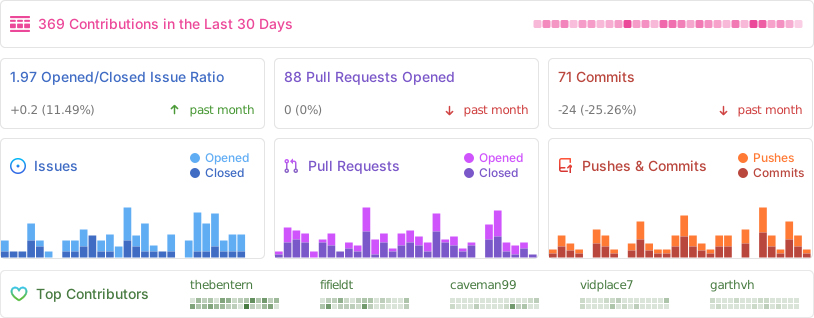
Stats