mirror of
https://github.com/meshtastic/firmware.git
synced 2026-10-04 20:25:44 -04:00
 0eaad08735
* Fix T1000-E QMA6100P I2C probing

* Refactored to make generic

* address copilot comments

* fix(i2c): address copilot comments on QMA6100P scanning and hardware init

- ScanI2CTwoWire: gate bounded QMA6100P probing to addresses 0x12/0x13 only
  (Copilot comment: avoid blocking other I2C device detection on nRF52)
  Falls back to normal Wire probing for all other addresses, allowing BMM150
  and other devices at overlapping addresses to be properly detected.

- Nrf52Twim: suppress cppcheck redundantAssignment on ENABLE register write
  (intentional disable→configure→enable pattern for hardware safety; explicit
  disable ensures known state before configuration even if already disabled)

Co-Authored-By: Claude Haiku 4.5 <noreply@anthropic.com>

* Nrf52Twim: gate on HAS_QMA6100P; suppress cppcheck redundantAssignment

The TWIM helper is only used by the QMA6100P probing path (T1000-E, the sole
board defining HAS_QMA6100P). It was gated only on ARCH_NRF52, so it compiled
as dead code on every other nRF52 board and was analyzed by the rak4631
cppcheck job -- which failed on a redundantAssignment false positive.

Gate the header and source on HAS_QMA6100P so the file is only built/analyzed
where it is actually used. Also keep an inline suppression on the ENABLE
re-assignment (a required volatile disable->reconfigure->enable sequence) for
the case where the T1000-E build is run through cppcheck locally.

Fixes the rak4631 cppcheck CI failure for PR #10713.

Co-Authored-By: Claude Opus 4.8 (1M context) <noreply@anthropic.com>

---------

Co-authored-by: Ben Meadors <benmmeadors@gmail.com>
Co-authored-by: nomdetom <nomdetom@protonmail.com>
Co-authored-by: Tom <116762865+NomDeTom@users.noreply.github.com>
Co-authored-by: Claude Haiku 4.5 <noreply@anthropic.com>

Meshtastic Firmware




Overview
This repository contains the official device firmware for Meshtastic, an open-source LoRa mesh networking project designed for long-range, low-power communication without relying on internet or cellular infrastructure. The firmware supports various hardware platforms, including ESP32, nRF52, RP2040/RP2350, and Linux-based devices.
Meshtastic enables text messaging, location sharing, and telemetry over a decentralized mesh network, making it ideal for outdoor adventures, emergency preparedness, and remote operations.
Get Started
- 🔧 Building Instructions – Learn how to compile the firmware from source.
- ⚡ Flashing Instructions – Install or update the firmware on your device.
Join our community and help improve Meshtastic! 🚀
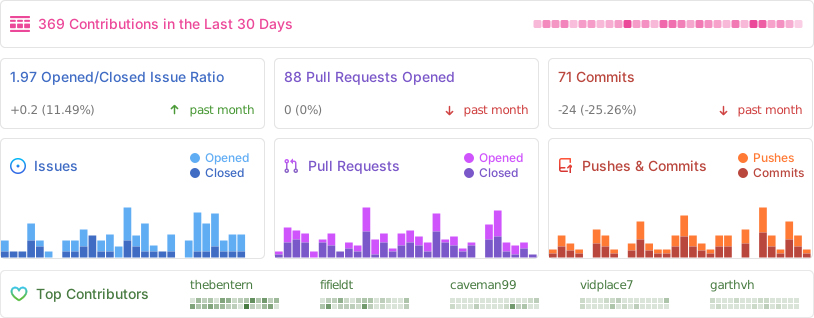
Stats