mirror of
https://github.com/meshtastic/firmware.git
synced 2026-10-02 19:25:29 -04:00
 87f1f9d349
Router::handleReceived stores its allocCopy of the encrypted packet in the
class member p_encrypted. callModules() invokes module replies that re-enter
the router via MeshService::sendToMesh -> Router::sendLocal, which on a
broadcast reply recursively calls handleReceived. The inner call overwrites
the outer's p_encrypted without releasing it; on the way out it nulls the
member, the outer release(p_encrypted) now releases nullptr, and the original
allocation is permanently leaked. ~381 B per recursion.

Promote p_encrypted to a function-local so each invocation owns its own copy
for its full lifetime. The MQTT-publish null check at the call site (added by
PR #9136 as a workaround for this bug) stays in place because allocCopy can
still legitimately return nullptr on packetPool exhaustion.

Copilot's review of PR #8999 (the original introduction) flagged this exact
pattern at merge time:
  "Storing p_encrypted as a class member can cause issues with recursive or
  concurrent calls to handleReceived() since each call would overwrite the
  previous packet pointer."

The historical reason for the member (S&F needing to retain the encrypted
copy across calls) was satisfied differently by PR #9799 (ServerAPI converted
to std::unique_ptr + cleanup on connection close), so the member is no longer
load-bearing.

Reproduces issues #9632 / #10101 / #8729 (heap leak when MeshMonitor
connected; TCP drops on Station G2 / LILYGO ServerAPI dump abort).

Hardware A/B on Station G2 under sustained TCP-API retry storm (open :4403,
request config, disconnect mid-stream, repeat at ~0.6/s) - 9 min run:

  | Build         | heapFree drift | rebootCount delta |
  | this patch    | -1.5 KB (noise)| 0                 |
  | stock 2.7.13  | -73 KB (8.1KB/min) | +1 (OOM crash) |

Co-authored-by: Claude Opus 4.7 <noreply@anthropic.com>
Co-authored-by: Ben Meadors <benmmeadors@gmail.com>

Meshtastic Firmware




Overview
This repository contains the official device firmware for Meshtastic, an open-source LoRa mesh networking project designed for long-range, low-power communication without relying on internet or cellular infrastructure. The firmware supports various hardware platforms, including ESP32, nRF52, RP2040/RP2350, and Linux-based devices.
Meshtastic enables text messaging, location sharing, and telemetry over a decentralized mesh network, making it ideal for outdoor adventures, emergency preparedness, and remote operations.
Get Started
- 🔧 Building Instructions – Learn how to compile the firmware from source.
- ⚡ Flashing Instructions – Install or update the firmware on your device.
Join our community and help improve Meshtastic! 🚀
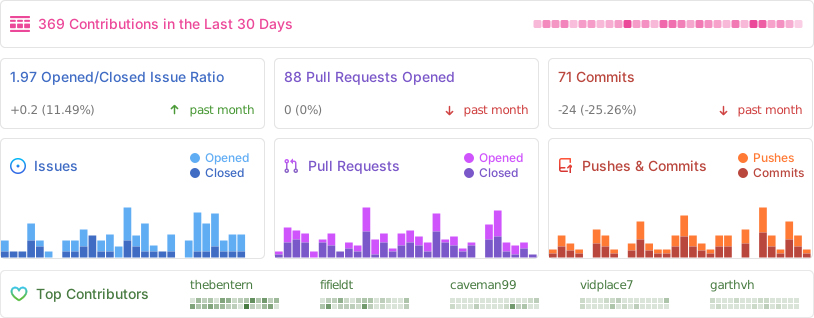
Stats