 Zoltan Kochan
05129e1fd2
Zoltan Kochan
05129e1fd2
The Rust release built the CLI binary and the NAPI addon back to back in
one matrix leg per target. The two are compiled under different Cargo
profiles — `release` for the CLI, `napi-release` for the addon, which
must keep `panic = "unwind"` so a panic reaching the FFI boundary becomes
a JS exception instead of aborting the host node process. Different
profile means a different target directory, so the two builds shared not
one compiled dependency: every leg paid for the whole graph twice, in
series.

Split the addon into its own `build-rust-napi` matrix over the same eight
targets. Measured on the 12.0.0-rc.9 release run, per-leg build time was:

  target             CLI     addon    leg
  win32-arm64        508s    369s     17m09s
  win32-x64          495s    363s     15m06s
  darwin-arm64       477s    241s     12m30s
  darwin-x64         461s    235s     12m10s
  linux-*        322-351s  217-238s   ~10m

The stage is bounded by its slowest leg, so dropping the addon out of
win32-arm64 takes the critical path from ~17 to ~11 minutes and the whole
release run from ~25m30s to roughly 19 minutes. The addon legs run
alongside and gate nothing.

Downstream needs no changes: the new job uploads to
`binaries-rust-napi-<code-target>`, which the `binaries-rust-*` download
pattern the verify, publish and draft-release jobs already use picks up
and merges into the same directory. It is also free of the node-gyp
payload dependency, since only the CLI archives ship `dist/`.

The toolchain prelude the two jobs share — installing cross, the
clang-cl/ARM64 Visual Studio components, the rustup target, and the guard
that the committed PNPM_VERSION matches the tag — moves into a
`rust-release-target` composite action rather than being duplicated.
zizmor flags that action's writes to GITHUB_ENV/GITHUB_PATH because a
composite action cannot see who calls it; the values come from the
Visual Studio install and `vcvarsall`, and the only caller is a release
job running on a maintainer-signed tag, so the audit is suppressed on
that step with that justification.
简体中文 | 日本語 | 한국어 | Italiano | Português Brasileiro

Fast, disk space efficient package manager:
- Fast. Up to 2x faster than the alternatives (see benchmark).
- Efficient. Files inside
node_modulesare linked from a single content-addressable storage. - Great for monorepos.
- Strict. A package can access only dependencies that are specified in its
package.json. - Deterministic. Has a lockfile called
pnpm-lock.yaml. - Works as a Node.js version manager. See pnpm runtime.
- Works everywhere. Supports Windows, Linux, and macOS.
- Battle-tested. Used in production by teams of all sizes since 2016.
- Experimental Rust port. Includes pacquet, an experimental port of the CLI written in Rust.
- See the full feature comparison with npm and Yarn.
To quote the Rush team:
Microsoft uses pnpm in Rush repos with hundreds of projects and hundreds of PRs per day, and we’ve found it to be very fast and reliable.



Platinum Sponsors

|

|

|
Gold Sponsors

|

|

|

|

|

|

|

|

|
Silver Sponsors

|

|

|

|

|

|

|

|
|
| ⏱️ Time.now |
Support this project by becoming a sponsor.
Background
pnpm uses a content-addressable filesystem to store all files from all module directories on a disk. When using npm, if you have 100 projects using lodash, you will have 100 copies of lodash on disk. With pnpm, lodash will be stored in a content-addressable storage, so:
- If you depend on different versions of lodash, only the files that differ are added to the store.
If lodash has 100 files, and a new version has a change only in one of those files,
pnpm updatewill only add 1 new file to the storage. - All the files are saved in a single place on the disk. When packages are installed, their files are linked from that single place consuming no additional disk space. Linking is performed using either hard-links or reflinks (copy-on-write).
As a result, you save gigabytes of space on your disk and you have a lot faster installations!
If you'd like more details about the unique node_modules structure that pnpm creates and
why it works fine with the Node.js ecosystem, read this small article: Flat node_modules is not the only way.
💖 Like this project? Let people know with a tweet
Getting Started
Benchmark
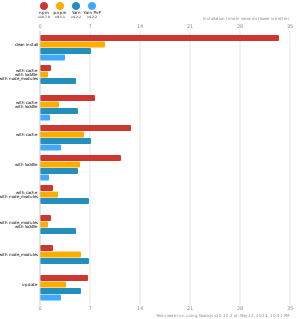
pnpm is up to 2x faster than npm and Yarn classic. See all benchmarks here.
Benchmarks on an app with lots of dependencies:
License
MIT, except the pnpr/ directory, which is source-available under the PolyForm Shield License 1.0.0.