097983fbca
Two changes ship together: the bulk is the pacquet refactor described in #11756, plus a TypeScript-side fix to `@pnpm/config.pick-registry-for-package` that surfaced during review.

### Pacquet — wire NpmResolver into install (Phases A/B/C of #11756)

- **Phase A.** New `parse_bare_specifier.rs` and `npm_resolver.rs` in `pacquet-resolving-npm-resolver`. `NpmResolver` implements the `Resolver` trait: parses the bare specifier (including npm-alias `npm:@scope/name@<spec>` and tarball-URL forms — with prefix-anchored name validation), picks a version via `pick_package`, surfaces `minimumReleaseAge` violations inline via `detect_min_release_age_violation`. `workspace:` specs decline so the chain falls through. `published_by` / `published_by_exclude` / `dry_run` added to `ResolveOptions`.
- **Phase B.** `install_without_lockfile.rs` constructs an `NpmResolver` at install entry from the config-derived registries map and an `InMemoryPackageMetaCache` that's shared across the resolve pass and dropped before the install pass.
- **Phase C.** New `pacquet-resolving-deps-resolver` crate exposes `resolve_dependency_tree`: a flat `name@version`-keyed package map with parent-child edges, concurrent sibling resolution via `try_join_all`, per-id dedup gate. `install_package_from_registry.rs` no longer calls `Package::fetch_from_registry` / `Package::pinned_version`; it takes a pre-resolved `ResolveResult` and reads tarball URL + integrity off `LockfileResolution::Tarball`.

Additional behaviors landed during review:

- **`minimumReleaseAge` policy in the resolve pass.** Previously only enforced by the lockfile-verification gate; the no-lockfile resolve pass now derives `published_by` and the exclude policy from `Config` so resolver-time picks match the configured policy.
- **`SPEC_NOT_SUPPORTED_BY_ANY_RESOLVER` surfaces correctly.** `resolve_dependency_tree` now returns a typed error when the chain returns `Ok(None)` — silently dropping the edge would leave installs missing transitive deps. Mirrors upstream's `default-resolver` error shape.
- **Per-package progress events.** `InstallPackageFromRegistry` takes a `first_visit: bool`; `pnpm:progress resolved` / `pnpm:progress imported` plus the tarball download fire once per `(name, version)`, while the per-parent `symlink_package` runs on every edge. Matches upstream's per-package (not per-edge) reporter contract.
- **Windows symlink race fix.** `ResolvedPackages` is now `DashMap<String, watch::Sender<bool>>`; the first writer signals completion after `import_indexed_dir`, so a second visitor's `symlink_package` (which may fall back to a Windows junction requiring an existing target) doesn't race ahead of the materialization. A dropped first-writer task surfaces as a typed `FirstWriterAborted` error.
- **Scope routing.** `pick_registry_for_package` is now bareSpecifier-aware so an entry like `"foo": "npm:@acme/bar@^1"` routes through `registries[@acme]`.

### TS — `@pnpm/config.pick-registry-for-package` unscoped-target fix

A separate bug surfaced during the scope-routing port: `pickRegistryForPackage('@private/foo', 'npm:lodash@^1')` was routing through `registries['@private']`, even though `lodash` is unscoped and doesn't live on the `@private` registry. `getScope` now returns `null` in the npm-alias branch when the alias target is unscoped (instead of falling through to the local pkgName's scope). Changeset is in `.changeset/pick-registry-unscoped-npm-alias.md` (patch bump for `@pnpm/config.pick-registry-for-package` and `pnpm`). Added matching tests on both the TS and pacquet sides.

### Out of scope (left as #11756 follow-ups)

- Preferred-versions harvesting from the lockfile (Phase D).
- Install-side aggregation of `policy_violation` from the tree (Phase E) — the resolver attaches them per-pick already, but the install layer doesn't yet collect or fail on them.
- Other-protocol resolvers (git, tarball, workspace, jsr, named-registry, …) — `NpmResolver` is the only chain entry today; once a second resolver lands, `DefaultResolver` will get wired in too.
- Full `parseBareSpecifier.test.ts` corpus port — the parser tests pacquet ships cover the cases the install path exercises; remaining corpus items land alongside Phase F.

Closes part of #11756.
简体中文 | 日本語 | 한국어 | Italiano | Português Brasileiro

Fast, disk space efficient package manager:
- Fast. Up to 2x faster than the alternatives (see benchmark).
- Efficient. Files inside
node_modulesare linked from a single content-addressable storage. - Great for monorepos.
- Strict. A package can access only dependencies that are specified in its
package.json. - Deterministic. Has a lockfile called
pnpm-lock.yaml. - Works as a Node.js version manager. See pnpm runtime.
- Works everywhere. Supports Windows, Linux, and macOS.
- Battle-tested. Used in production by teams of all sizes since 2016.
- See the full feature comparison with npm and Yarn.
To quote the Rush team:
Microsoft uses pnpm in Rush repos with hundreds of projects and hundreds of PRs per day, and we’ve found it to be very fast and reliable.



Platinum Sponsors

|
Gold Sponsors

|

|

|

|

|

|

|

|
Silver Sponsors

|

|

|

|

|

|

|
⏱️ Time.now |
Support this project by becoming a sponsor.
Background
pnpm uses a content-addressable filesystem to store all files from all module directories on a disk. When using npm, if you have 100 projects using lodash, you will have 100 copies of lodash on disk. With pnpm, lodash will be stored in a content-addressable storage, so:
- If you depend on different versions of lodash, only the files that differ are added to the store.
If lodash has 100 files, and a new version has a change only in one of those files,
pnpm updatewill only add 1 new file to the storage. - All the files are saved in a single place on the disk. When packages are installed, their files are linked from that single place consuming no additional disk space. Linking is performed using either hard-links or reflinks (copy-on-write).
As a result, you save gigabytes of space on your disk and you have a lot faster installations!
If you'd like more details about the unique node_modules structure that pnpm creates and
why it works fine with the Node.js ecosystem, read this small article: Flat node_modules is not the only way.
💖 Like this project? Let people know with a tweet
Getting Started
Benchmark
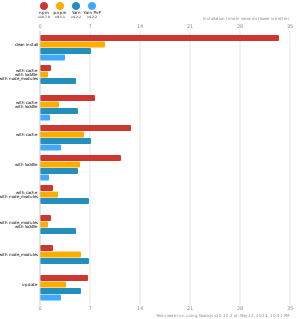
pnpm is up to 2x faster than npm and Yarn classic. See all benchmarks here.
Benchmarks on an app with lots of dependencies: