Zoltan Kochan
0cefccf158
Zoltan Kochan
0cefccf158
* feat(registry): persist pnpr users and tokens to disk

Backs UserStore with a verdaccio-shaped htpasswd file (bcrypt $2y$
hashes, atomically rewritten on every adduser) and TokenStore with a
SQLite database that stores SHA-256 token hashes plus the per-record
fields the upcoming /-/npm/v1/tokens surface will need (created_at,
last_used_at, readonly, cidr_whitelist).

Configuration mirrors verdaccio's auth.htpasswd.{file,max_users}
under the existing YAML schema; tokens default to a tokens.db
sibling of htpasswd, overridable via auth.tokens.file. max_users=-1
disables registration end-to-end. Both files are written via
tmp+rename and loaded eagerly on startup so a malformed htpasswd
fails fast rather than booting with a silent empty user list.

Closes #11974.

* fix(registry): use OS CSPRNG, satisfy dylint + rustdoc

- TokenStore's per-process secret now comes from getrandom (OS-backed
  CSPRNG) instead of time/pid/stack address. Tokens are derived from
  this secret + a per-issue nonce, so weak entropy was making mint
  outputs guessable to an attacker who could bound those inputs.
- Reorder derives on AuthConfig / HtpasswdConfig / TokensConfig /
  MaxUsers to satisfy perfectionist::derive-ordering (prefix-then-
  alphabetical: Debug, Default first, then the rest).
- Re-export auth::identify so the rustdoc link from the now-public
  UserStore::verify resolves; rustdoc::private-intra-doc-links no
  longer fails the workspace doc build.
- Drop the inaccurate "+inf" mention from MaxUsers' doc — serde-saphyr
  treats +inf as a float and can't deserialize it into i64, so the
  only way to get Unlimited is to omit max_users.
简体中文 | 日本語 | 한국어 | Italiano | Português Brasileiro

Fast, disk space efficient package manager:
- Fast. Up to 2x faster than the alternatives (see benchmark).
- Efficient. Files inside
node_modulesare linked from a single content-addressable storage. - Great for monorepos.
- Strict. A package can access only dependencies that are specified in its
package.json. - Deterministic. Has a lockfile called
pnpm-lock.yaml. - Works as a Node.js version manager. See pnpm runtime.
- Works everywhere. Supports Windows, Linux, and macOS.
- Battle-tested. Used in production by teams of all sizes since 2016.
- See the full feature comparison with npm and Yarn.
To quote the Rush team:
Microsoft uses pnpm in Rush repos with hundreds of projects and hundreds of PRs per day, and we’ve found it to be very fast and reliable.



Platinum Sponsors

|
Gold Sponsors

|

|

|

|

|

|

|

|
Silver Sponsors

|

|

|

|

|

|
|
⏱️ Time.now |
Support this project by becoming a sponsor.
Background
pnpm uses a content-addressable filesystem to store all files from all module directories on a disk. When using npm, if you have 100 projects using lodash, you will have 100 copies of lodash on disk. With pnpm, lodash will be stored in a content-addressable storage, so:
- If you depend on different versions of lodash, only the files that differ are added to the store.
If lodash has 100 files, and a new version has a change only in one of those files,
pnpm updatewill only add 1 new file to the storage. - All the files are saved in a single place on the disk. When packages are installed, their files are linked from that single place consuming no additional disk space. Linking is performed using either hard-links or reflinks (copy-on-write).
As a result, you save gigabytes of space on your disk and you have a lot faster installations!
If you'd like more details about the unique node_modules structure that pnpm creates and
why it works fine with the Node.js ecosystem, read this small article: Flat node_modules is not the only way.
💖 Like this project? Let people know with a tweet
Getting Started
Benchmark
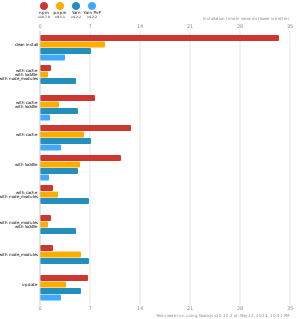
pnpm is up to 2x faster than npm and Yarn classic. See all benchmarks here.
Benchmarks on an app with lots of dependencies: