0cf64b76eb
* fix: skip Content-Length check when response is content-encoded

Per the HTTP spec, Content-Length refers to the encoded payload when
Content-Encoding is set, but undici fetch yields decoded bytes — so the
strict size check rejected legitimate downloads with
ERR_PNPM_BAD_TARBALL_SIZE. Closes #11506.

* fix(tarball-fetcher): match v10's no-compression behavior

Verified the user's report against v10 source: v10 worked because it
called node-fetch with `compress: false` (network/fetch/src/fetchFromRegistry.ts
on the v10 branch), which suppressed Accept-Encoding and prevented
auto-decompression. v11's switch to undici fetch lost that opt-out — undici
sends Accept-Encoding: gzip, deflate, br by default and transparently
decodes the body, while keeping Content-Length pointed at the encoded
payload (confirmed empirically). The strict size check then rejects the
download.

Restore v10's effective behavior by sending Accept-Encoding: identity for
tarball requests, and as defense in depth against misbehaving servers
that stamp Content-Encoding regardless, skip the strict size check when
the response declares a non-identity Content-Encoding.

* fix(tarball-fetcher): parse Content-Encoding as a coding list

Per RFC 9110 §8.4 the header is a comma-separated, case-insensitive list
that may include whitespace and mixed codings (e.g. `gzip, identity`).
The previous string-equality check misclassified those — the response is
now treated as encoded iff any coding is non-`identity`.
简体中文 | 日本語 | 한국어 | Italiano | Português Brasileiro

Fast, disk space efficient package manager:
- Fast. Up to 2x faster than the alternatives (see benchmark).
- Efficient. Files inside
node_modulesare linked from a single content-addressable storage. - Great for monorepos.
- Strict. A package can access only dependencies that are specified in its
package.json. - Deterministic. Has a lockfile called
pnpm-lock.yaml. - Works as a Node.js version manager. See pnpm runtime.
- Works everywhere. Supports Windows, Linux, and macOS.
- Battle-tested. Used in production by teams of all sizes since 2016.
- See the full feature comparison with npm and Yarn.
To quote the Rush team:
Microsoft uses pnpm in Rush repos with hundreds of projects and hundreds of PRs per day, and we’ve found it to be very fast and reliable.



Platinum Sponsors

|
Gold Sponsors

|

|

|

|

|

|

|

|
Silver Sponsors

|

|

|

|

|

|
|
⏱️ Time.now |
Support this project by becoming a sponsor.
Background
pnpm uses a content-addressable filesystem to store all files from all module directories on a disk. When using npm, if you have 100 projects using lodash, you will have 100 copies of lodash on disk. With pnpm, lodash will be stored in a content-addressable storage, so:
- If you depend on different versions of lodash, only the files that differ are added to the store.
If lodash has 100 files, and a new version has a change only in one of those files,
pnpm updatewill only add 1 new file to the storage. - All the files are saved in a single place on the disk. When packages are installed, their files are linked from that single place consuming no additional disk space. Linking is performed using either hard-links or reflinks (copy-on-write).
As a result, you save gigabytes of space on your disk and you have a lot faster installations!
If you'd like more details about the unique node_modules structure that pnpm creates and
why it works fine with the Node.js ecosystem, read this small article: Flat node_modules is not the only way.
💖 Like this project? Let people know with a tweet
Getting Started
Benchmark
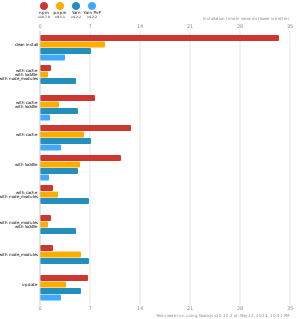
pnpm is up to 2x faster than npm and Yarn classic. See all benchmarks here.
Benchmarks on an app with lots of dependencies: