 159bd27ecb
* feat(pack): port the pnpm pack command to pacquet

Port `pnpm pack` to Rust: create a reproducible gzipped tarball from a
project, running the prepack / prepare / postpack lifecycle scripts,
building the publish manifest, computing the file list, and writing the
archive.

- Extract npm-packlist into a shared `pacquet-fs-packlist` crate so the
  git and directory fetchers and the new pack command share one copy,
  matching pnpm's standalone `@pnpm/fs.packlist` package.
- Extend `pacquet-exportable-manifest` with the full
  createExportableManifest: manifest obfuscation, workspace / catalog /
  jsr specifier rewriting, publishConfig hoisting, README embedding, and
  the bin / peerDependenciesMeta / repository transform.
- Add the `pacquet-pack` crate (single-project api plus JSON / text
  output) and wire `pacquet pack` into the CLI, including the recursive
  (-r) workspace sweep in topological order.

The dependency-converter composition is a straight function sequence
rather than upstream's higher-order combineConverters, and the tarball
write phase uses the capability-trait DI seam (a Host provider plus Fs*
traits) so its filesystem error branches stay testable without
process-global mutation.

Ported from
https://github.com/pnpm/pnpm/blob/cab1c11c69/releasing/commands/src/publish/pack.ts
https://github.com/pnpm/pnpm/blob/ef87f3ccff/releasing/exportable-manifest/src/index.ts

Co-Authored-By: Claude Opus 4.8 <noreply@anthropic.com>
Claude-Session: https://claude.ai/code/session_01G4k3hPXaosUkKBPbnChg4q

* style(pack): rustfmt the pack test fixture

Apply `cargo fmt` to the `fixture` helper's `package.json` write, which
drifted after a manual edit. No behavior change.

Co-Authored-By: Claude Opus 4.8 <noreply@anthropic.com>
Claude-Session: https://claude.ai/code/session_01G4k3hPXaosUkKBPbnChg4q

* style(exportable-manifest): satisfy perfectionist dylint lints

- Add trailing commas to two multi-line macro invocations in the
  transform tests (perfectionist::macro_trailing_comma).
- Replace a Unicode ellipsis with ASCII "..." in a create.rs doc
  comment (perfectionist::unicode_ellipsis_in_docs).

Co-Authored-By: Claude Opus 4.8 <noreply@anthropic.com>
Claude-Session: https://claude.ai/code/session_01G4k3hPXaosUkKBPbnChg4q

* style(pacquet): satisfy perfectionist single-letter and layout lints

- Rename the reporter generic `R` to `Reporter` (bounded `self::Reporter`)
  in pack's `api` / `run_scripts_if_present` and the CLI `pack` command,
  matching the convention already used in executor, git-fetcher, and
  package-manager (perfectionist::single_letter_generic).
- Rename `locale_compare_en`'s `a` / `b` parameters to `left` / `right`
  (perfectionist::single_letter_function_param).
- Move the inline `transform` test module into an external
  `transform/tests.rs` (perfectionist::unit_test_file_layout).

Co-Authored-By: Claude Opus 4.8 <noreply@anthropic.com>
Claude-Session: https://claude.ai/code/session_01G4k3hPXaosUkKBPbnChg4q

* test(pack): cover the prepack/prepare/postpack lifecycle path

Port pnpm's `pack: runs prepack, prepare, and postpack`
(releasing/commands/test/publish/pack.ts) so `run_scripts_if_present`
and `script_body` are exercised. The existing pack tests all pass
`ignore_scripts: true`, so that branch was never entered.

- runs_prepack_prepare_and_postpack (Unix-gated, like the executor's
  other script-running tests): with scripts enabled, each of prepack /
  prepare / postpack runs and leaves a marker file.
- pack_succeeds_when_scripts_enabled_but_absent: an empty `prepack`
  makes `script_body` yield `None` and `run_scripts_if_present` return
  early, so packing still succeeds without shelling out.

Co-Authored-By: Claude Opus 4.8 <noreply@anthropic.com>
Claude-Session: https://claude.ai/code/session_01G4k3hPXaosUkKBPbnChg4q

* test(pack): port bundleDependencies, custom-directory, and peer/jsr tests

Port the in-scope pnpm pack / createExportableManifest tests that close
coverage holes in this PR's new code:

- pack: bundleDependencies (array) and bundleDependencies: true cover the
  fs-packlist bundle recursion and the node_linker: hoisted allow-path.
- pack: publishConfig.directory covers reading the manifest from the
  build-output dir while resolving workspace: deps against the project
  root's node_modules.
- createExportableManifest: a peerDependencies workspace: rewrite and a
  jsr: specifier without a version selector.

Ported from releasing/commands/test/publish/pack.ts and
releasing/exportable-manifest/test/index.test.ts.

Co-Authored-By: Claude Opus 4.8 <noreply@anthropic.com>
Claude-Session: https://claude.ai/code/session_01G4k3hPXaosUkKBPbnChg4q

* docs(pack): pin pack.ts source citations to a valid commit

The `cab1c11c69` SHA the crate docs referenced does not exist upstream.
Repoint every `pack.ts` source link in `pack`'s module docs to
`54c5c0e028`, where pnpm's releasing command now lives under
`pnpm11/releasing/commands/...`, so the citations resolve.

* test(pack): port the transitive bundleDependencies pack test

Port pnpm's `pack: bundles transitive dependencies of bundled
dependencies (hoisted)` test. `top` is the only directly-bundled
package, but it depends on `nested`, which is hoisted to the root
`node_modules`; both must end up in the tarball. This exercises
`fs-packlist`'s transitive bundled-closure walk that landed via
pnpm/pnpm#12620 (resolving pnpm/pnpm#12602) and arrived on this branch
through the latest merge from `main`.

Also repoint the existing pack-test citations to the valid
`54c5c0e028` SHA, matching the docs fix in the surrounding crate.

* docs(cli): document the pacquet pack command

Add a `pacquet pack` section to the CLI README listing its flag support
(`--dry-run`, `--pack-destination`, `--json`, `--out`,
`--pack-gzip-level`, `--skip-manifest-obfuscation`, recursive mode), so
the new command ships with the same flag-status table the other
commands carry. Also pin the last `pack.ts` citation in `cli_args/pack`
to the valid `54c5c0e028` SHA, matching the rest of the crate.

* test(pack): assert the empty-prepack guard skips, not just succeeds

Mutation-testing the pack tests surfaced that
`pack_succeeds_when_scripts_enabled_but_absent` did not actually guard
the behavior its name and doc claim. It asserted only that packing
succeeds with an empty `prepack` script — but an empty lifecycle script
runs as a successful no-op, so removing `script_body`'s
`.filter(|s| !s.is_empty())` left the test green while the empty script
was now executed.

Record the emitted log events with the crate's `RecordingReporter`
idiom and assert no `pnpm:lifecycle` event fires, pinning the "returns
early without shelling out" half of the contract. With the empty-string
filter removed the empty `prepack` shells out and emits a lifecycle
event, so the test now fails — making it a real regression guard for
`script_body`.

* fix(pack): align manifest validation with pnpm and harden license injection

Address review feedback on the pack port:

- Validate `--pack-gzip-level` against 0-9 at the CLI boundary.
- Skip recursive-pack targets whose name/version are empty strings, so
  they match the pacquet_pack::api precondition.
- Stop coercing a non-object peerDependencies into an empty object in
  create_exportable_manifest; leave it in place like the other dep
  fields.
- Gate transform_required_fields on JavaScript truthiness to match
  upstream's `if (!manifest.name)` check instead of requiring a
  non-empty string.
- Gate the bundledDependencies guard on JS truthiness so an explicit
  `false` packs cleanly under the default non-hoisted linker.
- Only inject a workspace LICENSE when the entry resolves to a regular
  file, mirroring fast-glob's onlyFiles default and avoiding an "Is a
  directory" failure in the later read/size pass.

* fix(pack): skip symlinked workspace LICENSE to prevent file leakage

A symlinked workspace-root LICENSE was followed via fs::metadata, so a
symlink pointing outside the workspace could leak its target's bytes
into a sub-package's tarball. Use DirEntry::file_type (which does not
follow symlinks) so only a regular file is injected, mirroring the
symlink-skipping read_readme_file in exportable-manifest. Add a unix
regression test.

Also pin the empty-string version case in the required-field truthiness
test.

* fix(pack): write the tarball atomically to avoid symlink-redirected overwrite

Host::write used std::fs::write, which follows a symlink at the output
path and truncates in place. A repo-controlled symlink planted at the
tarball's output path could therefore redirect the write to clobber an
arbitrary file, and a crash mid-write could leave a truncated .tgz.

Write a sibling temp file, fsync it, then rename it over the target.
The rename replaces a symlink instead of following it and is atomic,
matching the write-file-atomic pattern pacquet-package-manifest already
uses for package.json. The mode is preserved on overwrite (else 0o644)
so the archive is not left owner-only. Add a unix regression test.

* fix(pack): reject path-traversal in version and main/bin packlist fields

Two manifest-controlled path-escape vectors, since manifests are
attacker-controlled per REVIEW_GUIDE:

- pacquet-pack interpolated the version into the default tarball name
  (<name>-<version>.tgz) after only a non-empty check, so a version
  containing a path separator could write the tarball outside the
  destination directory. Reject a version with a / or \.

- pacquet-fs-packlist force-included main/bin after only stripping a
  leading ./ or /, so ../secret (or a Windows drive/UNC path) escaped
  the package root and was read into the tarball/CAS — the packlist
  also feeds the git fetcher on untrusted packages. Require the
  normalized field to stay inside the package (only normal components,
  no backslash) and to be a regular file via symlink_metadata so a
  symlinked main/bin can't leak an out-of-tree target.

Add regression tests for both.

* fix(pack): reject --out with --pack-destination in recursive mode

Recursive pack resolved a shared destination before `api` ran, so the
`--out` branch silently dropped `pack_destination` and the mutually-
exclusive pair was accepted — unlike single-project pack, which rejects
it with ERR_PNPM_INVALID_OPTION. Validate the pair up front in the
recursive path so both modes behave the same.

* fix(pack): stream the tarball, honor unsafe_perm, and harden output

Address the remaining Qodo findings on the pack port:

- Stream the gzip+tar archive into the atomic temp file instead of
  buffering the whole archive in a Vec, so peak memory no longer scales
  with the packed size. Per-file reads stay in memory, matching pnpm's
  readFileSync. The FsWrite seam becomes FsAtomicWrite, taking a
  streaming write body.
- Thread Config.unsafe_perm into PackOptions instead of hardcoding
  unsafe_perm = true for prepack/prepare/postpack, so packing honors the
  same policy (and TMPDIR isolation) as pnpm.
- Strip control characters from the text pack output, so a filename with
  raw ANSI escapes can't spoof the terminal. JSON output is left as data.
- Reject an --out value that resolves to no file name (., .., "") up
  front instead of failing later with a confusing OS write error.
- Sort the contents list with one cached lowercase key per item instead
  of recomputing to_lowercase on both sides per comparison, and check
  bin executability against a HashSet instead of a linear scan.

Add regression tests for the --out and control-character cases.

* fix(pack): canonicalize main/bin containment and harden tarball mode

Two follow-ups from review:

- The main/bin force-include verified containment only on the path
  string, so an intermediate symlinked directory (subdir -> /outside)
  could still resolve a host file into the packlist. Verify the
  canonical resolved path is strictly inside the canonical package root
  instead, which also follows symlinks that stay in-package (matching
  npm-packlist) while failing closed on any escape.
- The atomic tarball write read the destination's mode with metadata
  (follows symlinks), so a symlink at the output path could donate its
  target's or a directory's mode to the archive. Use symlink_metadata
  and only inherit from an existing regular file, and set the mode
  before syncing so content and metadata flush together.

* test(package-manager): adapt patch-commit escape test to packlist filtering

Hardening the shared packlist to drop `..`-escaping main/bin fields
means patch-commit's `prepare_pkg_files_for_diff` no longer receives an
escaping entry, so the old integration test's `expect_err` no longer
fires. Unit-test patch-commit's own `safe_package_file_path` guard
directly (defense in depth), and rework the integration test to assert
the escaping `main` is filtered and never materialized into the diff
view.

---------

Co-authored-by: Claude <noreply@anthropic.com>
Co-authored-by: Zoltan Kochan <z@kochan.io>
简体中文 | 日本語 | 한국어 | Italiano | Português Brasileiro

Fast, disk space efficient package manager:
- Fast. Up to 2x faster than the alternatives (see benchmark).
- Efficient. Files inside
node_modulesare linked from a single content-addressable storage. - Great for monorepos.
- Strict. A package can access only dependencies that are specified in its
package.json. - Deterministic. Has a lockfile called
pnpm-lock.yaml. - Works as a Node.js version manager. See pnpm runtime.
- Works everywhere. Supports Windows, Linux, and macOS.
- Battle-tested. Used in production by teams of all sizes since 2016.
- Experimental Rust port. Includes pacquet, an experimental port of the CLI written in Rust.
- See the full feature comparison with npm and Yarn.
To quote the Rush team:
Microsoft uses pnpm in Rush repos with hundreds of projects and hundreds of PRs per day, and we’ve found it to be very fast and reliable.



Platinum Sponsors

|

|
Gold Sponsors

|

|

|

|

|

|

|

|
Silver Sponsors

|

|

|

|

|

|

|

|

|
| ⏱️ Time.now |
Support this project by becoming a sponsor.
Background
pnpm uses a content-addressable filesystem to store all files from all module directories on a disk. When using npm, if you have 100 projects using lodash, you will have 100 copies of lodash on disk. With pnpm, lodash will be stored in a content-addressable storage, so:
- If you depend on different versions of lodash, only the files that differ are added to the store.
If lodash has 100 files, and a new version has a change only in one of those files,
pnpm updatewill only add 1 new file to the storage. - All the files are saved in a single place on the disk. When packages are installed, their files are linked from that single place consuming no additional disk space. Linking is performed using either hard-links or reflinks (copy-on-write).
As a result, you save gigabytes of space on your disk and you have a lot faster installations!
If you'd like more details about the unique node_modules structure that pnpm creates and
why it works fine with the Node.js ecosystem, read this small article: Flat node_modules is not the only way.
💖 Like this project? Let people know with a tweet
Getting Started
Benchmark
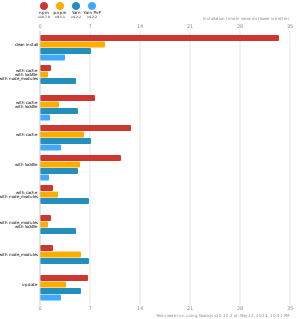
pnpm is up to 2x faster than npm and Yarn classic. See all benchmarks here.
Benchmarks on an app with lots of dependencies:
License
MIT, except the pnpr/ directory, which is source-available under the PolyForm Shield License 1.0.0.