 Zoltan Kochan
1e83fc5f8b
Zoltan Kochan
1e83fc5f8b
Add Cargo and Python registry protocols to pnpr. Concrete registries declare
an ecosystem, and routing filters mixed router sources by the requested
protocol. Ecosystem prefixes provide default and named registry endpoints
while preserving the original npm aliases.

Reuse hosted document and blob storage, package access rules, upstream
metadata caching, and verified artifact streaming across the new surfaces.
Keep upstream artifact cache identities bound to metadata checksums. Check
metadata before cache lookup so changed or removed entries take effect.

Honor package-specific Cargo privacy rules when advertising auth-required.
Require authentication before reading Python upload bodies. Bound multipart
boundaries and use the existing regex crate for delimiter searches, checking
boundary suffixes so binary lookalikes remain part of the uploaded file.
Reject Cargo archive traversal, links, oversized decompressed streams, and
manifests whose package identity differs from the publication metadata.
Reject package configuration keys that collide after normalization.

Apply route allowlists to Cargo and Python metadata and artifact fetches,
including redirects. Require secure same-origin destinations for configured
headers. Rebuild headers on every approved redirect so cross-origin metadata
and artifact downloads succeed without forwarding upstream credentials.
Share this redirect loop with the existing network metadata fetcher and retain
its request-budget guard while response bodies are read. Transfer permits to
streamed artifact responses so body consumption or cancellation releases them.
Keep one pnpr timeout budget across redirects and the final response body.
Stream through a bounded producer whose deadline runs independently of
downstream polling. Reject hosted Python blobs absent from publication metadata.

Abort publication on an immutable object-store conflict and remove the
conflicting staged file. The filesystem backend remains single-writer;
replicated deployments use the object-store backend. Journaled publication
across all registry surfaces remains tracked in pnpm/pnpm#14599.

Add protocol unit tests and HTTP regressions for publication, routing,
authentication, content negotiation, caching, and integrity validation.
简体中文 | 日本語 | 한국어 | Italiano | Português Brasileiro

Fast, disk space efficient package manager:
- Fast. Up to 2x faster than the alternatives (see benchmark).
- Efficient. Files inside
node_modulesare linked from a single content-addressable storage. - Great for monorepos.
- Strict. A package can access only dependencies that are specified in its
package.json. - Deterministic. Has a lockfile called
pnpm-lock.yaml. - Works as a Node.js version manager. See pnpm runtime.
- Works everywhere. Supports Windows, Linux, and macOS.
- Battle-tested. Used in production by teams of all sizes since 2016.
- Experimental Rust port. Includes pacquet, an experimental port of the CLI written in Rust.
- See the full feature comparison with npm and Yarn.
To quote the Rush team:
Microsoft uses pnpm in Rush repos with hundreds of projects and hundreds of PRs per day, and we’ve found it to be very fast and reliable.



Platinum Sponsors

|

|

|

|
Gold Sponsors

|

|

|

|

|

|

|

|
Silver Sponsors

|

|

|

|

|

|

|

|
|
| ⏱️ Time.now |
Support this project by becoming a sponsor.
Background
pnpm uses a content-addressable filesystem to store all files from all module directories on a disk. When using npm, if you have 100 projects using lodash, you will have 100 copies of lodash on disk. With pnpm, lodash will be stored in a content-addressable storage, so:
- If you depend on different versions of lodash, only the files that differ are added to the store.
If lodash has 100 files, and a new version has a change only in one of those files,
pnpm updatewill only add 1 new file to the storage. - All the files are saved in a single place on the disk. When packages are installed, their files are linked from that single place consuming no additional disk space. Linking is performed using either hard-links or reflinks (copy-on-write).
As a result, you save gigabytes of space on your disk and you have a lot faster installations!
If you'd like more details about the unique node_modules structure that pnpm creates and
why it works fine with the Node.js ecosystem, read this small article: Flat node_modules is not the only way.
💖 Like this project? Let people know with a tweet
Getting Started
Benchmark
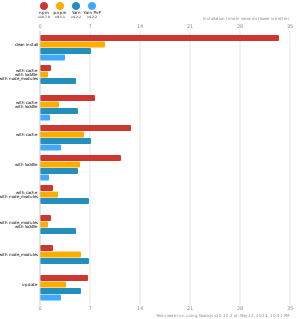
pnpm is up to 2x faster than npm and Yarn classic. See all benchmarks here.
Benchmarks on an app with lots of dependencies:
License
MIT, except the pnpr/ directory, which is source-available under the PolyForm Shield License 1.0.0.