Zoltan Kochan
1fb8a2d5d8
Zoltan Kochan
1fb8a2d5d8
Two fixes that together unlock pnpm-parity on the
`benchmarks.vlt.sh` `lockfile+node_modules` shape — the row where
pacquet was 2-12× slower than pnpm on every fixture.

### 1. `fix(modules-yaml)`: normalise joined `virtualStoreDir`

`read_modules_manifest` joins a stored relative `virtualStoreDir`
with `modules_dir` to recover an absolute path, mirroring upstream's
`path.join(modulesDir, modules.virtualStoreDir)`. Node's `path.join`
normalises interior `..` segments; Rust's `PathBuf::join` does not.
Stored values like `../../../Users/.../store/v11/links` came back
as `<modules_dir>/../../../Users/.../links` — never byte-matched
`Config::effective_virtual_store_dir()`, so the no-op short-circuit
added in #11904 silently missed every install whose store sits
outside the project (the default macOS / Linux setup).

The accompanying refactor lifts `lexical_normalize` (already
duplicated in `cmd-shim` and `store-dir`) into `pacquet-fs` so
`modules-yaml` doesn't make it a third copy.

### 2. `perf(resolving-npm-resolver)`: port the missing verifier layers

The npm resolution verifier walked a 4-layer fallback chain in
upstream pnpm (abbreviated-modified shortcut → on-disk full-meta
mirror → npm attestation endpoint → full packument fetch); pacquet
only had the last two. The module's doc-comment explicitly noted
"Phase 4 stubs the abbreviated-shortcut and on-disk-mirror layers
(no cached fetcher / no mirror yet); Phase 5 ports
`fetchFullMetadataCached.ts`…" — this is Phase 5.

Result: a cold lockfile-verification pass now pays at most one
*abbreviated* GET per name (small payload, decided by package-level
`modified`) instead of a full-meta GET per name (hundreds of KB
each).

## Bench

5-iteration cold-cache measured pass on `vltpkg/benchmarks/fixtures/svelte`
(`pnpm-lock.yaml` + `node_modules` present, `~/.cache/pnpm` and
store wiped before each run), 10-core M-series Mac:

|             |  pnpm  | pacquet@main | this PR |
|-------------|------:|-------------:|--------:|
| wall time   | 0.54 s | 2.16 s       | 0.71 s  |

3.0× faster on the `lockfile+node_modules` row.
简体中文 | 日本語 | 한국어 | Italiano | Português Brasileiro

Fast, disk space efficient package manager:
- Fast. Up to 2x faster than the alternatives (see benchmark).
- Efficient. Files inside
node_modulesare linked from a single content-addressable storage. - Great for monorepos.
- Strict. A package can access only dependencies that are specified in its
package.json. - Deterministic. Has a lockfile called
pnpm-lock.yaml. - Works as a Node.js version manager. See pnpm runtime.
- Works everywhere. Supports Windows, Linux, and macOS.
- Battle-tested. Used in production by teams of all sizes since 2016.
- See the full feature comparison with npm and Yarn.
To quote the Rush team:
Microsoft uses pnpm in Rush repos with hundreds of projects and hundreds of PRs per day, and we’ve found it to be very fast and reliable.



Platinum Sponsors

|
Gold Sponsors

|

|

|

|

|

|

|

|
Silver Sponsors

|

|

|

|

|

|

|
⏱️ Time.now |
Support this project by becoming a sponsor.
Background
pnpm uses a content-addressable filesystem to store all files from all module directories on a disk. When using npm, if you have 100 projects using lodash, you will have 100 copies of lodash on disk. With pnpm, lodash will be stored in a content-addressable storage, so:
- If you depend on different versions of lodash, only the files that differ are added to the store.
If lodash has 100 files, and a new version has a change only in one of those files,
pnpm updatewill only add 1 new file to the storage. - All the files are saved in a single place on the disk. When packages are installed, their files are linked from that single place consuming no additional disk space. Linking is performed using either hard-links or reflinks (copy-on-write).
As a result, you save gigabytes of space on your disk and you have a lot faster installations!
If you'd like more details about the unique node_modules structure that pnpm creates and
why it works fine with the Node.js ecosystem, read this small article: Flat node_modules is not the only way.
💖 Like this project? Let people know with a tweet
Getting Started
Benchmark
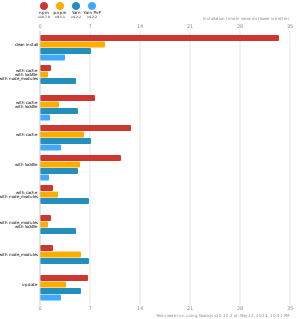
pnpm is up to 2x faster than npm and Yarn classic. See all benchmarks here.
Benchmarks on an app with lots of dependencies: