 Zoltan Kochan
2d30dd6db7
Zoltan Kochan
2d30dd6db7
Packages resolved from a named registry are now keyed
`<name>@<registryName>:<version>` (e.g. `foo@work:1.0.0`) instead of
`<name>@<version>`. Without the qualifier the same name+version served by two
different registries collapsed onto one `packages:` entry, so whichever
resolved first won and the other consumer silently got the wrong tarball.
The lockfile also carried no registry marker at all: entry lookup keys on
`refToRelative(ref, name)`, so a `work:foo` spec could be satisfied by an
entry that was really resolved from npmjs, and vice versa.

The alias goes in the version slot because the dep-path grammar already
admits colon-bearing non-semver values there (`foo@file:...`,
`node@runtime:...`), so every suffix mechanism composes unchanged:
`foo@work:1.0.0(react@18.0.0)` parses with the existing balanced-paren scan,
`depPathToFilename` escapes the colon to `+`, and `refToRelative` already
reconstructs `foo@work:1.0.0` from a `work:1.0.0` snapshot ref with no
change. The alias is recorded rather than the registry URL so keys stay
readable and independent of registry configuration; the concrete URL is
still pinned by the resolution when it is not derivable.

Tarball URLs now apply the pre-existing "omit whatever is reconstructible"
rule against the named registry instead of the scope-routed default, so a
canonical named-registry tarball serializes as bare `{integrity}` and is
recomputed from the alias on read. Registries whose URLs cannot be rebuilt
from name, version, and base URL (GitHub Packages hashed `/download/` URLs)
keep the explicit field, exactly as before.

The lockfile format version is unchanged. Registry-qualified keys are
additive: they appear only for packages resolved through `namedRegistries`,
the tarball-omission rule only fires on those entries, and the alias
validation is config-time, so a project that configures no named registry
produces a byte-identical lockfile. A format bump would not have been
adoptable incrementally — readers gate on the major version alone and reject
an unknown one outright rather than degrading, including pnpm engines
embedded in other tools, which cannot be patched after the fact.

Named-registry aliases that would shadow a reserved specifier prefix
(file, link, workspace, runtime, npm, jsr, and so on) are now rejected at
resolver construction with ERR_PNPM_RESERVED_NAMED_REGISTRY_NAME. They were
previously accepted and silently shadowed by that prefix's own resolver in
the chain, which was harmless while the alias only appeared in specifiers;
in the version slot it would make the dep path genuinely ambiguous.
简体中文 | 日本語 | 한국어 | Italiano | Português Brasileiro

Fast, disk space efficient package manager:
- Fast. Up to 2x faster than the alternatives (see benchmark).
- Efficient. Files inside
node_modulesare linked from a single content-addressable storage. - Great for monorepos.
- Strict. A package can access only dependencies that are specified in its
package.json. - Deterministic. Has a lockfile called
pnpm-lock.yaml. - Works as a Node.js version manager. See pnpm runtime.
- Works everywhere. Supports Windows, Linux, and macOS.
- Battle-tested. Used in production by teams of all sizes since 2016.
- Experimental Rust port. Includes pacquet, an experimental port of the CLI written in Rust.
- See the full feature comparison with npm and Yarn.
To quote the Rush team:
Microsoft uses pnpm in Rush repos with hundreds of projects and hundreds of PRs per day, and we’ve found it to be very fast and reliable.



Platinum Sponsors

|

|
Gold Sponsors

|

|

|

|

|

|

|

|
Silver Sponsors

|

|

|

|

|

|

|

|
|
| ⏱️ Time.now |
Support this project by becoming a sponsor.
Background
pnpm uses a content-addressable filesystem to store all files from all module directories on a disk. When using npm, if you have 100 projects using lodash, you will have 100 copies of lodash on disk. With pnpm, lodash will be stored in a content-addressable storage, so:
- If you depend on different versions of lodash, only the files that differ are added to the store.
If lodash has 100 files, and a new version has a change only in one of those files,
pnpm updatewill only add 1 new file to the storage. - All the files are saved in a single place on the disk. When packages are installed, their files are linked from that single place consuming no additional disk space. Linking is performed using either hard-links or reflinks (copy-on-write).
As a result, you save gigabytes of space on your disk and you have a lot faster installations!
If you'd like more details about the unique node_modules structure that pnpm creates and
why it works fine with the Node.js ecosystem, read this small article: Flat node_modules is not the only way.
💖 Like this project? Let people know with a tweet
Getting Started
Benchmark
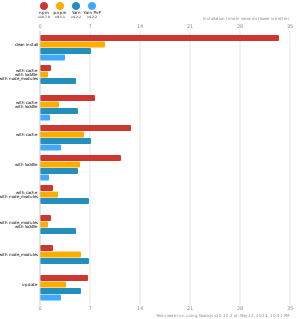
pnpm is up to 2x faster than npm and Yarn classic. See all benchmarks here.
Benchmarks on an app with lots of dependencies:
License
MIT, except the pnpr/ directory, which is source-available under the PolyForm Shield License 1.0.0.