2e33bb1955
* docs: split AGENTS.md into shared + pacquet-specific

Before: root AGENTS.md and pacquet/AGENTS.md each maintained their own
copy of the GitHub PR workflow, agent-footer rule, "never ignore test
failures," Conventional Commits list, and code-reuse philosophy.
Drift waiting to happen.

After:
  - Root AGENTS.md owns the shared conventions (PR workflow, agent
    footer, conventional commits, code reuse, never-ignore-tests,
    PR-conflict script) and marks TS-only sections explicitly
    (setup/build, testing, linting, changesets, Standard Style, Jest
    gotchas).
  - pacquet/AGENTS.md opens with "Read ../AGENTS.md first" and keeps
    only pacquet-specific rules (cardinal rule, branded types, just
    recipes, insta snapshots, miette diagnostics, Rust style notes,
    the `bench:` commit type, things-not-to-do that are Rust-flavored).
  - Root adds a one-line entry for `pacquet/` in the repo structure
    list so first-time readers find the cross-link.

CLAUDE.md and pacquet/{CLAUDE,GEMINI}.md are unchanged — they're
symlinks to AGENTS.md and follow automatically.

* docs(agents): require parity between pnpm and pacquet

Add a "Keep pnpm and pacquet in sync" section to root AGENTS.md spelling
out the bidirectional obligation: any user-visible change (CLI surface,
lockfile/manifest format, error codes, defaults, env-var handling, log
emissions, store layout) must land in both stacks in the same PR, or
the originating PR must spawn a tracking issue. Pure refactors / perf
wins / TS-only test cleanups don't need mirroring.

Cross-link from pacquet/AGENTS.md's "cardinal rule" so a pacquet-side
reader knows the obligation goes both ways and where the pnpm-side
version lives.

* docs(agents): restore Rust-specific dependency-level guidance

The root "Keep the dependency on the right level" bullet uses npm
vocabulary ("package," "shared package"). For a Rust reader that
required mentally translating "package" → "crate" and made the
workspace-vs-crate distinction less obvious. Restore the pacquet
phrasing alongside the existing pacquet-specific notes.

* docs(agents): hand off cross-stack porting via the same PR

Drop the "open a tracking issue" fallback — it lets one side drift
behind while the issue sits in the backlog. Instead, the PR author
opens the PR with their side and flags in the description what still
needs porting; someone else pushes the matching commits to the same
PR before it lands. Both sides land together or not at all.

* docs(agents): drop external-repo framing from the cardinal rule

pacquet now lives in the same repo as pnpm, so the cardinal rule no
longer needs the "fetch pnpm/pnpm main, compare ls-remote SHAs, watch
your local clone for drift" mechanics. The reference TypeScript code
is just a few directories over (`pnpm/`, `pkg-manager/`, `resolving/`,
`lockfile/`, `store/`, etc.), and pnpm is the source of truth by
position in the repo, not by branch tracking.

Updates:

  - Root `AGENTS.md`: rephrase the cross-link line to drop the "follow
    pnpm's main" framing.
  - `pacquet/AGENTS.md` cardinal rule: redirect "find the equivalent
    code" from `https://github.com/pnpm/pnpm` to the in-repo
    TypeScript workspaces, drop the "confirm you're on the freshest
    main" paragraph, and reword the source-of-truth wording.
  - Permalink citation rule: generalize from "upstream pnpm" to "any
    GitHub repository, including this one" — citation SHAs now usually
    point at this repo's history.

* docs(agents): note pacquet's current scope is install-only

Without this caveat the parity rule reads as if every command needs
porting today. pacquet only implements `install` right now; resolution
and other commands (`update`, `add`, `remove`, `publish`, `exec`,
`run`, `dlx`, `audit`, etc.) live only in TypeScript, so changes there
don't need a pacquet-side port. The caveat also flags that the parity
rule's scope will widen as pacquet ports more commands.
简体中文 | 日本語 | 한국어 | Italiano | Português Brasileiro

Fast, disk space efficient package manager:
- Fast. Up to 2x faster than the alternatives (see benchmark).
- Efficient. Files inside
node_modulesare linked from a single content-addressable storage. - Great for monorepos.
- Strict. A package can access only dependencies that are specified in its
package.json. - Deterministic. Has a lockfile called
pnpm-lock.yaml. - Works as a Node.js version manager. See pnpm runtime.
- Works everywhere. Supports Windows, Linux, and macOS.
- Battle-tested. Used in production by teams of all sizes since 2016.
- See the full feature comparison with npm and Yarn.
To quote the Rush team:
Microsoft uses pnpm in Rush repos with hundreds of projects and hundreds of PRs per day, and we’ve found it to be very fast and reliable.



Platinum Sponsors

|
Gold Sponsors

|

|

|

|

|

|

|

|
Silver Sponsors

|

|

|

|

|

|

|
⏱️ Time.now |
Support this project by becoming a sponsor.
Background
pnpm uses a content-addressable filesystem to store all files from all module directories on a disk. When using npm, if you have 100 projects using lodash, you will have 100 copies of lodash on disk. With pnpm, lodash will be stored in a content-addressable storage, so:
- If you depend on different versions of lodash, only the files that differ are added to the store.
If lodash has 100 files, and a new version has a change only in one of those files,
pnpm updatewill only add 1 new file to the storage. - All the files are saved in a single place on the disk. When packages are installed, their files are linked from that single place consuming no additional disk space. Linking is performed using either hard-links or reflinks (copy-on-write).
As a result, you save gigabytes of space on your disk and you have a lot faster installations!
If you'd like more details about the unique node_modules structure that pnpm creates and
why it works fine with the Node.js ecosystem, read this small article: Flat node_modules is not the only way.
💖 Like this project? Let people know with a tweet
Getting Started
Benchmark
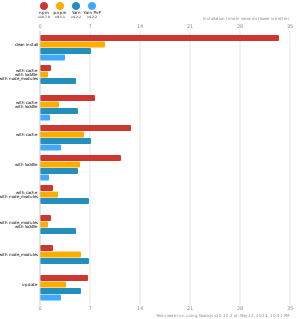
pnpm is up to 2x faster than npm and Yarn classic. See all benchmarks here.
Benchmarks on an app with lots of dependencies: