 302a2f7d2c
When `package.json` sets both `packageManager` and `devEngines.packageManager` to the same pnpm version with the same integrity hash pnpm prints a spurious warning on every command. For example, a `package.json` file that looks like:

```json
{
	"packageManager": "pnpm@11.5.1+sha512.93f7b57422ea7068257235b4c16eb60762eb68e1dc23723199cc739043ea9be2c4143274a399d8c6defa2b1176226d9ca1c4b63482d6200c1a8fbaa78c1d1485",
	"devEngines": {
		"packageManager": {
			"name": "pnpm",
			"version": "11.5.1+sha512.93f7b57422ea7068257235b4c16eb60762eb68e1dc23723199cc739043ea9be2c4143274a399d8c6defa2b1176226d9ca1c4b63482d6200c1a8fbaa78c1d1485",
			"onFail": "ignore"
		},
		"runtime": [
			{
				"name": "node",
				"version": "26.3.0",
				"onFail": "ignore"
			}
		]
	}
}
```

Issues a warning on every `pnpm` command:

> Cannot use both "packageManager" and "devEngines.packageManager" in package.json. "packageManager" will be ignored.

## Root cause

`getWantedPackageManager` compares the two fields to decide whether to warn, but the two sides were normalized differently:

  - `parsePackageManager` **strips the integrity hash** from the legacy `packageManager` field → `11.5.1`
  - the `devEngines.packageManager` version was compared **with its hash intact** → `11.5.1+sha512.93f7b57…`

So, `"11.5.1" !== "11.5.1+sha512…"` was always true and the warning fired, even for identical specs. An earlier fix in #11307 only suppressed the warning when *neither* side carried a hash.

## Fix

`parsePackageManager` now also returns the hash (via a shared `splitPackageManagerVersion`), and `getPackageManagerConflictWarning` compares the fields structurally. The warning is suppressed **only when the two specifiers are identical** (name + version + hash, both-absent counts as equal):

| name | version | hash | result |
|------|---------|------|--------|
| same | same | both absent, or both present & equal | ✅ no warning |
| same | same | present on **one side only** | ⚠️ generic "Cannot use both…" |
| same | same | both present & **differ** | ⚠️ "…contradictory integrity hashes" |
| same | **differ** | — | ⚠️ "…different versions of pnpm" |
| **differ** | — | — | ⚠️ "…different package managers" |

A hash on only one side is still a divergence — dropping the ignored `packageManager` field would lose that hash — so it warns with the original generic message. Two contradictory hashes for one version (a likely wrong-hash mistake) get a dedicated message. The generic single message is otherwise replaced by one tailored to each conflict, each ending with `"packageManager" will be ignored`.

Closes #12028.

---------

Signed-off-by: C. Spencer Beggs <spencer@beggs.codes>
Signed-off-by: Zoltan Kochan <z@kochan.io>
Co-authored-by: Zoltan Kochan <z@kochan.io>
简体中文 | 日本語 | 한국어 | Italiano | Português Brasileiro

Fast, disk space efficient package manager:
- Fast. Up to 2x faster than the alternatives (see benchmark).
- Efficient. Files inside
node_modulesare linked from a single content-addressable storage. - Great for monorepos.
- Strict. A package can access only dependencies that are specified in its
package.json. - Deterministic. Has a lockfile called
pnpm-lock.yaml. - Works as a Node.js version manager. See pnpm runtime.
- Works everywhere. Supports Windows, Linux, and macOS.
- Battle-tested. Used in production by teams of all sizes since 2016.
- See the full feature comparison with npm and Yarn.
To quote the Rush team:
Microsoft uses pnpm in Rush repos with hundreds of projects and hundreds of PRs per day, and we’ve found it to be very fast and reliable.



Platinum Sponsors

|

|
Gold Sponsors

|

|

|

|

|

|

|

|
Silver Sponsors

|

|

|

|

|

|

|
|
⏱️ Time.now |
Support this project by becoming a sponsor.
Background
pnpm uses a content-addressable filesystem to store all files from all module directories on a disk. When using npm, if you have 100 projects using lodash, you will have 100 copies of lodash on disk. With pnpm, lodash will be stored in a content-addressable storage, so:
- If you depend on different versions of lodash, only the files that differ are added to the store.
If lodash has 100 files, and a new version has a change only in one of those files,
pnpm updatewill only add 1 new file to the storage. - All the files are saved in a single place on the disk. When packages are installed, their files are linked from that single place consuming no additional disk space. Linking is performed using either hard-links or reflinks (copy-on-write).
As a result, you save gigabytes of space on your disk and you have a lot faster installations!
If you'd like more details about the unique node_modules structure that pnpm creates and
why it works fine with the Node.js ecosystem, read this small article: Flat node_modules is not the only way.
💖 Like this project? Let people know with a tweet
Getting Started
Benchmark
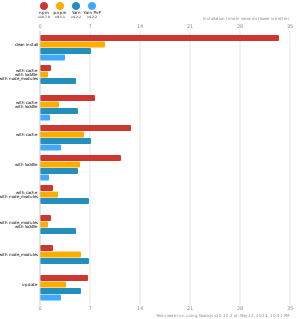
pnpm is up to 2x faster than npm and Yarn classic. See all benchmarks here.
Benchmarks on an app with lots of dependencies:
License
MIT, except the pnpr/ directory, which is source-available under the PolyForm Shield License 1.0.0.