35d235542e
Fixes #11818

## Summary

`devEngines.runtime` / `engines.runtime` entries with `onFail: error` or `warn` silently did nothing — only `onFail: download` had any effect. This PR wires up validation for all three supported runtimes (node, deno, bun).

- Add `getSystemDenoVersion` / `getSystemBunVersion` and a generic `getSystemRuntimeVersion(name)` dispatcher in the runtime-version helper package.
- Walk each runtime entry in the manifest during pnpm startup, compare to the live system runtime, and throw `ERR_PNPM_BAD_RUNTIME_VERSION` (or warn) on a mismatch. Invalid ranges (e.g. `"invalid range"`) are reported instead of crashing `semver.minVersion`. Missing runtimes ("no Node.js on the system") get the same error path.
- The shell-out for deno/bun only runs when the manifest configures them AND `onFail` is `error`/`warn`. `download`/`ignore` short-circuit, and projects with no runtime pin pay nothing. Memoized per runtime.
- `pnpm --version`, `pnpm --help`, and `pnpm <cmd> --global` are exempt from the check.
- Rename `@pnpm/engine.runtime.system-node-version` → `@pnpm/engine.runtime.system-version` to match its broader scope; hoist `RuntimeName` / `RUNTIME_NAMES` / `isRuntimeAlias` to `@pnpm/types` so callers don't need to depend on `pkg-manifest.utils` just for the alias check.

## Tests

- `pnpm --filter pnpm run compile`
- `pnpm --filter pnpm exec jest packageManagerCheck.test` — 42 passing. New coverage: node/deno/bun version mismatch, invalid range, missing range, multi-entry runtime arrays, `engines.runtime` path (not just `devEngines.runtime`), and the `pnpm --version` exemption.
- `pnpm --filter @pnpm/engine.runtime.system-version test` — 10 passing, 100% statement coverage; unit tests for each helper and the dispatcher.
- Manual end-to-end smoke tests against the rebuilt bundle for deno and bun version mismatch.

<!-- This is an auto-generated comment: release notes by coderabbit.ai -->
## Summary by CodeRabbit

## Release Notes

* **New Features**
  * Added runtime version validation for Node.js, Deno, and Bun. The system now enforces `devEngines.runtime` and `engines.runtime` declarations with configurable failure behavior (`error`, `warn`, or `ignore`).
  * Enhanced error messages for runtime version mismatches with helpful suggestions for overrides.

* **Improvements**
  * Improved system runtime detection and version checking across multiple runtime environments.

---------

Co-authored-by: Puneet Dixit <236133619+puneetdixit200@users.noreply.github.com>
Co-authored-by: Zoltan Kochan <z@kochan.io>
简体中文 | 日本語 | 한국어 | Italiano | Português Brasileiro

Fast, disk space efficient package manager:
- Fast. Up to 2x faster than the alternatives (see benchmark).
- Efficient. Files inside
node_modulesare linked from a single content-addressable storage. - Great for monorepos.
- Strict. A package can access only dependencies that are specified in its
package.json. - Deterministic. Has a lockfile called
pnpm-lock.yaml. - Works as a Node.js version manager. See pnpm runtime.
- Works everywhere. Supports Windows, Linux, and macOS.
- Battle-tested. Used in production by teams of all sizes since 2016.
- See the full feature comparison with npm and Yarn.
To quote the Rush team:
Microsoft uses pnpm in Rush repos with hundreds of projects and hundreds of PRs per day, and we’ve found it to be very fast and reliable.



Platinum Sponsors

|
Gold Sponsors

|

|

|

|

|

|

|

|
Silver Sponsors

|

|

|

|

|

|

|
⏱️ Time.now |
Support this project by becoming a sponsor.
Background
pnpm uses a content-addressable filesystem to store all files from all module directories on a disk. When using npm, if you have 100 projects using lodash, you will have 100 copies of lodash on disk. With pnpm, lodash will be stored in a content-addressable storage, so:
- If you depend on different versions of lodash, only the files that differ are added to the store.
If lodash has 100 files, and a new version has a change only in one of those files,
pnpm updatewill only add 1 new file to the storage. - All the files are saved in a single place on the disk. When packages are installed, their files are linked from that single place consuming no additional disk space. Linking is performed using either hard-links or reflinks (copy-on-write).
As a result, you save gigabytes of space on your disk and you have a lot faster installations!
If you'd like more details about the unique node_modules structure that pnpm creates and
why it works fine with the Node.js ecosystem, read this small article: Flat node_modules is not the only way.
💖 Like this project? Let people know with a tweet
Getting Started
Benchmark
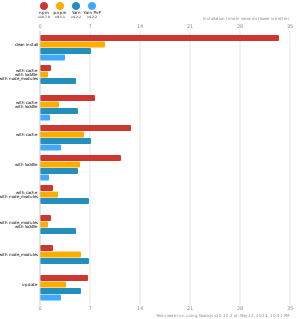
pnpm is up to 2x faster than npm and Yarn classic. See all benchmarks here.
Benchmarks on an app with lots of dependencies: