 Zoltan Kochan
3fb4ea7e36
Zoltan Kochan
3fb4ea7e36
`InstallWithFreshLockfile::run` had grown to 2103 lines — 68% of its
file — and read as one flat sequence with no boundary between the
install phases it drives. Give the fresh-install path one module per
phase, leaving `run` as the orchestrator that threads state between
them:

- `resolver_setup` — registries, store-index handles, and the resolver
  chain with its prefetching and observing wrappers.
- `manifest_transforms` — pnpm's built-in read-package chain
  (`packageExtensions` + `pnpm.overrides`).
- `resolve` — the seeds, options, hooks and reuse decisions the walk
  consumes, the walk itself, and the diagnostics that read its result.
- `materialization_plan` — installability host, engine name, skip set.
- `linking` — prune, the hoisted and isolated linker arms, and the
  module-resolution sidecars.

Two phases stay in the orchestrator on purpose. The build phase is
already `install_frozen_lockfile::run_build_phase`, shared with the
frozen path, so a local wrapper would add a layer and no meaning; the
`CreateVirtualStore` and build invocations are single calls whose option
literals gain nothing from being relocated behind another input type.

The resolver-chain split needs two functions rather than one:
`PrefetchContext` borrows the store handles, so the caller has to own
them before the chain that borrows them is built.

Four duplications fell out along the way:

- The store-index writer drain appeared verbatim on both the
  lockfile-only and materializing paths.
- The build-then-splice pair of `build_fresh_lockfile` and
  `merge_filtered_wanted_lockfile` appeared twice; both call sites are
  now one `build_lockfile` call.
- The fast-override pre-pass and the per-importer resolve closure built
  near-identical `ResolveOptions` literals differing only in
  `project_dir` and the preferred-versions seed, now
  `SharedResolveOptions::build`.
- `HoistedArmInputs` and `IsolatedArmInputs` were strict subsets of
  `LinkPhaseInputs`.

Two behavior-preserving simplifications: `needs_installability_check`
was redundant with `installability_host.is_some()` and collapsed into
it, and the `if x.is_empty() { None } else { Some(..) }` shapes around
the overrides hooks became `.filter(..).map(..)`.

Prose the extraction made redundant is gone: call sites no longer repeat
their callee's documentation. That also surfaced a stale comment
claiming the lockfile maps are built "only when GVS is on", which the
unconditional `build_lockfile` contradicts.

No user-visible change, so nothing to mirror in the TypeScript CLI and
no changeset.
简体中文 | 日本語 | 한국어 | Italiano | Português Brasileiro

Fast, disk space efficient package manager:
- Fast. Up to 2x faster than the alternatives (see benchmark).
- Efficient. Files inside
node_modulesare linked from a single content-addressable storage. - Great for monorepos.
- Strict. A package can access only dependencies that are specified in its
package.json. - Deterministic. Has a lockfile called
pnpm-lock.yaml. - Works as a Node.js version manager. See pnpm runtime.
- Works everywhere. Supports Windows, Linux, and macOS.
- Battle-tested. Used in production by teams of all sizes since 2016.
- Experimental Rust port. Includes pacquet, an experimental port of the CLI written in Rust.
- See the full feature comparison with npm and Yarn.
To quote the Rush team:
Microsoft uses pnpm in Rush repos with hundreds of projects and hundreds of PRs per day, and we’ve found it to be very fast and reliable.



Platinum Sponsors

|

|
Gold Sponsors

|

|

|

|

|

|

|

|
Silver Sponsors

|

|

|

|

|

|

|

|
|
| ⏱️ Time.now |
Support this project by becoming a sponsor.
Background
pnpm uses a content-addressable filesystem to store all files from all module directories on a disk. When using npm, if you have 100 projects using lodash, you will have 100 copies of lodash on disk. With pnpm, lodash will be stored in a content-addressable storage, so:
- If you depend on different versions of lodash, only the files that differ are added to the store.
If lodash has 100 files, and a new version has a change only in one of those files,
pnpm updatewill only add 1 new file to the storage. - All the files are saved in a single place on the disk. When packages are installed, their files are linked from that single place consuming no additional disk space. Linking is performed using either hard-links or reflinks (copy-on-write).
As a result, you save gigabytes of space on your disk and you have a lot faster installations!
If you'd like more details about the unique node_modules structure that pnpm creates and
why it works fine with the Node.js ecosystem, read this small article: Flat node_modules is not the only way.
💖 Like this project? Let people know with a tweet
Getting Started
Benchmark
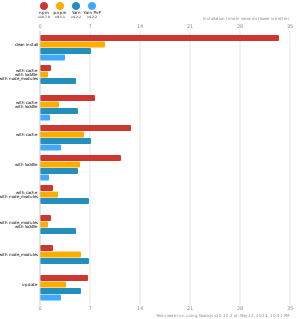
pnpm is up to 2x faster than npm and Yarn classic. See all benchmarks here.
Benchmarks on an app with lots of dependencies:
License
MIT, except the pnpr/ directory, which is source-available under the PolyForm Shield License 1.0.0.