Zoltan Kochan
4d7cd56ccc
Zoltan Kochan
4d7cd56ccc
* chore: upgrade @typescript/native-preview to 7.0.0-dev.20260421.2

- Add explicit `types: ["node"]` to the shared tsconfig because tsgo
  20260421 no longer auto-acquires `@types/*` from `node_modules`.
- Refactor test files to explicitly import jest globals (`describe`,
  `it`, `test`, `expect`, `beforeEach`, etc.) from `@jest/globals`
  instead of relying on `@types/jest` ambient declarations. Under the
  new tsgo build, `import { jest } from '@jest/globals'` shadows the
  ambient `jest` namespace, breaking `@types/jest`'s `declare var
  describe: jest.Describe;` globals.
- Add `@jest/globals` to each package's devDependencies where tests
  now import from it, and add `@types/node` to packages that need it
  but were relying on hoisted resolution.
- Replace `fail()` calls with `throw new Error(...)` since `fail` is
  no longer globally available.

* chore: fix remaining tsgo type-strictness errors

- Strip `as <PnpmType>` casts on objects passed to toMatchObject /
  toStrictEqual / toEqual; @jest/globals rejects the typed objects
  (which include AsymmetricMatchers) vs. the repo-specific type.
- Type `jest.fn<...>()` explicitly where the mock's signature matters
  for toHaveBeenCalledWith.
- Replace `beforeEach(() => X)` with `beforeEach(() => { X })` so the
  return value is void, as the stricter jest typing requires.
- Use `expect.objectContaining({...})` in one place where the full
  expected object triggered stricter type resolution.
- Cast `prompt.mock.calls` arg through `as unknown as Record<...>[]`
  for patch.test.ts's nested-array matchers.
- Fix off-by-one `<reference path>` in pnpm/test/getConfig.test.ts
  that only surfaced now.
- Move `@jest/globals` from devDependencies to dependencies in the
  two `__utils__` packages that import it from `src/`.
- Clean up unused imports from the @jest/globals migration.

* chore: address Copilot review on #11332

- Move misplaced `@jest/globals` imports to the top import block in
  checkEngine, run.ts, and workspace/root-finder tests where the
  script dropped them below executable code.
- Replace `try { await x(); throw new Error('should have thrown') } catch`
  in bins/linker, lockfile/fs, and resolving/local-resolver tests with
  `await expect(x()).rejects.toMatchObject({...})`. The old pattern
  swallowed an unrelated `throw` if the under-test call silently
  succeeded, which would fail on the catch-block assertion with a
  misleading message.
简体中文 | 日本語 | 한국어 | Italiano | Português Brasileiro

Fast, disk space efficient package manager:
- Fast. Up to 2x faster than the alternatives (see benchmark).
- Efficient. Files inside
node_modulesare linked from a single content-addressable storage. - Great for monorepos.
- Strict. A package can access only dependencies that are specified in its
package.json. - Deterministic. Has a lockfile called
pnpm-lock.yaml. - Works as a Node.js version manager. See pnpm runtime.
- Works everywhere. Supports Windows, Linux, and macOS.
- Battle-tested. Used in production by teams of all sizes since 2016.
- See the full feature comparison with npm and Yarn.
To quote the Rush team:
Microsoft uses pnpm in Rush repos with hundreds of projects and hundreds of PRs per day, and we’ve found it to be very fast and reliable.



Platinum Sponsors

|
Gold Sponsors

|

|

|

|

|

|

|

|
Silver Sponsors

|

|

|

|

|

|

|
⏱️ Time.now |
Support this project by becoming a sponsor.
Background
pnpm uses a content-addressable filesystem to store all files from all module directories on a disk. When using npm, if you have 100 projects using lodash, you will have 100 copies of lodash on disk. With pnpm, lodash will be stored in a content-addressable storage, so:
- If you depend on different versions of lodash, only the files that differ are added to the store.
If lodash has 100 files, and a new version has a change only in one of those files,
pnpm updatewill only add 1 new file to the storage. - All the files are saved in a single place on the disk. When packages are installed, their files are linked from that single place consuming no additional disk space. Linking is performed using either hard-links or reflinks (copy-on-write).
As a result, you save gigabytes of space on your disk and you have a lot faster installations!
If you'd like more details about the unique node_modules structure that pnpm creates and
why it works fine with the Node.js ecosystem, read this small article: Flat node_modules is not the only way.
💖 Like this project? Let people know with a tweet
Getting Started
Benchmark
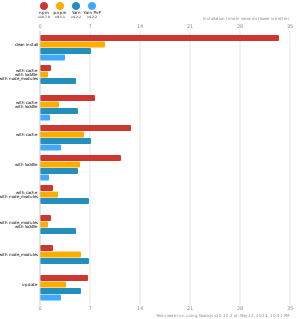
pnpm is up to 2x faster than npm and Yarn classic. See all benchmarks here.
Benchmarks on an app with lots of dependencies: