 Zoltan Kochan
4ed7a436ef
Zoltan Kochan
4ed7a436ef
Add operator-configured OIDC providers, explicit subject/claim bindings, and
separate browser and workload authentication paths to pnpr. Use the approved
openidconnect dependency for discovery, authorization code exchange, and
signature verification, with pnpr checks for authorized party and token times.

Keep OIDC sessions short-lived and out of the persistent token stores. Bind
browser login to a signed HttpOnly Secure cookie, PKCE, nonce, and one-use state.
Anonymous login starts allocate no server-side state. Bound callback attempts
and concurrent exchanges. Bound successful sessions,
discovery response sizes, deadlines, and JWKS refreshes. Restrict discovery
destinations to public IP addresses through the shared system DNS resolver.
Keep valid cached keys available while a refresh performs network I/O.
Redact callback query parameters from request logs.

Accept prefixed workload ID tokens as registry credentials without token-store
lookups, restricting them to exact packages in an explicitly named hosted npm registry and enforcing the
normal publish ACL. These credentials cannot mint durable pnpr tokens or use
account, unpublish, batch, or other protocol endpoints.

Document provider setup, limitations, and a GitHub Actions workflow that needs
no long-lived registry secret. Cover signed-token validation, claim constraints,
login replay and expiry, discovery caching, and request restrictions with tests.
简体中文 | 日本語 | 한국어 | Italiano | Português Brasileiro

Fast, disk space efficient package manager:
- Fast. Up to 2x faster than the alternatives (see benchmark).
- Efficient. Files inside
node_modulesare linked from a single content-addressable storage. - Great for monorepos.
- Strict. A package can access only dependencies that are specified in its
package.json. - Deterministic. Has a lockfile called
pnpm-lock.yaml. - Works as a Node.js version manager. See pnpm runtime.
- Works everywhere. Supports Windows, Linux, and macOS.
- Battle-tested. Used in production by teams of all sizes since 2016.
- Experimental Rust port. Includes pacquet, an experimental port of the CLI written in Rust.
- See the full feature comparison with npm and Yarn.
To quote the Rush team:
Microsoft uses pnpm in Rush repos with hundreds of projects and hundreds of PRs per day, and we’ve found it to be very fast and reliable.



Platinum Sponsors

|

|

|

|
Gold Sponsors

|

|

|

|

|

|

|

|
Silver Sponsors
|

|

|

|

|

|

|

|
|
| ⏱️ Time.now |
Support this project by becoming a sponsor.
Background
pnpm uses a content-addressable filesystem to store all files from all module directories on a disk. When using npm, if you have 100 projects using lodash, you will have 100 copies of lodash on disk. With pnpm, lodash will be stored in a content-addressable storage, so:
- If you depend on different versions of lodash, only the files that differ are added to the store.
If lodash has 100 files, and a new version has a change only in one of those files,
pnpm updatewill only add 1 new file to the storage. - All the files are saved in a single place on the disk. When packages are installed, their files are linked from that single place consuming no additional disk space. Linking is performed using either hard-links or reflinks (copy-on-write).
As a result, you save gigabytes of space on your disk and you have a lot faster installations!
If you'd like more details about the unique node_modules structure that pnpm creates and
why it works fine with the Node.js ecosystem, read this small article: Flat node_modules is not the only way.
💖 Like this project? Let people know with a tweet
Getting Started
Benchmark
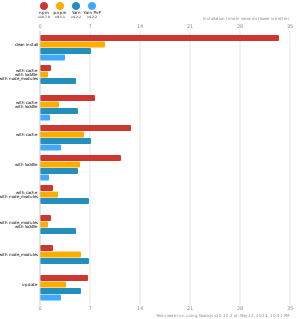
pnpm is up to 2x faster than npm and Yarn classic. See all benchmarks here.
Benchmarks on an app with lots of dependencies:
License
MIT, except the pnpr/ directory, which is source-available under the PolyForm Shield License 1.0.0.