 Zoltan KochanandClaude Fable 5.1
4f37bb5429
Zoltan KochanandClaude Fable 5.1
4f37bb5429
Two gates of the repeat-install check refused every run in common Bit
workspaces, and one of them affects plain pnpm workspaces too.

modules_dirs_present treated a sibling project without node_modules as
never installed. Under dedupeDirectDeps a sibling whose every direct
dependency the root declares identically gets nothing linked, so the
linker never creates that directory; the sibling is installed all the
same. The gate now lets such a sibling through when the root's modules
directory exists and, for every alias the sibling declares in a group
the install materializes, the wanted lockfile records one target on
each side and the two agree, which is what the linker compares. link:
targets are resolved against each importer's directory; an alias a side
declares with differing targets across groups proves nothing, since the
linker picks one by group order and the check does not reproduce that;
a modules directory has to be a directory. The TypeScript checkDepsStatus
had the same gate and gets the same rule.

The merge-conflict scan of a changed lockfile refused files of 16 MiB or
more as unverifiable. Every changed lockfile that passes the scan is
parsed in full right after, so the size budget could only refuse what
the parse would read anyway; the scan now streams the whole file through
its fixed 8 KiB buffer. The symlink and non-regular-file refusals stay.

Co-Authored-By: Claude Fable 5.1 <noreply@anthropic.com>
简体中文 | 日本語 | 한국어 | Italiano | Português Brasileiro

Fast, disk space efficient package manager:
- Fast. Up to 2x faster than the alternatives (see benchmark).
- Efficient. Files inside
node_modulesare linked from a single content-addressable storage. - Great for monorepos.
- Strict. A package can access only dependencies that are specified in its
package.json. - Deterministic. Has a lockfile called
pnpm-lock.yaml. - Works as a Node.js version manager. See pnpm runtime.
- Works everywhere. Supports Windows, Linux, and macOS.
- Battle-tested. Used in production by teams of all sizes since 2016.
- Experimental Rust port. Includes pacquet, an experimental port of the CLI written in Rust.
- See the full feature comparison with npm and Yarn.
To quote the Rush team:
Microsoft uses pnpm in Rush repos with hundreds of projects and hundreds of PRs per day, and we’ve found it to be very fast and reliable.



Platinum Sponsors

|

|

|

|
Gold Sponsors

|

|

|

|

|

|

|

|
Silver Sponsors

|

|

|

|

|

|

|

|

|
| ⏱️ Time.now |
Support this project by becoming a sponsor.
Background
pnpm uses a content-addressable filesystem to store all files from all module directories on a disk. When using npm, if you have 100 projects using lodash, you will have 100 copies of lodash on disk. With pnpm, lodash will be stored in a content-addressable storage, so:
- If you depend on different versions of lodash, only the files that differ are added to the store.
If lodash has 100 files, and a new version has a change only in one of those files,
pnpm updatewill only add 1 new file to the storage. - All the files are saved in a single place on the disk. When packages are installed, their files are linked from that single place consuming no additional disk space. Linking is performed using either hard-links or reflinks (copy-on-write).
As a result, you save gigabytes of space on your disk and you have a lot faster installations!
If you'd like more details about the unique node_modules structure that pnpm creates and
why it works fine with the Node.js ecosystem, read this small article: Flat node_modules is not the only way.
💖 Like this project? Let people know with a tweet
Getting Started
Benchmark
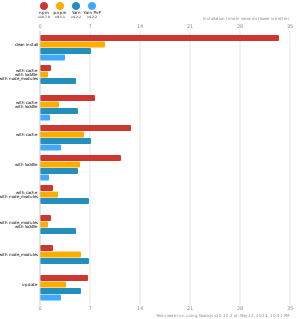
pnpm is up to 2x faster than npm and Yarn classic. See all benchmarks here.
Benchmarks on an app with lots of dependencies:
License
MIT, except the pnpr/ directory, which is source-available under the PolyForm Shield License 1.0.0.