 Zoltan Kochan
5192edf40e
Zoltan Kochan
5192edf40e
Closes #12184 (part 2).

#12181 shipped the per-caller access gate on `POST /v1/install`, which authorizes every served package against pnpr's own `packages:` policy — the complete answer **while pnpr fetches anonymously**. This PR adds the remaining piece: forwarding the caller's per-registry credentials so the accelerator can resolve/fetch **external private** content as the caller, and gating that content per user against the registry that actually owns it.

## Credential forwarding (issue steps 1–2)

- **Wire:** `POST /v1/install` gains an `authHeaders` body map (`{ "//host/path/": "Bearer …" }`, the shape `AuthHeaders::from_map` consumes / `getAuthHeadersFromCreds` produces) plus an HTTP `Authorization` header. The body map carries the *upstream* registry tokens; the header identifies the caller to pnpr's own gate and keys the grant table.
- **pacquet plumbing:** a request-scoped `Arc<AuthHeaders>` is threaded via a new `Install.auth_override` field and an `auth_override` param on `build_resolution_verifiers`, so resolution/verification run as the caller **without** baking per-user auth into the interned `&'static Config` (which would leak one config per user).
- **Server:** `handle_install` builds the per-request `AuthHeaders` and threads it through resolve, verify, and `fetch_uncached` (which now returns the freshly-fetched set).
- **Clients:** pacquet `pnpr-client` and `@pnpm/pnpr.client` send `registry` / `namedRegistries` / `authHeaders` + `Authorization`; the TS path sources them from the caller's registry credentials via `@pnpm/network.auth-header` (`getAuthHeadersFromCreds` is newly re-exported). `@pnpm/worker` is unchanged — downloads happen server-side.
- **Credential scope:** both clients forward the caller's *full* credential map, not a subset scoped to the declared registries. The registries a dependency graph touches aren't knowable up front — a transitive package can be scope-routed to another registry or pinned to a tarball URL on a host that's in `.npmrc` but isn't a declared registry — so pnpr attaches the right token per fetched URL exactly as a local install does. These are package-fetch credentials going to the very service the caller configured to fetch its packages.

## Per-user grant table (issue steps 3–4)

Externally-resolved private content carries no pnpr policy, so the store's possession of the bytes must not authorize a user the upstream never cleared. A served package is dispatched by **whether a forwarded credential was used to fetch it**:

- **No forwarded cred → pnpr-as-authority:** the existing local `packages:` policy check, unchanged.
- **Forwarded cred → upstream-as-authority:** gated against a persistent `(user, name@version)` grant table (SQLite, modeled on `VerdictCache`). Freshly fetched this request ⇒ record + allow (the upstream just accepted the token). Cache hit with a standing grant ⇒ allow, no upstream trip. Cache hit, no grant ⇒ re-verify against the owning registry with the caller's credential — record on success; **clear-on-discovery** (purge the user's grants for the package) + deny on `401`/`403`. TTL is the `installAccelerator.grantTtl` config knob (default: permanent).

## Public vs private (no per-user gating for public packages)

A forwarded credential matching a registry doesn't mean a package is *private* — in a mixed proxy (one registry serving a company's private packages **and** public ones), the token matches everything, and gating public content per user would cost a grant row and a re-verify round trip per user for bytes anyone may read. So before the per-user path, a not-yet-classified cache hit is probed **anonymously**: a `2xx` classifies the package public in a global set (no user pays for it again, no grant, no further round trip); a `401`/`403` means it's genuinely private and falls through to the grant / re-verify path above. Public packages thus cost **one anonymous probe across the whole fleet**, not one per user.

## Tests

- pnpr: grant-table + public-set mechanics, regime dispatch, the upstream-authorization paths (fresh-fetch, granted cache hit, private re-verify-and-record, denied-clears-grants, public-classified-once-then-free), and forwarded-cred-routes-around-local-policy.
- pacquet `pnpr-client`: a test asserting `authHeaders` + `Authorization` travel on the wire.
- Full suites green: `pnpr` (237), `pacquet-package-manager` (389), `pacquet-pnpr-client` (12), `pacquet-network`/`config` (325); clippy `-D warnings`, `cargo fmt`, rustdoc `-D warnings --document-private-items`, `typos`, and the TS compile all clean.

## Scoped follow-ups (not in this PR)

- Clear-on-discovery fires at the re-verify hook only. A `401`/`403` during the cold resolve aborts the request anyway (nothing is served); threading the offending package out of the deep resolve error to also clear stale grants for *future* requests needs structured auth errors.
- Per-scope external registries route via the default registry, since pacquet doesn't yet surface `@scope:registry` routing in `collect_packages`.
简体中文 | 日本語 | 한국어 | Italiano | Português Brasileiro

Fast, disk space efficient package manager:
- Fast. Up to 2x faster than the alternatives (see benchmark).
- Efficient. Files inside
node_modulesare linked from a single content-addressable storage. - Great for monorepos.
- Strict. A package can access only dependencies that are specified in its
package.json. - Deterministic. Has a lockfile called
pnpm-lock.yaml. - Works as a Node.js version manager. See pnpm runtime.
- Works everywhere. Supports Windows, Linux, and macOS.
- Battle-tested. Used in production by teams of all sizes since 2016.
- See the full feature comparison with npm and Yarn.
To quote the Rush team:
Microsoft uses pnpm in Rush repos with hundreds of projects and hundreds of PRs per day, and we’ve found it to be very fast and reliable.



Platinum Sponsors

|
Gold Sponsors

|

|

|

|

|

|

|

|
Silver Sponsors

|

|

|

|

|

|

|
⏱️ Time.now |
Support this project by becoming a sponsor.
Background
pnpm uses a content-addressable filesystem to store all files from all module directories on a disk. When using npm, if you have 100 projects using lodash, you will have 100 copies of lodash on disk. With pnpm, lodash will be stored in a content-addressable storage, so:
- If you depend on different versions of lodash, only the files that differ are added to the store.
If lodash has 100 files, and a new version has a change only in one of those files,
pnpm updatewill only add 1 new file to the storage. - All the files are saved in a single place on the disk. When packages are installed, their files are linked from that single place consuming no additional disk space. Linking is performed using either hard-links or reflinks (copy-on-write).
As a result, you save gigabytes of space on your disk and you have a lot faster installations!
If you'd like more details about the unique node_modules structure that pnpm creates and
why it works fine with the Node.js ecosystem, read this small article: Flat node_modules is not the only way.
💖 Like this project? Let people know with a tweet
Getting Started
Benchmark
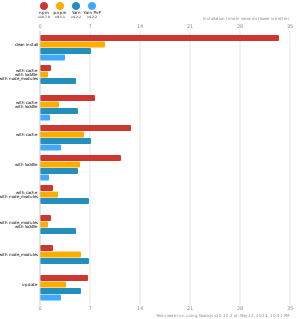
pnpm is up to 2x faster than npm and Yarn classic. See all benchmarks here.
Benchmarks on an app with lots of dependencies:
License
MIT, except the pnpr/ directory, which is source-available under the PolyForm Shield License 1.0.0.