 KhảiandClaude
577a90f819
KhảiandClaude
577a90f819
* feat(cli): port recursive run with --resume-from and --report-summary

Port pnpm's `pnpm run -r` (recursive run) to pacquet, including the
`--resume-from` and `--report-summary` flags, which previously existed
only in the TypeScript CLI.

- `pacquet -r run <script>` now runs the script in every workspace
  project in topological order, mirroring pnpm's runRecursive: discover
  projects, build the inter-project dependency graph, sort it into
  chunks via graph_sequencer (the port of sortProjects), and execute.
- `--resume-from <pkg>` drops every chunk before the one containing
  <pkg>, mirroring getResumedPackageChunks; an unknown package fails
  with ERR_PNPM_RESUME_FROM_NOT_FOUND.
- `--report-summary` writes pnpm-exec-summary.json with the per-package
  status (queued/running/passed/skipped/failure) and duration, nested
  under an executionStatus key, mirroring writeRecursiveSummary.
- `--no-bail` keeps running after a failure (recursive runs bail by
  default). Failures surface ERR_PNPM_RECURSIVE_FAIL, or
  ERR_PNPM_RECURSIVE_RUN_FIRST_FAIL when bailing; a run that matches no
  script fails with ERR_PNPM_RECURSIVE_RUN_NO_SCRIPT.

A new executor helper, execute_shell_with_status, returns the child's
exit status so per-package pass/fail can be recorded; execute_shell is
unchanged.

Not yet ported (noted in the module): --no-sort, --reverse,
--workspace-concurrency parallelism, --filter narrowing of the selected
set, and the RegExp script selector. The selected set is every workspace
project, matching pacquet's currently-unfiltered install.

Integration tests port the upstream resume-from and report-summary
cases from exec/commands/test/runRecursive.ts.

https://claude.ai/code/session_01QUdrDcP9iU3DwxR2TATobQ

* test(cli): gate recursive-run tests to unix and add macro trailing commas

Fix two CI failures on the recursive-run integration tests:

- Dylint (`perfectionist::macro_trailing_comma`): add the trailing comma
  to the four multi-line `assert!` invocations.
- Lint and Test (windows-latest): the shared helpers are used only by
  the Unix-gated tests, so on Windows they tripped `dead_code` under
  `-D warnings`. Gate the whole file with `#![cfg(unix)]` (the build
  scripts run through pacquet's `sh -c` executor anyway), matching the
  single-package `run` tests.

https://claude.ai/code/session_01QUdrDcP9iU3DwxR2TATobQ

* test(cli): cover recursive-run bail summary and no-script branches

Fill the two coverage holes in the recursive-run handler:

- bail + report-summary: the first failing script writes the summary,
  then aborts with ERR_PNPM_RECURSIVE_RUN_FIRST_FAIL; a package that
  sorts after the failure stays `queued`.
- no-script: a recursive run for a script no package defines fails with
  ERR_PNPM_RECURSIVE_RUN_NO_SCRIPT, and `--if-present` turns that into a
  clean no-op.

https://claude.ai/code/session_01QUdrDcP9iU3DwxR2TATobQ

* test(cli): cover the bail path without --report-summary

The bail tests always passed --report-summary, leaving the
report-summary-off side of the bail block (recursive.rs:136) uncovered.
Add a test for a failing script with bail on and no --report-summary:
it still fails with ERR_PNPM_RECURSIVE_RUN_FIRST_FAIL and writes no
summary file. Verified with cargo llvm-cov that recursive.rs now has no
missing lines.

https://claude.ai/code/session_01QUdrDcP9iU3DwxR2TATobQ

* fix(cli): run each recursive-run script from its own package root

Recursive run spawned every package's script via `sh -c` without
setting the working directory, so scripts ran in pacquet's process CWD
(the workspace root) instead of their own package root. That breaks
scripts relying on relative paths and diverges from pnpm, whose
`runLifecycleHook` runs with `pkgRoot` as the working directory.

- Give `execute_shell_with_status` a `current_dir` argument (factored
  through a private `spawn_shell` helper); `execute_shell` keeps its
  inherited-CWD behavior, so its callers are unchanged.
- Pass each package's root as the script's working directory.
- Make the marker-based recursive-run tests cwd-sensitive: scripts now
  write a relative `ran.txt`, and the tests assert it lands under each
  package root (and not at the workspace root), so a wrong-CWD
  regression fails the suite.

https://claude.ai/code/session_01QUdrDcP9iU3DwxR2TATobQ

---------

Co-authored-by: Claude <noreply@anthropic.com>
简体中文 | 日本語 | 한국어 | Italiano | Português Brasileiro

Fast, disk space efficient package manager:
- Fast. Up to 2x faster than the alternatives (see benchmark).
- Efficient. Files inside
node_modulesare linked from a single content-addressable storage. - Great for monorepos.
- Strict. A package can access only dependencies that are specified in its
package.json. - Deterministic. Has a lockfile called
pnpm-lock.yaml. - Works as a Node.js version manager. See pnpm runtime.
- Works everywhere. Supports Windows, Linux, and macOS.
- Battle-tested. Used in production by teams of all sizes since 2016.
- See the full feature comparison with npm and Yarn.
To quote the Rush team:
Microsoft uses pnpm in Rush repos with hundreds of projects and hundreds of PRs per day, and we’ve found it to be very fast and reliable.



Platinum Sponsors

|
Gold Sponsors

|

|

|

|

|

|

|

|
Silver Sponsors

|

|

|

|

|

|

|
⏱️ Time.now |
Support this project by becoming a sponsor.
Background
pnpm uses a content-addressable filesystem to store all files from all module directories on a disk. When using npm, if you have 100 projects using lodash, you will have 100 copies of lodash on disk. With pnpm, lodash will be stored in a content-addressable storage, so:
- If you depend on different versions of lodash, only the files that differ are added to the store.
If lodash has 100 files, and a new version has a change only in one of those files,
pnpm updatewill only add 1 new file to the storage. - All the files are saved in a single place on the disk. When packages are installed, their files are linked from that single place consuming no additional disk space. Linking is performed using either hard-links or reflinks (copy-on-write).
As a result, you save gigabytes of space on your disk and you have a lot faster installations!
If you'd like more details about the unique node_modules structure that pnpm creates and
why it works fine with the Node.js ecosystem, read this small article: Flat node_modules is not the only way.
💖 Like this project? Let people know with a tweet
Getting Started
Benchmark
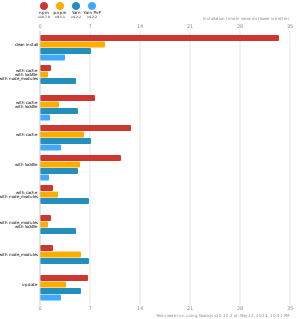
pnpm is up to 2x faster than npm and Yarn classic. See all benchmarks here.
Benchmarks on an app with lots of dependencies:
License
MIT, except the pnpr/ directory, which is source-available under the PolyForm Shield License 1.0.0.