 Zoltan Kochan
5b696ae2c3
Zoltan Kochan
5b696ae2c3
* ci: auto-tag released versions when the release PR merges

The release tag was pushed by hand after merging a release PR, which let
the tag name drift from the version committed on the merge commit. When
they disagree, release.yml's plan job publishes the committed version but
github-release-rust drafts a GitHub release for `v<committed-version>` — a
tag that doesn't exist as a git ref — and the create-release call returns
403 "Resource not accessible by integration" even with contents: write.

Add tag-release.yml: on a merged `release-pr/*` PR it derives each
product's tag from the committed manifest (the same manifests plan reads),
skips versions already tagged on the remote, and pushes the new tags with
UPDATE_LOCKFILE_TOKEN so the push triggers release.yml (a tag pushed with
the default GITHUB_TOKEN would not). Deriving the tag from the committed
version makes the off-by-one impossible, and the tag exists as a real ref
before release.yml runs, so the draft-release step no longer 403s.

A release PR can bump several products at once, landing several tags and
starting a release run apiece; add a `release` concurrency group so they
serialize and plan's already-published gate makes the later runs no-ops.

Drop the now-obsolete "push the version tag after merging" line from the
release PR body.

* ci: harden the auto-tag workflow per review

- Gate on create-release-pr.yml's exact contract (same-repo head branch
  named `release-pr/<base>`) instead of a `release-pr/` prefix, so a fork
  PR or an unrelated same-prefixed branch can't reach the PAT tag push.
- `set -euo pipefail` so a failed `git ls-remote` aborts instead of
  yielding an empty tag set that makes every version look new.
- `git ls-remote --refs` to drop annotated tags' peeled `^{}` entries.
- Reword the header comment to state the current contract rather than
  what it replaces.

* ci: tag pnpr in its own namespace to avoid pnpm tag collisions

pnpr's version starts at 0.x, and pnpm's tag history already holds 166
v0.x tags (v0.1.0, v0.2.0, …) plus the v1.x line. Tagging pnpr as
`v<version>` shares that namespace: once pnpr cuts a stable 0.x that
matches an old pnpm tag, the existence check would treat the ancient
pnpm tag as pnpr's and silently skip it, so pnpr would never get its
trigger tag or release.

Give pnpr its own `pnpr-v<version>` tag (it has no GitHub release and no
external consumer of the tag — it ships via npm and GHCR — so it's free
to move) and trigger/validate release.yml on `pnpr-v*.*.*` alongside
`v*.*.*`. plan reads committed manifests regardless of the triggering
tag, so a pnpr-only release still publishes correctly.

* ci: adopt the Changesets-style pnpr tag scheme

Use the widely-recognized `pnpr@<version>` form (the Changesets/Lerna
convention) for pnpr's release tag instead of the ad hoc `pnpr-v<version>`
from the previous commit. release.yml triggers and validates
`pnpr@*.*.*` alongside `v*.*.*`; pnpm (v11.x) and pacquet (v12.x) keep
`v<version>`, which get.pnpm.io's install scripts depend on.
简体中文 | 日本語 | 한국어 | Italiano | Português Brasileiro

Fast, disk space efficient package manager:
- Fast. Up to 2x faster than the alternatives (see benchmark).
- Efficient. Files inside
node_modulesare linked from a single content-addressable storage. - Great for monorepos.
- Strict. A package can access only dependencies that are specified in its
package.json. - Deterministic. Has a lockfile called
pnpm-lock.yaml. - Works as a Node.js version manager. See pnpm runtime.
- Works everywhere. Supports Windows, Linux, and macOS.
- Battle-tested. Used in production by teams of all sizes since 2016.
- Experimental Rust port. Includes pacquet, an experimental port of the CLI written in Rust.
- See the full feature comparison with npm and Yarn.
To quote the Rush team:
Microsoft uses pnpm in Rush repos with hundreds of projects and hundreds of PRs per day, and we’ve found it to be very fast and reliable.



Platinum Sponsors

|

|
Gold Sponsors

|

|

|

|

|

|

|

|
Silver Sponsors
|

|

|

|

|

|

|

|
|
| ⏱️ Time.now |
Support this project by becoming a sponsor.
Background
pnpm uses a content-addressable filesystem to store all files from all module directories on a disk. When using npm, if you have 100 projects using lodash, you will have 100 copies of lodash on disk. With pnpm, lodash will be stored in a content-addressable storage, so:
- If you depend on different versions of lodash, only the files that differ are added to the store.
If lodash has 100 files, and a new version has a change only in one of those files,
pnpm updatewill only add 1 new file to the storage. - All the files are saved in a single place on the disk. When packages are installed, their files are linked from that single place consuming no additional disk space. Linking is performed using either hard-links or reflinks (copy-on-write).
As a result, you save gigabytes of space on your disk and you have a lot faster installations!
If you'd like more details about the unique node_modules structure that pnpm creates and
why it works fine with the Node.js ecosystem, read this small article: Flat node_modules is not the only way.
💖 Like this project? Let people know with a tweet
Getting Started
Benchmark
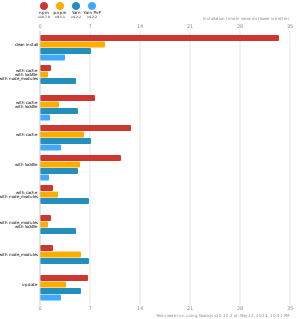
pnpm is up to 2x faster than npm and Yarn classic. See all benchmarks here.
Benchmarks on an app with lots of dependencies:
License
MIT, except the pnpr/ directory, which is source-available under the PolyForm Shield License 1.0.0.