 5c669d7387
Implements Tier 4 pnpmfile hooks for pacquet (#11633, point 4.1): pacquet now discovers and runs a project `.pnpmfile` during dependency management, matching pnpm.

## What it does

- **Discovery** — looks for `.pnpmfile.mjs` then `.pnpmfile.cjs` (dotted names only, `.mjs` preferred), matching pnpm's `requireHooks`. Only actual files are accepted (`is_file()`).
- **`readPackage`** — wired into resolution. Mirrors pnpm's `requirePnpmfile` contract: the four dependency fields are defaulted to `{}` before the hook runs, and the returned manifest is validated (must be a non-null object whose dependency fields, when present, are objects rather than arrays). A throwing/syntactically-invalid pnpmfile, a missing `require`, or a hook that returns nothing aborts the install (`PNPMFILE_FAIL`) instead of being silently ignored.
- **`afterAllResolved`** — wired into the lockfile write. The resolved lockfile is passed to the hook and its return value is what gets written to `pnpm-lock.yaml`. The round-trip goes through `serde_json::Value` (the workspace already enables `preserve_order`) so hook-added keys the typed `Lockfile` cannot represent survive to disk; the round-trip only runs when a hook is present, so unmodified installs write byte-identical lockfiles. A throwing hook aborts the install.
- **`preResolution`** — wired. Receives the resolution context (wanted/current lockfile, `existsCurrentLockfile`, `existsNonEmptyWantedLockfile`, lockfile dir, store dir, registries) over stdin.
- **`filterLog`** — implemented in the bridge but not yet routed through the reporter (pacquet's reporter is a stateless synchronous emitter); deferred, see follow-ups.

## How hooks run

Hooks are served by a long-lived Node.js worker, spawned lazily once per pnpmfile. Requests and responses are newline-delimited JSON over the worker's stdin/stdout, multiplexed by a monotonic request id so the concurrent `readPackage` calls the resolver makes (it resolves dependencies in parallel) share one process. This removes the per-package `node` startup cost on the resolution hot path and avoids interpolating payloads into a `node -e` argument (no `E2BIG` risk for large lockfiles). Each `context.log(...)` a hook emits is forwarded back to the call's log callback. `preResolution` keeps a one-shot `node` invocation since it runs once per install and needs an `info`/`warn` logger.

## Tests

- Unit (hooks crate): readPackage validation (returns nothing / non-object / array dependency fields), manifest-field normalization, syntax-error and missing-module failures, worker request-id multiplexing under concurrency, and `context.log` forwarding.
- Integration (package-manager): a `readPackage` hook pins a transitive dependency version; a hook that returns nothing aborts the install; a pnpmfile syntax error aborts the install; an `afterAllResolved` hook's mutation is written to `pnpm-lock.yaml`; a throwing `afterAllResolved` aborts the install.

## Scope

The remaining pnpmfile-hook surface pnpm has but pacquet does not yet implement — wiring `filterLog` and the `pnpm:hook` log channel into the reporter, the `--pnpmfile` / `--global-pnpmfile` / `--ignore-pnpmfile` flags, pnpmfile checksum invalidation, `updateConfig`, and finders/resolvers/fetchers — is tracked in #12118.

---------

Co-authored-by: Zoltan Kochan <z@kochan.io>
简体中文 | 日本語 | 한국어 | Italiano | Português Brasileiro

Fast, disk space efficient package manager:
- Fast. Up to 2x faster than the alternatives (see benchmark).
- Efficient. Files inside
node_modulesare linked from a single content-addressable storage. - Great for monorepos.
- Strict. A package can access only dependencies that are specified in its
package.json. - Deterministic. Has a lockfile called
pnpm-lock.yaml. - Works as a Node.js version manager. See pnpm runtime.
- Works everywhere. Supports Windows, Linux, and macOS.
- Battle-tested. Used in production by teams of all sizes since 2016.
- See the full feature comparison with npm and Yarn.
To quote the Rush team:
Microsoft uses pnpm in Rush repos with hundreds of projects and hundreds of PRs per day, and we’ve found it to be very fast and reliable.



Platinum Sponsors

|
Gold Sponsors

|

|

|

|

|

|

|

|
Silver Sponsors

|

|

|

|

|

|
|
⏱️ Time.now |
Support this project by becoming a sponsor.
Background
pnpm uses a content-addressable filesystem to store all files from all module directories on a disk. When using npm, if you have 100 projects using lodash, you will have 100 copies of lodash on disk. With pnpm, lodash will be stored in a content-addressable storage, so:
- If you depend on different versions of lodash, only the files that differ are added to the store.
If lodash has 100 files, and a new version has a change only in one of those files,
pnpm updatewill only add 1 new file to the storage. - All the files are saved in a single place on the disk. When packages are installed, their files are linked from that single place consuming no additional disk space. Linking is performed using either hard-links or reflinks (copy-on-write).
As a result, you save gigabytes of space on your disk and you have a lot faster installations!
If you'd like more details about the unique node_modules structure that pnpm creates and
why it works fine with the Node.js ecosystem, read this small article: Flat node_modules is not the only way.
💖 Like this project? Let people know with a tweet
Getting Started
Benchmark
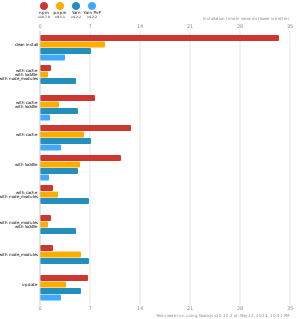
pnpm is up to 2x faster than npm and Yarn classic. See all benchmarks here.
Benchmarks on an app with lots of dependencies:
License
MIT, except the pnpr/ directory, which is source-available under the PolyForm Shield License 1.0.0.