 Zoltan Kochan
5f2bb9f5ba
Zoltan Kochan
5f2bb9f5ba
pnpm can be made to download and execute a native binary through two **repository-controlled** inputs, neither of which was authenticated before this change:

1. **pacquet install engine** — declaring `pacquet` (or `@pnpm/pacquet`) in `configDependencies` (in `pnpm-workspace.yaml`) opts in to pnpm's Rust install engine, and pnpm spawns the platform binary `@pacquet/<platform>-<arch>` during `pnpm install`.
2. **package-manager version switch** — the `packageManager` / `devEngines.packageManager` field makes pnpm download and run a specific pnpm version. This is **on by default** (`onFail` defaults to `download`) and also covers `pnpm self-update` and `pnpm with`.

In both cases the repository also controls the lockfile integrity and the registry the bytes are fetched from (via `.npmrc`), so matching the lockfile integrity proves nothing — it matches the hash the attacker wrote. A cloned, untrusted repository could therefore execute an arbitrary native binary just by running a normal pnpm command.

## Fix (corepack-style registry-signature verification)

pnpm now verifies the **npm registry signature** of the bytes it is about to spawn, **over the installed integrity**, against npm's public signing keys that **ship embedded in the pnpm CLI** (exactly as corepack does). If the bytes on disk were substituted or tampered with, npm's real signature does not validate over them.

- New reusable `verifyInstalledPackageSignatures()` in `@pnpm/deps.security.signatures` verifies `name@version:integrity` against `dist.signatures` using the embedded keys.
- Because the keys are **embedded** (not fetched), a registry the user did not vouch for cannot supply its own keypair to forge a signature. The signed packument is fetched from the **configured** registry, so an **npm mirror works transparently** — it proxies the same signed packument, with no configuration. There is intentionally **no runtime override or off-switch** for the keys.
- **pacquet** (`installing/commands`): verifies the `pacquet` shim and the host platform binary. It **fails the command** if the signature does not verify or cannot be checked (e.g. registry unreachable); the only graceful fallback to pnpm's own engine is when pacquet has no binary for the current platform.
- **pnpm engine** (`engine/pm/commands`): verifies `pnpm`, `@pnpm/exe`, and the host platform binary, **only on a store cache miss** (an actual download), so it adds no network round trip to every command. It **fails closed** — any verification failure, including an unreachable registry, refuses the version switch rather than running an unverified binary.

## Keeping the embedded keys fresh

The embedded keys live in a generated file. `deps/security/signatures/scripts/update-npm-signing-keys.mjs` keeps them in sync with npm's keys endpoint (`pnpm check:npm-signing-keys` / `--update`), and the **create-release-pr** workflow runs the check as a gate, so a key rotation cannot silently break verification — a stale key set blocks the release until refreshed.

## Pacquet parity

pacquet gained `configDependencies` support on `main` (#12285), but it has **no install-engine-spawn sink** — pacquet *is* the engine, and it does not select/spawn an alternate engine from `configDependencies` (its only config-dependency code-execution path is `updateConfig` plugin pnpmfiles, which it shares with pnpm and which this advisory does not cover). So CAND-PNPM-097 has no pacquet-side analog; no pacquet code change is needed.
简体中文 | 日本語 | 한국어 | Italiano | Português Brasileiro

Fast, disk space efficient package manager:
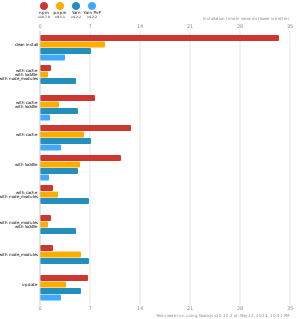
- Fast. Up to 2x faster than the alternatives (see benchmark).
- Efficient. Files inside
node_modulesare linked from a single content-addressable storage. - Great for monorepos.
- Strict. A package can access only dependencies that are specified in its
package.json. - Deterministic. Has a lockfile called
pnpm-lock.yaml. - Works as a Node.js version manager. See pnpm runtime.
- Works everywhere. Supports Windows, Linux, and macOS.
- Battle-tested. Used in production by teams of all sizes since 2016.
- See the full feature comparison with npm and Yarn.
To quote the Rush team:
Microsoft uses pnpm in Rush repos with hundreds of projects and hundreds of PRs per day, and we’ve found it to be very fast and reliable.



Platinum Sponsors

|

|
Gold Sponsors

|

|

|

|

|

|

|

|
Silver Sponsors
|

|

|

|

|

|

|
|
⏱️ Time.now |
Support this project by becoming a sponsor.
Background
pnpm uses a content-addressable filesystem to store all files from all module directories on a disk. When using npm, if you have 100 projects using lodash, you will have 100 copies of lodash on disk. With pnpm, lodash will be stored in a content-addressable storage, so:
- If you depend on different versions of lodash, only the files that differ are added to the store.
If lodash has 100 files, and a new version has a change only in one of those files,
pnpm updatewill only add 1 new file to the storage. - All the files are saved in a single place on the disk. When packages are installed, their files are linked from that single place consuming no additional disk space. Linking is performed using either hard-links or reflinks (copy-on-write).
As a result, you save gigabytes of space on your disk and you have a lot faster installations!
If you'd like more details about the unique node_modules structure that pnpm creates and
why it works fine with the Node.js ecosystem, read this small article: Flat node_modules is not the only way.
💖 Like this project? Let people know with a tweet
Getting Started
Benchmark
pnpm is up to 2x faster than npm and Yarn classic. See all benchmarks here.
Benchmarks on an app with lots of dependencies:
License
MIT, except the pnpr/ directory, which is source-available under the PolyForm Shield License 1.0.0.