 Zoltan Kochan
615c6694e1
Zoltan Kochan
615c6694e1
* feat: support URL-scoped registry auth via npm_config_// and pnpm_config_// env vars

Adds a file-free way to configure registry authentication, e.g.
  npm_config_//registry.npmjs.org/:_authToken=<token>
  pnpm_config_//registry.npmjs.org/:_authToken=<token>

These are host-scoped by construction — the registry the value applies to is
encoded in the (trusted) variable name — so they cannot be redirected to
another host by repository-controlled config. The env value is trusted: it
overrides a project/workspace .npmrc but is still overridden by CLI options.
pnpm_config_ wins over npm_config_ for the same key.

* feat(pacquet): support URL-scoped registry auth via npm_config_// and pnpm_config_// env vars

Pacquet parity for the same feature on the JS side: read URL-scoped registry
credentials from npm_config_//… and pnpm_config_//… environment variables
(e.g. npm_config_//registry.npmjs.org/:_authToken=<token>).

These are trusted (sourced from the environment, not the repository) and
host-scoped by construction, so they sit at the top of the .npmrc precedence
chain — above the project .npmrc. pnpm_config_ wins over npm_config_ for the
same key. Adds an EnvVar::vars() enumeration capability (default empty, so
existing fakes keep compiling; production providers override it).

* fix(pacquet): avoid Unicode ellipsis in a line comment (dylint)

* fix: exclude tokenHelper from URL-scoped env auth; add case-insensitive tests

Address review feedback on pnpm/pnpm#12338:
- A `//host/:tokenHelper` env var would land in authConfig but trip the
  TOKEN_HELPER_IN_PROJECT_CONFIG guard (which only trusts the user .npmrc),
  incorrectly failing. tokenHelper names an executable, so it is now excluded
  from the env-scoped layer entirely.
- Add tests for case-insensitive prefix matching and the tokenHelper exclusion.
- Add a 'text' language hint to the changeset's fenced block (MD040).

* fix(pacquet): avoid panics on non-UTF-8 / non-ASCII env var names

Address CodeRabbit review on the pacquet env-auth code:
- EnvVar::vars() used std::env::vars(), which panics if any env var name or
  value is not valid UTF-8. Iterate vars_os() and skip non-UTF-8 entries,
  matching var()'s .ok() behavior. (SystemEnv and Host.)
- parse_url_scoped_env_name sliced with name[..prefix.len()], which panics
  when the byte index lands inside a multi-byte char. Use boundary-checked
  name.get(..) instead.
- Add a regression test with non-ASCII env var names.

* test: cover env-auth precedence and pacquet end-to-end wiring

Fill the coverage gaps in the URL-scoped env-auth feature:
- JS: assert a CLI-provided //host/:_authToken still beats the same env var
  (workspace < env < CLI), and that non-token cred fields work while a
  non-URL-scoped env key is ignored.
- pacquet: add end-to-end tests through the full config load — that a
  npm_config_//… var is honored and outranks a project .npmrc token for the
  same host, and that the prefix is matched case-insensitively. FakeEnv now
  enumerates via vars() so the env-scoped reader sees the fixture.
简体中文 | 日本語 | 한국어 | Italiano | Português Brasileiro

Fast, disk space efficient package manager:
- Fast. Up to 2x faster than the alternatives (see benchmark).
- Efficient. Files inside
node_modulesare linked from a single content-addressable storage. - Great for monorepos.
- Strict. A package can access only dependencies that are specified in its
package.json. - Deterministic. Has a lockfile called
pnpm-lock.yaml. - Works as a Node.js version manager. See pnpm runtime.
- Works everywhere. Supports Windows, Linux, and macOS.
- Battle-tested. Used in production by teams of all sizes since 2016.
- See the full feature comparison with npm and Yarn.
To quote the Rush team:
Microsoft uses pnpm in Rush repos with hundreds of projects and hundreds of PRs per day, and we’ve found it to be very fast and reliable.



Platinum Sponsors

|

|
Gold Sponsors

|

|

|

|

|

|

|

|
Silver Sponsors

|

|

|

|

|

|

|

|
⏱️ Time.now |
Support this project by becoming a sponsor.
Background
pnpm uses a content-addressable filesystem to store all files from all module directories on a disk. When using npm, if you have 100 projects using lodash, you will have 100 copies of lodash on disk. With pnpm, lodash will be stored in a content-addressable storage, so:
- If you depend on different versions of lodash, only the files that differ are added to the store.
If lodash has 100 files, and a new version has a change only in one of those files,
pnpm updatewill only add 1 new file to the storage. - All the files are saved in a single place on the disk. When packages are installed, their files are linked from that single place consuming no additional disk space. Linking is performed using either hard-links or reflinks (copy-on-write).
As a result, you save gigabytes of space on your disk and you have a lot faster installations!
If you'd like more details about the unique node_modules structure that pnpm creates and
why it works fine with the Node.js ecosystem, read this small article: Flat node_modules is not the only way.
💖 Like this project? Let people know with a tweet
Getting Started
Benchmark
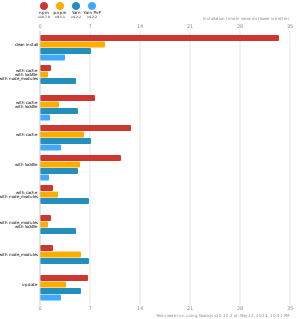
pnpm is up to 2x faster than npm and Yarn classic. See all benchmarks here.
Benchmarks on an app with lots of dependencies:
License
MIT, except the pnpr/ directory, which is source-available under the PolyForm Shield License 1.0.0.