6a5156bed8
## Summary

`pnpm publish` will now let an OIDC-derived token from npm's trusted publishing flow take precedence over a statically configured `_authToken` (e.g. one written from an `NPM_TOKEN` CI secret), mirroring the [npm CLI's behavior](https://github.com/npm/cli/blob/7d900c46/lib/utils/oidc.js).

### Background

We noticed that `pnpm@11.0.0-alpha.5` was published with trusted publishing on npm (its registry metadata has `_npmUser.trustedPublisher` and a SLSA `attestations.provenance` block) — but `pnpm@11.0.6` was not (`_npmUser: pnpmuser`, no attestations). The two were published by different clients: alpha.5 went out via `npm publish` (its metadata carries `_npmVersion: 11.6.2`, which `pnpm publish` never sets), while 11.0.6 went out via `pn release` from `.github/workflows/release.yml`.

Both paths run in CI with `id-token: write` granted, and both have the same `pn config set //registry.npmjs.org/:_authToken "\${NPM_TOKEN}"` step before publish. The difference is purely in how each client orders the auth precedence:

- **npm CLI**: tries the OIDC exchange first; on success **overwrites** the configured `_authToken`. The static token only acts as a fallback when OIDC isn't applicable (no trusted publisher configured, exchange fails, etc.).
- **pnpm publish (before this PR)**: bailed out of OIDC entirely as soon as a token was already configured (`releasing/commands/src/publish/publishPackedPkg.ts`, the old `fetchTokenAndProvenanceByOidcIfApplicable`). Worse, the call site used `??=` so OIDC could never overwrite the static token even if the bail-out had been removed.

So even though pnpm has a complete, working OIDC implementation, any release workflow that still wired in `NPM_TOKEN` silently downgraded to legacy token-based publishing — no `trustedPublisher` on the metadata, no provenance attestation. That's the fix here.

## Changes

- \`fetchTokenAndProvenanceByOidcIfApplicable\` → \`fetchTokenAndProvenanceByOidc\`. Dropped the now-unused \`targetPublishOptions\` parameter and removed the early bail-out — OIDC is always attempted when running in a supported CI environment with \`id-token: write\`.
- At the call site in \`createPublishOptions\`: when OIDC returns an authToken, it now overwrites \`publishOptions.token\` instead of nullish-assigning. The static token still wins when OIDC isn't applicable (no CI env, no trusted publisher configured, exchange fails).
- \`appendAuthOptionsForRegistry\` propagates the (possibly OIDC-overridden) token to the registry-scoped \`\${configKey}:_authToken\`, so libnpmpublish picks it up correctly.
- A \`ProvenanceError\` from \`determineProvenance\` no longer discards the freshly-fetched OIDC authToken — the publish itself can still go through with the OIDC token, again matching npm CLI behavior.
- Exported \`fetchTokenAndProvenanceByOidc\` (marked \`@internal\`) so the precedence rules are unit-testable.

### Recursive publish

The recursive publish loop in \`recursivePublish.ts\` calls \`publishPackedPkg\` once per workspace package, and OIDC token exchange is package-scoped on the npm side (\`/-/npm/v1/oidc/token/exchange/package/\${name}\`). With this fix, every workspace package independently attempts trusted publishing and only falls back to the static token if its own exchange fails. No structural change needed there.
简体中文 | 日本語 | 한국어 | Italiano | Português Brasileiro

Fast, disk space efficient package manager:
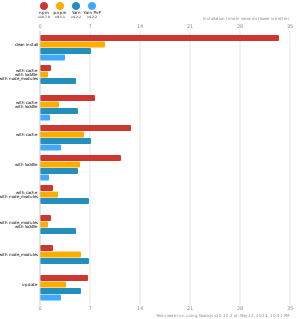
- Fast. Up to 2x faster than the alternatives (see benchmark).
- Efficient. Files inside
node_modulesare linked from a single content-addressable storage. - Great for monorepos.
- Strict. A package can access only dependencies that are specified in its
package.json. - Deterministic. Has a lockfile called
pnpm-lock.yaml. - Works as a Node.js version manager. See pnpm runtime.
- Works everywhere. Supports Windows, Linux, and macOS.
- Battle-tested. Used in production by teams of all sizes since 2016.
- See the full feature comparison with npm and Yarn.
To quote the Rush team:
Microsoft uses pnpm in Rush repos with hundreds of projects and hundreds of PRs per day, and we’ve found it to be very fast and reliable.



Platinum Sponsors

|
Gold Sponsors

|

|

|

|

|

|

|

|
Silver Sponsors

|

|

|

|

|

|
|
⏱️ Time.now |
Support this project by becoming a sponsor.
Background
pnpm uses a content-addressable filesystem to store all files from all module directories on a disk. When using npm, if you have 100 projects using lodash, you will have 100 copies of lodash on disk. With pnpm, lodash will be stored in a content-addressable storage, so:
- If you depend on different versions of lodash, only the files that differ are added to the store.
If lodash has 100 files, and a new version has a change only in one of those files,
pnpm updatewill only add 1 new file to the storage. - All the files are saved in a single place on the disk. When packages are installed, their files are linked from that single place consuming no additional disk space. Linking is performed using either hard-links or reflinks (copy-on-write).
As a result, you save gigabytes of space on your disk and you have a lot faster installations!
If you'd like more details about the unique node_modules structure that pnpm creates and
why it works fine with the Node.js ecosystem, read this small article: Flat node_modules is not the only way.
💖 Like this project? Let people know with a tweet
Getting Started
Benchmark
pnpm is up to 2x faster than npm and Yarn classic. See all benchmarks here.
Benchmarks on an app with lots of dependencies: