 Zoltan Kochan
6a5ad3c59a
Zoltan Kochan
6a5ad3c59a
Implement the five parity gaps tracked in section 3 of pnpm/pnpm#14101.

Recursive batch publish now packs all eligible projects before sending
anything, groups the standard npm publish documents by registry, and uses
pnpr's atomic batch endpoint once per group. It reuses the existing publish
document, authentication, OTP, lifecycle, and summary paths so single and
batch publishing cannot drift. Staging and provenance remain incompatible
with a multi-package request and fail with explicit diagnostics.

Global outdated accepts the recursive spelling already handled by the
TypeScript CLI. Global approve-builds aggregates pending packages across all
install groups, writes one policy under the global packages directory, clears
the corresponding group manifests, and rebuilds each affected group. Since
the TypeScript implementation rejected the same command, this behavior lands
in both stacks; canonical path checks prevent a tampered group symlink from
redirecting approval or rebuild work outside the global package root.

Recursive run and exec share a bounded worker pool per topological chunk,
preserve result ordering, and stop scheduling later batches after a failure
when bail is enabled. Parallel exec removes the cap, matching pnpm's
--parallel shorthand.

SBOM generation with dedicated project lockfiles constructs a synthetic
in-memory workspace lockfile for the selected projects. Importer paths are
validated and rebased to workspace-relative IDs, package and snapshot graphs
are merged, and metadata lookup searches the selected projects' virtual
stores. This supports both filtered output and split output without changing
the on-disk lockfiles.

Related to pnpm/pnpm#14101.
简体中文 | 日本語 | 한국어 | Italiano | Português Brasileiro

Fast, disk space efficient package manager:
- Fast. Up to 2x faster than the alternatives (see benchmark).
- Efficient. Files inside
node_modulesare linked from a single content-addressable storage. - Great for monorepos.
- Strict. A package can access only dependencies that are specified in its
package.json. - Deterministic. Has a lockfile called
pnpm-lock.yaml. - Works as a Node.js version manager. See pnpm runtime.
- Works everywhere. Supports Windows, Linux, and macOS.
- Battle-tested. Used in production by teams of all sizes since 2016.
- Experimental Rust port. Includes pacquet, an experimental port of the CLI written in Rust.
- See the full feature comparison with npm and Yarn.
To quote the Rush team:
Microsoft uses pnpm in Rush repos with hundreds of projects and hundreds of PRs per day, and we’ve found it to be very fast and reliable.



Platinum Sponsors

|

|
Gold Sponsors

|

|

|

|

|

|

|

|
Silver Sponsors

|

|

|

|

|

|

|

|
|
| ⏱️ Time.now |
Support this project by becoming a sponsor.
Background
pnpm uses a content-addressable filesystem to store all files from all module directories on a disk. When using npm, if you have 100 projects using lodash, you will have 100 copies of lodash on disk. With pnpm, lodash will be stored in a content-addressable storage, so:
- If you depend on different versions of lodash, only the files that differ are added to the store.
If lodash has 100 files, and a new version has a change only in one of those files,
pnpm updatewill only add 1 new file to the storage. - All the files are saved in a single place on the disk. When packages are installed, their files are linked from that single place consuming no additional disk space. Linking is performed using either hard-links or reflinks (copy-on-write).
As a result, you save gigabytes of space on your disk and you have a lot faster installations!
If you'd like more details about the unique node_modules structure that pnpm creates and
why it works fine with the Node.js ecosystem, read this small article: Flat node_modules is not the only way.
💖 Like this project? Let people know with a tweet
Getting Started
Benchmark
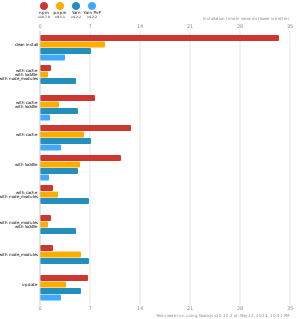
pnpm is up to 2x faster than npm and Yarn classic. See all benchmarks here.
Benchmarks on an app with lots of dependencies:
License
MIT, except the pnpr/ directory, which is source-available under the PolyForm Shield License 1.0.0.