 6aa5b70595
Let a `proxy:` rule name an ordered list of uplinks
(`proxy: npmjs private`, or the YAML sequence form) and walk it as a
fallback chain, matching verdaccio's serial first-success semantics:
try uplinks in declared order, stop at the first that answers, and fall
through to the next on a 404 or an availability failure. A later private
uplink can host a package the primary 404s.

- config: PackageAccess.proxy becomes an ordered AccessSpec list;
  Config::resolve_uplinks returns the chain (skipping unknown names);
  resolve_uplink stays as a primary-only convenience.
- packument: walk the chain, sending each uplink only its own cached
  validators. The cache holds one shared body, so its validators are
  scoped to that body's origin uplink (the validator map is replaced, not
  merged, on every write) — a conditional GET only ever reaches the
  origin, so a 304 can only confirm the bytes actually on disk and can't
  revalidate another origin's body. The freshness window (maxage) comes
  from the primary uplink only.
- tarball: try each uplink in order; integrity binds the streamed bytes,
  so the serving uplink decides whether they are mirrored (caches())
  while the cache read is gated on whether any uplink caches.
- fallthrough is restricted to availability failures
  (RegistryError::allows_uplink_fallthrough): transport errors, an open
  circuit, and upstream 5xx. Any authoritative 4xx (401/403 auth, 429
  throttle, 400/410, ...) stops the walk immediately so a later uplink
  can't mask the primary's rejection of a scoped or rate-limited request.

Out of scope (left to a later change): verdaccio's full cross-uplink
metadata merge and per-version origin tracking. pnpr stays first-success
fallback with one cache entry per package.

Part of pnpm/pnpm#11973.
简体中文 | 日本語 | 한국어 | Italiano | Português Brasileiro

Fast, disk space efficient package manager:
- Fast. Up to 2x faster than the alternatives (see benchmark).
- Efficient. Files inside
node_modulesare linked from a single content-addressable storage. - Great for monorepos.
- Strict. A package can access only dependencies that are specified in its
package.json. - Deterministic. Has a lockfile called
pnpm-lock.yaml. - Works as a Node.js version manager. See pnpm runtime.
- Works everywhere. Supports Windows, Linux, and macOS.
- Battle-tested. Used in production by teams of all sizes since 2016.
- Experimental Rust port. Includes pacquet, an experimental port of the CLI written in Rust.
- See the full feature comparison with npm and Yarn.
To quote the Rush team:
Microsoft uses pnpm in Rush repos with hundreds of projects and hundreds of PRs per day, and we’ve found it to be very fast and reliable.



Platinum Sponsors

|

|
Gold Sponsors

|

|

|

|

|

|

|

|
Silver Sponsors

|

|

|

|

|

|

|

|
|
| ⏱️ Time.now |
Support this project by becoming a sponsor.
Background
pnpm uses a content-addressable filesystem to store all files from all module directories on a disk. When using npm, if you have 100 projects using lodash, you will have 100 copies of lodash on disk. With pnpm, lodash will be stored in a content-addressable storage, so:
- If you depend on different versions of lodash, only the files that differ are added to the store.
If lodash has 100 files, and a new version has a change only in one of those files,
pnpm updatewill only add 1 new file to the storage. - All the files are saved in a single place on the disk. When packages are installed, their files are linked from that single place consuming no additional disk space. Linking is performed using either hard-links or reflinks (copy-on-write).
As a result, you save gigabytes of space on your disk and you have a lot faster installations!
If you'd like more details about the unique node_modules structure that pnpm creates and
why it works fine with the Node.js ecosystem, read this small article: Flat node_modules is not the only way.
💖 Like this project? Let people know with a tweet
Getting Started
Benchmark
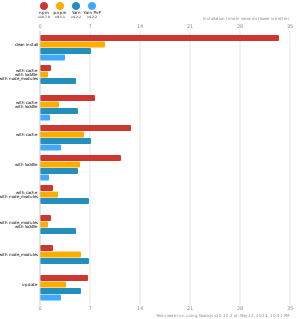
pnpm is up to 2x faster than npm and Yarn classic. See all benchmarks here.
Benchmarks on an app with lots of dependencies:
License
MIT, except the pnpr/ directory, which is source-available under the PolyForm Shield License 1.0.0.