Zoltan Kochan
71dfccce9a
Zoltan Kochan
71dfccce9a
* feat(pacquet): port workspace: protocol resolution and publish-time rewrite

Ports the `workspace:` family of bare specifiers end-to-end:

- `pacquet-workspace-spec` (new) ports `workspace/spec-parser`'s
  `WorkspaceSpec` parser + `toString`.
- `pacquet-workspace-range-resolver` (new) ports
  `workspace/range-resolver`'s `resolveWorkspaceRange` — `*`/`^`/`~`/`""`
  pick the highest version with prereleases included; other inputs
  follow standard semver range rules.
- `pacquet-resolving-npm-resolver` grows two helpers from the upstream
  npm-resolver: `workspace_pref_to_npm` (port of `workspacePrefToNpm.ts`)
  and `try_resolve_from_workspace` (port of `tryResolveFromWorkspace` +
  `tryResolveFromWorkspacePackages` + `pickMatchingLocalVersionOrNull` +
  `resolveFromLocalPackage`). `NpmResolver::resolve_impl` now intercepts
  `workspace:` specs before the npm pick, deferring `workspace:./` /
  `workspace:../` to the local resolver. Emits `link:` / `file:`
  (injected) lockfile resolutions, with the matching
  `WORKSPACE_PKG_NOT_FOUND` / `NO_MATCHING_VERSION_INSIDE_WORKSPACE`
  / `CANNOT_RESOLVE_WORKSPACE_PROTOCOL` error codes preserved.
- `pacquet-exportable-manifest` (new) ports the publish-time
  `replaceWorkspaceProtocol` and `replaceWorkspaceProtocolPeerDependency`
  helpers from `releasing/exportable-manifest`. The full
  `createExportableManifest` (catalog rewrite, jsr rewrite, pre-pack
  hooks, publishConfig overrides) lands as pacquet ports the surrounding
  commands.
- `Install::run` builds a workspace-packages map via
  `find_workspace_projects` when a `pnpm-workspace.yaml` is present and
  threads it through `ResolveOptions::workspace_packages` so the
  resolver chain can satisfy `workspace:` specs from local projects in
  the no-lockfile install path.

Test ports:
- `workspace/spec-parser/test/workspace-spec.test.ts`
- `workspace/range-resolver/test/index.test.ts`
- `resolving/npm-resolver/test/workspacePrefToNpm.test.ts`
- `releasing/exportable-manifest/test/index.test.ts` (workspace cases)
- plus new unit tests for `try_resolve_from_workspace` covering
  `WORKSPACE_PKG_NOT_FOUND`, `NO_MATCHING_VERSION_INSIDE_WORKSPACE`,
  the inject branch, and the `publishConfig.directory` /
  `linkDirectory` handling.

Frozen-lockfile installs already record `link:` entries directly; the
new resolution path matters for the no-lockfile install path.

---
Written by an agent (Claude Code, claude-opus-4-7).

* fix(pacquet): dylint + doc-link nits in workspace-protocol port

- Rename single-letter params (perfectionist::single-letter-*).
- Add trailing commas in multi-line macro invocations.
- Avoid the ambiguous `crate::parse_bare_specifier` doc link and the
  cross-crate `pacquet_workspace_spec::WorkspaceSpec` /
  `pacquet_workspace_range_resolver::resolve_workspace_range` doc
  links (the crates don't have a Cargo dependency on each other, so
  rustdoc can't resolve them).

---
Written by an agent (Claude Code, claude-opus-4-7).

* fix(pacquet): address coderabbit review comments

- replace_workspace_protocol_peer_dependency: use replacen("workspace:", "", 1)
  so compound peer specs match upstream JS String.replace's first-only
  semantics; locked with a new test
  peer_workspace_strip_only_removes_first_occurrence.
- npm-resolver module docs: drop the stale "workspace: returns
  Ok(None)" bullet and explain that non-path workspace specs now route
  through try_resolve_from_workspace while path-relative forms still
  fall through to the local resolver.

The third coderabbit nit (read_workspace_manifest error swallowing in
install.rs) was already addressed by the rebase: the workspace manifest
is now read once at the top of Install::run with proper error
propagation, and build_workspace_packages_map takes the pre-loaded
Option<&WorkspaceManifest> instead of re-reading the file.

---
Written by an agent (Claude Code, claude-opus-4-7).

* fix(pacquet/resolving-npm-resolver): surface WorkspacePkgNotFound.hint

Upstream pnpm's WORKSPACE_PKG_NOT_FOUND error carries a 'hint' field
that PnpmError prints as guidance after the message ('Packages found in
the workspace: ...'). The Rust port was populating the field but the
miette diagnostic didn't reference it, so the help text never reached
the user. Add help("{hint}") to the diagnostic attribute so miette
renders it under the message — matching pnpm's output verbatim.

---
Written by an agent (Claude Code, claude-opus-4-7).
简体中文 | 日本語 | 한국어 | Italiano | Português Brasileiro

Fast, disk space efficient package manager:
- Fast. Up to 2x faster than the alternatives (see benchmark).
- Efficient. Files inside
node_modulesare linked from a single content-addressable storage. - Great for monorepos.
- Strict. A package can access only dependencies that are specified in its
package.json. - Deterministic. Has a lockfile called
pnpm-lock.yaml. - Works as a Node.js version manager. See pnpm runtime.
- Works everywhere. Supports Windows, Linux, and macOS.
- Battle-tested. Used in production by teams of all sizes since 2016.
- See the full feature comparison with npm and Yarn.
To quote the Rush team:
Microsoft uses pnpm in Rush repos with hundreds of projects and hundreds of PRs per day, and we’ve found it to be very fast and reliable.



Platinum Sponsors

|
Gold Sponsors

|

|

|

|

|

|

|

|
Silver Sponsors

|

|

|

|

|

|

|
⏱️ Time.now |
Support this project by becoming a sponsor.
Background
pnpm uses a content-addressable filesystem to store all files from all module directories on a disk. When using npm, if you have 100 projects using lodash, you will have 100 copies of lodash on disk. With pnpm, lodash will be stored in a content-addressable storage, so:
- If you depend on different versions of lodash, only the files that differ are added to the store.
If lodash has 100 files, and a new version has a change only in one of those files,
pnpm updatewill only add 1 new file to the storage. - All the files are saved in a single place on the disk. When packages are installed, their files are linked from that single place consuming no additional disk space. Linking is performed using either hard-links or reflinks (copy-on-write).
As a result, you save gigabytes of space on your disk and you have a lot faster installations!
If you'd like more details about the unique node_modules structure that pnpm creates and
why it works fine with the Node.js ecosystem, read this small article: Flat node_modules is not the only way.
💖 Like this project? Let people know with a tweet
Getting Started
Benchmark
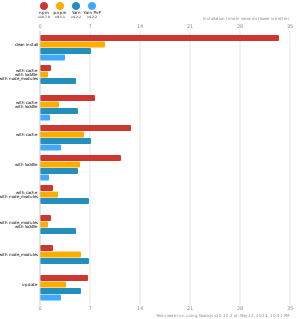
pnpm is up to 2x faster than npm and Yarn classic. See all benchmarks here.
Benchmarks on an app with lots of dependencies: