 Zoltan Kochan
74577d73fa
Zoltan Kochan
74577d73fa
The link pass spawned one CreateVirtualDirBySnapshot per snapshot key.
Under the global virtual store, peer variants of a package whose
recursive dependency hashes are equal map to one slot directory - that
sharing is the point of the hashing - so hash-equal variants raced
concurrent imports against a single path. Immutable packages tolerate
this (their import is marker-gated and safe to skip), but a mutable
`file:` source forces a stage-and-swap, whose remove-then-rename
assumes an exclusive owner: one worker's `remove_dir_all` interleaves
with another's rename and the install fails with `Directory not empty`
or `NotFound` depending on timing. Injected workspace packages in a
peer-heavy monorepo hit this on every install.

pnpm v11 never faces the race because `lockfileToDepGraph` keys its
graph by directory, so one node per location survives graph
construction. Restore that invariant here by grouping slot links by
`slot_dir` before the rayon pass: the first variant materializes the
directory, the rest only report progress, and obsolete-child aliases
recorded against any variant are unioned so stale links still get
removed no matter which variant runs. Without the global virtual store
every group is a singleton and the pass is unchanged.
简体中文 | 日本語 | 한국어 | Italiano | Português Brasileiro

Fast, disk space efficient package manager:
- Fast. Up to 2x faster than the alternatives (see benchmark).
- Efficient. Files inside
node_modulesare linked from a single content-addressable storage. - Great for monorepos.
- Strict. A package can access only dependencies that are specified in its
package.json. - Deterministic. Has a lockfile called
pnpm-lock.yaml. - Works as a Node.js version manager. See pnpm runtime.
- Works everywhere. Supports Windows, Linux, and macOS.
- Battle-tested. Used in production by teams of all sizes since 2016.
- Experimental Rust port. Includes pacquet, an experimental port of the CLI written in Rust.
- See the full feature comparison with npm and Yarn.
To quote the Rush team:
Microsoft uses pnpm in Rush repos with hundreds of projects and hundreds of PRs per day, and we’ve found it to be very fast and reliable.



Platinum Sponsors

|

|
Gold Sponsors

|

|

|

|

|

|

|

|
Silver Sponsors

|

|

|

|

|

|

|

|
|
| ⏱️ Time.now |
Support this project by becoming a sponsor.
Background
pnpm uses a content-addressable filesystem to store all files from all module directories on a disk. When using npm, if you have 100 projects using lodash, you will have 100 copies of lodash on disk. With pnpm, lodash will be stored in a content-addressable storage, so:
- If you depend on different versions of lodash, only the files that differ are added to the store.
If lodash has 100 files, and a new version has a change only in one of those files,
pnpm updatewill only add 1 new file to the storage. - All the files are saved in a single place on the disk. When packages are installed, their files are linked from that single place consuming no additional disk space. Linking is performed using either hard-links or reflinks (copy-on-write).
As a result, you save gigabytes of space on your disk and you have a lot faster installations!
If you'd like more details about the unique node_modules structure that pnpm creates and
why it works fine with the Node.js ecosystem, read this small article: Flat node_modules is not the only way.
💖 Like this project? Let people know with a tweet
Getting Started
Benchmark
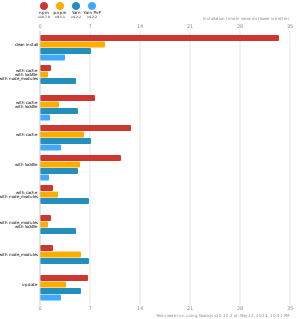
pnpm is up to 2x faster than npm and Yarn classic. See all benchmarks here.
Benchmarks on an app with lots of dependencies:
License
MIT, except the pnpr/ directory, which is source-available under the PolyForm Shield License 1.0.0.