 8bc25f3c26
## Problem

`pacquet` metadata fetches made a single registry request, so a transient
network failure or a retryable HTTP response (`408`/`429`/`5xx`) aborted
resolution — even though the tarball path already followed pnpm's retry policy.
pnpm wraps **every** registry request, metadata and tarball, in `@zkochan/retry`
under one `fetch-retries` budget; pacquet only retried tarballs, and the
metadata retry that was added in the first cut duplicated the tarball budget and
ignored the user's config.

Fixes #11841.

## Solution

A single retry primitive now lives in `pacquet-network` and is driven by config
on the install paths, matching pnpm exactly.

- **One shared `RetryOpts`.** The retry budget (`fetch-retries` /
  `-factor` / `-mintimeout` / `-maxtimeout`) plus its exponential-backoff math
  moves into `pacquet-network`, next to `should_retry_status` and a generic
  `send_with_retry(client, url, opts, build_request) -> (guard, Response)`
  helper. `pacquet-tarball` re-exports `RetryOpts`; the metadata fetchers use
  `send_with_retry`. This removes the duplicate `MetadataRetryOpts`.
- **No parked sockets/permits during backoff.** `send_with_retry` acquires the
  network permit *per attempt* and drops the response and its guard before each
  backoff sleep, so a flapping registry can't pin sockets or hold a concurrency
  permit while it waits. On the winning attempt the guard rides out with the
  `Response` so the caller keeps the permit through body streaming.
- **Config-driven retries on every metadata path.** A config-sourced
  `RetryOpts` (via the existing `retry_opts_from_config`) is threaded through the
  resolution verifier, `NpmResolver`, `NamedRegistryResolver`, and
  `PickPackageContext`, so the metadata and verify paths honor the user's
  `fetch-retries*` settings instead of a hardcoded default — the same way the
  tarball path already did.

### Parity bug fixed

Because the verifier and resolver hardcoded the default retry budget, a `5xx`
flap on the main resolve/verify paths hung for **~70 s** (`10 s + 60 s` default
backoff) regardless of the user's `fetch-retries` setting — a user who set
`fetch-retries=0` to fail fast would still wait. Driving the budget from config
fixes this; test harnesses use a zero-retry budget so failure-path cases don't
wait out the backoff.

### Not pnpr

`pnpr` is intentionally untouched. Retry is an install-time concern: pnpr's
`/v1/install` accelerator already retries through pacquet's resolver and tarball
fetcher, while the verdaccio-style registry-**proxy** path must fail fast (and
serve stale on failure) rather than block a client request behind a 70 s
backoff. The shared `RetryOpts` re-export keeps the accelerator's existing
tarball-download retry compiling unchanged.

---------

Co-authored-by: Zoltan Kochan <z@kochan.io>
简体中文 | 日本語 | 한국어 | Italiano | Português Brasileiro

Fast, disk space efficient package manager:
- Fast. Up to 2x faster than the alternatives (see benchmark).
- Efficient. Files inside
node_modulesare linked from a single content-addressable storage. - Great for monorepos.
- Strict. A package can access only dependencies that are specified in its
package.json. - Deterministic. Has a lockfile called
pnpm-lock.yaml. - Works as a Node.js version manager. See pnpm runtime.
- Works everywhere. Supports Windows, Linux, and macOS.
- Battle-tested. Used in production by teams of all sizes since 2016.
- See the full feature comparison with npm and Yarn.
To quote the Rush team:
Microsoft uses pnpm in Rush repos with hundreds of projects and hundreds of PRs per day, and we’ve found it to be very fast and reliable.



Platinum Sponsors

|
Gold Sponsors

|

|

|

|

|

|

|

|
Silver Sponsors

|

|

|

|

|

|

|
⏱️ Time.now |
Support this project by becoming a sponsor.
Background
pnpm uses a content-addressable filesystem to store all files from all module directories on a disk. When using npm, if you have 100 projects using lodash, you will have 100 copies of lodash on disk. With pnpm, lodash will be stored in a content-addressable storage, so:
- If you depend on different versions of lodash, only the files that differ are added to the store.
If lodash has 100 files, and a new version has a change only in one of those files,
pnpm updatewill only add 1 new file to the storage. - All the files are saved in a single place on the disk. When packages are installed, their files are linked from that single place consuming no additional disk space. Linking is performed using either hard-links or reflinks (copy-on-write).
As a result, you save gigabytes of space on your disk and you have a lot faster installations!
If you'd like more details about the unique node_modules structure that pnpm creates and
why it works fine with the Node.js ecosystem, read this small article: Flat node_modules is not the only way.
💖 Like this project? Let people know with a tweet
Getting Started
Benchmark
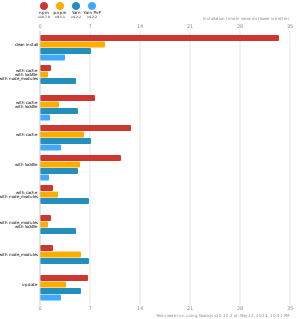
pnpm is up to 2x faster than npm and Yarn classic. See all benchmarks here.
Benchmarks on an app with lots of dependencies:
License
MIT, except the pnpr/ directory, which is source-available under the PolyForm Shield License 1.0.0.