 930c9d7718
* ci(pnpr): add pnpr@<rev> target + Bencher testbed for the install accelerator

Measures the pnpr-accelerated install path end to end. A new `pnpr@<rev>`
target in the integrated-benchmark orchestrator builds both the `pacquet`
client and the `pnpr` server from the revision's monorepo clone, boots a
per-target pnpr server with an isolated `--storage`, and points the client
at it via `PNPR_SERVER`.

Reusing the existing multi-target hyperfine model gives both comparisons:

- `pnpr@HEAD pacquet@HEAD` -> pnpr-vs-direct ratio in one run (same client,
  with and without the accelerator).
- `pnpr@HEAD pnpr@main` -> regression delta tracked in a new Bencher `pnpr`
  testbed.

Two CI workflows mirror the fork-safe two-stage pacquet pattern, triggered
on pnpr/**, pacquet/crates/pnpr-client/**, and pacquet/crates/config/**
(the pnprServer plumbing), running the hot-cache/hot-store restore and
fresh-install scenarios that model a warm long-running server.

* ci(pnpr): fold the install-accelerator bench into the pacquet workflow

The pnpr server is built from the pacquet resolver/store/tarball crates,
so any pacquet change can move the pnpr-accelerated numbers as much as the
direct ones. That means the two benchmarks share a trigger surface and
should co-run — so rather than a separate pnpr workflow posting a second
comment on every pacquet PR, measure both in one run.

The pacquet integrated-benchmark workflow now also runs `pnpr@<rev>`
targets in the two hot-cache/hot-store scenarios (a warm long-running
server is pnpr's realistic shape), emits one combined report/comment, and
uploads to two Bencher testbeds: `pacquet` (direct, all scenarios) and
`pnpr` (accelerated, hot scenarios). The trigger gains `pnpr/**`.

Deletes the standalone pnpr-integrated-benchmark{,-comment}.yml added
earlier in this branch.

* ci(pnpr): also benchmark pnpr with a cold client store

Run the pnpr targets in the cold-cache/cold-store scenarios too, not just
the hot ones. Those scenarios already wipe the client store between
iterations while the per-target pnpr server store stays warm, so this
measures pnpr's cold-client-vs-warm-server shape — the realistic CI case
(empty local store hitting a warm shared server) — alongside the existing
hot-client numbers.

Both tools now run all four scenarios, so the report tables and both
Bencher testbeds (pacquet, pnpr) cover cold and hot. Collapses the two
target-list env vars into one and bumps the cold-step timeouts for the
extra commands. Table rendering is unchanged.

* ci(pnpr): address PR review feedback

- work_env: wrap the spawned pnpr child in its PnprServer guard before the
  readiness wait and .pnpr-env write, so an early panic kills the process
  on unwind instead of leaking an orphaned server (Copilot).
- cli_args: document pnpr@<rev> in the `targets` --help text (CodeRabbit).
- workflows: guard each bencher upload on its file existing, so a missing
  optional results file logs a notice instead of failing the step (Copilot).
简体中文 | 日本語 | 한국어 | Italiano | Português Brasileiro

Fast, disk space efficient package manager:
- Fast. Up to 2x faster than the alternatives (see benchmark).
- Efficient. Files inside
node_modulesare linked from a single content-addressable storage. - Great for monorepos.
- Strict. A package can access only dependencies that are specified in its
package.json. - Deterministic. Has a lockfile called
pnpm-lock.yaml. - Works as a Node.js version manager. See pnpm runtime.
- Works everywhere. Supports Windows, Linux, and macOS.
- Battle-tested. Used in production by teams of all sizes since 2016.
- See the full feature comparison with npm and Yarn.
To quote the Rush team:
Microsoft uses pnpm in Rush repos with hundreds of projects and hundreds of PRs per day, and we’ve found it to be very fast and reliable.



Platinum Sponsors

|
Gold Sponsors

|

|

|

|

|

|

|

|
Silver Sponsors

|

|

|

|

|

|

|
⏱️ Time.now |
Support this project by becoming a sponsor.
Background
pnpm uses a content-addressable filesystem to store all files from all module directories on a disk. When using npm, if you have 100 projects using lodash, you will have 100 copies of lodash on disk. With pnpm, lodash will be stored in a content-addressable storage, so:
- If you depend on different versions of lodash, only the files that differ are added to the store.
If lodash has 100 files, and a new version has a change only in one of those files,
pnpm updatewill only add 1 new file to the storage. - All the files are saved in a single place on the disk. When packages are installed, their files are linked from that single place consuming no additional disk space. Linking is performed using either hard-links or reflinks (copy-on-write).
As a result, you save gigabytes of space on your disk and you have a lot faster installations!
If you'd like more details about the unique node_modules structure that pnpm creates and
why it works fine with the Node.js ecosystem, read this small article: Flat node_modules is not the only way.
💖 Like this project? Let people know with a tweet
Getting Started
Benchmark
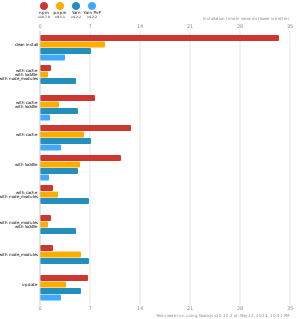
pnpm is up to 2x faster than npm and Yarn classic. See all benchmarks here.
Benchmarks on an app with lots of dependencies:
License
MIT, except the pnpr/ directory, which is source-available under the PolyForm Shield License 1.0.0.