997a8ca9bf
* test(exe): add Windows-only repro for #11486 (pn/pnpx/pnx aliases)

Captures the user-reported failure on a fresh Windows CI: when the
@pnpm/exe install rewrites bin entries to point at .cmd files,
@zkochan/cmd-shim's Bash shim does `exec cmd /C ...target.cmd`, MSYS2
mangles the lone `/C` into a Windows path, and cmd.exe falls into
interactive mode (printing its banner instead of running the alias).

These tests will fail on `windows-latest` until the follow-up commit
points the bin entries at .exe hardlinks of the SEA binary.

* fix(exe): route pn/pnpx/pnx through .exe hardlinks on Windows (#11486)

The @pnpm/exe install rewrote bin to point pn/pnpx/pnx at .cmd files,
which cmd-shim wraps as `exec cmd /C ...target.cmd "$@"` in its Bash
shim. MSYS2 / Git Bash mangles the lone `/C` into a Windows path
before cmd.exe sees it, so cmd.exe finds no /C or /K and falls into
interactive mode — the user sees its banner instead of `pnpm dlx`.

Hardlink pn.exe / pnpx.exe / pnx.exe to the SEA pnpm.exe (in setup.js
preinstall and in self-update's linkExePlatformBinary) and rewrite
those bin entries to the .exe names. cmd-shim emits a direct exec for
.exe sources, taking cmd.exe out of the chain entirely. The SEA reads
process.execPath's basename and prepends `dlx` when launched as
pnpx / pnx.

* test(exe): make Windows alias tests robust to local-dev environments

Two follow-ups from Copilot review on #11501:

* Use `'junction'` instead of `'dir'` for the detect-libc symlink on
  Windows. Non-junction directory symlinks need Developer Mode or
  admin, which the existing failure-path tests already skip on Windows
  for; junctions don't.
* Probe \`bash --version\` before running the Git Bash / MSYS2 alias
  test, and skip cleanly if it isn't on PATH (local Windows dev
  machines often lack it; CI windows-latest ships it). Fold the status
  check into the assertion so a non-zero exit surfaces in the diff.

* test(exe): wire @pnpm/exe into the recursive test runner

The setup.test.ts in this package wasn't running in CI — `@pnpm/exe`
had no `.test` script, so `pn -r .test` (what `test-pkgs-all` runs)
silently skipped it. The existing tests there have apparently been
dead since they were added; the Windows alias repro added in 1e93a1d
inherited the same gap.

Add `.test` (jest invocation, matching every other workspace
package's shape) and a `test` alias so it's picked up by the
recursive runner. meta-updater's @pnpm/exe / artifacts branch
short-circuits before adding test scripts; preserve that behavior by
hand-writing them rather than restructuring the rule.
简体中文 | 日本語 | 한국어 | Italiano | Português Brasileiro

Fast, disk space efficient package manager:
- Fast. Up to 2x faster than the alternatives (see benchmark).
- Efficient. Files inside
node_modulesare linked from a single content-addressable storage. - Great for monorepos.
- Strict. A package can access only dependencies that are specified in its
package.json. - Deterministic. Has a lockfile called
pnpm-lock.yaml. - Works as a Node.js version manager. See pnpm runtime.
- Works everywhere. Supports Windows, Linux, and macOS.
- Battle-tested. Used in production by teams of all sizes since 2016.
- See the full feature comparison with npm and Yarn.
To quote the Rush team:
Microsoft uses pnpm in Rush repos with hundreds of projects and hundreds of PRs per day, and we’ve found it to be very fast and reliable.



Platinum Sponsors

|
Gold Sponsors

|

|

|

|

|

|

|

|
Silver Sponsors

|

|

|

|

|

|

|
⏱️ Time.now |
Support this project by becoming a sponsor.
Background
pnpm uses a content-addressable filesystem to store all files from all module directories on a disk. When using npm, if you have 100 projects using lodash, you will have 100 copies of lodash on disk. With pnpm, lodash will be stored in a content-addressable storage, so:
- If you depend on different versions of lodash, only the files that differ are added to the store.
If lodash has 100 files, and a new version has a change only in one of those files,
pnpm updatewill only add 1 new file to the storage. - All the files are saved in a single place on the disk. When packages are installed, their files are linked from that single place consuming no additional disk space. Linking is performed using either hard-links or reflinks (copy-on-write).
As a result, you save gigabytes of space on your disk and you have a lot faster installations!
If you'd like more details about the unique node_modules structure that pnpm creates and
why it works fine with the Node.js ecosystem, read this small article: Flat node_modules is not the only way.
💖 Like this project? Let people know with a tweet
Getting Started
Benchmark
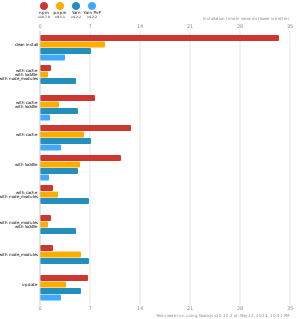
pnpm is up to 2x faster than npm and Yarn classic. See all benchmarks here.
Benchmarks on an app with lots of dependencies: