 a84d2a1157
Add @pnpm/resolving.tarball-url, which builds and recognizes the canonical npm
tarball URL of a package. It vendors getNpmTarballUrl (previously the external
get-npm-tarball-url dependency) and adds isCanonicalRegistryTarballUrl.

@pnpm/lockfile.utils (toLockfileResolution, pkgSnapshotToResolution) and
@pnpm/installing.env-installer now import from the new package; the private copy
of the canonical check in toLockfileResolution is removed, and the external
get-npm-tarball-url dependency and its catalog entry are dropped. The vendored
getNpmTarballUrl is byte-for-byte equivalent to get-npm-tarball-url@2.1.0, so the
fetch paths that use it are unchanged.

Two correctness fixes are folded in while consolidating the logic:
- the scoped-package unescape now handles uppercase %2F as well as %2f
  (percent-encoding is case-insensitive), so canonical scoped URLs are not
  needlessly persisted;
- protocol-insensitive comparison strips only a leading http(s):// scheme via
  regex instead of splitting on the first :// (which could truncate a URL
  containing a later :// and yield a false-positive "canonical" match).

Both fixes are mirrored in the pacquet port (is_canonical_registry_tarball_url
in pacquet/crates/lockfile/src/resolution.rs) so the two stacks omit the same
canonical scoped registry URLs from the lockfile, with matching regression tests.

---------

Co-authored-by: Zoltan Kochan <z@kochan.io>
简体中文 | 日本語 | 한국어 | Italiano | Português Brasileiro

Fast, disk space efficient package manager:
- Fast. Up to 2x faster than the alternatives (see benchmark).
- Efficient. Files inside
node_modulesare linked from a single content-addressable storage. - Great for monorepos.
- Strict. A package can access only dependencies that are specified in its
package.json. - Deterministic. Has a lockfile called
pnpm-lock.yaml. - Works as a Node.js version manager. See pnpm runtime.
- Works everywhere. Supports Windows, Linux, and macOS.
- Battle-tested. Used in production by teams of all sizes since 2016.
- See the full feature comparison with npm and Yarn.
To quote the Rush team:
Microsoft uses pnpm in Rush repos with hundreds of projects and hundreds of PRs per day, and we’ve found it to be very fast and reliable.



Platinum Sponsors

|

|
Gold Sponsors

|

|

|

|

|

|

|

|
Silver Sponsors

|

|

|

|

|

|

|

|
|
| ⏱️ Time.now |
Support this project by becoming a sponsor.
Background
pnpm uses a content-addressable filesystem to store all files from all module directories on a disk. When using npm, if you have 100 projects using lodash, you will have 100 copies of lodash on disk. With pnpm, lodash will be stored in a content-addressable storage, so:
- If you depend on different versions of lodash, only the files that differ are added to the store.
If lodash has 100 files, and a new version has a change only in one of those files,
pnpm updatewill only add 1 new file to the storage. - All the files are saved in a single place on the disk. When packages are installed, their files are linked from that single place consuming no additional disk space. Linking is performed using either hard-links or reflinks (copy-on-write).
As a result, you save gigabytes of space on your disk and you have a lot faster installations!
If you'd like more details about the unique node_modules structure that pnpm creates and
why it works fine with the Node.js ecosystem, read this small article: Flat node_modules is not the only way.
💖 Like this project? Let people know with a tweet
Getting Started
Benchmark
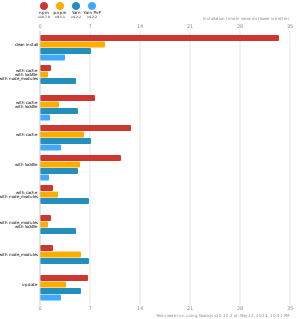
pnpm is up to 2x faster than npm and Yarn classic. See all benchmarks here.
Benchmarks on an app with lots of dependencies:
License
MIT, except the pnpr/ directory, which is source-available under the PolyForm Shield License 1.0.0.