Zoltan Kochan
a8a8cbce6d
Zoltan Kochan
a8a8cbce6d
* feat(pacquet/resolving-local-resolver): port file:/link:/workspace: resolver

Ports pnpm's @pnpm/resolving.local-resolver:

- parse_bare_specifier mirrors parseLocalScheme/parseLocalPath/fromLocal
  (link:/workspace:/file: prefixes, bare path shapes, tarball-filename
  detection, tilde/drive-letter handling, preserveAbsolutePaths,
  injected directories get file: not link:).
- local_resolver provides resolve_from_local_scheme / _path /
  resolve_latest_from_local matching upstream's three exports;
  ssri-based tarball integrity for file: tarballs;
  safe_read_package_json_from_dir for directories with the upstream
  fallback (warn + name=basename / version='0.0.0' for missing link:
  targets, LINKED_PKG_DIR_NOT_FOUND for missing file: targets,
  NOT_PACKAGE_DIRECTORY for ENOTDIR + Windows stat-check) and
  PATH_IS_UNSUPPORTED_PROTOCOL for path:.
- chain.rs wraps the free functions behind the Resolver trait so the
  default-resolver dispatcher can compose this in alongside the npm
  resolver. ResolveResult.name_ver is None for local resolutions —
  the canonical name lives in the fetched manifest, not the
  resolver-time signal.

17 ported tests mirror resolving/local-resolver/test/index.ts plus
3 chain-dispatch tests verifying the trait wiring. The missing-link:
target warn is emitted via tracing::warn! because pacquet's reporter
doesn't yet have a generic pnpm:logger channel.

Install-side wiring is left for a follow-up alongside the Stage-1
directory-fetcher integration: surfacing Directory resolutions to
install_without_lockfile today would only swap the
SPEC_NOT_SUPPORTED_BY_ANY_RESOLVER error for an UnsupportedResolution
one in install_package_from_registry.

Written by an agent (Claude Code, claude-opus-4-7).

* fix(pacquet): satisfy doc + dylint CI

Doc:
- pacquet_directory_fetcher intra-doc link was unresolved
  (resolving-local-resolver has no such dep — it's a sibling).
- LocalSpecError doc linked to crate-private parse_local_scheme /
  parse_local_path.

Dylint (perfectionist):
- PkgResolutionId / WantedLocalDependency / ParseOptions /
  PathProtocolNotSupportedError derive lists reordered to
  prefix_then_alphabetical.
- Single-letter closure params (|p|, |s|, |v|) renamed.
- Impure expression passed to tracing::warn! bound to a let first.
- Multi-line format!/assert_eq! macro invocations gained trailing
  commas; the single-line assert! shed its stray trailing comma.

Written by an agent (Claude Code, claude-opus-4-7).

* fix(pacquet/resolving-local-resolver): surface NOT_PACKAGE_DIRECTORY on Windows

`safe_read_package_json_from_dir` opens `<spec>/package.json` and lets
the OS error surface. On Unix that's `ENOTDIR` for a file path; on
Windows it's `NotFound`, so the resolver fell through to the
fallback-manifest branch instead of returning `NOT_PACKAGE_DIRECTORY`.

Upstream pnpm has the same gap on Windows and patches around it inside
`readProjectManifestOnly` (workspace/project-manifest-reader/src/index.ts#L100-L114
at ef87f3ccff) by stat-checking the spec and synthesizing ENOTDIR.
Mirror the check here so `link:./foo.tgz` raises NOT_PACKAGE_DIRECTORY
on every platform.

Written by an agent (Claude Code, claude-opus-4-7).

* fix(pacquet/resolving-local-resolver): raise LINKED_PKG_DIR_NOT_FOUND for missing tarballs

The `file:` tarball branch wrapped every read failure in
`ResolveLocalError::Integrity`, so `file:./missing.tgz` lost the
pnpm-compatible error code. The directory branch already maps the
same scenario to `LINKED_PKG_DIR_NOT_FOUND`; thread the tarball case
through the same code by short-circuiting on `NotFound` from
`compute_tarball_integrity`. Mirrors upstream's `resolveSpec` catch,
where `getTarballIntegrity`'s ENOENT funnels into the same
LINKED_PKG_DIR_NOT_FOUND throw the directory branch raises.

Adds a `fail_when_resolving_missing_tarball_with_file_protocol` test
to pin the contract.

Resolves a CodeRabbit review comment on #11778.

Written by an agent (Claude Code, claude-opus-4-7).

* feat(pacquet/package-manager): wire LocalResolver into install_without_lockfile chain

`install_without_lockfile`'s resolver chain was `[npm, git]` — `link:`
/ `file:` / `workspace:` and bare-path specifiers raised
`SPEC_NOT_SUPPORTED_BY_ANY_RESOLVER` even though the
`resolving-local-resolver` crate that handles them has been ported.
Slot `LocalResolver` in after git, mirroring upstream's
`createResolver` order (npm → jsr → git → tarball → local-scheme → …
→ local-path).

Pacquet doesn't expose `preserveAbsolutePaths` through `Config` yet
so the context defaults to `false`; once that setting lands in
`pacquet-config` the install path can thread it through.

The install pass still can't materialise Directory resolutions — the
tarball-shaped install path raises `UnsupportedResolution` — but the
resolver chain now correctly dispatches to the local resolver, so
the failure mode moves one step closer to the install-side gap
that's tracked by the Stage-1 `directory-fetcher` integration.

Written by an agent (Claude Code, claude-opus-4-7).

* fix(pacquet): satisfy cargo fmt --check

Local cargo fmt formatted the `fail_when_resolving_missing_tarball_with_file_protocol`
struct literal on one line; the CI Format job (`cargo fmt --all -- --check`)
disagreed. Re-run fmt locally to flush the diff.

Written by an agent (Claude Code, claude-opus-4-7).
简体中文 | 日本語 | 한국어 | Italiano | Português Brasileiro

Fast, disk space efficient package manager:
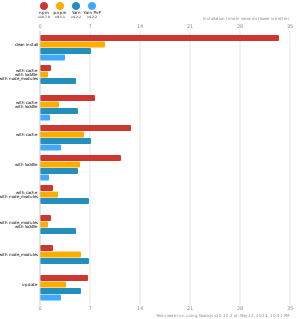
- Fast. Up to 2x faster than the alternatives (see benchmark).
- Efficient. Files inside
node_modulesare linked from a single content-addressable storage. - Great for monorepos.
- Strict. A package can access only dependencies that are specified in its
package.json. - Deterministic. Has a lockfile called
pnpm-lock.yaml. - Works as a Node.js version manager. See pnpm runtime.
- Works everywhere. Supports Windows, Linux, and macOS.
- Battle-tested. Used in production by teams of all sizes since 2016.
- See the full feature comparison with npm and Yarn.
To quote the Rush team:
Microsoft uses pnpm in Rush repos with hundreds of projects and hundreds of PRs per day, and we’ve found it to be very fast and reliable.



Platinum Sponsors

|
Gold Sponsors

|

|

|

|

|

|

|

|
Silver Sponsors

|

|

|

|

|

|

|
⏱️ Time.now |
Support this project by becoming a sponsor.
Background
pnpm uses a content-addressable filesystem to store all files from all module directories on a disk. When using npm, if you have 100 projects using lodash, you will have 100 copies of lodash on disk. With pnpm, lodash will be stored in a content-addressable storage, so:
- If you depend on different versions of lodash, only the files that differ are added to the store.
If lodash has 100 files, and a new version has a change only in one of those files,
pnpm updatewill only add 1 new file to the storage. - All the files are saved in a single place on the disk. When packages are installed, their files are linked from that single place consuming no additional disk space. Linking is performed using either hard-links or reflinks (copy-on-write).
As a result, you save gigabytes of space on your disk and you have a lot faster installations!
If you'd like more details about the unique node_modules structure that pnpm creates and
why it works fine with the Node.js ecosystem, read this small article: Flat node_modules is not the only way.
💖 Like this project? Let people know with a tweet
Getting Started
Benchmark
pnpm is up to 2x faster than npm and Yarn classic. See all benchmarks here.
Benchmarks on an app with lots of dependencies: