 Alessio Attilio
a9d2ec8817
Alessio Attilio
a9d2ec8817
Port pnpm's custom resolver hooks to the Rust pacquet engine: a pnpmfile can export a top-level `resolvers` array whose entries override built-in dependency resolution and force re-resolution when needed. See pnpm/pnpm#10389 for the TypeScript-side feature request that motivated this port.

## What's included

- **Hook contract** — `CustomResolver` trait (`canResolve` / `resolve` / `shouldRefreshResolution`) mirroring `hooks/types/src/index.ts`. All three methods are optional upstream, so the Node worker reports per-resolver capability flags in one IPC round trip and pacquet skips calls a resolver doesn't implement (mirrors pnpm's `if (!customResolver.canResolve || !customResolver.resolve) continue` and `checkCustomResolverForceResolve`'s hook filter).
- **Node IPC** — the long-lived pnpmfile worker gained `resolvers` (capabilities) and `resolver` (method invocation) requests. Methods are invoked with `this` bound to the resolver object, like pnpm. Pending-request cleanup is cancellation-safe via an RAII guard.
- **Adapter & chain integration** — `CustomResolverAdapter` bridges the JSON hook contract to the typed `Resolver` trait. Custom resolvers are built into the inner resolver chain ahead of the built-ins (upstream chain priority), inside the prefetching/observing wrappers so their tarball results get resolve-time prefetch and pnpr streaming. `canResolve` results are memoized keyed `alias@bareSpecifier`, exactly like pnpm's `getCustomResolverCacheKey`. A resolver-returned `manifest` passes through (pnpm spreads the whole hook result). Payloads match upstream: `prevSpecifier`, and resolve opts carry `lockfileDir` / `projectDir` / `preferredVersions` / `currentPkg`.
- **`shouldRefreshResolution` semantics** — port of `checkCustomResolverForceResolve`: the hook receives the merged packages+snapshots entry (pnpm's in-memory `PackageSnapshot`), checks run concurrently with first-true/first-error short-circuit, and a throwing hook aborts the install (`PNPMFILE_FAIL`). A `true` verdict defeats both up-to-date optimizations, as documented in the hook's contract:
  - the prefer-frozen dispatch consults the hook (pnpm: `forceResolutionFromHook` → `needsFullResolution` blocks `isFrozenInstallPossible`) and routes to the fresh-resolve path with lockfile reuse disabled (`UpdateReuseScope::None`);
  - the optimistic repeat-install fast path now ports the pnpmfile branch of `patchesOrHooksAreModified`: the workspace state records the loaded pnpmfile list, and an added/removed/edited pnpmfile invalidates the mtime check.
- **`CurrentPkg`** — added to `ResolveOptions`, matching upstream's `currentPkg` shape `{id, name?, version?, resolution, publishedAt?}` (camelCase).

## Tests

- Adapter unit tests: missing `id`/`resolution`, invalid shapes, `canResolve` memoization, payload shapes, manifest passthrough.
- `check_custom_resolver_force_resolve` unit tests: port of upstream's `checkCustomResolverForceResolve.ts` suite (capability filter, true/false/error propagation, merged snapshot payload).
- Node IPC integration tests against a real pnpmfile: capabilities, `this` binding, round trips, error propagation, cancellation cleanup.
- CLI e2e tests against the mock registry: custom resolver precedence over the npm resolver, `shouldRefreshResolution` re-resolving past an up-to-date lockfile, and a throwing hook failing the install.
简体中文 | 日本語 | 한국어 | Italiano | Português Brasileiro

Fast, disk space efficient package manager:
- Fast. Up to 2x faster than the alternatives (see benchmark).
- Efficient. Files inside
node_modulesare linked from a single content-addressable storage. - Great for monorepos.
- Strict. A package can access only dependencies that are specified in its
package.json. - Deterministic. Has a lockfile called
pnpm-lock.yaml. - Works as a Node.js version manager. See pnpm runtime.
- Works everywhere. Supports Windows, Linux, and macOS.
- Battle-tested. Used in production by teams of all sizes since 2016.
- See the full feature comparison with npm and Yarn.
To quote the Rush team:
Microsoft uses pnpm in Rush repos with hundreds of projects and hundreds of PRs per day, and we’ve found it to be very fast and reliable.



Platinum Sponsors

|

|
Gold Sponsors

|

|

|

|

|

|

|

|
Silver Sponsors

|

|

|

|

|

|

|
|
⏱️ Time.now |
Support this project by becoming a sponsor.
Background
pnpm uses a content-addressable filesystem to store all files from all module directories on a disk. When using npm, if you have 100 projects using lodash, you will have 100 copies of lodash on disk. With pnpm, lodash will be stored in a content-addressable storage, so:
- If you depend on different versions of lodash, only the files that differ are added to the store.
If lodash has 100 files, and a new version has a change only in one of those files,
pnpm updatewill only add 1 new file to the storage. - All the files are saved in a single place on the disk. When packages are installed, their files are linked from that single place consuming no additional disk space. Linking is performed using either hard-links or reflinks (copy-on-write).
As a result, you save gigabytes of space on your disk and you have a lot faster installations!
If you'd like more details about the unique node_modules structure that pnpm creates and
why it works fine with the Node.js ecosystem, read this small article: Flat node_modules is not the only way.
💖 Like this project? Let people know with a tweet
Getting Started
Benchmark
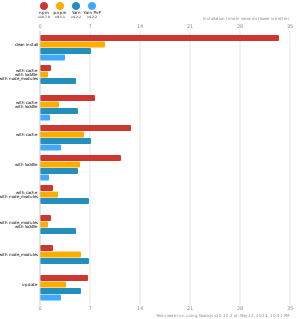
pnpm is up to 2x faster than npm and Yarn classic. See all benchmarks here.
Benchmarks on an app with lots of dependencies:
License
MIT, except the pnpr/ directory, which is source-available under the PolyForm Shield License 1.0.0.