 Zoltan Kochan
a9ee095ca7
Zoltan Kochan
a9ee095ca7
`pylock.toml` was resolved for the machine that ran the install: one
marker environment, one wheel tag order, one wheel per distribution. A
lockfile a repository commits could therefore not serve Linux CI and
macOS or Windows contributors at once, which every repository surveyed in
pnpm/pnpm#14945 needs.

`python.platforms` and `python.pythonVersions` now name the environments
`pylock.toml` is resolved for. Every platform is paired with every
version, and a list left empty is the platform or the version of the
interpreter running the install, so declaring neither keeps the previous
behavior. Each environment is resolved on its own and the answers are
merged into one lockfile: a package pins the wheel every environment
takes for it and carries the PEP 751 `marker` saying which of them
install it. `[tool.pnpm]` records the declared environments, so changing
them resolves the project again.

The interpreter reports what a declared environment resolves as, through
the same host helper that reports its own tags and markers. A platform is
named as a Rust target triple, or as an architecture and the libc
baseline its wheels are built against; `linux`, `macos` and `windows` are
short names for the most common three. An architecture the triple spells
differently from the wheel tag is translated, and a baseline outside the
glibc 2 or musl 1 series is refused. Two names for one environment are
one environment, told apart by what the interpreter reports them as.

`pnpm install` narrows the lockfile to the environment its interpreter
matches: it installs the packages that environment's marker selects and,
for each, the pinned wheel whose tags the interpreter prefers. An
interpreter none of the declared environments stand for is refused, since
nothing in the lockfile answers for it.

A declared environment answers for a platform and a Python version and
nothing else. A requirement whose marker it leaves undecided is refused
rather than locked under a claim the resolution did not make. That covers
a requirement gated on the kernel release, and one gated on a patch
release of a minor version declared without one.

Declared environments are resolved locally, since a pnpr server answers
for one interpreter. An index page is fetched once per run and read back
from its cache for every environment after the first.

Separately, the rule that decides whether a lockfile's marker names the
full interpreter version counted only release segments, so a locked
package requiring `<3.12.0.post1` was claimed for every 3.12 patch
release. A bound whose version falls between two releases now tells them
apart.

Related to pnpm/pnpm#14945.
简体中文 | 日本語 | 한국어 | Italiano | Português Brasileiro

Fast, disk space efficient package manager:
- Fast. Up to 2x faster than the alternatives (see benchmark).
- Efficient. Files inside
node_modulesare linked from a single content-addressable storage. - Great for monorepos.
- Strict. A package can access only dependencies that are specified in its
package.json. - Deterministic. Has a lockfile called
pnpm-lock.yaml. - Works as a Node.js version manager. See pnpm runtime.
- Works everywhere. Supports Windows, Linux, and macOS.
- Battle-tested. Used in production by teams of all sizes since 2016.
- Experimental Rust port. Includes pacquet, an experimental port of the CLI written in Rust.
- See the full feature comparison with npm and Yarn.
To quote the Rush team:
Microsoft uses pnpm in Rush repos with hundreds of projects and hundreds of PRs per day, and we’ve found it to be very fast and reliable.



Platinum Sponsors

|

|

|

|
Gold Sponsors

|

|

|

|

|

|

|

|
Silver Sponsors
|

|

|

|

|

|

|

|
|
| ⏱️ Time.now |
Support this project by becoming a sponsor.
Background
pnpm uses a content-addressable filesystem to store all files from all module directories on a disk. When using npm, if you have 100 projects using lodash, you will have 100 copies of lodash on disk. With pnpm, lodash will be stored in a content-addressable storage, so:
- If you depend on different versions of lodash, only the files that differ are added to the store.
If lodash has 100 files, and a new version has a change only in one of those files,
pnpm updatewill only add 1 new file to the storage. - All the files are saved in a single place on the disk. When packages are installed, their files are linked from that single place consuming no additional disk space. Linking is performed using either hard-links or reflinks (copy-on-write).
As a result, you save gigabytes of space on your disk and you have a lot faster installations!
If you'd like more details about the unique node_modules structure that pnpm creates and
why it works fine with the Node.js ecosystem, read this small article: Flat node_modules is not the only way.
💖 Like this project? Let people know with a tweet
Getting Started
Benchmark
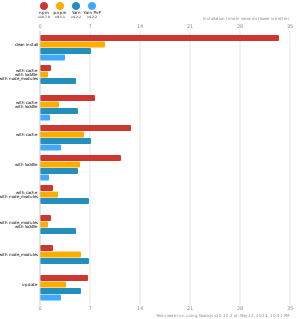
pnpm is up to 2x faster than npm and Yarn classic. See all benchmarks here.
Benchmarks on an app with lots of dependencies:
License
MIT, except the pnpr/ directory, which is source-available under the PolyForm Shield License 1.0.0.