 Zoltan Kochan
aaaca889de
Zoltan Kochan
aaaca889de
APFS serializes metadata-write syscalls volume-wide: measured against a
warm store, clonefile(2) throughput never exceeds its single-thread rate
no matter how many threads issue it, and link(2) scales negatively.
Importing packages one CAS file at a time from a rayon-wide fan-out
therefore sits at a per-volume ceiling, and the kernel lock convoy
behind that ceiling deepens with core count — which is how a warm-store
install that rebuilds node_modules got several times slower than pnpm
11's libuv-4-thread importer on many-core Macs.

Instead of tuning thread counts against a machine-dependent contention
curve, cut the syscall count: materialize each package once into the
canonical global-virtual-store slot under <store>/v11/links (the same
layout, completion-marker protocol, and concurrent-writer healing that
enableGlobalVirtualStore installs already use), then project it into
the project-local virtual store with one directory clonefile(2) per
package. A hot install whose canonical slots already exist pays one
stat and one clonefile per package instead of one syscall per file: on
a 60-project / 1354-package / 44k-file workspace fixture, rebuilding
node_modules from a warm store drops from 10-14s to ~4.4s (pnpm 11:
~14.7s), while the canonical-populating first install stays at the old
per-file cost. The resulting node_modules is byte-identical to the
per-file path's.

The cache engages only on macOS, under the isolated linker, with the
local virtual store, when the import method may clone (auto, clone,
clone-or-copy). Slots that need a build or patch marker, come from
mutable local sources, are force-re-imported, or resolve without a
checkable integrity (git dependencies, whose slot hash cannot see
whether their fetch-time prepare ran) keep the per-file path, so
canonical slots always hold plain pre-build CAS content and stay
interchangeable with what a GVS-enabled install materializes before
its build phase. Slots are addressed only through the content-addressed
graph-hash suffix, and the engine name is resolved synchronously for
eligible installs so those hashes agree with GVS installs sharing the
store. Every cache failure falls back to the per-file import; failures
that condemn the volume (EXDEV, ENOTSUP) disable the cache for the rest
of the process.

The pnpm 11 TypeScript CLI keeps its per-file importer: it cannot issue
a directory clonefile through libuv, its 4-thread pool sits near the
APFS ceiling already, and materialization strategy is not part of the
cross-stack contract. Like the Linux hardlink-first Auto ladder, this
is a v12-only materialization difference shipped behind the major.

Closes pnpm/pnpm#14231.
简体中文 | 日本語 | 한국어 | Italiano | Português Brasileiro

Fast, disk space efficient package manager:
- Fast. Up to 2x faster than the alternatives (see benchmark).
- Efficient. Files inside
node_modulesare linked from a single content-addressable storage. - Great for monorepos.
- Strict. A package can access only dependencies that are specified in its
package.json. - Deterministic. Has a lockfile called
pnpm-lock.yaml. - Works as a Node.js version manager. See pnpm runtime.
- Works everywhere. Supports Windows, Linux, and macOS.
- Battle-tested. Used in production by teams of all sizes since 2016.
- Experimental Rust port. Includes pacquet, an experimental port of the CLI written in Rust.
- See the full feature comparison with npm and Yarn.
To quote the Rush team:
Microsoft uses pnpm in Rush repos with hundreds of projects and hundreds of PRs per day, and we’ve found it to be very fast and reliable.



Platinum Sponsors

|

|

|
Gold Sponsors

|

|

|

|

|

|

|

|

|
Silver Sponsors

|

|

|

|

|

|

|

|
|
| ⏱️ Time.now |
Support this project by becoming a sponsor.
Background
pnpm uses a content-addressable filesystem to store all files from all module directories on a disk. When using npm, if you have 100 projects using lodash, you will have 100 copies of lodash on disk. With pnpm, lodash will be stored in a content-addressable storage, so:
- If you depend on different versions of lodash, only the files that differ are added to the store.
If lodash has 100 files, and a new version has a change only in one of those files,
pnpm updatewill only add 1 new file to the storage. - All the files are saved in a single place on the disk. When packages are installed, their files are linked from that single place consuming no additional disk space. Linking is performed using either hard-links or reflinks (copy-on-write).
As a result, you save gigabytes of space on your disk and you have a lot faster installations!
If you'd like more details about the unique node_modules structure that pnpm creates and
why it works fine with the Node.js ecosystem, read this small article: Flat node_modules is not the only way.
💖 Like this project? Let people know with a tweet
Getting Started
Benchmark
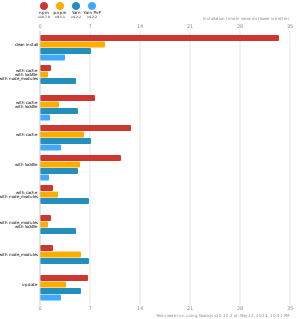
pnpm is up to 2x faster than npm and Yarn classic. See all benchmarks here.
Benchmarks on an app with lots of dependencies:
License
MIT, except the pnpr/ directory, which is source-available under the PolyForm Shield License 1.0.0.