 Zoltan Kochan
aacdcee266
Zoltan Kochan
aacdcee266
## Summary

Third parity gap surfaced by the [pnpm/setup](https://github.com/pnpm/setup) action (after #13194): `pnpm install --no-runtime` without `--frozen-lockfile` was refused with `ERR_PNPM_PACKAGE_MANAGER_UNSUPPORTED_FRESH_INSTALL_SKIP_RUNTIMES`. The setup action passes `--no-runtime` when its `runtime` input is set, so any workspace without a committed `pnpm-lock.yaml` failed its install step. The TypeScript CLI honors the flag in every install mode: runtime dependencies are resolved and recorded in the lockfile, but their archives are not fetched and their bins are not linked (`pnpm11/installing/deps-installer/src/install/index.ts`, the `skipRuntimes` block after `resolution_done`).

## Implementation

- The frozen path's direct-runtime filter (previously inline in `install_frozen_lockfile.rs`) is extracted into a shared `add_direct_runtime_skips` helper in `installability.rs`, next to the `SkippedSnapshots` type it mutates.
- The fresh path now runs the same filter between its `--no-optional` exclusion and the dependency-closure extension, so runtime snapshots never reach the materialization fetch, the hoist, the symlink pass, or bin linking. The skip reuses the transient `optional_excluded` bucket, so nothing is persisted to `.modules.yaml.skipped` and the resolved entries stay in the written lockfile — same as the frozen path.
- `InstallWithFreshLockfile` grows a `skip_runtimes` field, threaded from `Install`; the dispatch-time guard and its `UnsupportedFreshInstallSkipRuntimes` error variant are removed.

## Parity notes

- Rust-only change; the TypeScript CLI already behaves this way. Changeset targets `pacquet` (patch).
- One deliberate behavior pin: after `install --no-runtime`, a follow-up plain `install` reports the modules state up to date and does **not** restore the skipped runtime. I verified empirically that TypeScript pnpm 11.13 behaves identically (`Already up to date`), so the integration test pins the current parity rather than a hypothetical restore. If we ever want the restore behavior, it needs to change in both stacks together.

## Tests

- `fresh_install_with_no_runtime_resolves_but_does_not_fetch_the_runtime` (integration, mocked node release): fresh `install --no-runtime` succeeds, the runtime stays in the written lockfile, `node_modules/node` and its bin links are absent, and the archive endpoint records zero hits — including across the follow-up plain install.
- The old guard unit test is repurposed as `fresh_install_honors_skip_runtimes` (dispatch must not refuse the flag).
- Full `pacquet-package-manager` + `pacquet-cli` suites: 2858/2858 pass; fmt / clippy / doc clean (pre-push gate).
简体中文 | 日本語 | 한국어 | Italiano | Português Brasileiro

Fast, disk space efficient package manager:
- Fast. Up to 2x faster than the alternatives (see benchmark).
- Efficient. Files inside
node_modulesare linked from a single content-addressable storage. - Great for monorepos.
- Strict. A package can access only dependencies that are specified in its
package.json. - Deterministic. Has a lockfile called
pnpm-lock.yaml. - Works as a Node.js version manager. See pnpm runtime.
- Works everywhere. Supports Windows, Linux, and macOS.
- Battle-tested. Used in production by teams of all sizes since 2016.
- Experimental Rust port. Includes pacquet, an experimental port of the CLI written in Rust.
- See the full feature comparison with npm and Yarn.
To quote the Rush team:
Microsoft uses pnpm in Rush repos with hundreds of projects and hundreds of PRs per day, and we’ve found it to be very fast and reliable.



Platinum Sponsors

|

|
Gold Sponsors

|

|

|

|

|

|

|

|
Silver Sponsors

|

|

|

|

|

|

|

|
|
| ⏱️ Time.now |
Support this project by becoming a sponsor.
Background
pnpm uses a content-addressable filesystem to store all files from all module directories on a disk. When using npm, if you have 100 projects using lodash, you will have 100 copies of lodash on disk. With pnpm, lodash will be stored in a content-addressable storage, so:
- If you depend on different versions of lodash, only the files that differ are added to the store.
If lodash has 100 files, and a new version has a change only in one of those files,
pnpm updatewill only add 1 new file to the storage. - All the files are saved in a single place on the disk. When packages are installed, their files are linked from that single place consuming no additional disk space. Linking is performed using either hard-links or reflinks (copy-on-write).
As a result, you save gigabytes of space on your disk and you have a lot faster installations!
If you'd like more details about the unique node_modules structure that pnpm creates and
why it works fine with the Node.js ecosystem, read this small article: Flat node_modules is not the only way.
💖 Like this project? Let people know with a tweet
Getting Started
Benchmark
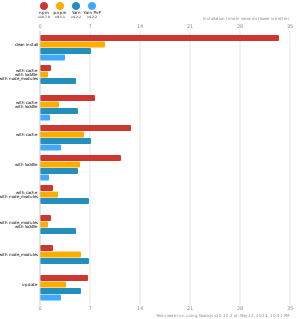
pnpm is up to 2x faster than npm and Yarn classic. See all benchmarks here.
Benchmarks on an app with lots of dependencies:
License
MIT, except the pnpr/ directory, which is source-available under the PolyForm Shield License 1.0.0.