 KhảiandClaude
ac367fce91
KhảiandClaude
ac367fce91
* chore: enable clippy::pedantic lint group for pacquet workspace * style(pacquet): comply with clippy::pedantic Apply clippy's machine-applicable pedantic fixes across the workspace (inlined format args, removed needless borrows/closures, added must_use, etc.), fix a few doc-comment backtick nits, and drop pointless #[inline(always)] on trivial accessors. Opt specific pedantic lints back out in [workspace.lints.clippy] with documented justifications, grouped into false positives, library-API hygiene that doesn't fit an internal CLI, suggestions that conflict with the cardinal rule of porting pnpm 1:1, and opinionated style. * style: taplo-format Cargo.toml lint table * style(pnpr): comply with clippy::pedantic in merged auth backend code Re-apply pedantic compliance to the networked-SQLite auth backend that landed on main (#12186, #12199/#12206): doc-comment backticks, #[must_use] on constructors and status_code, i64::from over `as`, map_or, and a method-reference closure. * docs(clippy): trim and inline the pedantic allow-list comments * docs(clippy): note perfectionist supersedes many_single_char_names * docs(clippy): note pnpm-mirroring rationale on structure/naming lints * docs(clippy): mark unused_async as deferred pending audit * style: enable clippy::match_wildcard_for_single_variants * refactor: enable clippy::unused_self Convert two self-less private methods (overrides pick_most_specific, tarball head_only_result) to associated functions. * refactor: enable clippy::ref_option Widen engine_json to Option<&str>; #[expect] the two serde serialize_with helpers, which serde must call as f(&field, ser). * perf: enable clippy::trivially_copy_pass_by_ref Pass the 1-byte Copy types NodeLinker and FilterWorkspaceProjectsOptions by value; #[expect] the serde skip_serializing_if helper is_false. * perf: enable clippy::assigning_clones Use clone_from for seven field assignments to reuse allocations. * style: enable clippy::manual_let_else Convert 27 match/if-let guards to let-else; preserve the non-UTF-8 skip rationale comment in the directory walker. * style: enable clippy::default_trait_access Name the concrete type on Default::default() call sites; #[expect] two struct-literal test fixtures where naming each field type would force ~20 imports. * refactor: enable clippy::format_push_string Replace push_str(&format!(...)) with write!/writeln! into the target String (local 'use std::fmt::Write as _'); writeln! preserves the exact LF/CRLF shell-shim output. * refactor: enable clippy::needless_pass_by_value Take by reference where the argument is only read (incl. dropping some redundant clones in resolve_peers' recursion). Where converting would cascade badly, #[expect] with a reason: functions that destructure/consume the arg (build_resolve_result, PrefetchingResolver, S3Store::new), the by-value `impl IntoIterator + Clone` in build_direct_deps_by_importer, and the serde/test helpers whose owned fixtures keep call sites clean. * fix(perfectionist): satisfy dylint after format_push_string changes Add trailing commas to the multi-line writeln! shell-shim templates (macro_trailing_comma) and merge the new `fmt::Write as _` imports into each file's existing `use std::{...}` block (import_granularity). * docs(clippy): explain missing_errors_doc suppression; mark missing_panics_doc deferred * fix(perfectionist): collapse fmt::{self, Write as _} in work_env imports The format_push_string Write import landed as a sibling fmt:: path next to the existing fmt import; merge them so import_granularity passes. * style: enable clippy::return_self_not_must_use Add #[must_use] to the WorkspaceTreeCtx builder methods, matching the #[must_use] already on the parallel TreeCtx builders. * perf: enable clippy::large_stack_arrays Heap-allocate the 64 KiB read buffer in verify_file_integrity with a Vec instead of placing it on the stack. * chore(clippy): enable clippy::nursery group Enable the nursery lint group on the pacquet/pnpr workspace and bring the code into compliance. Fixed in code: - iter_on_single_items: [x].into_iter()/.iter() -> std::iter::once - equatable_if_let: pattern match -> equality check (the install_accelerator rewrite wraps in a multi-line matches!, which gets a trailing comma for perfectionist::macro_trailing_comma) - needless_pass_by_ref_mut: load_pending_row/apply_write_msg take &StoreIndex Opted back out in Cargo.toml, each with a documented justification: use_self, too_long_first_doc_paragraph, missing_const_for_fn, option_if_let_else, significant_drop_tightening, redundant_pub_crate, derive_partial_eq_without_eq, branches_sharing_code, useless_let_if_seq, single_option_map, iter_with_drain, literal_string_with_formatting_args, collection_is_never_read. Dropped the now-redundant individual nursery warns (needless_collect, or_fun_call, redundant_clone) the group now covers, plus the default-on unnecessary_lazy_evaluations. Kept clone_on_ref_ptr and if_then_some_else_none (restriction lints not enabled by any group). * style: bring merged main code into clippy pedantic compliance The 17 commits merged from main predate this branch's pedantic/nursery lint config, so their new code tripped pedantic lints. Apply the machine-applicable fixes (uninlined_format_args, if_not_else, elidable_lifetime_names, must_use_candidate, single_match_else, map_unwrap_or, default_trait_access, assigning_clones, doc_markdown, ...) and re-add the documented #[expect(needless_pass_by_value)] on S3Store::new that this branch had carried on the now-replaced file. * style: bring merged main code into clippy pedantic compliance The 28 commits merged from main predate this branch's lint config, so their new code tripped pedantic lints. Apply the machine-applicable fixes (uninlined_format_args, manual_let_else, needless_raw_string_hashes, redundant_closure_for_method_calls, map_unwrap_or, elidable_lifetime_names, doc_markdown, ...) plus a few by hand: - derive Copy on LinkSlotsParallel (all fields are Copy/refs) to clear needless_pass_by_value without a signature change - deduplicate_all takes &[Vec<DepPath>] (it only borrows the duplicates) - pick_most_specific becomes an associated fn (it never used self) - default_trait_access -> concrete types; assigning_clones -> clone_from; format_push_string -> write! - #[expect] with reasons where a fix would churn main's feature code: needless_pass_by_value on the recursive resolve_node and a test helper, and float_cmp on two deterministic-fixture assertions * style: enable clippy::allow_attributes and allow_attributes_without_reason Both are restriction lints (not implied by any group), enabled alongside the existing clone_on_ref_ptr / if_then_some_else_none. Convert every #[allow(...)] (including one nested in cfg_attr) to #[expect(...)]; all already carried a reason, so allow_attributes_without_reason is satisfied. Drop two now-redundant suppressions surfaced by the conversion: a duplicated #[expect(too_many_arguments)] on fetch_and_extract_zip_once (a prior merge left both an allow and an expect), and the #[expect(dead_code)] on MissingPeerInfo's fields (the #[derive(Debug, Clone)] already reads them, so dead_code never fired). clone_on_ref_ptr was already enabled. mod_module_files is intentionally NOT enabled: it mandates mod.rs, the opposite of the flat module.rs pattern this project requires (CODE_STYLE_GUIDE.md, enforced by perfectionist::flat_module_pattern). * style: enable clippy::mod_module_files to enforce the flat module layout mod_module_files bans mod.rs files, enforcing the flat module.rs pattern this project already uses (0 mod.rs in the tree, so no violations). Update CODE_STYLE_GUIDE.md to cite it as the enforcer; perfectionist's flat_module_pattern is being retired in favor of this Clippy rule. * fix(perfectionist): trailing comma on wrapped assert_eq! in workspace_yaml tests The default_trait_access fix lengthened the assert_eq! so fmt wrapped it to multi-line, which perfectionist::macro_trailing_comma requires to end with a trailing comma. * fix(fs): use cfg_attr expect instead of allow for Windows-unused mode args With clippy::allow_attributes enabled, the #[cfg_attr(windows, allow(unused))] on make_file_executable and the ensure_file/write_atomic mode params fails Windows CI. Switch to #[cfg_attr(windows, expect(unused, reason = ...))]; on Windows the lint fires (Unix mode unused there) so the expectation is fulfilled, and the attribute stays inert on Unix. * fix(fs): drop the Windows unused suppression on ensure_file's mode arg ensure_file forwards mode to verify_or_rewrite unconditionally, so it is used on Windows too; the #[cfg_attr(windows, expect(unused))] was therefore unfulfilled and failed Windows CI under -D warnings. write_atomic and make_file_executable keep their expect — they use mode/file only under #[cfg(unix)], so the lint fires (and the expectation holds) on Windows. * chore(git): revert "fix(fs): drop the Windows unused suppression on ensure_file's mode arg" This reverts commit1d617c3e1f. * chore(git): revert "fix(fs): use cfg_attr expect instead of allow for Windows-unused mode args" This reverts commit155e4a3dde. * chore(git): revert "style: enable clippy::allow_attributes and allow_attributes_without_reason" This reverts commita47d7926f2. * style: bring merged main code into clippy compliance + fix merge mismatch - Add & at the two run_postinstall_hooks / run_project_lifecycle_scripts call sites: this branch widened lifecycle.rs to take &RunPostinstallHooks, but main's by-value call sites came in via the conflict resolution. - pedantic fixes on main's new code: must_use_candidate, unnested_or_patterns, manual_let_else, default_trait_access, iter_on_single_items, and trivially_copy_pass_by_ref (map_node_linker takes NodeLinker by value). --------- Co-authored-by: Claude <noreply@anthropic.com>
简体中文 | 日本語 | 한국어 | Italiano | Português Brasileiro

Fast, disk space efficient package manager:
- Fast. Up to 2x faster than the alternatives (see benchmark).
- Efficient. Files inside
node_modulesare linked from a single content-addressable storage. - Great for monorepos.
- Strict. A package can access only dependencies that are specified in its
package.json. - Deterministic. Has a lockfile called
pnpm-lock.yaml. - Works as a Node.js version manager. See pnpm runtime.
- Works everywhere. Supports Windows, Linux, and macOS.
- Battle-tested. Used in production by teams of all sizes since 2016.
- See the full feature comparison with npm and Yarn.
To quote the Rush team:
Microsoft uses pnpm in Rush repos with hundreds of projects and hundreds of PRs per day, and we’ve found it to be very fast and reliable.



Platinum Sponsors

|

|
Gold Sponsors

|

|

|

|

|

|

|

|
Silver Sponsors

|

|

|

|

|

|

|

|
⏱️ Time.now |
Support this project by becoming a sponsor.
Background
pnpm uses a content-addressable filesystem to store all files from all module directories on a disk. When using npm, if you have 100 projects using lodash, you will have 100 copies of lodash on disk. With pnpm, lodash will be stored in a content-addressable storage, so:
- If you depend on different versions of lodash, only the files that differ are added to the store.
If lodash has 100 files, and a new version has a change only in one of those files,
pnpm updatewill only add 1 new file to the storage. - All the files are saved in a single place on the disk. When packages are installed, their files are linked from that single place consuming no additional disk space. Linking is performed using either hard-links or reflinks (copy-on-write).
As a result, you save gigabytes of space on your disk and you have a lot faster installations!
If you'd like more details about the unique node_modules structure that pnpm creates and
why it works fine with the Node.js ecosystem, read this small article: Flat node_modules is not the only way.
💖 Like this project? Let people know with a tweet
Getting Started
Benchmark
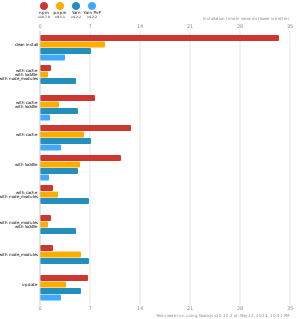
pnpm is up to 2x faster than npm and Yarn classic. See all benchmarks here.
Benchmarks on an app with lots of dependencies:
License
MIT, except the pnpr/ directory, which is source-available under the PolyForm Shield License 1.0.0.