Zoltan Kochan
ae2175829a
Zoltan Kochan
ae2175829a
* feat(registry-access): extract setDistTag and dogfood from tests

Add `@pnpm/registry-access.commands#setDistTag` — the low-level PUT to
`/-/package/:pkg/dist-tags/:tag`. The CLI `dist-tag add` handler now
calls it instead of issuing the fetch inline.

Tests in this monorepo now use a thin new package
`@pnpm/testing.registry-mock` (REGISTRY_MOCK_PORT + REGISTRY_MOCK_CREDENTIALS
baked in) that delegates to `setDistTag`, replacing `addDistTag` from
`@pnpm/registry-mock`. That dropped helper relied on
`anonymous-npm-registry-client` and a verdaccio-era
fetch-then-DELETE-then-PUT dance that is no longer needed against
pnpm-registry.

39 test files swapped from `@pnpm/registry-mock` to
`@pnpm/testing.registry-mock`.

* fix: move setDistTag to its own package to break tsconfig project-reference cycle

testing/registry-mock → registry-access.commands → releasing/commands
→ installing/commands → installing/deps-installer → testing/registry-mock.

Extract setDistTag into @pnpm/registry-access.set-dist-tag (only depends
on @pnpm/error, @pnpm/network.fetch, @pnpm/npm-package-arg). Both
@pnpm/registry-access.commands and @pnpm/testing.registry-mock import
from it. Cycle gone.

* feat(registry-access): extract addUser helper, dogfood from login + tests

Add @pnpm/registry-access.add-user — a small helper that PUTs to
/-/user/org.couchdb.user:<name> and returns { token }. The CLI's
classicLogin (pnpm login fallback path) now calls it, and tests
use it via @pnpm/testing.registry-mock instead of the legacy
addUser from @pnpm/registry-mock.

Swapped 3 call sites: globalSetup.js, installing/deps-installer's
auth.ts, and pnpm/test/dlx.ts. AddUserHttpError exposes status +
text + parsed-json-if-applicable + headers so the CLI can still
do its OTP detection. One webauth-OTP login test mock had to be
adjusted to provide its body via `text` (JSON-stringified) rather
than `json` only, since the helper consumes the body via `text()`.

* refactor: consolidate set-dist-tag + add-user helpers into one @pnpm/registry-access.client package

One shared package is better than splitting per endpoint. Future endpoints
(publish, deprecate, etc.) can land here without another wrapper.

No behavioral change — same setDistTag and addUser exports as before,
just under one roof. Callers updated: registry-access.commands,
auth.commands, testing.registry-mock.

* fix(registry-access): sort imports
简体中文 | 日本語 | 한국어 | Italiano | Português Brasileiro

Fast, disk space efficient package manager:
- Fast. Up to 2x faster than the alternatives (see benchmark).
- Efficient. Files inside
node_modulesare linked from a single content-addressable storage. - Great for monorepos.
- Strict. A package can access only dependencies that are specified in its
package.json. - Deterministic. Has a lockfile called
pnpm-lock.yaml. - Works as a Node.js version manager. See pnpm runtime.
- Works everywhere. Supports Windows, Linux, and macOS.
- Battle-tested. Used in production by teams of all sizes since 2016.
- See the full feature comparison with npm and Yarn.
To quote the Rush team:
Microsoft uses pnpm in Rush repos with hundreds of projects and hundreds of PRs per day, and we’ve found it to be very fast and reliable.



Platinum Sponsors

|
Gold Sponsors

|

|

|

|

|

|

|

|
Silver Sponsors

|

|

|

|

|

|

|
⏱️ Time.now |
Support this project by becoming a sponsor.
Background
pnpm uses a content-addressable filesystem to store all files from all module directories on a disk. When using npm, if you have 100 projects using lodash, you will have 100 copies of lodash on disk. With pnpm, lodash will be stored in a content-addressable storage, so:
- If you depend on different versions of lodash, only the files that differ are added to the store.
If lodash has 100 files, and a new version has a change only in one of those files,
pnpm updatewill only add 1 new file to the storage. - All the files are saved in a single place on the disk. When packages are installed, their files are linked from that single place consuming no additional disk space. Linking is performed using either hard-links or reflinks (copy-on-write).
As a result, you save gigabytes of space on your disk and you have a lot faster installations!
If you'd like more details about the unique node_modules structure that pnpm creates and
why it works fine with the Node.js ecosystem, read this small article: Flat node_modules is not the only way.
💖 Like this project? Let people know with a tweet
Getting Started
Benchmark
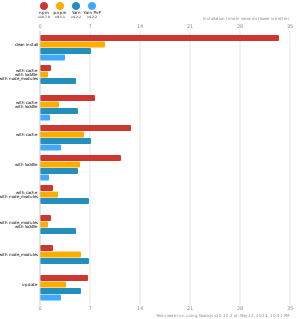
pnpm is up to 2x faster than npm and Yarn classic. See all benchmarks here.
Benchmarks on an app with lots of dependencies: