 ae6e07705d
## What

Ports pnpm's `outdated` command to pacquet. It reports the direct dependencies whose newest published version (or highest in-range version under `--compatible`) is newer than the lockfile-pinned version, and exits with code `1` when any outdated dependency is found.

This widens pacquet's command surface beyond `install`/`add`/`update`/`remove`.

## How

- **Detection core** — `collect_outdated` / `OutdatedQuery` / `TargetVersion` in `pacquet/crates/cli/src/cli_args/outdated.rs`. This is shared with `update --interactive`, which already computed the same "what has a newer version" list inline; that code now calls the shared collector. The two callers differ only in the `TargetVersion` they compare against (`outdated` → `latest` tag / highest in-range under `--compatible`; `update` → the version a bump moves to). Packument fetches fan out concurrently via `futures::join_all`, mirroring pnpm's `Promise.all` (bounded by the HTTP client's per-registry concurrency limit).
- **Flags** — `--compatible`, `--long`, `--format table|list|json` (plus `--no-table` / `--json` shorthands), `-P/--prod` (`--production`), `-D/--dev`, `--no-optional` (following pnpm's `only`-normalization include-set), `--sort-by name` (default sort is by semver-change size then name), and positional name patterns (`@pnpm/config.matcher`).
- **Exit code** — `OutdatedArgs::run` returns an `OutdatedOutcome`; the single `process::exit(1)` lives in the top-level CLI dispatch, keeping the command composable.
- **`--global` and `--recursive` are rejected** with a "not supported yet" message, matching `pacquet update` (single-project scope).
- **Empty-manifest short-circuit** — a dependency-free manifest reports empty (exit 0) *before* the no-lockfile check, matching pnpm's `packageHasNoDeps` behavior so an empty, never-installed project doesn't error.
- **Rendering** — adds `tabled` (`Style::modern()` reproduces pnpm's `@zkochan/table` full-grid borders) and `owo-colors` (auto-disables on non-TTY, like chalk, so piped/JSON output is escape-free). Both are MIT (allowed by `deny.toml`). JSON output is keyed by package name with `current` / `latest` / `wanted` / `isDeprecated` / `dependencyType` (+ `latestManifest` under `--long`), matching pnpm's `renderOutdatedJSON`.
- Adds an optional `homepage` field to the registry `Package` for the `--long` details column.

## Parity notes / scope

pacquet loads a single (wanted) lockfile, so `current == wanted` and pnpm's "missing (wanted X)" state does not arise. `OUTDATED_NO_LOCKFILE` is raised when a manifest declares dependencies but no lockfile exists. Deprecated-but-current packages are still reported.

Deferred with their surrounding features (not yet ported to pacquet), each tracked by an upstream test that does not yet translate:
- `--long` **homepage** needs full registry metadata; the abbreviated fetch omits it, so it appears only when the registry serves it (deprecation details work fully).
- `minimumReleaseAge` / `minimumReleaseAgeExclude`, `pnpm.updateConfig.ignoreDependencies`, `catalog:` protocol replacement, `-g`/global packages, recursive workspace listing, and `runtime:` (node/deno/bun) dependencies.

## Tests

Ported the translatable pnpm `outdated` tests (`deps/inspection/outdated/test/*` and `deps/inspection/commands/test/outdated/*`):

- **10 unit tests** — semver-change classification, include-set normalization (default / `--prod` / `--dev` / `--no-optional`), default sort order, `renderLatest` (deprecated / not), and JSON shape (with/without `--long`).
- **14 integration tests** against the mocked registry — newer-version report, `--compatible` discrimination, JSON, JSON-empty `{}`, list (`--no-table`) format, up-to-date → exit 0, name-pattern filter, prod/dev filtering, npm-alias real-name reporting, deprecated package, `--long` deprecation details, no-deps/no-lockfile → empty exit 0, no-lockfile-with-deps error, and `--recursive` rejection.
简体中文 | 日本語 | 한국어 | Italiano | Português Brasileiro

Fast, disk space efficient package manager:
- Fast. Up to 2x faster than the alternatives (see benchmark).
- Efficient. Files inside
node_modulesare linked from a single content-addressable storage. - Great for monorepos.
- Strict. A package can access only dependencies that are specified in its
package.json. - Deterministic. Has a lockfile called
pnpm-lock.yaml. - Works as a Node.js version manager. See pnpm runtime.
- Works everywhere. Supports Windows, Linux, and macOS.
- Battle-tested. Used in production by teams of all sizes since 2016.
- See the full feature comparison with npm and Yarn.
To quote the Rush team:
Microsoft uses pnpm in Rush repos with hundreds of projects and hundreds of PRs per day, and we’ve found it to be very fast and reliable.



Platinum Sponsors

|
Gold Sponsors

|

|

|

|

|

|

|

|
Silver Sponsors

|

|

|

|

|

|
|
⏱️ Time.now |
Support this project by becoming a sponsor.
Background
pnpm uses a content-addressable filesystem to store all files from all module directories on a disk. When using npm, if you have 100 projects using lodash, you will have 100 copies of lodash on disk. With pnpm, lodash will be stored in a content-addressable storage, so:
- If you depend on different versions of lodash, only the files that differ are added to the store.
If lodash has 100 files, and a new version has a change only in one of those files,
pnpm updatewill only add 1 new file to the storage. - All the files are saved in a single place on the disk. When packages are installed, their files are linked from that single place consuming no additional disk space. Linking is performed using either hard-links or reflinks (copy-on-write).
As a result, you save gigabytes of space on your disk and you have a lot faster installations!
If you'd like more details about the unique node_modules structure that pnpm creates and
why it works fine with the Node.js ecosystem, read this small article: Flat node_modules is not the only way.
💖 Like this project? Let people know with a tweet
Getting Started
Benchmark
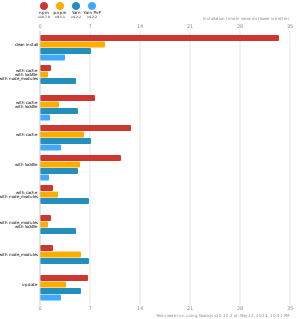
pnpm is up to 2x faster than npm and Yarn classic. See all benchmarks here.
Benchmarks on an app with lots of dependencies:
License
MIT, except the pnpr/ directory, which is source-available under the PolyForm Shield License 1.0.0.