 b4194aa5e0
Ports the virtual-store sweep from pnpm's `prune` to pacquet's isolated linker.
After an install, `node_modules/.pnpm` (pacquet: `.pacquet`) entries the wanted
lockfile no longer references are removed, instead of accumulating across branch
switches and downgrades. Before this, only the hoisted linker removed orphans
(`remove_orphans`); the default isolated linker never pruned its virtual store.

- **Sweep** — `prune_virtual_store`: needed set = `node_modules` + one
  `depPathToFilename` per non-skipped snapshot key; readdir the virtual store;
  rimraf the rest. Mirrors `prune.ts` L180-190.
- **Throttle** — `should_prune_virtual_store` mirrors the `pruneVirtualStore` gate
  (`index.ts` L471-473) and `cacheExpired` (L1180-1182): skip under the global
  virtual store; otherwise prune unless `prunedAt` is within `modulesCacheMaxAge`.
  An unparseable `prunedAt` is treated as not-expired, matching pnpm's
  `NaN > maxAge == false`.
- **`prunedAt` lifecycle** — now stamped only when a sweep ran or on first install,
  else the prior value is preserved (`index.ts` L1828). Pacquet previously stamped
  it every install, which would have wedged the throttle off.

## Notable deviation

The sweep keeps `lock.yaml` (the current lockfile), whereas upstream deletes it and
unconditionally rewrites it. Pacquet's current-lockfile write is *conditional*
(skipped when `config.lockfile` is off), so deleting it in the sweep could orphan
it. Preserving it is end-state-equivalent whenever the rewrite runs and strictly
safer when it doesn't. Making pacquet's current-lockfile write unconditional (full
parity) is a separate, pre-existing concern.

## Scope

Only the virtual-store sweep slice of `prune()`. Deferred (other roadmap items /
follow-ups): changed-direct-dep removal, the subset-importer orphan calculation,
and the `pnpm:stats` `removed` count + `pnpm:removal` debug channel.

## Tests

- Unit: sweep (keeps needed + `lock.yaml`; removes surplus dir and skipped
  snapshot; missing-dir no-op) and throttle (both directions; empty/unparseable/
  future timestamps; global-store exclusion).
- Integration: a first install with a pre-seeded surplus `.pacquet` dir asserts the
  dir is swept while the installed package's slot survives. Confirmed it fails when
  the wiring is disabled.

Refs #11633 (Rust roadmap, Stage 1 Tier 4).

---------

Co-authored-by: Zoltan Kochan <z@kochan.io>
简体中文 | 日本語 | 한국어 | Italiano | Português Brasileiro

Fast, disk space efficient package manager:
- Fast. Up to 2x faster than the alternatives (see benchmark).
- Efficient. Files inside
node_modulesare linked from a single content-addressable storage. - Great for monorepos.
- Strict. A package can access only dependencies that are specified in its
package.json. - Deterministic. Has a lockfile called
pnpm-lock.yaml. - Works as a Node.js version manager. See pnpm runtime.
- Works everywhere. Supports Windows, Linux, and macOS.
- Battle-tested. Used in production by teams of all sizes since 2016.
- See the full feature comparison with npm and Yarn.
To quote the Rush team:
Microsoft uses pnpm in Rush repos with hundreds of projects and hundreds of PRs per day, and we’ve found it to be very fast and reliable.



Platinum Sponsors

|

|
Gold Sponsors

|

|

|

|

|

|

|

|
Silver Sponsors

|

|

|

|

|

|

|

|
⏱️ Time.now |
Support this project by becoming a sponsor.
Background
pnpm uses a content-addressable filesystem to store all files from all module directories on a disk. When using npm, if you have 100 projects using lodash, you will have 100 copies of lodash on disk. With pnpm, lodash will be stored in a content-addressable storage, so:
- If you depend on different versions of lodash, only the files that differ are added to the store.
If lodash has 100 files, and a new version has a change only in one of those files,
pnpm updatewill only add 1 new file to the storage. - All the files are saved in a single place on the disk. When packages are installed, their files are linked from that single place consuming no additional disk space. Linking is performed using either hard-links or reflinks (copy-on-write).
As a result, you save gigabytes of space on your disk and you have a lot faster installations!
If you'd like more details about the unique node_modules structure that pnpm creates and
why it works fine with the Node.js ecosystem, read this small article: Flat node_modules is not the only way.
💖 Like this project? Let people know with a tweet
Getting Started
Benchmark
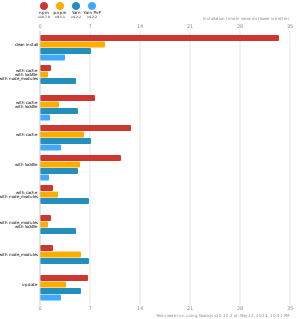
pnpm is up to 2x faster than npm and Yarn classic. See all benchmarks here.
Benchmarks on an app with lots of dependencies:
License
MIT, except the pnpr/ directory, which is source-available under the PolyForm Shield License 1.0.0.