 bc9ed78f48
* fix: clearer warning when a project .npmrc uses env variables in registry/auth settings

The previous warning only said the setting was ignored. It now explains why
(the project .npmrc is committed to the repository and must not expand secrets
into request destinations or credentials) and how to fix it: move the value to a
trusted source such as the user-level ~/.npmrc or via pnpm config set, with a
link to the docs.

The suggested 'pnpm config set' example is only shown when the key has no
${...} placeholder, so the snippet is always safe to copy-paste (a shell would
otherwise expand a placeholder embedded in the key). The wording does not claim
a specific destination file.

* fix: only suggest a pnpm config set command for shell-safe keys

The key embedded in the warning's suggested 'pnpm config set' command comes
from a repository-controlled .npmrc. The previous guard only suppressed the
example for keys containing a ${...} placeholder, but a shell also expands
$(...), backticks and $VAR inside double quotes — so a crafted key could turn
the suggested copy-paste command into command execution. The example is now
emitted only for keys made up entirely of shell-inert characters.
简体中文 | 日本語 | 한국어 | Italiano | Português Brasileiro

Fast, disk space efficient package manager:
- Fast. Up to 2x faster than the alternatives (see benchmark).
- Efficient. Files inside
node_modulesare linked from a single content-addressable storage. - Great for monorepos.
- Strict. A package can access only dependencies that are specified in its
package.json. - Deterministic. Has a lockfile called
pnpm-lock.yaml. - Works as a Node.js version manager. See pnpm runtime.
- Works everywhere. Supports Windows, Linux, and macOS.
- Battle-tested. Used in production by teams of all sizes since 2016.
- See the full feature comparison with npm and Yarn.
To quote the Rush team:
Microsoft uses pnpm in Rush repos with hundreds of projects and hundreds of PRs per day, and we’ve found it to be very fast and reliable.



Platinum Sponsors

|

|
Gold Sponsors

|

|

|

|

|

|

|

|
Silver Sponsors

|

|

|

|

|

|

|
|
⏱️ Time.now |
Support this project by becoming a sponsor.
Background
pnpm uses a content-addressable filesystem to store all files from all module directories on a disk. When using npm, if you have 100 projects using lodash, you will have 100 copies of lodash on disk. With pnpm, lodash will be stored in a content-addressable storage, so:
- If you depend on different versions of lodash, only the files that differ are added to the store.
If lodash has 100 files, and a new version has a change only in one of those files,
pnpm updatewill only add 1 new file to the storage. - All the files are saved in a single place on the disk. When packages are installed, their files are linked from that single place consuming no additional disk space. Linking is performed using either hard-links or reflinks (copy-on-write).
As a result, you save gigabytes of space on your disk and you have a lot faster installations!
If you'd like more details about the unique node_modules structure that pnpm creates and
why it works fine with the Node.js ecosystem, read this small article: Flat node_modules is not the only way.
💖 Like this project? Let people know with a tweet
Getting Started
Benchmark
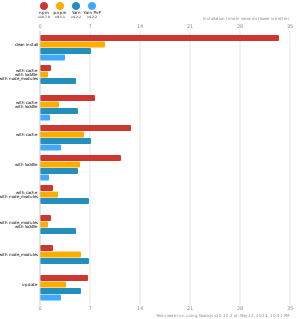
pnpm is up to 2x faster than npm and Yarn classic. See all benchmarks here.
Benchmarks on an app with lots of dependencies:
License
MIT, except the pnpr/ directory, which is source-available under the PolyForm Shield License 1.0.0.