 Zoltan Kochan
bf1b731ee6
Zoltan Kochan
bf1b731ee6
## Summary

Package-name `allowBuilds` entries no longer approve lifecycle scripts for artifacts whose identity a name cannot pin: git, git-hosted tarball, direct tarball, and local directory dependencies. To approve such an artifact explicitly, use its peer-suffix-free lockfile depPath as the `allowBuilds` key — error hints, `pnpm ignored-builds`, and `pnpm approve-builds` print exactly that key.

- `AllowBuild` policy functions identify packages by `DepPath` instead of caller-supplied name/version. The policy parses name and version out of the depPath itself, so name-keyed rules can never be fed an identity that disagrees with the gated artifact. `AllowBuildContext` carries only an explicit `trustPackageIdentity` override, used to evaluate a previously recorded policy under its original semantics when detecting revoked approvals.
- Identity trust is derived from the depPath shape: a registry-style depPath (`name@semver`) is a trusted identity. This is sound because lockfile verification runs a new unconditional, offline structural pass that rejects lockfiles where such a key is backed by a git, directory, or git-hosted tarball resolution (`ERR_PNPM_RESOLUTION_SHAPE_MISMATCH`), while the npm resolution verifier already binds explicit tarball URLs of semver-keyed entries to the registry's own `dist.tarball` unconditionally. The pass runs inside the existing candidate walk and participates in the verification cache key (`resolutionShapeCheck`) on both the gate's and the fresh-resolve record paths, so the stat-only cache fast path stays sound and records written before the rule existed are re-verified.
- Installs detect approvals that were revoked (or stopped applying) for git/tarball artifacts and surface those packages as ignored builds; approvals granted for previously ignored builds trigger a rebuild of exactly those packages.
- `preparePackage` always treats the fetched manifest as an untrusted identity: it requires a `pkgResolutionId` and gates on the synthesized `name@<resolution id>` depPath. scp-style git URLs are normalized to `ssh://` form in resolution ids, and the git fetcher reuses `createGitHostedPkgId` from the resolver instead of re-deriving ids.
- Under the global virtual store, `pnpm rebuild` locates a projection created before the approval was granted by following the project's node_modules link, since the projection hash includes the allowBuilds verdict (relocating the projection instead is tracked in https://github.com/pnpm/pnpm/issues/12302).
- New shared helpers: `removePeersSuffix()` in `@pnpm/deps.path` (string-level peer-suffix stripping for user-written keys) and `allowBuildKeyFromIgnoredBuild()` in `@pnpm/building.policy` (the key under which an ignored build is approved).
- pacquet mirrors the whole policy: `AllowBuildPolicy::check(dep_path)` derives trust from the dep path, the git-fetcher allow-build closures take only the dep path, `pacquet-lockfile-verification` gains the same structural pass, error code, and cache identity, and dep-path keys normalize via `remove_suffix`.
- `shell-quote` is overridden to 1.8.4 (GHSA-w7jw-789q-3m8p / CVE-2026-9277).
- Test-harness fix: a module-level drain keeps the global log stream flowing in the deps-installer lifecycle tests, so reporter assertions no longer receive the buffered backlog of earlier installs that ran without a reporter.
简体中文 | 日本語 | 한국어 | Italiano | Português Brasileiro

Fast, disk space efficient package manager:
- Fast. Up to 2x faster than the alternatives (see benchmark).
- Efficient. Files inside
node_modulesare linked from a single content-addressable storage. - Great for monorepos.
- Strict. A package can access only dependencies that are specified in its
package.json. - Deterministic. Has a lockfile called
pnpm-lock.yaml. - Works as a Node.js version manager. See pnpm runtime.
- Works everywhere. Supports Windows, Linux, and macOS.
- Battle-tested. Used in production by teams of all sizes since 2016.
- See the full feature comparison with npm and Yarn.
To quote the Rush team:
Microsoft uses pnpm in Rush repos with hundreds of projects and hundreds of PRs per day, and we’ve found it to be very fast and reliable.



Platinum Sponsors

|

|
Gold Sponsors

|

|

|

|

|

|

|

|
Silver Sponsors

|

|

|

|

|

|

|

|
⏱️ Time.now |
Support this project by becoming a sponsor.
Background
pnpm uses a content-addressable filesystem to store all files from all module directories on a disk. When using npm, if you have 100 projects using lodash, you will have 100 copies of lodash on disk. With pnpm, lodash will be stored in a content-addressable storage, so:
- If you depend on different versions of lodash, only the files that differ are added to the store.
If lodash has 100 files, and a new version has a change only in one of those files,
pnpm updatewill only add 1 new file to the storage. - All the files are saved in a single place on the disk. When packages are installed, their files are linked from that single place consuming no additional disk space. Linking is performed using either hard-links or reflinks (copy-on-write).
As a result, you save gigabytes of space on your disk and you have a lot faster installations!
If you'd like more details about the unique node_modules structure that pnpm creates and
why it works fine with the Node.js ecosystem, read this small article: Flat node_modules is not the only way.
💖 Like this project? Let people know with a tweet
Getting Started
Benchmark
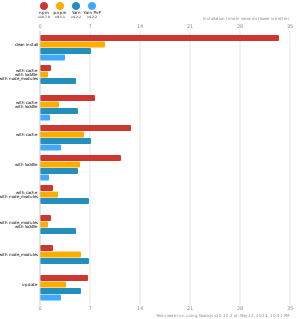
pnpm is up to 2x faster than npm and Yarn classic. See all benchmarks here.
Benchmarks on an app with lots of dependencies:
License
MIT, except the pnpr/ directory, which is source-available under the PolyForm Shield License 1.0.0.