KhảiandClaude
bfa861fe04
KhảiandClaude
bfa861fe04
* refactor(pacquet/config): thread default_store_dir through the EnvVar DI seam Replaces process-environment mutation in the `default_store_dir` tests with the dependency-injection pattern established in pnpm/pacquet#339 and consolidated for the in-tree pacquet subtree in #11708. Tracks pnpm/pacquet#343 — the original issue still applied after pacquet was merged into this repo because the env-mutating tests came with it. The four affected unit tests (`test_default_store_dir_with_pnpm_home_env` and `test_default_store_dir_with_xdg_env` in `defaults::tests`, plus `should_use_pnpm_home_env_var` and `should_use_xdg_data_home_env_var` in `lib::tests`) now drive each branch with per-test unit structs that satisfy `EnvVar`. No `EnvGuard` snapshot, no `unsafe` block, no process-environment write. The `home_dir` and `current_dir` closures call `unreachable!` for branches the early `PNPM_HOME` / `XDG_DATA_HOME` returns short-circuit before consulting them, documenting the precondition the way the style guide's worked example does. `default_store_dir` is now generic over `Sys: EnvVar` and takes the `home_dir` and `current_dir` lookups as `FnOnce` closures, mirroring the shape of `Config::current`. A thin args-less wrapper `default_store_dir_host` wires the production `Host` provider together with `home::home_dir` and `env::current_dir` so the SmartDefault expression on `Config::store_dir` stays short. The `have_default_values` wiring assertion now compares against `default_store_dir::<Host>(home::home_dir, env::current_dir)` instead of the old args-less helper. `npmrc_auth::tests::ignores_non_auth_keys` no longer needs to hold the EnvGuard global lock against the two `Config::new()` snapshots it compares — nothing in the crate mutates `PNPM_HOME` or `XDG_DATA_HOME` anymore, so the env-derived `store_dir` is observed identically by both calls even under nextest's in-process parallelism. `EnvGuard` itself stays in `pacquet-testing-utils` because the proxy cascade and `NPM_CONFIG_WORKSPACE_DIR` tests in `lib::tests`, as well as out-of-crate users in `git-fetcher` and `executor`, still rely on it. Retiring it entirely is out of scope for this issue. --- Written by an agent (Claude Code, claude-opus-4-7). * fix(pacquet/config): add Debug bound on default_store_dir's Error parameter The Windows branch of `default_store_dir` calls `current_dir().expect("current directory is unavailable")`, which requires `Error: Debug` on the `Result<PathBuf, Error>` returned by the `CurrentDir` closure. The original `where` clause didn't declare that bound, so the function compiled on Linux/macOS (where the Windows branch is `#[cfg(windows)]`-gated out) but failed on `Lint and Test (windows-latest)` once the cfg fired. All current callers pass `env::current_dir` (Error = `io::Error`) or pin `Error = std::io::Error` via turbofish on test fakes — both already satisfy `Debug` — so this is a pure type-bound fix with no behaviour or call-site change. --- Written by an agent (Claude Code, claude-opus-4-7). * docs(pacquet): add shared-process-state DI exception to the style guide The "Dependency injection for tests" gating list in `pacquet/CODE_STYLE_GUIDE.md` enumerated four reasons to reach past real fixtures for the DI seam: filesystem error kinds, deterministic time, external-service happy paths, and unreachable-by-design preconditions. It did not cover the case this PR retired from `default_store_dir`: tests that mutate a single per-process slot (env vars, cwd, umask, signal handlers, …) and so race with every other test in the same process. The pre-existing `EnvGuard` workaround restored correctness only by holding a binary-wide mutex around `unsafe { env::set_var(...) }`, which forecloses parallelism inside the affected tests and leaves `unsafe` in the test source. A capability-trait fake keeps the read deterministic and the mutation contained to the test that needs it. Adds that bullet to the style guide between "Deterministic time" and "External-service happy paths," and updates rule 7 in `pacquet/AGENTS.md` (and its `CLAUDE.md` / `GEMINI.md` symlink targets) so the summary mirrors the longer list. --- Written by an agent (Claude Code, claude-opus-4-7). * docs(pacquet): drop unfounded set_current_dir example from DI guidance The previous commit cited `set_current_dir` and "the umask" as illustrative examples in both the style guide and the AGENTS rule 7 summary. Neither is actually used anywhere in the pacquet codebase today — only `env::set_var` is. Speculative examples in a style guide invite contributors to chase patterns that don't exist, so narrow the wording to the one slot we have a concrete example for while keeping the principle generalisable (the bullet still says "any future analogue"). --- Written by an agent (Claude Code, claude-opus-4-7). * docs(pacquet): revert example narrowing on the shared-process-state bullet Reviewer feedback: keep the broader `set_current_dir` / umask / signal-handler / global-allocator examples in the DI gating bullet and rule 7 summary. They're not used in the codebase today, but the analogues are useful as forward-looking illustrations so the next contributor recognises the same shape when it comes up. Restores the wording introduced in 96040d7; reverses the narrowing ind930bed. --- Written by an agent (Claude Code, claude-opus-4-7). * docs(pacquet): document when library code may read process state Adds a "Reading process state" section to CODE_STYLE_GUIDE.md, placed right before "Dependency injection for tests" so the reading order captures the two questions in dependency order: first ask whether you should be reaching for `env::var` / `env::current_dir` at all, then ask how to inject it if the answer is yes. The section pins: 1. Library code should rarely call `std::env::var`, `std::env::var_os`, or `std::env::current_dir` directly. The default fix is a parameter (`&Path`, `&str`, an `Option<String>`, or a `FnOnce` closure) so the caller decides which value to read; `Config::current` and `workspace::find_workspace_dir_from_env_with` already follow this. 2. When the read genuinely needs to happen, route through the DI seam (`Sys: EnvVar`, `Sys::var(name)`). 3. The narrow legitimate direct-call case is computing a `Config` default that has no caller — `default_store_dir`, `default_modules_dir`, `default_virtual_store_dir`. This is the "begrudging" use that pnpm/pacquet#343 + pnpm/pnpm#11718 finally threaded through the DI seam. 4. Other accepted boundary reads are program-entry knobs (`RAYON_NUM_THREADS`, `TRACE`) and the lifecycle-script env snapshot in `crates/executor` / `crates/git-fetcher` that forwards the parent env to spawned children verbatim. The section belongs in CODE_STYLE_GUIDE.md (code-level convention), not CONTRIBUTING.md (PR workflow) or AGENTS.md (agent-specific operating rules); rule 7 in AGENTS.md already cross-links the style guide, so no change there. --- Written by an agent (Claude Code, claude-opus-4-7). * refactor(pacquet/config): inline default_store_dir's SmartDefault wiring Reviewer pointed out that the args-less `default_store_dir_host` wrapper could be inlined into the `#[default(_code = ...)]` expression on `Config::store_dir` — the SmartDefault macro accepts the turbofish form `default_store_dir::<Host, _, _, _>(home::home_dir, env::current_dir)` verbatim, and once the wrapper is gone there's nothing for the indirection to earn. Dropping the wrapper also removes a small motivation for the `Host` import inside `defaults.rs` — adjust the doc comment on `default_store_dir` to cite `crate::Host` by full path instead. The `#[cfg(windows)] Error: std::fmt::Debug` bound that the same reviewer asked about is not feasible: attributes on where-clause predicates are still unstable (rust-lang/rust#115590), so the bound stays unconditional with a comment explaining why. --- Written by an agent (Claude Code, claude-opus-4-7). * docs(pacquet/config): purge stale default_store_dir_host references Commit49c690cinlined the SmartDefault expression for `Config::store_dir` and dropped the `default_store_dir_host` wrapper, but three comments still pointed at the wrapper or at the old single-type-parameter signature of `default_store_dir`. CodeRabbit and Copilot flagged all three on review: - `crates/config/src/lib.rs`, `have_default_values`: the comment said the SmartDefault resolved "via the thin `default_store_dir_host` wrapper". Now reflects the direct `default_store_dir::<Host, _, _, _>(home::home_dir, env::current_dir)` call. - `crates/config/src/npmrc_auth/tests.rs`, `ignores_non_auth_keys`: the comment cited `default_store_dir::<Host>` with no closure parameters. Now spells out the four-parameter turbofish that matches the current signature. - `CODE_STYLE_GUIDE.md`, "Reading process state": the paragraph recommended an args-less `default_store_dir_host` wrapper as the pattern to follow. Now recommends inlining the production composition at the `SmartDefault` site directly. Copilot also queried whether `pnpm/pnpm#11718` was the right number in the DI section's `EnvGuard` retirement citation — confirmed it is. #11708 introduced the DI seam consolidation; this PR is the one that retires the env-mutation pattern from `default_store_dir`. --- Written by an agent (Claude Code, claude-opus-4-7). --------- Co-authored-by: Claude <noreply@anthropic.com>
简体中文 | 日本語 | 한국어 | Italiano | Português Brasileiro

Fast, disk space efficient package manager:
- Fast. Up to 2x faster than the alternatives (see benchmark).
- Efficient. Files inside
node_modulesare linked from a single content-addressable storage. - Great for monorepos.
- Strict. A package can access only dependencies that are specified in its
package.json. - Deterministic. Has a lockfile called
pnpm-lock.yaml. - Works as a Node.js version manager. See pnpm runtime.
- Works everywhere. Supports Windows, Linux, and macOS.
- Battle-tested. Used in production by teams of all sizes since 2016.
- See the full feature comparison with npm and Yarn.
To quote the Rush team:
Microsoft uses pnpm in Rush repos with hundreds of projects and hundreds of PRs per day, and we’ve found it to be very fast and reliable.



Platinum Sponsors

|
Gold Sponsors

|

|

|

|

|

|

|

|
Silver Sponsors

|

|

|

|

|

|

|
⏱️ Time.now |
Support this project by becoming a sponsor.
Background
pnpm uses a content-addressable filesystem to store all files from all module directories on a disk. When using npm, if you have 100 projects using lodash, you will have 100 copies of lodash on disk. With pnpm, lodash will be stored in a content-addressable storage, so:
- If you depend on different versions of lodash, only the files that differ are added to the store.
If lodash has 100 files, and a new version has a change only in one of those files,
pnpm updatewill only add 1 new file to the storage. - All the files are saved in a single place on the disk. When packages are installed, their files are linked from that single place consuming no additional disk space. Linking is performed using either hard-links or reflinks (copy-on-write).
As a result, you save gigabytes of space on your disk and you have a lot faster installations!
If you'd like more details about the unique node_modules structure that pnpm creates and
why it works fine with the Node.js ecosystem, read this small article: Flat node_modules is not the only way.
💖 Like this project? Let people know with a tweet
Getting Started
Benchmark
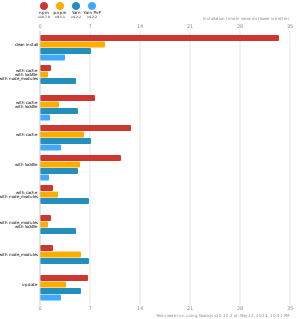
pnpm is up to 2x faster than npm and Yarn classic. See all benchmarks here.
Benchmarks on an app with lots of dependencies: